This website uses cookies, pixels, and other tracking technologies to personalize content, analyze how our site and apps are used, and create aggregated statistics.
We disclose data about site and app users to third parties so we can target our ads to you on other websites, and those third parties may use that data for their own purposes.
For more information on how we collect, use, and disclose this information, please review our
Privacy Policy.
Continued use of this site means you consent to our Privacy Policy.
Summary generated by our research from the article below.
Description/Taste
Wild Rose hips are the buds that remain on wild rose flowers after their bloom falls away. They have a deep red color and an oblong shape, though the shape, color, and size of Wild Rose hips will vary depending on the variety of rose plants they are foraged from. The berry-like Wild Rose hips are filled with small, hard seeds covered with fine hairs. These hairs can irritate the mouth and digestive tract but when properly ripe, they should be less aggravating. The hips have a sweet, citrusy, and almost cranberry-like taste. When underripe, they are firm and tart.
Seasons/Availability
Wild Rose hips are available during fall and winter.
Current Facts
The botanical name for Wild Rose hips is Rosa canina, which is part of the Rosaceae family. The Latin name Rosa Canina translates to Dog Rose, likely a reference to Rose hip's usage as a treatment for dog bites. Other names for this fruit include Haws, Dog Brier, and Brier Rose. Though Wild Rose hips have culinary value, they have been used for their medicinal benefits since the times of the ancient Chinese, Persians, and Greeks. American Indian tribes and Ancient Romans were also known to use Wild Rose hips to treat respiratory infections, stomach issues, and toothaches. Rose hips are the fruit of the rose flower and in some cultures, symbolize true love and adoration.
Nutritional Value
Rose hips are a significant source of Vitamin C, providing 200% of the daily recommended amount per ounce. This vitamin is important for immune function, skin health, and protection against free radicals. Rose hips contain Vitamin A, which helps with vision, reproductive health, and bone growth. They are a source of folate, calcium, and magnesium, nutrients crucial to cell growth, muscle function, nerve transmission, energy production, and regulating blood sugar levels. Rose hips contain carotenoids like beta-carotene, lutein, zeaxanthin, and lycopene. These carotenoids protect against age-related macular degeneration and promote heart health. Rose hips are commonly turned into oils for skincare products like soap, face serum, and lip balm. Their moisturizing properties have led to their use in products for reducing scarring, wrinkles, and signs of aging. The medicinal and therapeutic benefits of rose hips can be enjoyed through herbal teas, syrups, and infusions with honey, oil, vinegar, and alcohol.
Applications
Wild Rose hips can be eaten raw, dried, or boiled. They can also be made into teas, candies, juice, jelly, and wine. The hollow fruit can be dried for tea, mashed or blended, and added to a sugar mixture for jellies or syrup. The seeds can be dried, ground, and added to granola. Fresh Rose hips can be eaten on their own or sprinkled into salads. In their dried form, they may be incorporated into baked goods like cookies, macaroons, meringues, tarts, donuts, bread, and muffins. They can be enjoyed in frozen yogurt, ice cream, chia seed pudding, soups, barbeque sauces, and ketchup. To prepare, cut away the small nub at the tip where the flower was attached and gently squeeze to expel the seeds. The hips can also be cut in half and the seeds can be removed using a small paring knife or butter knife. Rose hips pair well with cranberries, strawberries, crabapples, honey, apples, almonds, walnuts, and shortbread.
Ethnic/Cultural Info
The British kept this fruit in their pharmacopeia well into the 1930s. During World War II, Rose hip syrup became a popular substance for British soldiers. Citizens were encouraged to gather Rose hips for the syrup to be sent to troops, particularly during the winter when citrus fruit was scarce. This syrup was used as an alternative to citrus because of its high Vitamin C and iron content, nutrients that could greatly benefit soldiers suffering from diseases like scurvy.
Geography/History
Wild Rose hips are native to Europe and Asia. They can be found growing on the east and west coasts of the United States, Europe, Britain, northwest Africa, western Asia, Australia, and northern Canada. Wild Rose hips grow in temperate climates with loamy soils and plentiful sun exposure. They can be found in disturbed areas, fields, thickets, woodlands, roadsides, trails, and Coastal areas. Though appreciated since ancient times, the medicinal values of Rose hips have been increasingly used in health supplements, essential oils, and skincare products in the modern day. Wild rose hips can be found through foraging, cultivated in home gardens, or obtained as a byproduct for health and skincare products at specialty stores.
Ouid-Zuid
Cornelis Schuytstraat 5 1071 JC Amsterdam
Wild Rose hips: These plants are native to Europe and Asia and thrive in temperate climates with loamy soil and plenty of sun. They grow in diverse areas such as fields, thickets, woodlands, roadsides, coastal regions, and trails. Valued since ancient times, Rose hips are increasingly used in health supplements, essential oils, and skincare products, available through foraging, home gardening, or specialty stores.
Canterbury Cathedral
Cathedral House 11 The Precincts Canterbury CT1 2EH England
+44 1227 762862
Rose hips in the old monastic gardens of Canterbury Cathedral….Wild Rose hips have a vibrant red hue and oblong shape, but their appearance varies with plant variety. Inside, they're packed with small, hard seeds covered in fine hairs that can irritate if not handled properly. When ripe, they deliver a sweet, citrusy, cranberry-like flavor, but remain firm and tart when underripe. These nutritious buds come from roses after their blooms fade away.
Oi Qaragai
Wild rose hips of Ile Alatau foothills…Wild rose hips are incredibly versatile and can be used in many ways. They can be eaten raw, boiled, or dried and transformed into teas, candies, juices, jellies, or even wine. They can also enhance baked goods like cookies, tarts, or muffins. Pair them with cranberries, apples, or nuts like almonds or walnuts. Preparing rose hips involves removing the seeds, either by squeezing or using a small knife. Their unique flavor also complements sauces, frozen desserts, and even salad mixes.
Almaty Green Central Market
Zhibek Zholy 53, Almaty, Kazakhstan
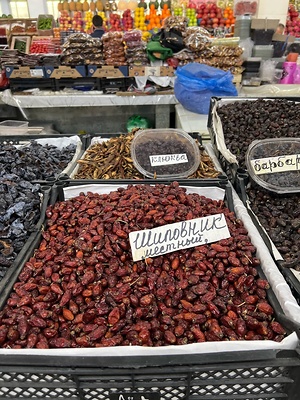
Dried rose hips of Kazakhstan...Rose hips were highly valued during World War II because of their exceptionally high Vitamin C content. British citizens were actively encouraged to collect rose hips in large quantities to prepare syrup for their soldiers. This syrup served as a crucial source of nutrients, such as Vitamin C and iron, particularly during winters when citrus fruits were unavailable. It proved helpful in combating conditions like scurvy among troops.
Almaty Green Central market
Zhibek zholy srt 53, Almaty, Kazakhstan
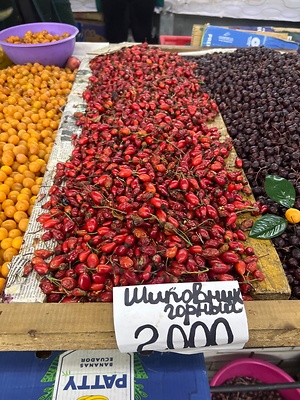
Rosehip of Ile Alatau foothills…Rose hips are native to Europe and Asia but grow in various regions, including the United States, northwest Africa, western Asia, Australia, and northern Canada. Thriving in temperate climates, they prefer loamy soils and abundant sunlight. Historically recognized for their value, rose hips are now widely used in health supplements, essential oils, and skincare products, showcasing their versatility and enduring significance.
Almaty Central Green Market
Zhibek Zholy 58, Almaty, Kazakhstan
View on Instagram
Wild Rose hips develop their deep red color and oblong shape after the flower’s bloom has fallen. While their size and appearance vary by plant variety, they are known for a sweet, citrusy flavor reminiscent of cranberries when ripe. Their firm and tart profile when underripe contrasts with the ripe hips. Fine hairs on their seeds can irritate, but ripeness reduces this issue, offering a smoother culinary experience.
Murray Family Farms
6700 General Beal Rd.
(661) 330-3030 [email protected]
These are from Murray Family Farms in Bakersfield, CA….Wild Rose hips are highly versatile and can be used in a variety of culinary applications. They can be transformed into teas, candies, jelly, and wine or added to baked goods like bread, muffins, and cookies. Their seeds can be dried and ground into granola, while fresh hips work in salads. They pair well with fruits like cranberries, strawberries, and apples, as well as nuts like almonds and walnuts, adding bright citrusy notes to multiple recipes.
Murray Family Farms
Wild Rose Hips in Santa Monica, California….Wild Rose hips are botanically classified as Rosa canina, also known as Dog Rose, Haws, Dog Brier, and Brier Rose. They were historically used as remedies for respiratory infections, stomach issues, and toothaches by ancient cultures like the Persians, Chinese, Greeks, and Romans. Rich in Vitamin C, they supply 200% of the daily intake per ounce, aiding immune health and combatting free radicals. These fruits also symbolize true love and adoration in some traditions.
Almaty agricultural food fair
ул. имени Валиханова 170, Алматы 050000, Казахстан
Rosehips of Alatau mountains…Rosehips have been valued for their medicinal properties since ancient times and are increasingly used in modern health supplements, essential oils, and skincare products. They grow in temperate climates with loamy soils and sunlight, thriving in fields, woodlands, trails, and coastal areas. They can be foraged, cultivated, or sourced from specialty stores as part of health and skincare formulations.
Check out our QR code Library to download QR Codes that link to our fruit encyclopedia. Use on your signage and other promotions to share the knowledge!