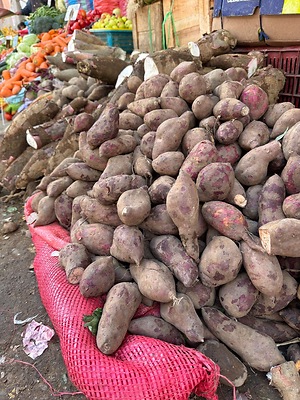
Purple Camotes
Estimated Inventory, lb : 0

Description/Taste
Purple Camote varies in size and shape depending on growing conditions and the specific variety, and generally has an oblong, oval, or cylindrical shape. Some tubers may be curved or straight with tapered or blunt ends. The skin is typically rough, firm, taut, and textured, showcasing hues of purple-brown, red-purple, and dark purple. In commercial markets, Purple Camote is often sold with a layer of soil still covering the skin, giving the tubers a dusty brown appearance. Once cleaned, the tuber’s true coloring shines through, and some varieties may be flakier than others. Underneath the surface, the ivory-to-purple flesh is dense, dry, and firm when raw, becoming soft, tender, and creamy once cooked. A few Purple Camote varieties may have marbled flesh, while others exhibit a single main color. Purple Camote is not edible raw and must be cooked. Heated tubers have a rich, sweet, sugary, and savory taste.
Seasons/Availability
Purple Camote is available year-round.
Current Facts
Purple Camote, botanically classified as Ipomoea batatas, is a category of pigmented sweet potato varieties belonging to the Convolvulaceae family. The name Camote is derived from Nahuatl, an indigenous Mesoamerican language, for the word “camotli,” a term used throughout Central and South America for varieties of sweet potatoes. Purple Camote is a specific descriptor for purple sweet potato cultivars and is primarily used in Spanish-speaking countries across Central and South America, the Caribbean, and the Philippines. The tubers have been cultivated in the Americas for centuries and are an easy-to-grow, ancestral crop revered for its versatility, nutritional value, and role as a famine food. In present-day markets, Purple Camote is widely available and sought by chefs and home cooks as a staple ingredient in a wide array of sweet and savory dishes.
Nutritional Value
Purple Camote is a source of fiber that helps regulate the digestive tract and contains vitamins A, B, C, and E, which strengthen the immune system, support energy production, protect cells against free radical damage, and maintain healthy organs. Camotes also provide varying amounts of minerals, including iron, phosphorus, potassium, and calcium. These minerals help the body maintain fluid balance, produce the protein hemoglobin for oxygen transport in the bloodstream, and assist in bone and tooth development.
Applications
Purple Camote is utilized in cooked preparations as it cannot be consumed raw. For the purposes of this article, this section focuses on the potato’s uses in regions that call the tubers Camotes rather than universal use. The pigmented potatoes are favored for their sweet taste and creamy consistency, typically steamed, baked, or boiled as a filling side dish. Purple Camote can be cooked and mashed, cut and baked with cinnamon and honey, or sliced into thin pieces and roasted. They are also diced and added to casseroles, thinly sliced and baked into chips, or simmered into soups and stews. In Peru, Purple Camote is sometimes added to ceviche, the country's national dish, or used in variations of tamales. The tubers are also used as a filling for empanadas or added to sweet dishes in Mexico, such as flan, puddings, cakes, pies, and ice cream. In the Caribbean, Purple Camote is diced and fried with aromatics as an accompaniment to meat mains, baked whole, or chopped into salsa. Other countries that use Purple Camote include the Philippines, where slices are fried and coated in brown sugar, resulting in crisp caramelization. Roasted tubers are also tossed into salads or used in a mash for chicken adobo. Purple Camote pairs well with spices like cumin, paprika, garlic, cinnamon, and nutmeg, sweeteners such as brown sugar, maple syrup, and honey, and herbs like rosemary, parsley, sage, and oregano. Whole, unwashed tubers will keep for several weeks to months when stored in a cool and dry location.
Ethnic/Cultural Info
Camote, in all colors, is a favorite snack sold by street vendors known as camoteros in Mexico. These vendors are easily identified by their traveling carts with portable wood-fired ovens and are famous for their signature sound. As the camotes are cooked over hot coals, the camotero opens a valve to release water into a pipe running through the oven, creating steam. The steam is released through a whistle on the end of the pipe, creating a distinct sound that resembles a train’s horn echoing down the street. Camoteros sell cooked camotes and plantains, and the vendors are a beloved historical staple of neighborhoods. It is common for families to come outside when they hear the cametero’s whistle, and the cooked tubers are consumed as an afternoon snack or as a filling side dish at dinner.
Geography/History
Purple Camote is native to the Americas and is a descendant of early species that have been growing wild since ancient times. The exact origins of Purple Camote are unknown, as several reported theories connect the tubers to various wild ancestors and regions. Archeological remains of Camote have been discovered at the pre-Hispanic settlement of Huaca Prieta in Peru, dating back around 5,300 to 4,100 years. They were also found at several other sites in Peru, supporting the hypothesis that the tubers have been used for culinary purposes for thousands of years. Purple Camote expanded in cultivation over time, and the species became domesticated in home and commercial gardens across the Americas. The tubers have been improved through generations of selective breeding for specific traits, and purple types are prized in markets for their distinctive color. Purple Camote was later introduced worldwide and was extensively planted in Europe, Asia, Africa, and Australia. Today, Purple Camote is available under various names and sold at fresh markets, retailers, and select wholesalers.
Recipe Ideas
Recipes that include Purple Camotes. One
 is easiest, three is harder.
| Rico Q |
|
Peruvian Potato Mixed Grill |
| Pinch of Yum |
|
Camote Fritters |
| Rico Q |
|
Purple Camote Fries |
| Thyme & Love |
|
Mexican Candied Camotes |

Purple Camotes for sale around the world shared on the Specialty Produce App