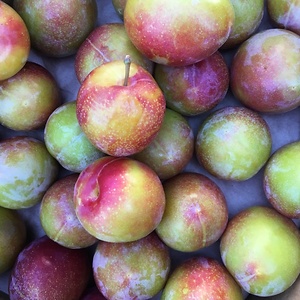


Sierra Plums
Estimated Inventory, 8 lbs : 0

Description/Taste
Sierra plums are small, averaging 1 to 3 centimeters in diameter, and have a round, ellipsoid shape with a slightly tapered tip on the non-stem end. The plum’s skin is semi-thin, smooth, glossy, and taut, ripening from green to golden yellow-orange hues once ripe with large patches of dark red-purple blush. It is important to note that Sierra plums will vary in coloring, depending on the specific variety. Some fruits may have a yellow-red appearance, while others may be more saturated, dark purple-red. Sierra plums may also have prominent lenticels on the surface, resembling tiny dots. Underneath the skin, the golden yellow flesh is dense, aqueous, and firm with a crunchy, succulent consistency. The flesh also envelops a central, flattened pit or stone. Sierra plums are edible raw once ripe and are known for their zingy, sweet-tart flavor. Some varieties may be tangier than others, and some may be mostly sweet, depending on the degree of ripeness and growing conditions.
Seasons/Availability
Sierra plums are in season during the late summer, typically between August and September.
Current Facts
Sierra plums, botanically classified as Prunus subcordata, are an American species belonging to the Rosaceae family. Prunus subcordata is the only wild plum species native to the Western United States, and the fruits are known by several names, including Klamath, Pacific, Oregon, and Western plums. Many of these descriptors, including Sierra, were given to the plums for their native locations in California and Oregon. Sierra plums grow on deciduous trees reaching eight meters in height and are a prolific species, producing high yields of sweet-tart fruits. There is considerable variation between wild trees, and the species is divided into four main varieties: kelloggii, rubicunda, subcordata, and oregana. These types differ in fruit appearance, tree characteristics, and growing region within the Western United States. Sierra plums are not commercially produced on a broad scale and are cultivated mainly by select growers and home gardeners as a specialty fruit. The species is viewed as a beneficial native food source for wildlife in the Western United States and is planted as an ornamental and culinary tree. Sierra plums are eaten raw or cooked and are versatile, used in a wide array of sweet and savory culinary preparations.
Nutritional Value
Sierra plums have not been studied for their nutritional properties. Plums, in general, are a source of fiber to regulate the digestive tract and vitamins A, B, C, E, and K to maintain healthy organs, strengthen the immune system, guard the cells against free radical damage, and assist in faster wound healing. Plums also provide minerals like copper, potassium, iron, magnesium, manganese, phosphorus, and calcium. These minerals help the body balance fluid levels, control daily nerve functions, support bone and teeth health, and produce red blood cells.
Applications
Sierra plums have a sweet and sour flavor suited for fresh and cooked preparations. The fruits are commonly consumed out of hand as a light snack or sliced and tossed into green salads. Sierra plums can be used as a substitute in most recipes calling for standard commercial plums, but it should be noted that they are smaller in size, which may affect quantities in recipes. Sierra plums are occasionally served on cheese boards or used as a topping over breakfast dishes like parfaits and oatmeal. The plums are also made into homemade beverages, including fruit juices and wine, or infused into vinegar. In addition to fresh preparations, Sierra plums are simmered with sugar and pectin into jams and jellies or combined with spices for chutney. They are also cooked into savory-sweet sauces and glazes to complement roasted and grilled meat. While less common, Sierra plums can be halved and grilled or incorporated into baked goods like scones, muffins, and crumbles. The plums are also popularly made into fruit leather or dried for extended use. Sierra plums pair well with spices like cinnamon, star anise, and cardamom, flavorings including vanilla, maple syrup, and brown sugar, nuts such as walnuts, hazelnuts, and almonds, and herbs like sage, rosemary, and coriander. Whole, unwashed Sierra plums should be ripened at room temperature. Once ripe, the fruits should be immediately consumed for the best quality and flavor, and will keep for a few days to weeks when stored in the refrigerator.
Ethnic/Cultural Info
Sierra plums were historically used as a food source by several indigenous North American tribes. These recorded uses were listed through Native American Ethnobotany, a database that began recording traditional foods and medicines of indigenous communities in the late 20th century. The noted uses were also collected from anthropological records and books written in the late 19th and 20th centuries. Sierra plums were consumed fresh and dried by the Klamath, Mendocino, and Modesse tribes. The Klamath primarily resided in Oregon, while Mendocino and Modesse were in Northern California. The Atsugewi tribe, based in Northeastern California, also pounded the fruit’s pulp into small cakes as a method of storage to have food during the winter season. Beyond culinary uses, the seeds from Sierra plums were used by the Mountain Maidu, an indigenous people group based in the Sierra Nevada mountains. The seeds were used for making decorative beads, and the shoots of the tree were sometimes used for making baskets.
Geography/History
Sierra plums are native to the United States and have origins in regions of California and Oregon. The species has been growing wild since ancient times and thrives in forests between 100 and 1,900 meters in elevation. Select types of Sierra plums have also been found in Washington, and the current species range has expanded from its native sites to include trees present in British Columbia to Central California. In the late 19th century, Sierra plums were introduced to European gardens, mainly in England, and were grown as a specialty cultivar. The species is not well-known in Europe and is reserved as a novelty and plant used for breeding purposes. Today, Sierra plums have remained localized to the Western United States and are foraged from wild trees and produced on a small scale through select growers and home gardeners. When in season, Sierra plums are sold directly through growers or at farmers’ markets.
Podcasts

Sierra Plums for sale around the world shared on the Specialty Produce App