



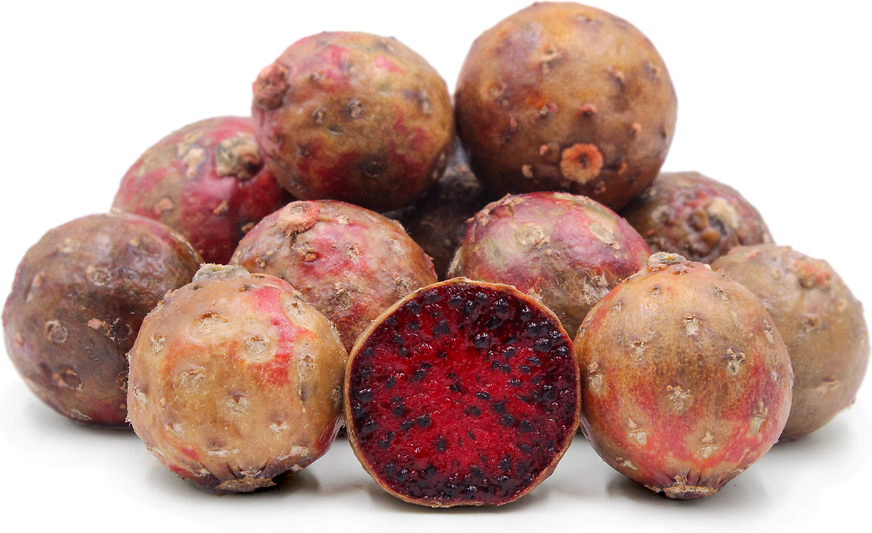


Iguaraya Cactus Fruit
Estimated Inventory, lb : 0

Description/Taste
Iguaraya cactus fruits are small, averaging 4 to 5 centimeters in diameter, and have a round, ovoid, or oblate shape. The fruit’s skin is thin, taut, and lightly textured, covered in prominent dots called areolas with numerous spines. These spines are 1 to 1.8 centimeters long and have a white to yellow color. Iguaraya cactus fruits ripen to red, brown, and dark purple-red hues, and once mature, the sharp spines begin to fall off the fruit. A few spines may remain after harvest, so care should be taken when handling the fruits. Beneath the surface, Iguaraya cactus fruits have saturated, dark red-purple flesh and an aqueous, soft, and succulent consistency. The flesh also encases many tiny black-brown seeds ranging from 1.3 to 2.2 millimeters in length. These seeds are edible and provide a crunchy textural layer when eaten with the soft flesh. Iguaraya cactus fruits are known for their sweet taste with a hint of acidity, creating a sweet and sour flavor.
Seasons/Availability
Iguaraya cactus fruits are available year-round in some growing regions. In Colombia, they experience a peak season in the fall through spring, typically between September and April.
Current Facts
Iguaraya cactus fruits, botanically classified as Stenocereus griseus, are the edible, seasonal fruits of the Guajiro cactus, belonging to the family Cactaceae. The Guajiro cactus, also called the Dagger cactus and the Cardón cactus, is an upright, towering species that reaches 11 meters in height. The fruits appear on the cacti after flowering and are a foraged delicacy, favored for their juicy, thirst-quenching nature. Iguaraya fruits are harvested with long poles and consumed within families or sold in small quantities at markets in their growing regions. The fruits are known as Yosuu and Yosú in Wayúunáiki, the indigenous language of the Wayúu people in Colombia, and the name roughly translates as “to which nothing sticks.” This moniker is thought to have been given to the ripe fruits because the spines tend to fall off naturally at maturity. Iguaraya cactus fruits are not commercially produced and sold, and the fruits are rare, remaining localized to their growing regions. Chefs and home cooks seek out Iguaraya cactus fruits for a wide array of fresh and cooked culinary preparations.
Nutritional Value
Iguaraya cactus fruits have not been extensively studied for their nutritional properties. Cactus fruits, in general, are a source of fiber to aid digestion and contain vitamins A, B, and C, which strengthen the immune system, contribute to energy production, and maintain organ health. The fruits also provide minerals in varying amounts, including magnesium, potassium, calcium, and phosphorus. These minerals help the body balance fluid levels, regulate nerve function, and support bone and tooth development. Iguaraya cactus fruits are known for their high water content, making them a natural source of hydration. The fruits have been used in traditional medicine in Colombia for their antioxidant properties and ability to cleanse the body, improve digestion, and support overall health. Other portions of the species are applied topically to burns and wounds or ingested to reduce inflammation.
Applications
Iguaraya cactus fruits have a sweet-and-sour flavor suited for both raw and cooked culinary preparations. The fruits are primarily enjoyed out of hand, with the skin peeled and discarded, and the flesh and seeds are eaten as a juicy snack. Some prefer to chill the fruits for a refreshing twist, and others dice the flesh into green salads and fruit medleys. In Colombia, Iguaraya cactus fruits are commonly blended into juices, smoothies, or fermented into chicha and wine. The fruits are sometimes mixed with milk over ice, made into artisanal liquors or cocktail syrups, or mashed and added to micheladas. Iguaraya cactus fruits are also blended and frozen into ice cream, used as flavoring in cakes and other desserts, or mixed into flan. The fruits are simmered into jams, jellies, and other preserves, or cooked into sauces and salad dressings. Beyond the fruits, the pulp from fresh cactus stems is cooked and made into tortillas. Iguaraya cactus fruits pair well with other fruits like citrus, guavas, berries, and kiwis, as well as herbs such as cilantro, mint, and basil. Fresh Iguaraya cactus fruits have a short shelf life and should be immediately consumed after purchase for the best quality and flavor. The fruit will only keep for a day or two when stored in a cool, dry, and dark location, such as the refrigerator.
Ethnic/Cultural Info
Iguaraya cactus fruits are a treasured food and source of hydration among the Wayúu people in the arid La Guajira region of northeastern Colombia. The entire plant is valued for cultural, culinary, and construction purposes, and the inner portion of the cactus’ stems, also called the xylem or the “yotojoro” in Wayúunáiki, is the primary material used in fences and houses. Yotojoro is the dried, cane-like wood collected from the cactus once it has reached three years of age. The cactus stems are dried in the sun, and the lightweight, hard wood is used as slats for walls, fences, and roofing. These slats are combined with mud, sand, or hay to create a low-cost construction method using local materials. The benefit for the Wayúu people is that the slats can be easily replaced when they are aged or worn, thanks to the natural cactus population in their region. Whole portions of the cactus stems are also cut from the plants and anchored to the ground as a protective fence. The spines are left intact to deter animals and humans from entering or exiting specific areas.
Geography/History
Iguaraya cactus fruits are native to South America and the Caribbean and have grown wild since ancient times. The species Stenocereus griseus can be found in tropical deciduous forests, savannahs, shrublands, and arid, hot desert climates at elevations up to 1,200 meters. The fruits are seasonally prevalent on the Guajira Peninsula of Colombia and are also found in the departments of Magdalena, Cesar, Huila, Boyacá, Santander, and La Guajira. In Venezuela, the species is present in the states of Zulia, Sucre, Vargas, Lara, Falcón, Mérida, and Táchira, and on Caribbean islands such as Trinidad and Tobago, Bonaire, Aruba, and Curaçao. Over time, Stenocereus griseus has been naturalized in other parts of the Caribbean and in several Mexican states, notably Oaxaca, Veracruz, and Yucatán. Throughout history, Iguaraya cactus fruits have been foraged as a culinary ingredient, medicinal aid, and source of hydration among indigenous communities. The practice of collecting fruits is declining throughout their native region as modern markets make other foods more convenient, but Iguaraya cactus fruits are still prized as a traditional delicacy. Today, Iguaraya cactus fruits are sold in limited quantities through local markets in their growing regions and through select retailers and distributors.




