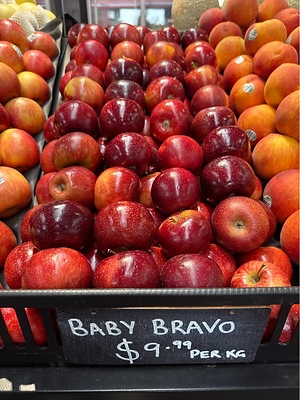


Baby Bravo® Apples
Estimated Inventory, lb : 0

Description/Taste
Baby Bravo® apples are small in size, less than 7 to 9 centimeters in diameter, which is the average for the normal-sized versions, and have a conic, oblate, or round appearance. The squat fruits sometimes feature green-brown russeting in the stem cavity and have a golden yellow-green base hue, almost entirely covered by a dark red, burgundy, or crimson blush. The yellow base hue is mostly seen around the stem cavity. The amount of blush and its saturation vary per fruit, position on the tree during cultivation, and growing environment, and only the premium fruits sold in markets bear the signature dark red-purple coloring. The skin is lightly ribbed and has a smooth, taut, glossy, and slightly waxy feel. The skin also features prominent lenticels and is occasionally encased in a faint bloom. Beneath the surface, the ivory-to-white flesh is firm, dense, fine-grained, and aqueous, with a crisp, succulent consistency. A small core is also found in the center of the flesh, containing tiny black-brown seeds. Baby Bravo® apples are edible raw once ripe and emit a subtly fruity, earthy aroma. The variety is known for its balanced sugar and acidity levels and has a refreshing, sweet, and subtly tangy flavor with spice-filled, woodsy, and vinous undertones.
Seasons/Availability
Baby Bravo® apples are available in Australia from mid-April through December.
Current Facts
Baby Bravo® apples, botanically classified as Malus domestica, are a smaller, snack-sized version of the popular Australian commercial variety, Bravo®, belonging to the Rosaceae family. Bravo® apples were commercially released in the early 21st century as a modern cultivar with extended storage life, a distinct skin color, and a sweet, crisp texture. The variety was created by famous breeder John E. Cripps, who is known for developing Pink Lady, also known as Cripps Pink, and Sundowner, also called Joya and Cripps Red apples. Since their release, Bravo® apples have been cultivated under strict regulations and evaluation protocols to maintain the variety’s signature aesthetic characteristics. The variety has also been separated into small, medium, and large types. The small, handheld-sized fruits are marketed as Baby Bravo® apples and are positioned in retail settings as an on-the-go, snack-sized option. Baby Bravo® apples are prized for their refreshing, sweet flavor and dense, crisp flesh, and are sought by apple enthusiasts primarily for fresh eating.
Nutritional Value
Baby Bravo® apples have not been extensively studied for their nutritional properties. Apples, in general, are a source of fiber to aid digestion and contain vitamins A, B, C, E, and K, which strengthen the immune system, contribute to energy production, maintain organ health, assist in faster wound healing, and protect cells against free radical damage. Apples also provide minerals in varying amounts, including calcium, potassium, copper, phosphorus, manganese, magnesium, iron, and zinc. These minerals help the body balance fluid levels, build red blood cells, regulate nerve function, produce the protein hemoglobin that transports oxygen in the bloodstream, and support bone and tooth development.
Applications
Baby Bravo® apples have a balanced, refreshing, sweet, and tangy flavor suited for raw preparations. The fruits are commercially advertised for their small size and are packed in school lunches, served as on-the-go snacks, or eaten on breaks as a source of nourishment. Baby Bravo® apples are favored for children as the fruits can easily fit in the palm of their hands, and the flesh remains white after slicing. The variety can also be chopped into salads, shredded into slaws, and sliced for serving over toast or in sandwiches. Baby Bravo® apples complement soft and hard cheeses on appetizer platters and can be used as a garnish for breakfast dishes such as yogurt, porridge, or chia seed pudding. Try mixing Baby Bravo® apples into fruit medleys or blending them into smoothies, juices, and cocktails. The small fruits are not commonly cooked because of their size, but they can be incorporated into recipes that call for larger Bravo® apples, such as baked goods, sauces, and roasts. Baby Bravo® apples pair well with spices such as ginger, cloves, nutmeg, cardamom, and cinnamon, herbs like basil, rosemary, parsley, and mint, and other fruits such as strawberries, citrus, blueberries, and stone fruits. Whole, unwashed Baby Bravo® apples will keep for a few days to a few weeks at room temperature in a cool, dry, dark location, and for several weeks to months in the refrigerator's crisper drawer.
Ethnic/Cultural Info
Bravo® apples are promoted as being a flavonoid-rich variety in Australia. Flavonoids are natural compounds found in the apples that give the skin its pigmented coloring. These compounds have antioxidant properties to reduce inflammation and boost overall bodily health. Flavonoids also inhibit oxidation, allowing the flesh to remain white after slicing. The antioxidants in the fruit slow the natural browning process, and tests on the variety have shown that Bravo® apple slices remain white even after 7 days. Bravo® apples are positioned in markets as snacking apples for their slow-to-brown nature, and Baby Bravo® apples are favored for school or work lunches.
Geography/History
Baby Bravo® apples are native to Australia and are one defined size of Bravo® apples. The history of Bravo® apples dates to 1992, when the variety was created from a cross made by breeder John E. Cripps in partnership with the Australian National Apple Breeding Program at the Stoneville Research Station in Western Australia. The cross was naturally made using traditional breeding techniques between Cripps Red apples, the female parent, and Royal Gala, the male parent. In 1993, the seedlings were planted at the Manjimup Horticultural Research Institute in Manjimup, Western Australia, and examined in field trials for several years. Later in 1999, one seedling was selected for cultivation and was named ANABP 01. The seedling began producing fruit in 2008, and in 2014, ANABP 01 was distributed to select Australian orchards for commercial production and initial trials. ANABP 01 was filed for a patent in 2014 and was approved in 2016 under USPP27420P3. The patent is active until 2035. After a few years of trials, ANABP 01 was renamed Bravo® and commercially released in 2016, becoming widespread across Australia by 2019. The variety was also exported internationally in 2017 under the name Soluna™. It is unknown when Baby Bravo® apples were selectively marketed separately from larger Bravo® apples. The smaller-sized fruits are offered throughout Australia and are a specialty version of the more widely available standard size. The apples featured in the photograph above were sourced through Queen Victoria Market in Melbourne, Australia.
Recipe Ideas
Recipes that include Baby Bravo® Apples. One
 is easiest, three is harder.
| Kate Flower Food |
|
Bravo Apple and Smoked Chicken Fresh Spring Roll |

Baby Bravo® Apples for sale around the world shared on the Specialty Produce App