



Poh Pohan Leaves
Estimated Inventory, lb : 0

Description/Taste
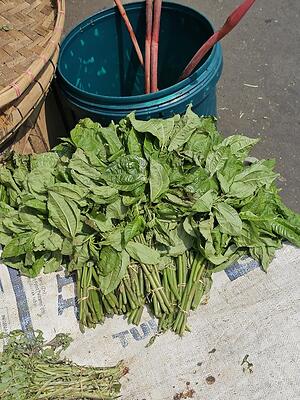
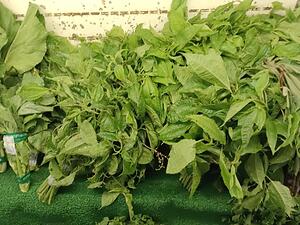
Poh Pohan leaves vary in size, depending on maturity at harvest and growing conditions, and average 5 to 20 centimeters in length and 2 to 10 centimeters in diameter. The leaves have a broad, elliptic to ovate shape with a rounded base tapering to a distinct point on the non-stem end. Poh Pohan leaves are pliable, thin, and flat, with a glossy, lightly textured surface and prominent veining. The leaves are dark green above, and pale green below, and the edges are naturally serrated. Poh Pohan leaves are attached to succulent stems when picked young, and the leaves have a crisp, slightly chewy, and tender consistency. The leaves are known for their light, refreshing, and mint-like aroma and are edible raw or cooked. Poh Pohan leaves have a green, vegetal, and herbal flavor with subtle tart and astringent notes.
Seasons/Availability
Poh Pohan leaves are available year-round in Southeast Asia.
Current Facts
Poh Pohan leaves, botanically classified as Pilea melastomoides, are the edible foliage of a tropical, herbaceous species belonging to the Urticaceae family. The leafy plants grow upright, typically reaching about 1 meter in height, but under certain conditions, they can reach 2 meters. Poh Pohan leaves are native to Asia and are a treasured culinary and medicinal ingredient in Indonesia, especially in Java, Bali, and Sumatra. The leaves are foraged from wild plants, grown in home gardens, and also produced in small quantities for commercial purposes. The name Poh Pohan is the Indonesian descriptor for the species, and it is also known as Pohpohan, Poh-Pohan, Popongan, Seureuh, Melastome Clearweed, Thuy Ma La Mua in Vietnam, Chang Xu Leng Shui Hua in China, and Narali and Dongorbhori in India. The species is utilized as a culinary ingredient year-round and is valued for the leaves’ distinct aroma, nutritional properties, and fresh taste. Chefs and home cooks seek Poh Pohan leaves as a raw ingredient to balance other flavors in dishes, and they can be incorporated into a wide array of savory culinary preparations.
Nutritional Value
Poh Pohan leaves are a source of fiber to aid digestion and contain vitamins A, B, and C, which strengthen the immune system, contribute to energy production, and maintain healthy organs. Poh Pohan leaves also provide varying amounts of minerals, including calcium, copper, magnesium, potassium, iron, and phosphorus. These minerals help the body support bone and tooth development, regulate nerve function, maintain fluid balance, and produce the protein hemoglobin, which transports oxygen through the bloodstream. In traditional Indonesian medicine, Poh Pohan leaves are crushed and applied topically to reduce irritation and heal burns. The leaves are also made into extracts as a health supplement or brewed into an herbal tea to support digestion.
Applications
Poh Pohan leaves have a fresh, green, fragrant, and subtly astringent taste suited for raw and cooked preparations. The leaves are primarily eaten fresh as an accompaniment to condiments, dips, meat, and fried dishes. Poh Pohan leaves are consumed when young and tender and can be used as wraps for fillings or tossed into salads. In Indonesia, where the greens are extensively used, Poh Pohan leaves are sometimes stuffed with minced shrimp, coated in flour, and fried to create a crunchy roll. The leaves are also eaten with sambal, simmered into soups, curries, and stews, or stir-fried with other vegetables. A popular snack involves frying the leaves into a crisp chip or steaming them to eat with rice. Poh Pohan leaves are commonly added to urap, an Indonesian dish of blanched vegetables with a coconut topping, consumed with tofu or tempeh, or shredded into a raw salad called karedok. Outside of Indonesia, Poh Pohan is less used as a culinary ingredient but is sometimes cooked in soups, stir-fries, and simple side dishes. Poh Pohan leaves pair well with aromatics like garlic, ginger, shallots, and chile peppers, meats such as beef, poultry, and fish, and flavorings like soy sauce, oyster sauce, and fermented pastes. Fresh leaves should be immediately consumed for the best quality and flavor. The greens will keep for 2 to 3 days when wrapped in a damp cloth and placed into a container in the refrigerator. Poh Pohan can also be blanched and frozen for extended use.
Ethnic/Cultural Info
In Indonesia, Poh Pohan leaves are a traditional ingredient in lalapan, also known as lalap or lalab, a plate of fresh or lightly boiled vegetables served with fried food, grilled meat, and rice. The fresh vegetables are served with sambal, a paste-like, spicy condiment that adds depth of flavor, complemented by the vegetables' crisp, textural component. The history of lalapan begins with Sudanese customs in West Java, Indonesia. Early versions of the dish were noted in the 10th century CE in the Taji Inscription found in Ponorogo, believed to have been written around 901 or 902 CE. Lalapan is viewed as a dish that connects the Sudanese to their environment. The plants used in the dish were customarily gathered from home gardens, fields, and along community borders and were revered for their various nutritional properties. Poh Pohan is one of the most popular leaves for lalapan as its soft texture, refreshing taste, and distinct aroma complement the spicy, salty, and umami-filled sambal. Lalapan is prepared at home, in restaurants, and by street vendors throughout Indonesia, and is regarded as a dish that upholds customs and cultural heritage from past generations.
Geography/History
Poh Pohan leaves are native to Asia and have been growing wild since ancient times. The species is found across a broad geographical range extending from India and Sri Lanka, throughout Southeast Asia, and into East Asia, notably in Vietnam, Thailand, Malaysia, Indonesia, the Philippines, Japan, Taiwan, and China. Poh Pohan plants thrive at elevations of 500 to 2,700 meters and grow in moist, shaded areas of forests, alongside streams, rivers, and lakes, or beside roadways. The species has also been taken from the wild and naturalized in populations for small-scale commercial production and home gardens. Today, Poh Pohan leaves are widely used as a culinary and medicinal green in Indonesia and are sold in local markets and select retailers. In other parts of Asia, the species is used in smaller quantities and is more challenging to find through market vendors. The Poh Pohan leaves featured in the photograph above were sourced in South Tangerang near Jakarta on the island of Java.

Poh Pohan Leaves for sale around the world shared on the Specialty Produce App




Check out our QR code Library to download QR Codes that link to our fruit encyclopedia.
Use on your signage and other promotions to share the knowledge!
Use on your signage and other promotions to share the knowledge!



