Amazon Pineapples
Estimated Inventory, lb : 0

Description/Taste
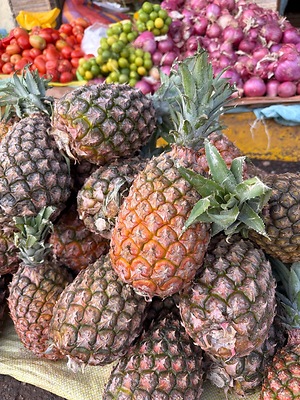
Amazon pineapples vary in size and shape, depending on the specific variety, maturity at harvest, and growing region. The fruits can be elongated, cylindrical, and straight with blunt, curved ends, or oval and bulbous with rounded ends. The fruits are also topped with crowns of many small, muted green, lanceolate-shaped leaves growing in a thick, spikey, rigid, and fibrous rosette. Pineapples are a type of syncarp, meaning they are formed by flowers that fuse around a central core. The pineapple's surface is covered in textured, round-to-hexagonal scales, and these small pieces are joined together to form a thick, rough exterior. Amazon pineapples showcase green, brown, golden yellow, and pink-red hues. Underneath the exterior, the yellow flesh is soft, tender, and aqueous with some fibers, creating a succulent, chewy consistency. The flesh also envelops a small core that can range from fibrous to edible, depending on the variety. Ripe Amazon pineapples will have a permeating, sweet, fruity, and tropical scent. When pressed, the base should also have a slight give. Amazon pineapples are harvested mature, as they are a non-climacteric fruit, meaning they will not ripen once picked, and have a rich, fruity, sweet, and tropical taste with balanced sugar and acidity.
Seasons/Availability
Amazon pineapples are available year-round.
Current Facts
Amazon pineapples, botanically classified as Ananas comosus, are a category of varieties grown in South America, belonging to the Bromeliaceae family. The Amazon rainforest spans nine countries and is home to over 50,000 plant species, including serving as the center of pineapple diversity. Throughout the Amazon, many wild and commercial pineapple cultivars are grown by indigenous communities, and the fruits are revered as a food source, medicinal ingredient, and cultural symbol. Amazon pineapples develop on upright, leafy shrubs, and varieties range in size, appearance, and flavor, depending on the growing environment and cultivar. In local Amazonian markets, most pineapples are collectively sold under the general name Piña Amazónica and are not marketed by their varietal or indigenous names. These wild and rarer cultivars include, but are not limited to, Tabë Cänä, Eruwä Canä, Gobernadora, Oriente, Perolera, Manzana, India, Guainía, Pucallpina, and Avallana. The Amazon is also home to widespread commercial varieties, including MD-2, also known as Golden, and Smooth Cayenne. Amazon pineapples are planted in home gardens, grown on plantations, and are collected from wild and naturalized populations throughout South America. The fruits are valued for their sweet, acidic taste and are utilized in a wide array of fresh and cooked culinary preparations and beverages.
Nutritional Value
Amazon pineapples have not been extensively studied for their nutritional properties. Pineapples, in general, are a source of fiber to regulate the digestive tract and contain vitamins A, B, C, and E. These vitamins help strengthen the immune system, contribute to energy production, maintain healthy organs, and protect the cells against free radical damage. Pineapples also provide varying amounts of minerals, including phosphorus, calcium, magnesium, iron, potassium, and copper. These minerals build red blood cells, help the body balance fluid levels, support bone and tooth development, and produce the protein hemoglobin, which transports oxygen through the bloodstream. In natural medicines, pineapples are valued for their anti-inflammatory and antioxidant properties. The fruit’s juice is used as a diuretic and is mixed with ginger to ward off illness and settle stomach ailments.
Applications
Amazon pineapples have an aromatic nature suited for fresh and cooked preparations. The fruits are traditionally consumed out of hand when ripe and are eaten for their tender flesh, discarding the exterior. Each variety grown in the Amazon will have a slightly different flavor, with varying sugar and acidity levels, and even within a single fruit, sections will range from sweeter to more acidic, with the base typically the sweetest. Amazon pineapples are sliced and eaten as wedges, or their flesh is diced and added to green salads and fruit medleys. The flesh is best enjoyed slightly chilled and is also chopped as a topping for breakfast dishes, rice bowls, or as a finishing element. In the Amazon, pineapples are frequently served over seafood dishes, especially with river fish. The fruits are also skewered and caramelized over fires, blended into juice for a sweet glaze on roasted meats, or incorporated into sauces. Beyond savory dishes, Amazon pineapples are simmered into jams, jellies, preserves, and syrups or pressed into fresh fruit juices, smoothies, and shakes. The fruits are also sometimes used in fermented beverages like wine and chicha. Amazon pineapples pair well with other tropical fruits like passionfruit, papaya, coconut, and bananas, as well as herbs such as mint, cilantro, basil, and parsley. Whole Amazon pineapples are harvested ripe and are immediately ready for consumption. Unopened fruits can sit for a few days in a cool, dry, and dark place at room temperature or in the refrigerator. Once opened, the sliced pieces should be stored in an airtight container in the fridge for 3 to 5 days.
Ethnic/Cultural Info
Pineapples are used in an ancestral drink of the Huitoto indigenous community in the Amazon. The fruits are blended with water and panela, boiled, and later combined with cassava starch to create a beverage called pineapple caguana, which has been consumed since ancient times. The Huitoto historically resided in parts of the Amazon spanning southeastern Colombia and northern Peru, and are among the communities nicknamed the “guardians of the Amazon.” Pineapple caguana is passed down through generations through demonstration and oral tradition, and the process of making the drink is a communal practice. The pineapples are harvested, and the cassava root must be peeled, washed, grated, and strained to extract the starch. This process takes several hours to days, and once the starch is ready, it is combined with the sweetened pineapple juice, either consumed immediately or left to ferment for 1 to 2 days. Pineapple caguana is valued for its energizing properties and nutritional value, and the beverage is often used in natural medicines to support stomach health. It is also used in celebratory gatherings, rituals, and community assemblies as a communal symbol of connection, socialization, and unity. Pineapple caguana is meant to be shared, and the fruit’s tropical sweetness enhances the drink’s sweet reputation.
Geography/History
Amazon pineapples are native to South America and have a center of origin in the Amazon rainforest. Various pineapple species have grown wild since ancient times and have been naturalized and selectively bred over time to create new types in various sizes, shapes, and colors. Amazon pineapples represent mostly local varieties grown in the forest, and these fruits are found through vendors and fresh markets. Within the Amazon, the forest between Paraguay and Brazil is hypothesized to be where indigenous communities first used pineapples, and the fruit gained notoriety and household use throughout tropical regions. Much of how pineapples spread in the Amazon remains unknown, but a few sources note that by the 15th century, pineapples had been carried by communities in South America to Central America, Mexico, and the Caribbean. It had also been established throughout South America before the arrival of the Spanish and was later introduced worldwide with European explorers. Today, Amazon pineapples are cultivated throughout tropical regions of South America, especially in Peru, Colombia, Brazil, Ecuador, Bolivia, and Venezuela. The fruits are sold through local markets and exported on a small scale to urban cities.

Amazon Pineapples for sale around the world shared on the Specialty Produce App