



Lemon Cucumbers
Estimated Inventory, lb : 0

Description/Taste
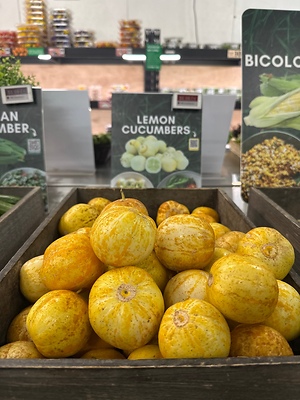
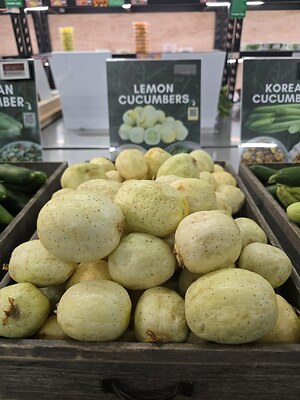
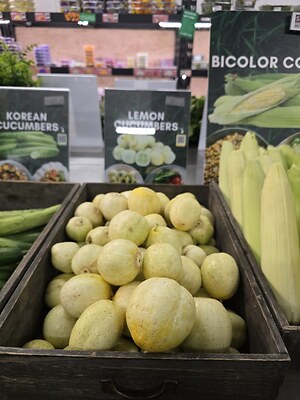
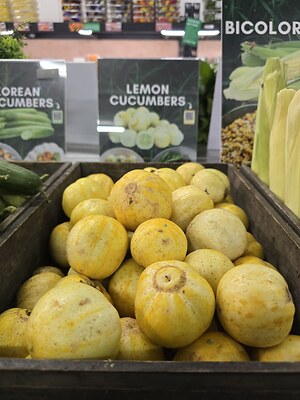
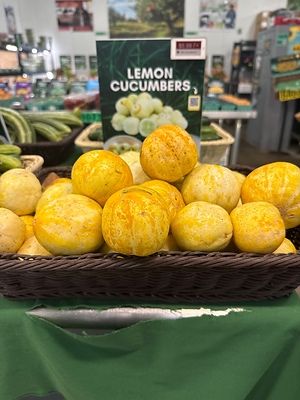
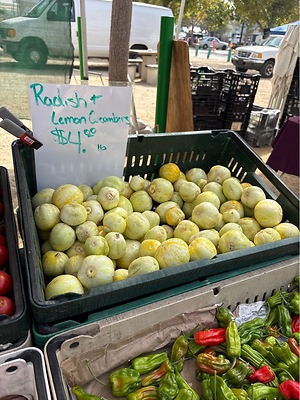
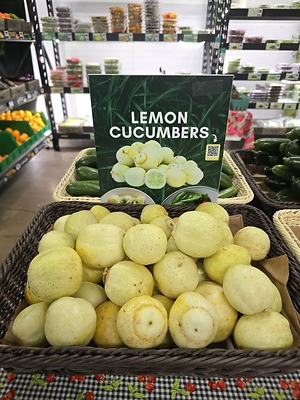
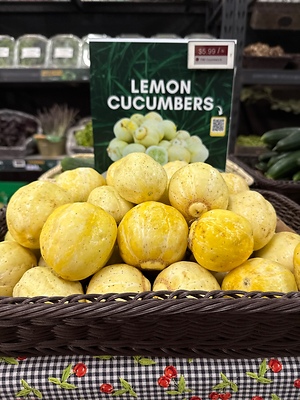
Lemon cucumbers have a round tennis ball shape with small protrusions at their blossom end, similar to a navel orange. They average 5 to 7 centimeters in length. This variety's skin is thin and tender with some striping and mottling, transitioning from lemon-yellow to golden-yellow as they ripen. Their skin also has tiny bristles that are edible but can easily be removed. The inner flesh of Lemon cucumbers is a pale yellow-green with edible seeds. They have a mild, sweet taste with a cool, crisp texture.
Seasons/Availability
Lemon cucumbers are available during the summer.
Current Facts
Lemon cucumbers are botanically classified as Cucumis sativus and belong to the Cucurbitaceae family, which also includes melons, gourds, and squash. This variety is often referred to as a Garden Lemon, Apple cucumber, Budamkaya, and Dosakai. Lemon cucumbers have thin skin and are burpless, meaning they lack bitter flavor components and are easily digestible. This heirloom variety matures late and has a low yield but is valuable for genetic research. Lemon Cucumber flowers have both male and female parts, making it easier to self-pollinate than other cucumber varieties. This cultivar is one of seven types of cucumbers, which include Gherkins, Armenian, English, Persian, and oriental cucumbers. Lemon, English, and Persian cucumbers are classified as slicing cucumbers, while Gherkins, Armenian, and Oriental cucumbers are typically used for pickling.
Nutritional Value
Lemon cucumbers contain vitamins C and A, nutrients essential for the immune system, tissue repair and growth, healthy vision and skin, and the prevention of free radical cell damage. This variety possesses zeaxanthin and lutein, antioxidants that help filter harmful blue light and reduce the risk of macular degeneration and cataracts. They provide the body with fiber to help regulate blood sugar and cholesterol levels, encourage digestion, and prevent constipation. Lemon cucumbers are a source of potassium that maintains fluid balance, muscle and nerve function, heart health, sodium levels, and may reduce blood pressure. In India, cucumbers like the Lemon variety are used for their cooling properties to help combat the sweltering summer heat.
Applications
Lemon cucumbers are most often consumed raw. Some people prefer to peel their skin because eating it can be bitter. They can be sliced as a snack, used as a garnish, or mixed into fresh salads with greens, tofu, zucchini, tomatoes, and peas. This variety is ideal for combining with pesto in pasta salads, adding to charcuterie boards, or slicing into sandwiches and vegetable wraps. Lemon cucumbers can also be juiced into cocktails, agua frescas, and smoothies. They may be selected for cold soups like gazpacho, chopped up into fresh salsa, or mixed with yogurt and dill in a tzatziki sauce. Lemon cucumbers have a strong presence in India where they are commonly added to Daal, Dosa-Aavakaaya, and chutney. This variety pairs well with ingredients like fresh herbs, cheese, citrus, olives, vinegar, beans, hummus, watermelon, summer squash, and carrots. Lemon cucumbers will last up to three days when stored in the refrigerator.
Ethnic/Cultural Info
In 1909, a traveling salesman once told the story of when he celebrated his daughter's wedding by taking an orange blossom from her bouquet and pollinating it with a cucumber plant. The result a fruit that blended the properties of a Florida orange with the crispness of a cucumber. He offered up his creation for a dollar per seed, a steep price in the early 20th century. The salesman's claim of having created a cucumber-orange hybrid was debunked as it was impossible to cross a vegetable from the squash family with a fruit in the citrus family. In 1910, a horticulturist and plant breeder named Hal Fullerton officially proved that the seeds he was selling actually belonged to the Lemon cucumber, which was commonly found in seed catalogs of the time.
Geography/History
Lemon cucumbers likely originated in the Middle East or India, where all wild cucumbers are believed to have come from. The variety was brought to the United States in the late 1800s. They first appeared in American Samuel Wilson’s catalog in 1894, where they were advertised for their unique combination of desirable cucumber qualities and a lemon-like flavor. Soon after, the variety became well-known throughout the Old and New World. Lemon cucumbers are well-suited for warm weather but are adaptable enough to grow in cooler climates as well. They are a cultivated variety that has been bred for commercial production and growth in home gardens. Lemon Cucumbers remain popular in Indian and Australian markets. They can also be purchased from seed all over the world and found at farmers' markets and specialty grocers in the United States, Europe, and Asia.
Recipe Ideas
Recipes that include Lemon Cucumbers. One
 is easiest, three is harder.

Lemon Cucumbers for sale around the world shared on the Specialty Produce App



Check out our QR code Library to download QR Codes that link to our fruit encyclopedia.
Use on your signage and other promotions to share the knowledge!
Use on your signage and other promotions to share the knowledge!



