This website uses cookies, pixels, and other tracking technologies to personalize content, analyze how our site and apps are used, and create aggregated statistics.
We disclose data about site and app users to third parties so we can target our ads to you on other websites, and those third parties may use that data for their own purposes.
For more information on how we collect, use, and disclose this information, please review our
Privacy Policy.
Continued use of this site means you consent to our Privacy Policy.
Summary generated by our research from the article below.
Description/Taste
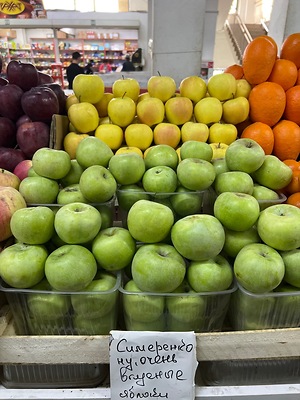
Semerenko apples are round to conical fruits with a slightly flattened and asymmetrical appearance. The skin is smooth, firm, waxy, and dry with prominent white spots and russeting surrounding the dark brown stem. When ripe, the apples are light green, sometimes speckled with pale red blush, and as the fruits continue to mature, the skin will transform into a green-yellow hue. Underneath the surface, the flesh is aqueous, fine-grained, white, and soft, encasing a central core filled with black-brown seeds. Semerenko apples have a sweet and sour, wine-like flavor with subtle notes of spice.
Seasons/Availability
Semerenko apples are harvested in the fall and can be stored until early spring.
Current Facts
Semerenko apples, botanically classified as Malus domestica, are an old Russian variety that belongs to the Rosaceae family. The sweet-tart fruits are considered to be one of the most popular home garden varieties in Russia and Ukraine and have earned many names over time, including Simirenko, Green Renet Simirenko, Renet Simirenko, Symirinka, and Renet Plato Semerenko apples. The cultivar earned its primary name after Platon Feorovich Simirenko, the father of the variety’s founder Lev Platonovich Simirenko. Semerenko apples are consumed as both a dessert and cooking apple and are highly valued for their wine-like flavor. The variety is also commercially grown and is favored by growers for its resistance to drought, high productivity, and extended storage capabilities.
Nutritional Value
Semerenko apples are an excellent source of vitamin C, which is an antioxidant that can help rebuild collagen and boost the immune system. The apples also provide fiber, which can help regulate digestion, and contain potassium, iron, vitamins E and K, and manganese.
Applications
Semerenko apples are best suited for both raw and cooked applications such as baking, roasting, and stewing. The tender flesh is showcased when consumed fresh, out-of-hand, and the apples can be sliced for green and fruit salads, blended into smoothies, pressed into juice or cider, chopped and used as a topping over pancakes, or dried and canned for extended use. Semerenko apples can also be chopped and minced into dumplings, cooked into sauces, jams, and marmalades, or stewed with meats and other vegetables. In addition to savory applications, the apples can be incorporated into baked goods such as tarts, cakes, pies, and rolls, or baked as a simple dessert with maple syrup, spices, and nuts. Semerenko apples pair well with meats such as poultry, pork, beef, and fish, spices such as cinnamon, nutmeg, ginger, and cloves, potatoes, pumpkins, lemon juice, raisins, and cherries. The fresh fruits will keep 1-4 months when stored in a cool, dry, and dark place.
Ethnic/Cultural Info
In Russia, Semerenko apples are popularly baked into traditional Russian apple cakes during the holiday known as Yablochniy Spas. Celebrated in August in conjunction with the beginning of the apple season, many Russians bring the first fruit harvest to church to be blessed on the eve of the holiday. The next day, the blessed fruit is consumed, and celebrations are held throughout cities with dancing, live music, and street fairs. Semerenko apples are favored for their sweet-tart flavor and are traditionally baked into sharlotka, which is a sponge-like cake that has been adapted and simplified over time into the recipe used in Russia today. The cake can be served as an afternoon snack, or it can be topped with whipped cream or ice cream as a light dessert. In addition to sustenance, apples are a symbol of life in Russia. During the Yablochniy Spas celebration, some Russians believe consuming apples on the holiday will grant a secret wish, and the fruits are also placed on the graves of family members in remembrance of past life.
Geography/History
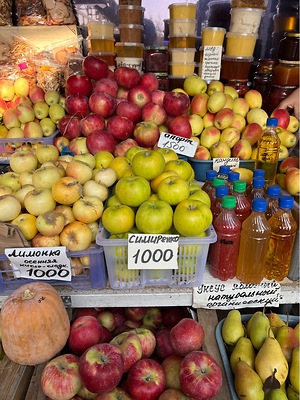
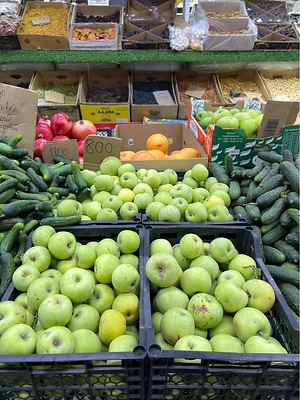
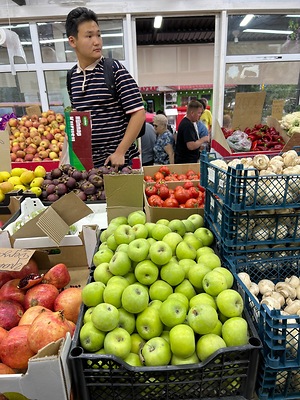
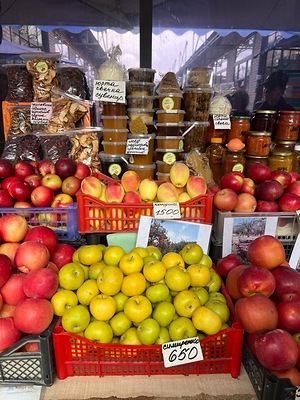
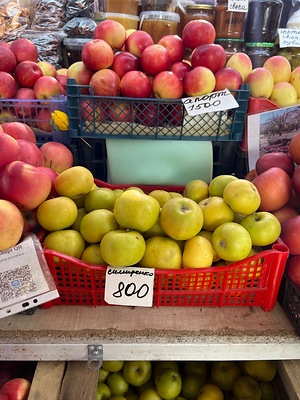
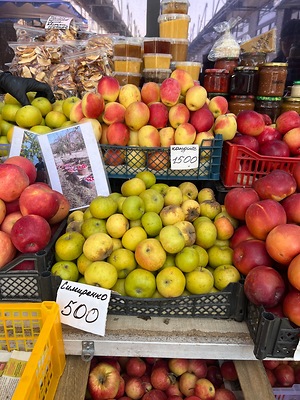
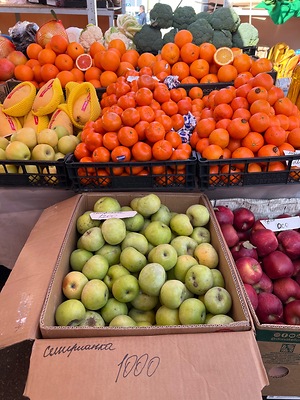
Semerenko apples are rumored to have been discovered by gardener Lev Platonovich Simirenko in the late 19th century on the Platonov family farm in the Cherkasy region of Ukraine. While the exact parentage of the variety is unknown, some experts believe zelenka wooda may be one of the parent varieties due to the apple’s similarity in appearance. Semerenko apples were also listed in the State Register of the Russian Federation in 1947. Today Semerenko apples are widely cultivated across Central and Southern Russia and can also be found in local markets in Ukraine, Georgia, Kazakhstan, and Uzbekistan. The Semerenko apples featured in the photograph above were found at a food fair in Almaty, Kazakhstan.
Orbita market
мкр. Орбита-3, Almaty, Almaty
Semerenko apples of Kazakhstan…Semerenko apples are known for their unique flavor profile, combining a sweet and sour, wine-like taste with delicate hints of spice. They have a smooth, firm, and waxy green skin that may develop a pale red blush as they ripen, eventually turning green-yellow. The flesh is fine-grained, juicy, and soft, enclosing a core with dark seeds. These apples also feature prominent white spots and a rustic texture near the brown stem, adding to their distinctive appearance.
Kazakhfilm bazaar
Semerenko apples of Kazakhstan…Semerenko apples pair beautifully with various ingredients and can be enjoyed raw or cooked. They shine in dishes like fruit salads, smoothies, and green salads, or as toppings for pancakes. They're also perfect for jams, sauces, and marmalades or baked goods like pies and tarts. These apples can be stored for 1–4 months in a cool, dry space, making them a reliable choice for both fresh consumption and extended use in recipes.
Базар
улица Исиналиева, Almaty
Semerenko apples of Kazakhstan...Semerenko apples are an old Russian variety classified as Malus domestica, belonging to the Rosaceae family. They are known for their sweet-tart flavor and are highly popular in Russia and Ukraine. Renowned for their wine-like taste, they are consumed as both dessert and cooking apples. These apples boast resistance to drought, high productivity, and extended storage capabilities, making them particularly appealing to growers. They are also a rich source of vitamin C, fiber, potassium, and other essential nutrients.
Orbita market
Birzhan Street, Almaty, Almaty
Semerenko apples of Kazakhstan...Semerenko apples are believed to have been first discovered by gardener Lev Platonovich Simirenko in the late 19th century on a farm in Ukraine's Cherkasy region. Although their exact parentage remains uncertain, experts suggest the zelenka wooda variety may be a likely ancestor due to their resemblance. Now, these apples are widely grown in Central and Southern Russia and found in markets across Ukraine, Georgia, Kazakhstan, and Uzbekistan.
Almaty Green Central Market
Sweet Semerenko apples of Kazakhstan…Semerenko apples are known for their unique sweet and sour taste with wine-like and slightly spicy undertones. Their flesh is fine-grained, white, and soft, while the skin transitions from light green to green-yellow as they mature. They feature prominent white spots and russeting around the stem, and their dry, smooth surface makes them visually striking, perfect for fresh snacking or culinary uses.
Базар в Орбите / Orbita Market
Birzhan Street, Almaty, Almaty
Semerenko apples of Alatau foothills...Semerenko apples are versatile and suitable for both raw and cooked recipes. Their tender flesh is ideal for eating fresh or slicing into salads. They can also be baked, roasted, stewed, or blended into smoothies. The apples pair well with spices like cinnamon and nutmeg, meats, and fruits such as cherries. They can be stored for 1-4 months in a cool, dry, and dark place, making them a long-lasting option for a variety of culinary uses.
Базар в Орбите / Orbita Market
Birzhan Street, Almaty, Almaty
Semerenko apples grown in Almarasan vallley of Ile Alatau...Semerenko apples, known for their sweet-tart flavor, have a fascinating history tied to Platon Feorovich Simirenko and his son Lev Platonovich Simirenko, who developed the variety. Valued for their wine-like taste, these apples serve both culinary and dessert purposes. They’re appreciated for drought resistance, high yield, and extended storage, making them a favorite for growers in Russia and Ukraine.
Базар в Орбите / Orbita Market
Birzhan Street, Almaty, Almaty
Semerenko apples grown on the foothills of Ile Alatau mountains...Semerenko apples, thought to be discovered by gardener Lev Platonovich Simirenko in the late 19th century, originated on the Platonov family farm in Ukraine. Their exact parentage is uncertain, but some experts suggest a link to zelenka wooda due to visual similarities. These apples have been cultivated in regions like Central and Southern Russia, Ukraine, Georgia, Kazakhstan, and Uzbekistan, gaining recognition in the Russian Federation’s State Register in 1947.
Базар
улица Исиналиева, Almaty
Semerenko apples of Kazakhstan...Semerenko apples are known for their round to conical shape and unique sweet-sour, wine-like flavor with hints of spice. The apples have smooth, firm, and waxy skin that is light green when ripe, sometimes showing a pale red blush. With time, the skin changes to a green-yellow hue. Inside, the flesh is fine-grained, white, and soft, surrounding a core filled with black-brown seeds. Additionally, their surface often showcases distinctive white spots and russeting around the dark brown stem.
Check out our QR code Library to download QR Codes that link to our fruit encyclopedia. Use on your signage and other promotions to share the knowledge!