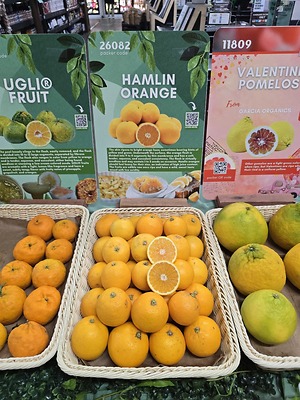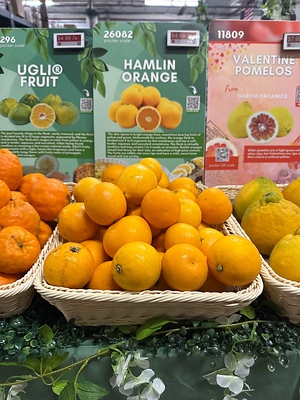


Hamlin Oranges
Estimated Inventory, lb : 0
This item was last sold on : 03/15/26

Description/Taste
Hamlin oranges vary in size and are generally considered a smaller variety, averaging 6 to 7 centimeters in diameter. The fruits have a round, oblong, or oblate shape and are often smaller than other commercial types, such as Navel or Valencia. The skin, also called the rind or peel, is thin, smooth, taut, and lightly textured, with finely pitted oil glands that give the surface a pebbled feel. The skin ripens to bright orange hues, sometimes bearing hints of yellow and green. Underneath the surface, the orange flesh is divided into 9 to 11 segments by thin membranes and has a soft, tender, aqueous, and succulent consistency. The flesh is virtually seedless and may contain 1 to 3 seeds on occasion. Hamlin oranges should feel heavy for their size, an indication of high juice content. The fruits are edible raw once ripe and have a mild, sweet taste mixed with low acidity.
Seasons/Availability
Hamlin oranges are available in the winter through early spring, typically between October and January. Some regions may have fruits into March, depending on the growing environment. Hamlin oranges hold well on the tree once mature and can be left for 3 to 4 months before being picked, which also helps extend their season.
Current Facts
Hamlin oranges, botanically classified as Citrus sinensis, are a sweet orange variety belonging to the Rutaceae or citrus family. The fruits grow on evergreen trees reaching 3 to 4.5 meters in height and are one of the most commercially grown sweet oranges in Florida. Hamlin oranges are an early-season cultivar valued by growers for their cold tolerance, mild flavor, and high juice content. The variety accounts for almost half of the Florida orange crop and is promoted in markets as a fresh-eating and juicing orange. It is important to note that Hamlin oranges are sometimes sold under the name Norris, but the name Hamlin is the most common moniker used in markets worldwide. Since its discovery in the late 19th century, Hamlin oranges have become well-known in citrus-growing regions around the world and are prized for their versatility, used in a wide array of sweet and savory culinary preparations and beverages.
Nutritional Value
Hamlin oranges have not been extensively studied for their nutritional properties. Oranges, in general, are a source of fiber to regulate the digestive tract and contain vitamins A, B, and C. These vitamins strengthen the immune system, maintain healthy organs, and contribute to energy production. Oranges also provide varying amounts of minerals, including calcium, copper, iron, magnesium, manganese, phosphorus, and potassium. These minerals help the body build red blood cells, produce the protein hemoglobin for oxygen transport through the bloodstream, support bone and tooth development, and balance fluid levels.
Applications
Hamlin oranges have a mild, sweet taste suited for fresh and cooked culinary preparations. The variety is mainly positioned in commercial markets as a juicing orange. Hamlin oranges produce a sweet, subtly tart juice and are often mixed with tangerines to create a darker-hued, more balanced beverage. The oranges can also be eaten out of hand like other cultivars or blended into smoothies and shakes for added flavoring. Try juicing Hamlin oranges and incorporating them into sauces, dressings, marinades, and glazes. Pulp and juice from the variety can also be frozen into popsicles and homemade sorbet. In addition to fresh preparations, Hamlin oranges are sometimes simmered into jams, marmalades, and jellies, or the juice and zest are folded into batters for muffins, cookies, cakes, and scones. Beyond the flesh, the rind may occasionally be cooked in syrup and candied as a sweet treat. Hamlin oranges pair well with herbs such as mint, basil, parsley, and cilantro, and spices like cinnamon, nutmeg, ginger, and cloves. Whole, unopened Hamlin oranges will keep for a few days at room temperature and for several weeks when stored in the refrigerator.
Ethnic/Cultural Info
Hamlin oranges are named after Arthur George Hamlin, the former owner of the grove where the variety originated in Florida. Mr. Hamlin was the first attorney to reside in the town of DeLand, Florida, in 1883, and served as the legal advisor to Henry DeLand, the town's founder. Mr. Hamlin also worked for several other well-known businesses, including the Florida East Coast Railway and the DeLand Town Council. Outside his legal career, Hamlin was an avid orange grower and helped develop the Hamlin orange, which later became one of the most popular varieties grown commercially in Florida. Mr. Hamlin passed away in 1932, but his legacy lived on through his naming of the well-known orange cultivar. There is also a planned town center in Horizon West of Orange County, Florida, named Hamlin after the attorney and orange grower.
Geography/History
Hamlin oranges are native to Florida and arose from a chance seedling planted in an orchard created by Isaac Stone in 1879 in DeLand, Florida. The grove was initially designed for Mary H. Payne and was later acquired by Arthur George Hamlin. Once Mr. Hamlin purchased the grove, he began performing extensive bud grafting and nurturing the trees. During the great Florida freeze of 1894-95, a variety was observed in Mr. Hamlin's grove that exhibited cold hardiness and early maturity. This variety was selected for commercial introduction for the above characteristics and was named Hamlin oranges. Initially, Hamlin oranges were planted throughout DeLand, Florida, but by the mid-20th century, they had been widely planted across the state and were being commercially produced by Florida juice companies. Hamlin oranges remained a prominent variety in the Florida citrus industry into the 21st century and are now planted worldwide in select citrus-growing regions. Today, Hamlin oranges are primarily grown in Lake, Orange, Polk, Pasco, and Hillsborough counties in Florida and are found in limited quantities in Texas and California. They are also grown in areas of Australia, China, South Africa, Brazil, and Spain.

Hamlin Oranges for sale around the world shared on the Specialty Produce App