



Ribston Pippin Apples
Estimated Inventory, lb : 0

Description/Taste
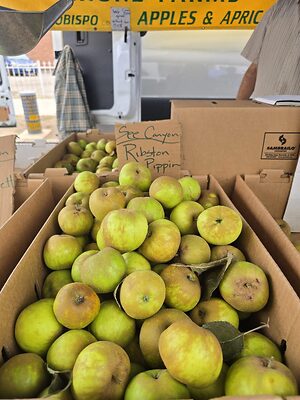
Ribston Pippin apples vary in size, depending on growing conditions, and can average 5 to 8 centimeters in diameter with a round to slightly conic shape. The variety often has a lopsided, flattened nature with angular shoulders and bases. The green-brown stems are short, slender, and woody, set in a deep and narrow cavity, and textured golden brown russet spills from the cavity onto the shoulders of the fruit. This russet has a rough, sandy feel and can also appear in the calyx basin. The fruit’s skin is matte, semi-smooth, firm, and taut, ripening to a golden yellow-green base hue with red and orange blush patches and streaking. There are also prominent lenticels scattered across the surface. Underneath the skin, the pale yellow to cream-colored flesh is firm, dense, and crunchy. The flesh also encases a central fibrous core filled with tiny black-brown seeds. Ribston Pippin apples emit a fragrant, fruity aroma and are edible once ripe. The variety is sometimes stored for a few weeks to develop its full flavor and is said to have a rich, sweet, sharp, acidic, and tangy taste with fruity, sweet wine-like notes.
Seasons/Availability
Ribston Pippin apples are harvested in the fall, typically in September or October. Once picked, the variety can be stored for a few months and is sold through the early winter into December.
Current Facts
Ribston Pippin apples, botanically classified as Malus domestica, are an English variety belonging to the Rosaceae family. The heirloom apples grow on deciduous trees and were once a popular home garden variety for the tree’s vigorous nature, especially during the Victorian Era in England. Ribston Pippin apples are known by several names, including the Glory of York, Travers, Traver’s Pippin, Formosa Pippin, and Beautiful Pippin. Historically, the variety was favored as a versatile fruit, incorporated into raw and cooked, sweet or savory culinary preparations. In the present day, Ribston Pippin apples have faded from commercial cultivation due to the introduction of modern varieties and have become a rare heritage apple only grown on a small scale as a specialty, seasonal fruit.
Nutritional Value
Ribston Pippin apples have not been studied for their nutritional properties. Apples, in general, are a source of fiber to aid digestion and vitamins A, B, C, E, and K. These vitamins help maintain healthy organ functioning, strengthen the immune system, contribute to energy production, assist in faster wound healing, and guard the cells against free radical damage. Apples also provide minerals like potassium, calcium, magnesium, phosphorus, iron, and copper to balance fluid levels, support bone and teeth health, control nerve functions, and build red blood cells.
Applications
Ribston Pippin apples have a sweet and sharp flavor suited for fresh and cooked preparations. The variety is favored for eating out of hand as a dessert cultivar and is sliced and served on cheese boards, tossed into salads, or shredded for slaws. Ribston Pippin apples are also utilized as a fresh topping over oatmeal and other breakfast dishes, sliced and layered into sandwiches, or eaten in chunks with dips and spreads. In England, apples are popularly added to cider blends and pressed for their sweet and tangy juice. Beyond fresh dishes, Ribston Pippin apples are cooked and incorporated into sweet baked goods like cakes, muffins, tarts, pies, and crisps. They are also cooked to make savory-sweet sauces, preserves, and spreads. Try serving Ribston Pippin apple sauce with meats like pork or turkey. Ribston Pippin apples are also roasted as a side dish with root vegetables, sauteed in a caramel sauce, or mashed with potatoes for a sweet variation. Ribston Pippin apples pair well with fruits like pear, nectarines, and oranges, nuts including pecans, almonds, and walnuts, cheeses such as cheddar, brie, and gouda, and herbs like rosemary, parsley, and mint. Whole, unwashed Ribston Pippin apples will keep for 1 to 2 months when stored in a cool, dry, and dark location such as a cellar or the refrigerator’s crisper drawer.
Ethnic/Cultural Info
Ribston Pippin apples were named after their site of origin beside Ribston Hall in Yorkshire, England. The Ribston estate was established in 1217 and was passed for several centuries between families until it was purchased by the Goodricke family in 1542. Ribston Hall was built in 1674 and was a two-story manor house on the property. The Ribston Pippin mother tree resided beside the hall on the property for over two hundred years. The tree eventually fell in a storm in 1815, but it was propped up and continued living for another twenty years until it died in 1928.
Geography/History
Ribston Pippin apples are native to England and were discovered in the late 17th century. There are two main theories as to the variety’s origin. The most prevalent theory claims that five apple seeds, also known as pips, were carried by Sir Henry Goodricke from Rouen, Normandy, France, and were planted by Ribston Hall, near Knaresborough, Yorkshire, in Northeast England around 1688. Two of the five pips were crab apples, while the other three pips were common apples. Of the three common apple pips, only one grew into a tree that eventually bore fruit in 1707. The second theory, derived from a written letter, hypothesizes that Ribston Pippin apples may have been created from a graft rather than a seed. Despite its origins, Ribston Pippin apples were listed in English nursery catalogs in the late 18th century and increased steadily over time as a home garden apple tree. The variety was also carried from England to North America sometime in the late 18th century and was planted by Benjamin Vaughan on his farm in Hallowell. Vaughan helped promote the variety in the United States and encouraged farmers along the Kennebec River to grow the fruits. By the mid-19th century, Ribston Pippin apples were one of the most popular apples in Maine. They also received the Award of Garden Merit from the Royal Horticultural Society in 1962, a recognition of varieties that have favorable cultivation characteristics, flavor, and use. Today, Ribston Pippin apples are an heirloom variety cultivated in Europe and North America, and are a rare cultivar primarily localized to heritage orchards and home gardens. When in season, the apples are sold directly through growers, farmers’ markets, and select wholesalers.

Ribston Pippin Apples for sale around the world shared on the Specialty Produce App


Check out our QR code Library to download QR Codes that link to our fruit encyclopedia.
Use on your signage and other promotions to share the knowledge!
Use on your signage and other promotions to share the knowledge!



