





| Frieda's Inc. | Homepage |
Description/Taste
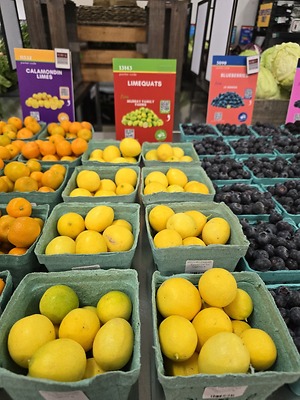
Limequats vary in size and shape, depending on the specific variety, but average 3 to 4 centimeters in diameter and 2 to 5 centimeters in length. The fruits are typically 15 to 25 grams in weight in commercial markets and showcase round, elongated, or oval, curved shapes, sometimes with a distinct point at one end. The skin is thin, smooth, faintly glossy, leathery, and covered in sunken oil glands, giving the surface a pebbled, occasionally oily feel. Limequats range in color from yellow-green, yellow, to yellow-orange hues at maturity, changing with the variety. Underneath the surface, the pale yellow-green flesh is divided into 7 to 10 sections by white membranes and has a soft, tender, aqueous, and succulent consistency. The flesh also encases a few to many seeds, determined by the variety. Limequats are edible raw once ripe, and the entire fruit can be eaten, including the skin. The skin has an initially sweet, floral taste, followed by the acidic, tart, sharp, and sour flavors of the flesh, reminiscent of a lime, creating a complexly flavored eating experience.
Seasons/Availability
Limequats are available year-round in some climates and in mid-fall through spring in cooler regions.
Current Facts
Limequats, botanically classified as Citrus x floridana, are a category of hybrid fruits belonging to the Rutaceae or Citrus family. The small fruits grow on compact, evergreen trees or small shrubs reaching 2 to 3 meters in height and are primarily planted as an ornamental in home gardens. Limequats are a cross between West Indian Limes and Kumquats, creating a new citrus variety that features an edible peel, a sweet and sour flavor profile, and a versatile nature. There are three main types of Limequats, including Eustis, Lakeland, and Tavares. Eustis limequats are the most commercially grown Limequats as they closely resemble the West Indian Lime with improved cold hardiness and a more productive nature. Lakeland is a sister variety that is slightly larger, sweeter, and milder than Eustis. Tavares was developed from a different type of Kumquat and has an elongated, oval shape, darker skin coloring, and floral nuances. All three varieties are interchangeable in recipes and are often collectively sold under the Limequat name. Chefs and home cooks utilize Limequats in a wide array of fresh or cooked culinary preparations, as well as in mixology, as a garnish, juice, or zest.
Nutritional Value
Limequats have not been extensively studied for their nutritional properties. The fruits are said to be a source of fiber to regulate the digestive tract and vitamin C to strengthen the immune system. Limequats also provide minerals in varying amounts, including potassium, calcium, zinc, magnesium, and iron. These minerals help the body balance fluid levels, support bone and tooth development, control daily nerve functions, and produce proteins for oxygen transport through the bloodstream.
Applications
Limequats have a bright, sour, and subtly sweet taste suited for raw and cooked culinary preparations. The fruits are unique as they can be eaten whole, including their skin. The skin has a sweet taste, and the flesh is reminiscent of the zesty acidity of lime. Many consumers appreciate eating Limequats whole, but some may find the taste too overpowering or abrasive. Limequats can also be thinly sliced and eaten over salads, parfaits, and as an edible garnish. Try juicing Limequats and mixing them into dressings, marinades, and sauces, or simmering the fruits whole into jams, jellies, and marmalades. They can also be used in any recipe calling for lemons or limes. Limequats add acidity to seafood-based dishes, can be squeezed for soups, curries, and stews, or pickled as a tangy condiment. They are also incorporated into sweet preparations like pies, cakes, tarts, and other baked goods, as well as syrups or candied whole fruits. Limequats pair well with meats such as poultry, beef, pork, and fish, fruits like berries, persimmons, and lychee, and flavorings, including vanilla and chocolate. The fruits will keep for several weeks when stored whole and unwashed in the refrigerator.
Ethnic/Cultural Info
Limequats are comprised of three main varieties: Eustis, Lakeland, and Tavares. All three varieties were named after towns in Florida in homage to their development in the Sunshine State. Eustis limequats, the most commercially grown of the three varieties, were specifically named after the town where the United States Department of Agriculture’s research station was built. It is said that the original Eustis limequat tree, developed by Walter T. Swingle, still exists at the research station in the present day. Swingle also created the name Limequat. The Agricultural Botanist combined “lime” and “kumquat” to create a hybrid name, reflecting the hybrid nature of the fruits.
Geography/History
Limequats are native to the United States and were developed through the United States Department of Agriculture in the early 20th century. Three main varieties were created at the USDA’s research station in Eustis, Florida, and the project was led mainly by Agricultural Botanist Walter T. Swingle. Hybrid crosses between the West Indian Lime, also known as Key Lime, and two Kumquat species were made to develop new types of citruses that had improved cold tolerance. This cold-tolerant species program was born out of the devastation caused by the twin freezes of 1894 and 1895 to citrus in Florida. West Indian Limes are a cold-sensitive species and were significantly affected in the twin freezes. Swingle attempted to create a similar fruit to the West Indian Lime with increased temperature tolerance by using Kumquats, as they are one of the most cold-tolerant citrus species. Pollen from round and oval Kumquats, Fortunella margarita and Fortunella japonica, was used to pollinate West Indian Limes, Citrus x aurantiifolia, in 1909. Swingle planted seeds from the hand-pollinated crosses, and when the seedlings produced fruits, he later released three varieties in 1913. Swingle named the sister hybrids from West Indian Limes and the Round Kumquat, Fortunella japonica, Eustis and Lakeland, and the Round Kumquat cross, Fortunella margarita, was named Tavares. All three varieties were also categorized under the new descriptor Limequat. Initially, Limequats were released commercially as a cold-hardy alternative to West Indian Limes for areas prone to cooler weather, but they never became a large-scale crop. Limequats eventually found a place in home gardens and were sown as ornamentals. The fruits are also grown on a small scale as a specialty citrus. Today, Limequats thrive in tropical to subtropical climates and have expanded worldwide. When in season, Limequats are sold through farmers’ markets, select retailers, and wholesalers.
 Learn More...
Recipe Ideas
Recipes that include Limequats. One
 is easiest, three is harder.

Limequats for sale around the world shared on the Specialty Produce App


Check out our QR code Library to download QR Codes that link to our fruit encyclopedia.
Use on your signage and other promotions to share the knowledge!
Use on your signage and other promotions to share the knowledge!



