



Pippin's Golden Honey Pepper
Estimated Inventory, lb : 0
This item was last sold on : 08/22/26

Description/Taste
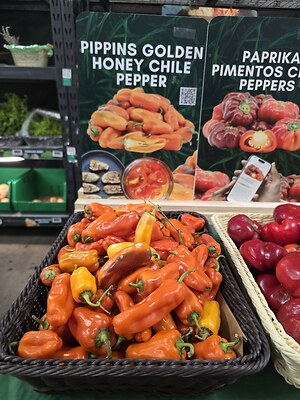
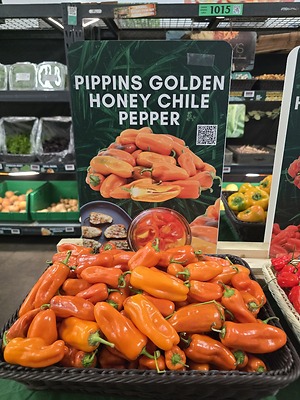
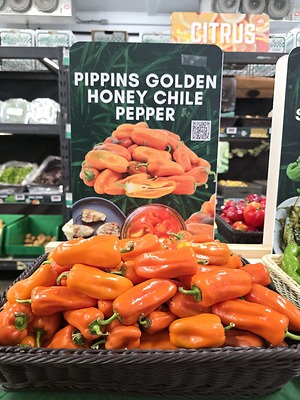
Pippin’s Golden Honey peppers vary in size depending on growing conditions and maturity at harvest, typically measuring 7 to 13 centimeters in length when ripe. The elongated, cylindrical-to-conical peppers taper to a blunt point at the non-stem end and feature slight indentations across their surface. The pods average 40 to 80 grams and are capped by a slender, fibrous green stem. Pippin’s Golden Honey peppers are known for their multi-colored nature, often appearing on plants in various maturity stages. The pods transition from dark purple to yellow to dark orange hues and have a taut, smooth, and glossy exterior. The flesh is thin and also changes color from bright green when unripe to orange when ripe, and is aqueous with a crisp, succulent consistency. The pods contain a hollow cavity filled with pale membranes and a few tiny, flat, round, cream-colored seeds. Pippin’s Golden Honey peppers are edible raw and have a mild, sweet, and subtly fruity flavor once ripe. The peppers are notably free of heat and are valued as sweet peppers.
Seasons/Availability
Pippin’s Golden Honey peppers are typically available in the mid to late summer through fall.
Current Facts
Pippin’s Golden Honey peppers, botanically classified as Capsicum annuum, are a rare variety in the Solanaceae, or nightshade, family. The multi-colored pods hang like jeweled pendants on upright, bushy plants reaching up to 1.2 meters in height, and the variety is a mid-early to mid-season pepper prized for its lack of heat and sweet taste. Pippin’s Golden Honey peppers mature 75 to 90 days after transplanting and are an heirloom variety entwined into the American history of World War I, folk artist Horace Pippin, and seed cultivation in the early to mid-20th century. Seed savers and growers often comment that Pippin’s Golden Honey peppers carry flavor and memories, and the plants are primarily grown in home and specialty gardens as an ornamental and culinary ingredient. Chefs and pepper enthusiasts seek Pippin’s Golden Honey peppers for their versatility, which is utilized in a wide array of fresh and cooked culinary preparations.
Nutritional Value
Pippin’s Golden Honey peppers have not been studied for their nutritional properties. Sweet peppers, in general, are a source of fiber that aids digestion and contain vitamins A, B, C, and E, which contribute to energy production, help maintain healthy organs, protect cells against free radical damage, and strengthen the immune system. Sweet peppers also provide varying amounts of minerals, including calcium, potassium, zinc, iron, phosphorus, manganese, and magnesium. These minerals help the body control nerve functions, balance fluid levels, produce the protein hemoglobin for oxygen transport through the bloodstream, and support bone and tooth development.
Applications
Pippin’s Golden Honey peppers have a mild, sweet taste suited for fresh and cooked culinary preparations. The variety is enjoyed out of hand as a snacking pepper and is primarily eaten in its ripe, orange stage. Pippin’s Golden Honey peppers can be consumed at any maturity and largely depend on preference, but the orange varieties will be the sweetest. The peppers can be sliced and tossed into salads, added to salsa, slaws, and spreads as a sweet, crunchy addition, or blended into sauces. They can also be served on charcuterie boards, diced as a fresh topping over tacos and grains, or served with creamy dips. Beyond fresh preparations, Pippin’s Golden Honey peppers are ideal for stuffing and can be filled with rice, minced meat, and cheeses. The variety can be used in any recipe that calls for sweet peppers and develops a savory-sweet flavor when roasted. Try pan-frying Pippin’s Golden Honey peppers or adding them to stir-fries. The variety can also be pickled or preserved for extended use. Pippin’s Golden Honey peppers pair well with herbs like cilantro, parsley, and rosemary, meats like poultry, beef, and pork, and spices such as paprika, cumin, garlic, and onion powder. Fresh peppers should be immediately eaten for the best quality and flavor, and can be stored for a few days in a ventilated container in the refrigerator’s crisper drawer.
Ethnic/Cultural Info
Pippin’s Golden Honey peppers are named after their coloring, sweet taste, and Horace Pippin, a 20th-century African American folk artist. Horace Pippin is known as one of the first African American painters to depict social injustices and wartime scenes in his art, drawing on experiences from his lifetime. Pippin notably had to deal with a lifelong injury he sustained during World War I. In 1917, when Pippin was 29 years old, he enlisted in the 15th Regiment of the New York National Guard, also known as the Army’s 369th Infantry Regiment, which was assigned to the 16th Division of the French army during World War I. Pippin’s regiment spent 191 days in the front-line trenches in France and was the first Allied unit on the Western Front to reach the Rhine River. Their regiment was nicknamed the Harlem Hellfighters for their courage and fearlessness, but in 1918, during the war, Pippin was shot in the right shoulder by a German sniper. The bullet shattered his shoulder, and a steel plate was eventually inserted to keep his right arm connected to his shoulder, leaving his arm permanently damaged. After the war, Pippin used art as a practice for mental and physical rehabilitation, beginning to paint in oil and to use a hot-poker technique called pyrography. His work attracted the attention of several figures in the art world, and his first solo exhibition was held in 1937. Pippin later gained national recognition for his work and remains a prominent figure of the 20th century. In addition to his life as an artist, Pippin was an avid gardener and seed keeper, a practice that later led to the development of Pippin’s Golden Honey peppers.
Geography/History
Pippin’s Golden Honey peppers are native to the United States and have origins in the mid-20th century. The variety’s history may extend much further back than is commonly told, but the only known information about the peppers is tied to the garden of Horace Pippin. It is said that Pippin grew these colorful peppers in his home garden and often acquired the seeds for his plantings from the surrounding community of African-American food entrepreneurs in the Philadelphia area in the early 20th century. After his arm injury in World War I, Pippin gave seeds to Homer Ralph Weaver, an accountant and gardener in West Chester, Pennsylvania, in exchange for bees to perform sting therapy for pain relief. Weaver was known for collecting and preserving rare heirloom seeds, especially during the Great Depression, to help feed his family, and for keeping bees to pollinate his garden. Pippin’s pepper seeds were saved alongside other cultivars in Weaver’s collection, and many years later, Weaver’s grandson, Dr. William Woys Weaver, rediscovered Pippin’s seeds stored in baby food jars in a deep freezer belonging to his grandfather. Dr. William Weaver established the Roughwood Seed Collection through his grandfather's seed-saving efforts, and the educational nonprofit, which is also the oldest seed collection in Pennsylvania, remains active today, with over 5,000 varieties. Dr. William Weaver shared Pippin’s Golden Honey pepper seeds with seed networks, growers, and preservation collections to increase cultivation of the variety to preserve its presence in gardens. Today, Pippin’s Golden Honey peppers are offered through seed catalogs in the United States and are planted in small quantities through specialty growers. The rare variety is seasonally found fresh through farmers’ markets and select distributors.

Pippin's Golden Honey Pepper for sale around the world shared on the Specialty Produce App


Check out our QR code Library to download QR Codes that link to our fruit encyclopedia.
Use on your signage and other promotions to share the knowledge!
Use on your signage and other promotions to share the knowledge!



