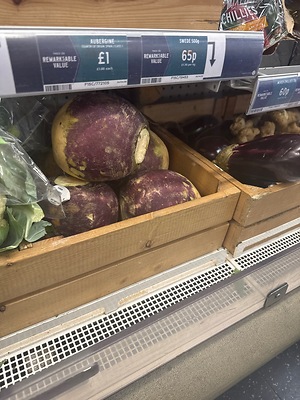
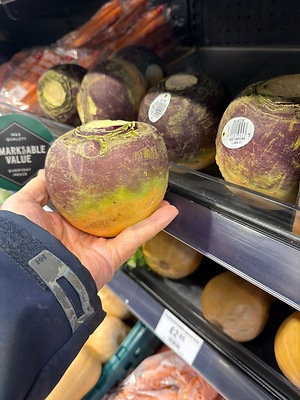
Swede
Estimated Inventory, lb : 0

Description/Taste
Swede varies in size and shape, depending on growing conditions, maturity at harvest, and the specific variety. Some types can grow to very large sizes, but it is recommended to purchase roots with a diameter of 7 to 12 centimeters and around 1 kilogram in weight. Larger roots may develop a tough, dry, and woody consistency. The roots have a bulbous, round to oblong, swollen shape with curved edges and a thick, bitter skin that must be removed before consumption. The skin is taut and firm, with a rough, textured surface, and some roots may have a few bumps, raised scarring, and cracks. Swede ranges in color, showcasing yellow-brown, purple, green, and brown hues. The shoulders are often colored, and underneath the skin, the flesh is yellow to ivory. The flesh is solid, dense, aqueous, starchy, and crisp when raw, becoming soft and tender once cooked. Swede generally holds its shape when heated, but if overcooked, it can fall apart. The roots should appear fresh, without blemishes, and feel heavy for their size, indicating they have not dried out. Swede is edible raw or cooked and has a zesty, earthy, slightly bitter-sweet, and mildly spicy taste when raw and is known to be milder than turnips. Cooked flesh develops a mellow, savory, slightly nutty, and sweet taste.
Seasons/Availability
Swede is typically harvested in the fall through winter, and has extended storage properties, allowing it to be sold in markets through the spring. Some regions may be able to grow the species year-round, and other regions may have a constant supply, as it is grown in both hemispheres and exported into areas where it is out of season
Current Facts
Swede, botanically classified as Brassica napus var. napobrassica, is an heirloom species cultivated for culinary use, belonging to the Brassicaceae family. The swollen, bulbous root is also known as Rutabaga, Swedish turnip, Russian turnip, and Yellow turnip in the United States; Neep and Baigie in Scotland; Kålrot and Botabagge in Sweden; and Erfinen, Rwden, and Meipen in Wales. The name Swede is primarily used in New Zealand, Australia, and the United Kingdom. It is important to note that though Swede is often referred to as a turnip, it is botanically not the same as true turnips, which belong to Brassica rapa var. rapa species. Both species are members of the Brassicaceae family and are used similarly in culinary preparations, but their flavor varies, with Swede being mellower and sweeter once cooked. There are three main types of Swede available in commercial markets: purple, bronze, and green. The purple-rooted varieties are the most commercially available and can produce the largest crops. Swede is commonly hand-harvested and promoted as a traditional culinary ingredient that can be served raw or cooked. While it is less known than potatoes in modern markets, chefs and home cooks seek out Swede for its distinct flavor and ability to be incorporated in a wide array of sweet or savory dishes.
Nutritional Value
Swede is a source of fiber to aid digestion and contains vitamins B, C, E, and K, which contribute to energy production, assist in faster wound healing, guard cells against free radical damage, and strengthen the immune system. Swede also provides varying amounts of minerals, including manganese, potassium, magnesium, calcium, iron, zinc, and phosphorus. These minerals help the body support bone and tooth development, balance fluid levels, build red blood cells, control nerve functions, and produce the protein hemoglobin for oxygen transport through the bloodstream. Throughout history, Swede has been used as a natural diuretic and was valued for its vitamin C content on long voyages to prevent scurvy.
Applications
Swede has a versatile nature, making it suitable for raw or cooked use. When raw, the roots have a slightly peppery, sweet, zesty, and earthy flavor and add a crunchy texture to plates. Swede must be washed and peeled before use, removing its tough outer skin. Once peeled, it can be sliced into sticks and served as a crisp snack with creamy dips and citrusy dressings. Swede can also be added to salads, tossed into grain bowls, or grated and mixed into coleslaw. Try using Swede as an alternative topping to radishes over tacos and avocado toast. In addition to fresh preparations, Swede is commonly steamed, boiled, roasted, stir-fried, and mashed. The roots are utilized throughout Europe in gratins, casseroles, and savory pies, or cooked into stews, soups, and curries. They are also cooked into pasties and roasts, cut into elongated pieces and fried into chips, or heated in a tagine with ingredients like lamb and apricot to balance flavors. Some chefs layer Swede into spinach loaves and other baked goods. In the United Kingdom, Swede is often mashed with carrots and served with Sunday roasts, simmered in a fresh vegetable-based soup called hotch potch, or mashed with various vegetables as a side dish. Swede can be used in any preparation calling for turnips. The roots develop a soft texture and mellower flavor when cooked and can sometimes be used as an alternative to potatoes. Swede can also be found in Asian fusion dishes, including saag, laksa, noodles, fritters, and curries. Swede pairs well with herbs like thyme, rosemary, parsley, dill, and sage, as well as flavorings like maple syrup, honey, garlic, and chilies, and spices such as nutmeg, paprika, and cumin. Whole, unopened Swede will keep for several weeks when stored in a cool, dry, and dark location, such as a cellar. The roots are also wrapped in damp paper towels and placed in a sealed container in the refrigerator’s crisper drawer for 7 to 10 days. In addition, Swede can be sliced, blanched into thin strips, and frozen for extended use.
Ethnic/Cultural Info
Swede is traditionally incorporated as a staple ingredient in meals prepared during Burns Night in Scotland. Burns Night is annually celebrated on January 25th, marking the birthday of Robert Burns, Scotland’s National Bard, or poet. Burns is one of Scotland's most famous poets, revered for his ability to capture and offer insight into the common emotions of the working class. Many of his poems remain relatable today and offer readers hope for a better future. The origins of Burns Night date back to 1801, when friends of Burns held the first Burns Night Supper on his birthday, five years after he died in 1796. The event slowly gained traction each year with multiple families hosting dinners, and it eventually became a nationally observed holiday. During Burns Night, haggis is the central dish, and it is also the national dish of Scotland. Burns wrote a poem dedicated to haggis in 1786, and at the time, haggis was a luxury, celebratory dish reserved for special events. When the haggis is served on Burns Night, the host recites Burn’s “Address to a Haggis” and slices it open during the reading as a dramatic addition. Other dishes, notably tatties and neeps, are customarily served with haggis. Tatties and neeps are a dish of mashed potatoes and Swede, as neep is the Scottish word for Swede.
Geography/History
Swede is native to Europe and is thought to have origins in areas of Scandinavia and possibly parts of Russia. The species has been growing wild since ancient times and is thought to be a cross between a turnip and a cabbage. The first known written reference to Swede is from the Swiss botanist Gaspard Bauhin in 1620. In his record, he noted the root was growing wild in Sweden. Swede is thought to have been trialed as a possible food source in selective cultivation sometime at the end of the Middle Ages. Over time, it was bred for improved size, flavor, and use, and spread across Europe, arriving in England and Scotland around the 17th or 18th century. Swede was later introduced to North America in the early 19th century and was consumed as a famine food during the World Wars. The species has experienced periods of popularity and obscurity throughout history and has become a lesser-known heirloom crop. Today, Swede is grown worldwide in commercial and home gardens and is sold as an everyday culinary ingredient. Its presence in markets will be more prominent in some communities than others, especially in Europe, and is primarily displayed through local vendors, retailers, and wholesalers.
Recipe Ideas
Recipes that include Swede. One
 is easiest, three is harder.
| Little Sunny Kitchen |
|
Roasted Swede |
| Lowly Food |
|
Swede and Lentil Jungle Curry |

Swede for sale around the world shared on the Specialty Produce App