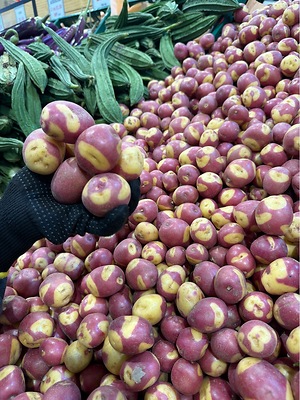


Miss Blush Potatoes
Estimated Inventory, lb : 0

Description/Taste
Miss Blush potatoes are a small to medium-sized variety and have a round, oval, or oblong appearance with bluntly curved ends. The tuber's skin is thin, taut, firm, and semi-smooth, covered in medium-set eyes with some brown dots and markings. The skin has a golden yellow base coloring and is covered in patches of muted red blush. Most of the eyes within the tuber are surrounded by the golden yellow base, while other parts of the skin are flushed with red. Underneath the surface, the yellow flesh is hard and slippery when raw, becoming soft, tender, and creamy once cooked. Miss Blush potatoes are a waxy potato, meaning the flesh has high moisture and low starch content. This makes the tubers hold their shape well with heat and have a denser consistency. The tubers can be cooked with the skin on and have a mild, earthy, and subtly nutty taste.
Seasons/Availability
Miss Blush potatoes are harvested in mid-summer through fall and can be stored for extended periods. This allows the tubers to be sold in commercial markets through the winter.
Current Facts
Miss Blush potatoes, botanically classified as Solanum tuberosum, are a European variety belonging to the Solanaceae or nightshade family. The bi-colored tubers are a mid-early, also known as a second early variety, meaning they fill the gap between early and maincrop potatoes. Miss Blush potatoes are typically ready for harvest 90 to 130 days after sowing and can be harvested as baby or full-grown tubers. The tubers are valued for their smaller size, allowing them to be cooked whole, and are favored by chefs for their distinctly colored skin, adding visual appeal to dishes. Miss Blush potatoes are a versatile table variety sold throughout Europe for use in savory cooked preparations.
Nutritional Value
Miss Blush potatoes have not been studied for their nutritional properties. Potatoes, in general, are a source of fiber to aid digestion and vitamins B, C, and K to assist in faster wound healing, contribute to energy production, and strengthen the immune system. Potatoes also provide minerals in varying amounts, such as calcium, iron, potassium, copper, magnesium, manganese, and phosphorus. These minerals help the body produce proteins for oxygen transport through the bloodstream, control daily nerve functions, build red blood cells, balance fluid levels, and support bone and teeth health.
Applications
Miss Blush potatoes have a mild, neutral, and earthy taste suited for cooked preparations. The variety’s smaller size allows it to be cooked whole, but larger tubers can be sliced in half for even cooking times. Miss Blush potatoes hold their shape well when cooked and are popularly used for salads. The tubers are also incorporated into soups, stews, curries, and chilis or steamed as a simple side dish. Miss Blush potatoes are sold as an everyday culinary variety throughout Europe and can add texture and mild flavor to dishes. They are customarily boiled, stewed, roasted, fried, or steamed. The tubes can be roasted whole or cooked and smashed for a crispy bite, or sliced and layered into gratins and casseroles. Try adding Miss Blush potatoes with other varieties into variations of shepherd’s pie, pot roasts, or fry mashed tubers into croquettes for a crisp exterior. Miss Blush potatoes pair well with herbs such as cilantro, chives, rosemary, and dill, meats including beef, pork, and poultry, and spices like paprika, turmeric, cumin, and cayenne. Whole, unwashed tubers will keep for a few days to weeks when stored in a cool, dry, and dark location. Once cooked, potatoes can be stored in sealed containers in the fridge for a few days.
Ethnic/Cultural Info
Miss Blush potatoes were named for their bi-colored skin tone. The variety’s base coloring is golden yellow, and the surface is “blushed” with patches of muted red hues. These red-pink tones are generally developed from anthocyanins, which are pigments naturally found in the flesh. Anthocyanins are present in varying amounts in many types of fruits and vegetables, creating a dynamic red, pink, and purple color gradient. Miss Blush potatoes are celebrated for their distinct appearance, and chefs and home cooks often use them whole in preparations to showcase their coloring.
Geography/History
Miss Blush potatoes were developed in the Netherlands in 1999. The variety was bred by JP Van Loon and was created from a cross between Bildstar potatoes and CD1045-2 in the municipality of Dronten in Central Netherlands. The product of that cross was later used as a female parent and combined with an undesignated selection made from a self-crossing as the male parent to create Miss Blush. The variety was commercially released in the early 21st century and is promoted and sold throughout Europe as a table and seed tuber. Today, Miss Blush potatoes are found through select retailers, wholesalers, and growers in Europe.

Miss Blush Potatoes for sale around the world shared on the Specialty Produce App