



Red Bok Choy
Estimated Inventory, bunch : 0

Description/Taste
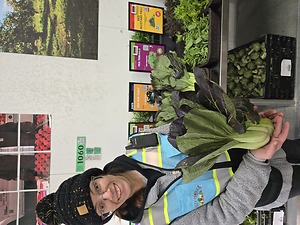
Red Bok Choy varies in size and appearance depending on the specific variety. Each type can be harvested in its tiny microgreen stage, during its baby stage, or at maturity, when the leaves and stems reach 25 to 45 centimeters in length. Red Bok Choy is comprised of overlapping, clustered stems connected to a central base and bears oval, spoon-shaped leaves. The stems, also known as petioles, are thick, firm, and slightly curved, showcasing a pale green to dark green hue. The leaves are deeply veined, giving the surface a slightly crinkled, textured look, ranging in color from green, red, purple-red, to dark purple. Some varieties may only have their purple-red coloring on the tops of the leaves, while other types will be entirely pigmented. The leaves also have a broad, flat, and pliable texture with a soft, crisp, and tender consistency reminiscent of a water chestnut or celery. Red Bok Choy is edible raw or cooked, depending on its age at harvest. Younger types have a milder, subtly sweet, and tangy green taste. More mature greens will become earthy, mineral-forward, and peppery like mustard greens.
Seasons/Availability
Red Bok Choy is available year-round, with peak seasons in the early spring and fall.
Current Facts
Red Bok Choy, botanically classified as Brassica rapa var. chinensis, is a category of pigmented varieties belonging to the Brassicaceae family. Bok Choy is a general term for non-heading types of Chinese cabbage grown worldwide for culinary use. Many varieties of Bok Choy are found in varying sizes and colors, and Red Bok Choy encompasses cultivars with red-purple accents on the leaves. Common varieties of Red Bok Choy include Red Inferno, Rosie, Shikibu, and Purple Lady. Red Bok Choy is less prevalent in retail markets than green types of Bok Choy, but the colored varieties can be interchangeably used in recipes. Red Bok Choy can also be used at multiple stages of maturity. In Asia, Bok Choy is the Cantonese name, while in Mandarin it is called Bai Cai. Bok Choy is also known by other names, including Chingensai in Japanese, Cai Be and Cai Chip in Vietnamese, Phak Gwangtung in Thai, Pechay in Filipino, and Cheonggyeongchae in Korean. In English-speaking countries, Red Bok Choy is called Red Choy, Red Choi, Red Pak Choi, Red Pak Choy, and Red Spoon Cabbage. Red Bok Choy types are primarily grown in home gardens or through specialty growers worldwide. The herbaceous, leafy-stemmed plants are favored for their unique coloring and stronger flavor than green types and are versatile, used in a wide array of raw or cooked culinary preparations.
Nutritional Value
Red Bok Choy has not been extensively studied for its nutritional properties. Most research collectively studies Bok Choy, which generally encompasses many green and red varieties that vary in vitamin and mineral content. Bok Choy is a source of fiber to aid digestion and vitamins A, B, C, E, and K to promote energy production, maintain healthy organs, strengthen the immune system, and guard the cells against free radical damage. The greens also provide minerals like phosphorus, calcium, iron, potassium, magnesium, copper, and manganese. These minerals help the body produce red blood cells, balance fluid levels, control daily nerve functions, and support bone and teeth health. Red Bok Choy types contain anthocyanins, which are organic compounds with antioxidant properties to reduce inflammation and protect overall bodily health. In Traditional Chinese Medicine, Bok Choy is a cooling ingredient believed to help balance energy, or qi, in bodily organs. It is also used to detox the body and clear excess heat.
Applications
Red Bok Choy has a green, slightly peppery, and mineral-forward taste suited for raw and cooked culinary preparations. The leaves must be washed before use, as dirt can be trapped between the tightly overlapping stems at the base. Once cleaned, the leaves can be used at varying stages of maturity, from micro to full-grown, and younger greens have a more tender consistency favored for salads. Smaller Red Bok Choy leaves can also be used as a vessel for dips and spreads on appetizer platters or added to grain bowls and slaws. Mature, larger Red Bok Choy leaves are primarily cooked to develop a softer consistency and mellow their stronger flavor. It is important to note that the deep red-purple color will fade with cooking and will transform into a dark green. Red Bok choy can be lightly braised and served as a side dish or simmered in soups, curries, and stews. The leaves are typically separated from the stems as they bear different cooking times. Worldwide, Red Bok Choy is finely chopped into dumplings, added to rice and noodle dishes, or stir-fried with flavorings like soy sauce, sesame oil, and oyster sauce. Bok choy is also a traditional ingredient during Lunar New Year celebrations. The Chinese pronunciation of Bok Choy sounds similar to the phrase “one hundred fortunes.” This homophone has made Bok Choy a symbol for prosperity, longevity, and health, nicknamed the vegetable of “100 kinds of fortune and wealth.” Red Bok Choy is occasionally used in these dishes, as red is also a lucky color for New Year celebrations. Red Bok Choy pairs well with tofu, seafood, meats like pork, poultry, duck, and beef, and aromatics including ginger, garlic, and scallions. Whole, unwashed Red Bok Choy will keep for 3 to 5 days when wrapped in a damp towel and stored in the crisper drawer of the refrigerator.
Ethnic/Cultural Info
In China, Bok Choy is traditionally dried in the sun and stored for extended use during the winter season. Each leaf is separated, blanched, and hung to dry until it obtains a delicate, brittle consistency. Dried Bok Choy leaves are called cai gan in Chinese and have been used for hundreds of years as a sustainable method to consume greens during harsh winters. When stored properly, the dried leaves can last for over six months and develop a concentrated, salty, and sweet taste. The dried leaves are rehydrated in water for several hours, washed before use, and predominantly used in dumplings, stews, and soups. Choi gon tong, a well-known soup from the Canton region of China, utilizes dried Bok Choy along with pork bones, honey dates, carrots, and dried scallops to make a savory meal. This soup is also believed to help reduce coughs and mucus by rehydrating the airways and lungs.
Geography/History
Bok Choy is native to China, with possible origins within the Yangtze River Valley. Much of the early history is unknown, but Bok Choy is thought to be a descendant of an ancient Brassica species that was selectively bred for improved traits, creating many different types of Chinese cabbage. Bok Choy was widely cultivated in China by the 5th century, and over time, it spread to other countries in Asia, including Korea in the 14th century and Southeast Asia, in general, around the 16th century. Bok Choy was also planted in Japan in the late 19th and 20th centuries. It is unknown when Red Bok Choy varieties were developed, but the pigmented cultivars were created through natural breeding and are sold as specialty Bok Choy types. Bok Choy was also introduced to the United States in the 19th century, with Chinese immigrants settling in California during the Gold Rush. After the plant’s introduction, growers and seed breeding companies in the United States created new Bok Choy varieties for diversity and improved traits in the 20th and 21st centuries. Today, Red Bok Choy is grown worldwide and is primarily a home garden plant. Some varieties may also be sold through select growers at farmers' markets and wholesalers.
Recipe Ideas
Recipes that include Red Bok Choy. One
 is easiest, three is harder.

Red Bok Choy for sale around the world shared on the Specialty Produce App


Check out our QR code Library to download QR Codes that link to our fruit encyclopedia.
Use on your signage and other promotions to share the knowledge!
Use on your signage and other promotions to share the knowledge!



