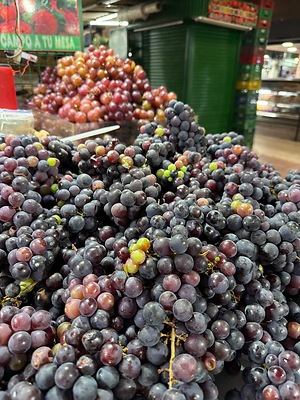


Isabella Grapes
Estimated Inventory, lb : 0

Description/Taste
Isabella grapes grow in loose, medium to large cascading bunches attached to woody, fibrous branching stems. The bunches have a conical to cylindrical shape and are comprised of round to oval berries. Each grape averages 1 to 2 centimeters in diameter, and several sizes of grapes can be found throughout the bunch, maturing at different periods. Isabella grapes have smooth, taut, firm, and thick skin, and the variety is a slip-skin type, meaning the skin can be easily separated from the flesh. The skin exhibits variegated hues of red, purple, and dark purple, almost black. The surface is also covered in a silvery blue-gray bloom, a natural, protective layer that prevents the grapes from losing moisture. Underneath the skin, the flesh has a translucent pale green to yellow-green hue and a gelatinous, aqueous, tender, and succulent nature. The flesh is considered fine-grained and encases several large brown tapered crunchy seeds that release a bitter flavor if consumed. These seeds are typically discarded and not eaten. Isabella grapes have astringent, sour skin combined with sweet, fruity, and musky flesh. The grapes are known for their aromatic nature and possess an intense, rich sweetness with foxy, strawberry-like nuances.
Seasons/Availability
Isabella grapes are available from late summer to fall.
Current Facts
Isabella grapes, botanically a hybrid of Vitis labrusca and Vitis vinifera, are an American variety belonging to the Vitaceae family. The mid to late season grapes grow on vigorous, spreading vines extending 3 to 4 meters in length and are well-known for their distinct sweet flavor. Isabella grapes have origins in the United States and were spread worldwide as a table, wine, and juice grape. The variety has been known under at least fifty other names, including Albany Surprise, Fragolina, Strawberry, Uva Fragola, Seksarda, and Alexander. Growers favor Isabella grapes for their hardiness, tolerance to heat and humidity, and high yields. The loose grape bunches are harvested by hand and sold in markets as fresh eating grapes or processed into beverages. Isabella grapes are a specialty cultivar promoted as a delicacy in markets worldwide, valued for their robust flavor, pigmented nature, strong aroma, and versatility in sweet and savory culinary preparations.
Nutritional Value
Isabella grapes are a source of fiber to regulate the digestive tract and contain vitamins A, B, C, E, and K. These vitamins maintain healthy organs, strengthen the immune system, guard cells against free radical damage, contribute to energy production, and aid in faster wound healing. Isabella grapes also provide minerals in varying amounts, including calcium, copper, iron, magnesium, manganese, phosphorus, and potassium. These minerals help the body support bone and tooth development, build red blood cells, produce proteins for oxygen transport through the bloodstream, control nerve functions, and balance fluid levels. The fruit’s pigmented appearance indicates the presence of anthocyanins, natural compounds with antioxidant properties to reduce inflammation and protect overall bodily health.
Applications
Isabella grapes have a sweet, fruity flavor suited for fresh and cooked preparations. The variety is traditionally consumed as a table grape and is eaten out of hand as a refreshing snack. Isabella grapes are also halved and tossed into salads, served in bunches on cheese boards and fruit platters, layered into parfaits, or mixed into grain bowls and rice dishes. The fruits are sometimes sliced and added to creamy dips and spreads, or blended and frozen into homemade sorbet, ice cream, or granita. Try using Isabella grapes as a decorative garnish on cakes, tarts, and other desserts. In addition to fresh preparations, Isabella grapes are sometimes simmered into syrups, jellies, jams, and sauces or made into various compotes with other fruits. They are also cooked into chutney or roasted as a savory-sweet side to meat main dishes. Isabella grapes can be used in any recipe calling for red or black grapes. They can also be used to flavor baked goods. Isabella grapes pair well with herbs like basil, rosemary, and sage, cheeses like goat, parmesan, mozzarella, and brie, and meats like poultry, veal, duck, and pork. Unwashed Isabella grapes will keep for a week or two when stored in a perforated plastic bag in the refrigerator.
Ethnic/Cultural Info
Isabella grapes developed a challenging reputation in Europe due to their ability to carry phylloxera, a microscopic insect that destroyed most of the European grapevines, Vitis vinifera, in the 19th century. Isabella grapes belong to the Vitis labrusca species, which are American varieties and are naturally resistant to phylloxera. When Vitis labrusca was introduced to Europe in the early 19th century, phylloxera infected Vitis vinifera vines, decimating Europe’s wine-producing regions. Many European vineyards had to be replanted using American phylloxera-resistant rootstocks, leading European growers to be frustrated with Vitis labrusca varieties. American varieties, including Isabella grapes, were also banned in Europe in the 1970s by the European Commission to prevent the spread of phylloxera and to protect the quality of the wines being produced. Despite this ban, Iseballa grapes are still used in some home gardens in Europe and in winemaking regions of the United States. Wines made from Isabella grapes have a fruity and floral flavor. One of the most famous wines made from Isabella grapes is Fragolino, a refreshing, light wine that pairs well with meals. Fragolino roughly translates from Italian to mean “little strawberry,” a name derived from the Isabella grape’s other famous moniker, Strawberry grape.
Geography/History
Isabella grapes are native to the United States and were first documented during the early 19th century. Much of the variety’s origins are unknown. Most sources claim that Isabella grapes originated in one of the Carolinas, possibly South Carolina, and were cultivated in home gardens. In 1816, nurseryman William Prince of Flushing, Long Island, encountered the variety through Mrs. Isabella Gibbs, the wife of George Gibbs, a merchant in Brooklyn, New York. Mr. Prince asked Mrs. Gibbs where the variety came from, and she hypothesized that it came from Dorchester, South Carolina. Mr. Prince named the variety Isabella after Mrs. Gibbs and began selling it in his nursery around 1819. Isabella grapes later became a commercially successful grape in New York State, as they could be grown in areas with shorter seasons and were also used in winemaking. They were also introduced to Europe in the 1830s. In 1852, Isabella grapes were officially featured in the American Pomological Society fruit catalog as a commercial and home garden grape. The variety eventually fell out of favor with the rise of Concord grapes and was replaced in orchards. Throughout their history, the parentage of the variety was unknown; however, modern genetic studies have led scientists to believe that Isabella grapes were created from a cross between a Vitis vinifera cultivar, Meslier Petit, and a Vitis labrusca variety known as Ives Madeira Seedling. Today, Isabella grapes have expanded their cultivation beyond the United States and Europe and are now grown in tropical and subtropical regions worldwide, notably in southern Brazil. The variety is also cultivated on a small scale in Asia, Australia, New Zealand, and South America. When in season, Isabella grapes are sold fresh through farmers’ markets, directly through growers, and select retailers.
Recipe Ideas
Recipes that include Isabella Grapes. One
 is easiest, three is harder.
| Tortellini & Co |
|
Red Isabella Grape Jam |
| What's On Our Plates Tonight |
|
Isabella Grape and Kefir Ice Cream |

Isabella Grapes for sale around the world shared on the Specialty Produce App