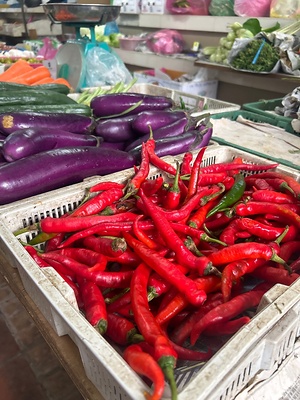


Red Spur Chile Peppers
Estimated Inventory, lb : 0

Description/Taste
Red Spur chiles vary in size, depending on maturity at harvest and growing conditions, but are typically conical, slender, and tapered pods averaging 5 to 15 centimeters in length. The pods can be straight or curved and end in a distinct point. On the plants, Red Spur chile peppers tend to point upward toward the sky. The pods have semi-thin, smooth, glossy, and taut skin, ripening from green to bright red hues. Spur chiles can be harvested in their green or red stage, and the surface may sometimes bear faint ridging. Underneath the exterior, the green to pale red flesh, varying with maturity, is thin, crisp, and aqueous with a succulent consistency. The flesh also encases a central cavity filled with round and flat, cream-colored seeds attached to membranes. Red Spur chile peppers are edible raw and are known for their mild to moderate spice, experiencing an immediate heat on the palate that quickly subsides. The variety also has a subtly sweet and earthy taste.
Seasons/Availability
Red Spur chile peppers are available year-round.
Current Facts
Red Spur chile peppers, botanically classified as Capsicum annuum, are an Asian culinary pepper belonging to the Solanaceae or nightshade family. The variety is prized for its moderate heat, ranging from 5,000 to 30,000 SHU on the Scoville scale, which is much lower than many of the other chile peppers sold in Asian markets. Red Spur chile peppers are considered an everyday culinary type, and the pods can be harvested in their immature, green state or mature, red stage. The variety is famous in Thailand and is widely found throughout fresh markets. It has also expanded in cultivation throughout Southeast Asia and is sold for culinary use in other countries, including but not limited to Laos, Malaysia, and Indonesia. In Thailand, Red Spur chile peppers are called Prik Chee Fah, which translates to “chiles pointing to the sky,” a descriptor of how the pods point up on the plant during cultivation. The variety is also known under names like Spur chile, Mild Red Thai chile, and general names like Cabai Merah in Indonesian and Cili Merah and Cili Kulai in Malay. Red Spur chile peppers are sought by chefs and home cooks for their versatility and are used to flavor sauces, or they are incorporated into a wide array of sweet and savory culinary preparations.
Nutritional Value
Red Spur chile peppers have not been extensively studied for their nutritional properties. Red chile peppers, in general, are a source of fiber to aid digestion and vitamins A, B, C, E, and K. These vitamins guard the cells against free radical damage, strengthen the immune system, maintain healthy organs, and support faster wound healing. Red chile peppers also provide minerals in varying amounts, including copper, manganese, zinc, phosphorus, iron, potassium, and magnesium. These minerals help the body produce red blood cells, promote bone and teeth development, build proteins for oxygen transport through the bloodstream, and balance fluid levels. The moderate spice is created by the presence of capsaicin, a natural compound within the pods that leads the brain to feel the sensation of heat. Capsaicin has been known to have antioxidant and anti-inflammatory benefits.
Applications
Red Spur chile peppers have a moderate heat and subtly sweet, earthy taste suited for raw and cooked preparations such as frying, sautéing, and roasting. When raw, the peppers can be chopped into sauces, blended into pastes, or sliced and tossed into salads. They are also frequently used as a garnish to add dimension, color, and aesthetic appeal to dishes. The variety is extensively used across Southeast Asia in cooked preparations, including soups, curries, condiments, and salads. In Thailand, Red Spur chile peppers are an everyday ingredient in meat dishes, vegetable stir-fries, stews, and chile sauces. The variety is also added to egg dishes or incorporated into noodle and rice dishes. In Malaysia and Indonesia, Red Spur chile peppers are typically labeled as Thai chile peppers in markets and are used for chile pastes, slow-cooked dishes like rendang, or placed fresh on a side plate as an accompaniment to meals in restaurants. Chile pastes are sometimes eaten with nasi lemak, Malaysia’s national dish, or used to flavor laksa, a popular sweet, spicy, fragrant, and savory soup. The peppers can also be dried, ground into a powder, and added to sauces and dips or used as a seasoning. Red Spur chiles pair well with aromatics like ginger, garlic, galangal, and onions, flavorings like coconut milk and Thai lime leaves, and herbs including basil, cilantro, and mint. Whole, unwashed Red Spur chile peppers will keep for 1 to 2 weeks when stored in a paper or plastic bag in the refrigerator. Dried Red Spur chile peppers will last several months to years when placed in a sealed container.
Ethnic/Cultural Info
Red Spur chile peppers traditionally flavor Thai red curry paste, called nam prik kaeng, just kaeng, or gaeng in Thailand. This curry paste is the foundational flavoring in dishes prepared throughout Thailand and is found in many variations, broadly divided into green, yellow, and red. Preparing curries in Thailand was thought to have been influenced by early Indian merchants and Buddhist missionaries during the 4th century. The traveling groups introduced new spices, herbs, and aromatics like lemongrass, tamarind, and shallots throughout Thailand as new culinary ingredients. By the 13th century, nam prik, a savory, sweet, and spicy paste, was developed, becoming the base flavoring for curry pastes. The Portuguese also introduced Chile peppers in the 16th century, and shrimp paste evolved throughout the 14th to 18th centuries, being added to nam prik to create early curry pastes. Over time, curry paste changed with the region and available ingredients, and Red Spur chile peppers became a favored element in red curry paste for color, flavor, and moderate spice.
Geography/History
Red Spur chile peppers are descendants of peppers native to South and Central America that have been growing wild since ancient times. Early pepper types were spread through animal and human intervention throughout the Americas and were historically used for medicinal and culinary purposes. Later in the 15th and 16th centuries, with the arrival of Portuguese explorers in the New World, peppers were carried on ships from South America to Asia. Chile peppers were thought to have been used as a food source and a method to prevent scurvy on ships due to their vitamin C content. The Portuguese introduced chile peppers to Thailand when they began settling in Ayutthaya, a city known for being an important trade center. After their introduction, chile peppers were planted in Thailand and selectively bred over time to create new varieties. Red Spur chile peppers are Thailand's second most cultivated variety and have also spread throughout Southeast Asia as an everyday culinary pepper with less heat. Red Spur chile peppers are extensively grown in commercial and home gardens. When in season, Red Spur chile peppers are sold through fresh markets, retailers, and wholesalers worldwide. The peppers are also dried and offered through online retailers.
Recipe Ideas
Recipes that include Red Spur Chile Peppers. One
 is easiest, three is harder.
| Eating Thai Food |
|
Authentic Thai Red Curry Paste |

Red Spur Chile Peppers for sale around the world shared on the Specialty Produce App