



20th Century Pears
Estimated Inventory, 22 lbs : 0

Description/Taste
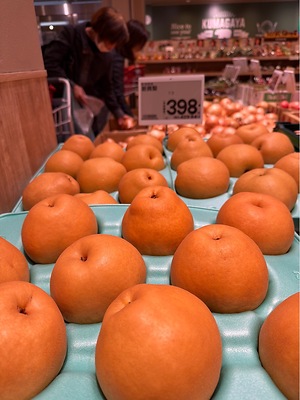
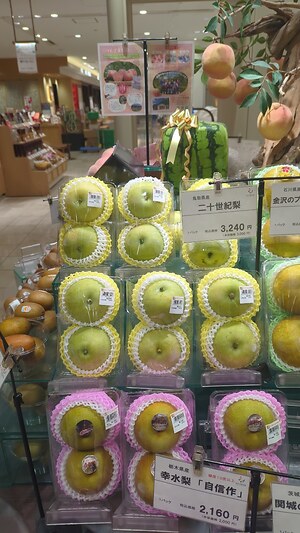
20th Century pears vary in size, depending on growing conditions, and are round to oblate in shape with a uniform, curved appearance. The fruits feature a short, fibrous green-brown stem, and the skin is thin, semi-smooth, taut, and firm, showcasing prominent lenticels which resemble tiny dots across the surface. The skin ripens from green, shades of yellow-green, to golden yellow with maturity. Underneath the surface, the ivory to cream-colored flesh is crisp, dense, and aqueous, with a crunchy, snappy, and chewy consistency. The flesh also encases a central fibrous core filled with tiny black-brow seeds. 20th Century pears are fragrant when ripe and release fruity and floral aromas. The variety is mostly preferred in its yellow-green state. Mature, golden yellow pears will be the sweetest, while yellow-green fruits will have a refreshing, balanced, sweet, and sour flavor. One distinct characteristic of 20th Century pears is their initial flavoring. The pears are said to have vanilla and butterscotch nuances in the flesh closest to the skin, and the flesh beside the core carries a more tart and sour taste.
Seasons/Availability
20th Century pears are available in the late summer through fall in Japan, typically between August and October. Peak season occurs around September.
Current Facts
20th Century pears, botanically classified as Pyrus pyrifolia, are a Japanese variety belonging to the Rosaceae family. The fruits grow on deciduous trees reaching ten meters in height and are one of the most commercially grown pear varieties in Japan. 20th Century pears are also known as Nijisseiki pears and Shin Daikhaku pears, and if the fruits are grown without bags, they are sold under the name Sanseki. The variety is prized for its high moisture content, balanced sweet and sour taste, and crisp flesh. 20th Century pears are a labor-intensive variety that must be cultivated and bagged by hand to protect the fruits against black spot disease. During the growing season, the pears are bagged at two different stages to ensure that disease and insects do not penetrate the skin. This also allows the fruits to be sold internationally as they are free of diseases, pesticides, and insects. 20th Century pear trees produce high yields, and the fruits are a seasonal delicacy consumed fresh or incorporated into a wide array of sweet and savory culinary dishes.
Nutritional Value
20th Century pears have not been studied for their nutritional properties. Asian pears, in general, are a source of fiber to promote digestion and vitamins B, C, E, and K, to contribute to energy production, strengthen the immune system, guard the cells against free radical damage, and aid in faster wound healing. Asian pears also provide minerals like copper, potassium, calcium, magnesium, manganese, and phosphorus. These minerals help the body build red blood cells, balance fluid levels, support bones and teeth, and control daily nerve functions. In some Japanese natural medicines, pears are believed to soothe throats and are cooked into syrups to lessen pain and inflammation.
Applications
20th Century pears have a sweet and subtly sour taste suited for fresh and cooked preparations. The variety can be consumed in its yellow-green or entirely yellow stages, giving them varying flavors and uses. 20th Century pears are eaten out of hand as a snack or sliced and tossed into salads. It is recommended to chill the fruits for 2 to 3 hours before eating to enhance their refreshing nature. 20th Century pears are also served on cheese boards, used as a topping over oatmeal, or shredded into slaws for a crunchy bite. The variety is occasionally incorporated into sandwiches for added texture, frozen into sorbet, or blended into smoothies and other beverages. In addition to raw dishes, 20th Century pears are steamed as a simple dish and sprinkled with salt or honey. They are also baked with spices or warming ingredients like ginger and coconut. Try incorporating 20th Century pears into poached desserts and serving them over ice cream. They can also be added to crisps, baked whole, or sliced and layered into tarts, clafoutis, and galettes. In Japan, 20th Century pears are pureed and used to marinate meat such as beef. They are also cooked into compotes and other preserves. 20th Century pears complement spices such as cinnamon, cardamom, and cloves, flavorings like sesame, soy, rice vinegar, and vanilla, and sweeteners including maple syrup, honey, and brown sugar. Whole, unwashed 20th Century pears will keep for a few days to weeks, depending on maturity, when wrapped in newspaper or paper towels and stored in a bag in the refrigerator’s vegetable drawer.
Ethnic/Cultural Info
The 20th Century pear mother tree was designated a national monument in Japan in 1935. The tree was known for developing high yields of fruit, approximately 1,500 pears, in its peak production around 1918. When it was declared a national monument, the tree had reduced its production to less than 800 fruits per season. In 1944, the mother tree was burned in an air raid during the Pacific War, but survived for a few more years until its passing in 1947. The monument to the pear variety still stands at the site, and a few of the city streets surrounding the landmark were named 20th Century and Pear Town after the cultivar. In the present day, the largest 20th Century pear tree resides in the Tottori Nijisseiki Pear Museum, Japan’s only museum dedicated to Asian pears. The museum opened in April 2001 to commemorate the 100th anniversary of 20th Century pears, and in the center of the museum is a 20-meter-tall pear tree. The 20th Century pear tree is displayed in a glass case and has a root system believed to be over five meters long underground. In 1999, the tree produced over 4,000 pears. The pear museum provides a space for visitors to learn about the commercially important cultivar and the labor involved in making the fruit.
Geography/History
20th Century pears are native to Japan and were discovered growing as a chance seedling in 1888 in Yatsuhashira Village, now known as Matsudo City. The variety’s story begins with a young farm boy named Kakunosuke Matsudo, who was thirteen years old when he noticed a seedling growing in the garbage dump of a neighboring relative. Kakunosuke’s family had recently planted a pear orchard, and the young boy sowed the unknown seedling in the orchard and began to nurture the young tree. It took around ten years for the tree to bear fruit, but when the pears appeared, it was noticed that they were green and yellow, an unusual coloring for pears at the time. Kakunosuke continued to protect the tree and named the fruits Shin Daihaku, meaning New Large White. In 1904, the variety was featured in Konno Zasshi, a well-known Japanese agricultural magazine, and the article highlighted the pear’s sweetness, juicy flesh, and coloring. The magazine’s editor-in-chief, Torajiro Watase, and professor at Tokyo Imperial University, Tomochika Ikeda, later collaborated in rebranding the pears under the name 20th Century. During the same year of the article’s release and rebranding, ten seedlings of the variety were planted in the Tottori Prefecture by a man named Kitawaki Eiji. The variety flourished in the Tottori Prefecture and became widely planted during the Meiji Era, from 1868 to 1912 CE. 20th Century pears were exported internationally for the first time in 1933, and by the late 20th century, they were being shipped to countries in Asia, along with the United States. Today, 20th Century pears are still commercially grown in Japan in the Tottori, Nagano, Chiba, Yamaguchi, and Fukushima Prefectures. The pears are exported internationally and also grown on a small scale through specialty farms and home gardens worldwide. When in season, 20th Century pears are sold through farmers’ markets, select retailers, and wholesalers.
Podcasts

20th Century Pears for sale around the world shared on the Specialty Produce App




Check out our QR code Library to download QR Codes that link to our fruit encyclopedia.
Use on your signage and other promotions to share the knowledge!
Use on your signage and other promotions to share the knowledge!



