



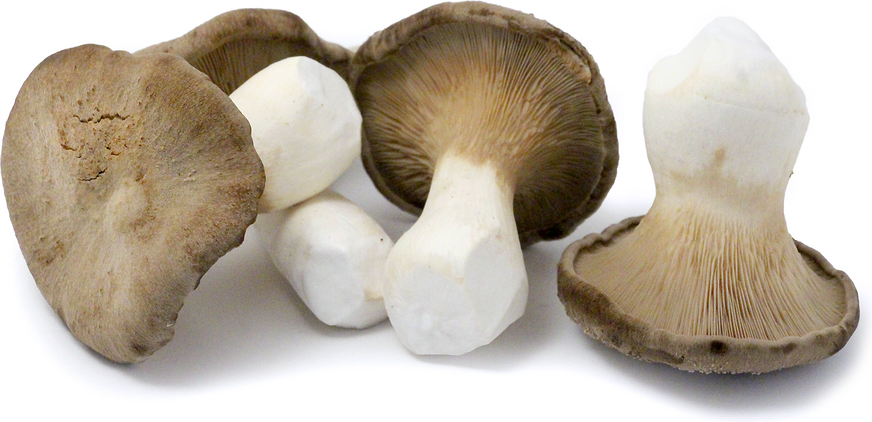


Agitake Mushrooms
Estimated Inventory, lb : 0

Description/Taste
Agitake mushrooms vary in size, color, and shape depending on their maturity at harvest and whether they were foraged in the wild or cultivated. The species comprises a broad cap that connects to an elongated stem. The caps average 4 to 10 centimeters in diameter and 20 to 25 grams when collected from the wild, and 6 to 12 centimeters in diameter and 50 to 150 grams when grown in cultivation. The caps are initially hemispherical, with inward-facing edges. As the mushroom ages, it becomes semi-spherical and lightly flattened. The surface of the caps is smooth, taut, and delicate, showcasing brown-gray, white, and ivory hues. Underneath the caps, long, brown to tan gills cascade down the cap’s underside onto the stem and bear white spores. The stems are long and thick, often longer than the cap’s width, and range from 5 to 15 centimeters in length. The stems are cylindrical, slightly larger at the base, and, when sliced open, have a white, spongy, elastic, soft, and springy feel. Agitake mushrooms do not discolor when sliced and retain a firm, chewy, and tender consistency. The variety is edible once cooked and is known for its rich, earthy, savory flavor with umami nuances.
Seasons/Availability
Agitake mushrooms are harvested from wild populations in the spring, typically between March and June. Some regions may have a season that extends into the summer, generally through September. The variety is also cultivated, providing extended availability in some markets.
Current Facts
Agitake mushrooms, botanically classified as Pleurotus ferulae, are a wild and cultivated species belonging to the family Pleurotaceae. The mushrooms are saprotrophic and grow on the roots and stems of various Ferula species throughout the eastern regions of the Northern Hemisphere. Agitake mushrooms tend to fruit in small clusters or singularly and have been prized throughout history as a foraged culinary mushroom. The species is known for its thick, dense flesh and heartiness, and is sold under several regional names, including Ferula mushrooms, Aweigu, Agi mushrooms, and Asafoetida mushrooms. Though Pleurotus ferulae is found throughout Europe, Asia, and northern Africa, for the purposes of this article, its use in Japan is addressed, as Agitake is the Japanese name for the mushroom. Agitake mushrooms are a seasonal delicacy, now cultivated and foraged in East Asia, and are sought by chefs and home cooks for their aroma, shape, and flavor in savory cooked preparations.
Nutritional Value
Agitake mushrooms have not been extensively studied for their nutritional properties. The mushrooms are said to be a source of fiber to aid digestion and contain vitamins B and D, which contribute to energy production and assist in the absorption of calcium for bone development. Mushrooms also provide minerals in varying amounts, including potassium, zinc, magnesium, phosphorus, and iron. These minerals help the body balance fluid levels, produce the protein hemoglobin for oxygen transport in the bloodstream, regulate nerve operations, and support immune function. Agitake mushrooms are hypothesized to have antioxidant, antimicrobial, and antifungal properties, as well as a high amino acid content that supports tissue repair and growth.
Applications
Agitake mushrooms have a rich, savory flavor suited for cooked preparations. The variety is not eaten raw, and its firm, dense flesh is ideal for frying, sautéing, and grilling. Agitake mushrooms are often marinated in garlic or soy-based sauces for enhanced flavoring and used as a meat substitute in vegetarian dishes. In Japan, Agitake mushrooms are simmered in soups, stews, and curries, added to stir-fries, or pan-fried with aromatics as a simple side. The mushrooms are also added to noodle and rice dishes, sauteed with other vegetables, or minced and combined with various meats. Try slicing, battering, and frying Agitake mushrooms into tempura for a crunchy, springy consistency. Agitake mushrooms are also sometimes used in takikomi gohan, a Japanese dish that incorporates meat or seafood and vegetables in rice. Agitake mushrooms pair well with legumes, aromatics such as garlic, shallots, ginger, and chiles, and vegetables like cabbage, carrots, broccoli, and bok choy. Fresh mushrooms will keep for a few days when stored in a paper bag in the refrigerator.
Ethnic/Cultural Info
Agitake mushrooms are named after their host plants when foraged in the wild. The moniker Agitake is derived from the Japanese words “agi,” a name for a plant species within the genus Ferula, and “take,” meaning “mushroom or fungus.” It is thought that Pleurotus ferulae mushrooms can grow on several species in the genus Ferula across Asia, most notably Ferula communis and Ferula asafoetida. In Japanese, “agi” refers to Ferula asafoetida, a species within the family Apiaceae, that has been used throughout Asia as a medicinal plant. Agitake mushrooms are also known by several commercial names throughout Japan, including Hakureitake, Yukiwaritake, Hakurei-take, Yukirei-take, Sanriku Awabi-take, Agi mushrooms, and Awi mushrooms.
Geography/History
Pleurotus ferulae is native to parts of Europe, Asia, and North Africa and has grown wild since ancient times. The species thrives in dry, arid regions, primarily grasslands, in subtropical climates, and grows up to 1,400 meters in elevation. Pleurotus ferulae is well documented in the Xinjiang Uyghur Autonomous Region of China, and other regions of Central Asia have recognized the species as an ancient food source among nomadic tribes. The species remained wild until scientists began attempting to cultivate mushrooms in the mid-20th century. Agitake mushrooms were successfully cultivated in China by the 1980s and 90s and were later introduced to Japan for commercial production in the early 21st century. The variety is primarily cultivated in the Nagano and Iwate Prefectures and may be grown on a small scale in other prefectures. Today, Agitake mushrooms are a rare variety and are not well-known as a commercial cultivar. The mushrooms are prized as a delicacy and are sold at premium prices in select retail markets. The variety is challenging to cultivate, and there are only a few commercial producers, limiting the mushroom’s availability. The Agitake mushrooms featured in the photograph above were sourced from the Tsukiji Market in Tokyo, Japan.
Recipe Ideas
Recipes that include Agitake Mushrooms. One
 is easiest, three is harder.
| YouTube |
|
White Elf Mushroom Pancake |
Podcast




