This website uses cookies, pixels, and other tracking technologies to personalize content, analyze how our site and apps are used, and create aggregated statistics.
We disclose data about site and app users to third parties so we can target our ads to you on other websites, and those third parties may use that data for their own purposes.
For more information on how we collect, use, and disclose this information, please review our
Privacy Policy.
Continued use of this site means you consent to our Privacy Policy.
Summary generated by our research from the article below.
Description/Taste
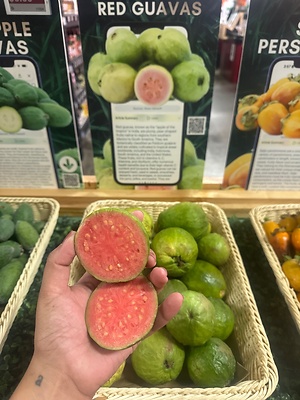
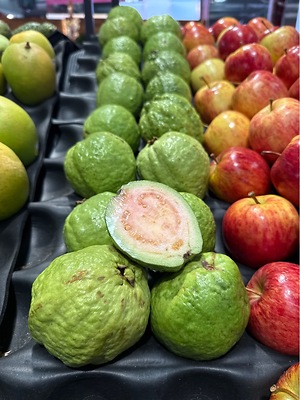
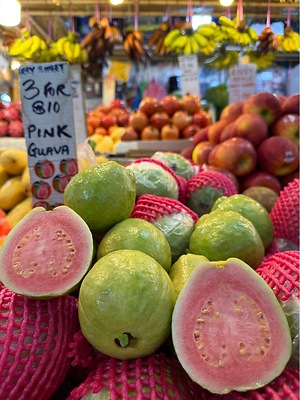
Red guavas are plump and round or pear-shaped measuring 6 to 10 centimeters in diameter. Their smooth skin furrows at the base and matures from dark green to light green and yellow. They are firm with an aromatic, edible skin that softens as the fruit ripens. The flesh ranges from pale rose to a deep pink or red and has a fleshy central cavity with dozens of small, edible seeds. They have a sweet, tropical flavor with a hint of acid.
Seasons/Availability
Red guavas are available year-round in tropical regions.
Current Facts
Red guavas, known as the “apple of the tropics” in India, are botanically classified as Psidium guajava. Commonly referred to as the Apple guava, they are found in various tropical regions around the world, most commonly in India, Indonesia, and South America. There are dozens of varieties of Red guava, some developed in Hawaii and others in India. They are widely grown in a bio-geographical region referred to as “Sundaland,” an area encompassing the Malay Peninsula, Sumatra, Java and Kalimantan (Boreno), where their juice is often prescribed to treat the symptoms of dengue fever.
Nutritional Value
Red guavas are high in vitamins A and C, thiamine, and riboflavin. The rind contains anywhere from 2 to 4 times more vitamin C than a citrus fruit. They also contain other essential B-complex vitamins, magnesium, calcium, phosphorus, and iron. Red guavas are a good source of lycopene and provide antioxidant, immune-boosting and digestive benefits.
Applications
Red guava can be enjoyed raw, cut into pieces or cooked into sweet and savory applications. Wash and cut the fruit into chunks and add to tropical fruit salads or smoothies. Diced, chopped and crushed fruits are used in desserts like trifles and tarts. The fruits are crushed or pureed and strained, the resulting pulp used in cakes, muffins, panna cotta, and ice creams. The juice adds both color and flavor to any dish. It is cooked down and used for glazes for seafood or fish, in marinades or in sauces and reductions. Sugar is added to the puree for use in pastries, cookies, or breads. The high pectin content in Red guavas gives it excellent thickening properties for making pies, jams and pastes. Guava paste is used in pastries and paired with soft cheeses. They are preserved in syrups and canned. Ripen Red guavas at room temperature and refrigerate for up to 3 days. Washed and cut pieces or puree can be frozen for up to 8 months.
Ethnic/Cultural Info
Red guavas are the fifth most commercially important fruits in India, after bananas, mango, citrus and papaya. They are grown for the fresh market as well as for processing into jellies, a sweet paste referred to as “cheese,” and a sweetened guava beverage called “squash.” The Indian Institute of Horticulture Research in Bangalore, located in south-central India, developed two different red-fleshed varieties, the Arka Kiran and Arka Rashmi. Bangalore, known locally as Bengaluru, and the surrounding areas are known as the ‘land of Red guavas’.
Geography/History
Red guavas are native to an area that stretches from southern Mexico to the tropical areas of South America. They are very common in India, Sri Lanka, Malaysia and Indonesia, where they were introduced by Spanish and Portuguese explorers. During the mid-1800s they were brought to Florida in the United States from the Caribbean. Red guavas are widely cultivated in the south-central states of India and to a certain extent in South America, Mexico, California and Hawaii. They are commonly spotted at wet markets in India, Southeast Asia, and the Philippines, and at mercados and farmers markets in South America, Mexico, Hawaii and Southern California.
Specialty Produce
1929 Hancock St, San Diego, CA 92110
(619) 295-3172
Red guavas are known for their sweet, tropical flavor with a slight hint of acidity. These plump fruits are typically 6 to 10 centimeters in diameter and can be round or pear-shaped. As they ripen, their smooth skin transitions from dark green to light green or yellow and becomes softer. Inside, the flesh ranges in color from pale rose to deep pink or red, and it contains a central cavity filled with small, edible seeds.
Marketboys
Victoria St, Melbourne, VIC
+61 413 667 353
Red guava: Red guava can be enjoyed raw or cooked in both sweet and savory dishes. Its high pectin content makes it perfect for making pies, jams, and pastes. The fruit is commonly used in tropical salads, smoothies, desserts, glazes for seafood, and sauces. Guava pairs well with soft cheeses in pastries and can be preserved in syrups or canned. Once ripe, it can be refrigerated for 3 days or frozen as pieces or puree for up to 8 months.
Pasar Modern BSD City
Jl. Letnan Sutopo, Rw. Mekar Jaya, Kec. Serpong, Kota Tangerang Selatan, Banten 15310, Indonesia
Red guavas are native to regions from southern Mexico to tropical South America and were introduced to countries like India, Malaysia, and Indonesia by Spanish and Portuguese explorers. Brought to Florida from the Caribbean in the mid-1800s, they are now widely cultivated in places like India, Mexico, California, and Hawaii. They are commonly found in wet markets and farmers markets across Southeast Asia, the Philippines, and the Americas.
Tekka Centre
Red guavas: These fruits are typically 6 to 10 centimeters in diameter and can be either round or pear-shaped. Their smooth, aromatic skin starts dark green but transitions to light green or yellow as it ripens. Inside, the flesh varies from pale rose to deep pink or red, with a central cavity full of small, edible seeds. Their sweet, tropical flavor is complemented by a subtle acidic undertone, making them a delightful choice for consumption.
Heritage Family Farm
Fallbrook, CA
Red guavas are originally from southern Mexico down to tropical South America. They spread globally via Spanish and Portuguese explorers, becoming a staple in countries like India, Sri Lanka, Malaysia, and Indonesia. In the mid-1800s, they were introduced to Florida from the Caribbean. Today, they're cultivated in places such as India, Mexico, South America, California, and Hawaii, frequently appearing in wet markets, mercados, and farmers markets.
Jambu Merah, also known as red guava, is a tropical fruit known for its sweet flavor with a hint of acidity. The fruit is typically round or pear-shaped and measures 6 to 10 centimeters in diameter. Its smooth skin transitions from dark green to light green or yellow as it ripens, while the flesh ranges from pale rose to deep pink or red, often containing a soft central cavity filled with small, edible seeds. Its aromatic skin is also edible.
Red guavas are incredibly versatile and can be enjoyed raw or cooked in both sweet and savory dishes. Their pulp is used in desserts like trifles, tarts, cakes, and ice creams, while their juice enhances flavor and color in various recipes. The high pectin content makes them ideal for jams and pastes, and they pair well with soft cheeses. Red guavas can be refrigerated for 3 days or frozen as puree or pieces for up to 8 months.
Shin Kong Mitsukoshi Taipei Station Store
100, Taiwan, Taipei City, Zhongzheng District, 忠孝西路一段66號
Red guavas, often called the "apple of the tropics" in India, belong to the botanical classification Psidium guajava. They thrive in tropical regions like India, Indonesia, and South America, with many varieties cultivated in Sundaland, encompassing areas like Sumatra and Java. Rich in vitamins A, C, and B-complex, their rind has up to 4 times more vitamin C than citrus fruits, while lycopene content provides antioxidant, immune-boosting, and digestive benefits.
Red guavas are characterized by their smooth skin that transitions from dark green to yellow as they ripen. They range in size from 6 to 10 centimeters in diameter and have a fragrant, edible skin that softens over time. The flesh inside varies in color, from pale rose to deep pink or red, containing a fleshy central cavity filled with numerous small, edible seeds. Their taste is tropical and sweet with a slight hint of acidity.
Check out our QR code Library to download QR Codes that link to our fruit encyclopedia. Use on your signage and other promotions to share the knowledge!




 is easiest, three is harder.