



Keniker Leaves
Estimated Inventory, lb : 0

Description/Taste
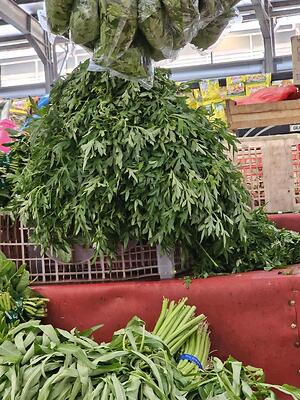
Keniker leaves vary in size, depending on their maturity at harvest, but are generally collected when they are small and young, averaging 5 to 20 centimeters in length. The leaves are comprised of branching segments and have a lanceolate, triangular, or ovate shape, tapering to a pointed tip. Keniker leaves are flat, crisp, chewy, and succulent, appearing in dark green shades. The young leaves are softer, more pliable, and have faint veining across the surface. The pale green to purple-green stems are thick at the base, becoming thinner in between the leaves. Keniker leaves release a distinct aroma when crushed or rubbed. Most consumers consider the scent a mixture of turpentine, pine, citrus, and mango-like nuances. The young leaves are edible raw or cooked and have a fresh, green, grassy flavor with citrusy, peppery, and subtle astringency with a faint taste of green mango.
Seasons/Availability
Keniker leaves are available year-round.
Current Facts
Keniker leaves, botanically classified as Cosmos caudatus, are an herbaceous species belonging to the Asteraceae family. The leaves form on bushy plants reaching 0.5 to 3 meters in height and are traditionally foraged for culinary and medicinal purposes. Keniker leaves have origins in the Americas and were spread over time to regions worldwide. The name Keniker is the moniker most commonly used in Indonesia. The species is also known as Wild Cosmos in English, Ulam Raja, Ulan Rajah, Pelampong, and Hulam Raja in Malaysia, Cosmos, Turay-Turay, Onuad, and Lansa-Lansa in the Philippines, Daoruang-phama and Khamhae in Thailand, Chactsul, Chacxul, and Estrelle del Mar in Mexico, and Cambray and Mozote-Doradilla in El Salvador. Young leaves are the preferred stage for culinary purposes and can be harvested 4 to 6 weeks after sowing. The leaves are gathered before the plants flower, as the greens develop an unpleasant bitter taste with the arrival of the blooms. Keniker leaves are used in various culinary dishes worldwide and are versatile for raw and cooked, savory preparations.
Nutritional Value
Keniker leaves are a source of vitamins B, C, and E to guard the cells against free radical damage, strengthen the immune system, and contribute to energy production. The greens also provide some beta-carotene, which is converted into vitamin A in the body to maintain healthy organs. Beyond vitamins, Keniker leaves contain minerals like calcium, iron, magnesium, zinc, potassium, phosphorus, and copper. These minerals help the body support bone and teeth health, control daily nerve functions, balance fluid levels, and build red blood cells. In Southeast Asia, Keniker leaves are used in natural medicines for their anti-inflammatory, antioxidant, antimicrobial, and anti-fungal properties. The leaves are topically applied to sprains, wounds, and infections, or they are consumed to assist in lowering blood pressure and increasing circulation.
Applications
Keniker leaves have a subtly astringent, citrusy, grassy, and green taste suited for fresh and cooked preparations. The leaves are popularly used throughout Southeast Asia in salads and raw side dishes. In Malaysia, the leaves are dipped in various sauces like shrimp, anchovy, or chili paste. Keniker leaves are sometimes blended into healthy juices and smoothies or into sauces like pesto. In addition to raw preparations, Keniker leaves are added to soups, stews, and curries, or tossed into stir-fries. The aromatic greens can be boiled as a simple dish, tossed in sambal or fiery sauces, or cooked into omelets. They can also be mixed into rice dishes, served with grilled fish, or combined with coconut milk and spices for enhanced flavoring. Keniker leaves pair well with aromatics like chile peppers, galangal, garlic, and onions, spices including cumin, turmeric, and cardamom, and herbs such as coriander, pandan, and lemongrass. Whole, unwashed Keniker leaves have a short shelf life and should be immediately consumed for the best quality and flavor. The leaves can be trimmed, placed upright in a jar of water, and kept in the refrigerator for a few days.
Ethnic/Cultural Info
Keniker leaves are known as Ulam Raja in Malaysia, translating to the “King’s Salad.” The herbaceous species acquired this name for its widely known nutritional properties and prominence in fresh salads, locally referred to as ulam. There are many variations of ulam made throughout Malaysia and other Southeast Asian regions. In general, ulam represents dishes made from fresh herbs, greens, aromatics, and sometimes rice. Ulam is traditionally made from sweet, sour, bitter, green, vegetal, spicy, citrusy, and savory flavors to create a complex taste. Ingredients were historically foraged from the wild, and in the present day, ulam is believed to connect communities to their indigenous roots. Over 120 ingredients have been noted as part of ulam, and Ulam Raja is a respected, staple element for its distinct aroma, taste, and vitamin and mineral content. Ulam Raja is also called “awet muda,” meaning “stay young” in Malaysia, and is consumed to improve beauty.
Geography/History
Keniker leaves are native to the Americas and have origins in regions of Mexico extending south to Brazil. The species has been growing wild since ancient times and has historically been used as a culinary and medicinal plant. In the early 19th century, Spanish sailors carried the species from the New World to the Philippines as a source of food on their ships and later planted and naturalized it as an ornamental. As the species spread throughout Southeast Asia, it was adopted into culinary preparations, especially in Indonesia and Malaysia. Keniker leaves were also introduced to parts of Africa, Europe, and Australia. Today, Keniker leaves thrive in subtropical to tropical regions worldwide and are a foraged culinary ingredient. When in season, the young leaves are sold in fresh markets.
Recipe Ideas
Recipes that include Keniker Leaves. One
 is easiest, three is harder.
| Ayo- Ma |
|
Keniker soup |

Keniker Leaves for sale around the world shared on the Specialty Produce App


Check out our QR code Library to download QR Codes that link to our fruit encyclopedia.
Use on your signage and other promotions to share the knowledge!
Use on your signage and other promotions to share the knowledge!



