



Ananas Heirloom Tomatoes
Estimated Inventory, lb : 0

Description/Taste
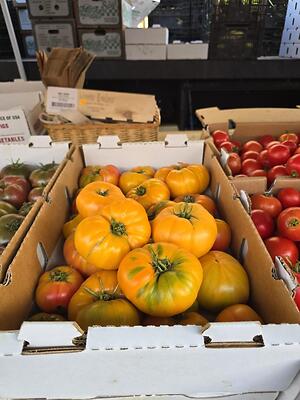
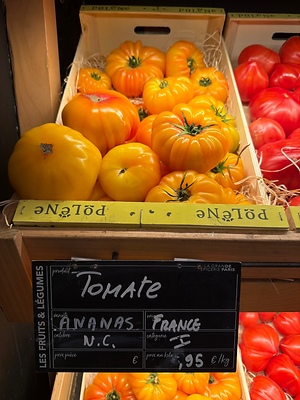
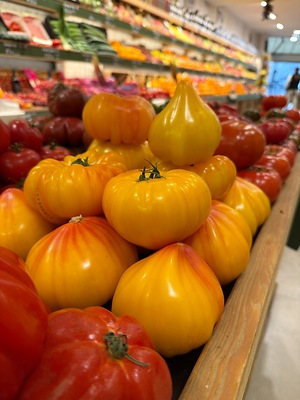
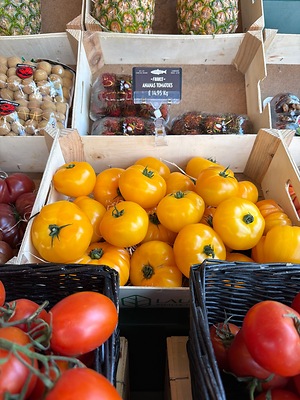
Ananas tomatoes vary in size and shape, as they are an heirloom variety whose appearance changes depending on growing conditions. The tomatoes can be round, oblate, or pyriform in shape and may be flattened, lopsided, or pointed. The surface is covered in prominent ribbing, forming indentations and creases, and the tomatoes range from 250 to 400 grams in weight, sometimes reaching up to 1 kilogram. The skin is smooth, taut, glossy, and thin, being easily punctured or damaged. It also showcases variegated yellow, orange, red, and pink hues. Each tomato will have varying levels of color, and some have a marbled interior with hues matching the skin, giving them a memorable aesthetic. Ananas tomatoes have a dense, aqueous, meaty, and rich flesh with a tender, succulent consistency. The flesh contains very few seeds and becomes soft with maturity. Ananas tomatoes emit a noticeable aroma and are known for their low acidity, which is balanced by a sweet, subtly citrusy flavor with a fruity aftertaste.
Seasons/Availability
Ananas tomatoes are harvested from outdoor plantings in the summer through fall, typically between July and October. The variety may also be cultivated in greenhouses, allowing the tomatoes to be sold year-round.
Current Facts
Ananas tomatoes, botanically classified as Solanum lycopersicum, are an heirloom variety belonging to the Solanaceae family. The large, late-season cultivar is considered a type of beefsteak tomato, a descriptor for fleshy, meaty tomatoes with a dense, thick texture that holds their shape well. Ananas tomatoes are harvested 80 to 100 days from transplanting and are an indeterminate variety, meaning the plants will produce tomatoes throughout the season until the first frost. The variety is also open-pollinated, allowing growers to save seeds each season. The name Ananas is the term most used in Europe for the variety. Ananas means “pineapple” in French and derives from the variety’s original name, Pineapple tomato, in the United States before it was introduced to European markets in the 20th century. It is important to note that there are several types of Ananas found in retail settings, including Ananas Noire, or Black Pineapple, Ananas Bleue, or Blue Pineapple, and Ananas Verte, or Green Pineapple. These variations will range in flavor, coloring, and texture. Ananas tomatoes are typically ripened on the plant and have thin, delicate, easily punctured skin, making them a challenging commercial cultivar. The tomatoes are transported in a single layer to prevent bursting and are sold in European markets as a premium delicacy. Chefs and home cooks seek out Ananas tomatoes for their rich flavor, marbled coloring, and tender flesh, and incorporate the variety into a wide array of fresh and cooked culinary preparations.
Nutritional Value
Ananas tomatoes have not been studied for their nutritional properties. Tomatoes, in general, are a source of fiber to aid digestion and contain vitamins A, B, C, E, and K, which maintain healthy organs, protect cells against free radical damage, strengthen the immune system, and assist in faster wound healing. Tomatoes also provide varying amounts of minerals, including potassium, calcium, phosphorus, magnesium, iron, copper, and manganese. These minerals help the body balance fluid levels, build red blood cells, support bone and tooth development, and control nerve functions.
Applications
Ananas tomatoes have a rich, subtly sweet, fruity, and citrusy flavor, suited to both fresh and cooked preparations. The variety is primarily eaten fresh, sprinkled with salt, lemon juice, and olive oil, as a light snack. Ananas tomatoes are also layered into carpaccio and caprese, diced for bruschetta, or marinated and served as a fresh side with herbs and oil. In Europe, Ananas tomatoes are ideal for salads and can be added to leafy green dishes or tossed into heartier recipes like panzanella. The tomatoes also have a dense texture, allowing them to be sliced and layered on sandwiches or hollowed and stuffed. Ananas tomato slices can be added to galettes and tarts, served over flatbread, or layered in quiche. The tomatoes are also simmered into pastes and sauces or cooked into hot and cold soups, notably gazpacho. In the summer and fall, Ananas tomatoes are promoted in retail markets as a flavor-forward variety ideal for grilling and pairing with main meat dishes. The variety is also pressed or pureed into select juices and beverages. Ananas tomatoes pair well with herbs like parsley, rosemary, oregano, and cilantro, aromatics such as garlic, shallots, and ginger, and other ingredients like olives, eggplant, bell peppers, asparagus, and zucchini. Fresh Ananas tomatoes should be stored at room temperature in a single layer for 1 to 2 weeks, depending on the degree of ripeness. Ripe tomatoes become softer and should be consumed relatively quickly for the best flavor and texture.
Ethnic/Cultural Info
Ananas tomatoes are a prized variety in France, favored for their flavor. The fleshy tomatoes are used in several traditional French recipes, such as tarts, ratatouille, and velouté for sauces and soups, and are notably used in tomates farcies or stuffed tomatoes. The first well-known mention of tomates farcies in France was made by food writer Grimod de la Reynière in his piece “L’Almanach des Gourmands.” This written piece was one of the first French restaurant and food guides, published annually from 1803 to 1812. Before this date, tomates farcies was a recipe synonymous with Provençal cuisine in Southern France. This style of cooking refers to simple, rustic cuisine that uses homegrown produce and other locally sourced ingredients to create flavorful dishes. Tomates farcies were created in home kitchens to use leftover ingredients and avoid waste. Historically, large tomatoes were stuffed with ground meat, breadcrumbs, and fresh herbs and cooked. Over time, many variations of this dish were made, and the tomatoes were later cooked over a bed of rice to create a filling meal. Tomates farcies appeared in mainstream recipe books in the 20th century, and the dish spread beyond Southern France to Paris and other metropolitan areas. In the modern day, tomates farcies is still a popular dish, especially in the summer, and Ananas tomatoes are a choice variety for their large size, flavor, and dense flesh.
Geography/History
Ananas tomatoes have a convoluted history, and much of their origin is unknown. Most sources claim the tomato originated in the United States and was developed in home gardens in either Kentucky, Ohio, North Carolina, or West Virginia under the name Pineapple tomato. Seeds for the tomatoes were saved and distributed over time, eventually being acquired by American seed catalogs like Seed Savers Exchange and Glecklers Seedmen for cultivation. A few sources claim Glecklers Seedmen had the variety listed in the 1950s, while others say it wasn’t listed until the 1990s. More viable research is needed before conclusions can be drawn about this fact. Ananas tomatoes were introduced to Europe in the mid-20th century and received their Ananas name as a French translation of the American pineapple moniker. After their introduction, Ananas tomatoes became a favored home garden cultivar in Europe and were eventually offered as a specialty variety in select high-end markets. Today, Ananas tomatoes are cultivated worldwide in home gardens and by select growers. In Europe, Ananas tomatoes are sown in greenhouses and open fields and are sold in fresh markets, retailers, and through wholesalers.

Ananas Heirloom Tomatoes for sale around the world shared on the Specialty Produce App




Check out our QR code Library to download QR Codes that link to our fruit encyclopedia.
Use on your signage and other promotions to share the knowledge!
Use on your signage and other promotions to share the knowledge!



