This website uses cookies, pixels, and other tracking technologies to personalize content, analyze how our site and apps are used, and create aggregated statistics.
We disclose data about site and app users to third parties so we can target our ads to you on other websites, and those third parties may use that data for their own purposes.
For more information on how we collect, use, and disclose this information, please review our
Privacy Policy.
Continued use of this site means you consent to our Privacy Policy.
Summary generated by our research from the article below.
Description/Taste
Saltanat apples are large, globular fruits that have an ovate to squat shape, attached to thin and fibrous, brown stems. The skin is smooth, firm, and waxy with a yellow-green to orange base, and depending on exposure to the sun, the surface may be covered in bright red blushing and striping. Underneath the thin skin, the flesh is crisp, ivory to pale yellow, dense, and fine-grained, encasing a central core filled with small, brown-black oval seeds. Saltanat apples are juicy and fragrant with a balanced, sweet and sour flavor.
Seasons/Availability
Saltanat apples are harvested in the fall and can be stored through the late winter or early spring.
Current Facts
Saltanat apples, botanically classified as Malus domestica, are a late-ripening, autumn variety that belongs to the Rosaceae family. Developed at the Kazakh Research Institute of Horticulture and Viticulture, Saltanat apples were selected for their resistance to disease, high yields, and tolerance to cold weather. Saltanat apples are not commercially produced and are sold at fresh markets through small farms in Kazakhstan and in select eastern European countries. The apples are primarily consumed fresh, out-of-hand, but they can also be utilized in a wide variety of cooked applications.
Nutritional Value
Saltanat apples are a good source of vitamins C and E, which are antioxidants that can help boost the immune system and protect the body from external environmental aggressors. The apples also contain calcium, potassium, iron, and manganese.
Applications
Saltanat apples are best suited for raw applications as their tangy, sweet flesh is showcased when consumed fresh, out-of-hand. The fruit can be eaten as a snack, discarding the seeds and core, or it can be sliced and layered on cheese plates, tossed into green salads, chopped into fruit salads, used as a vessel for dips, or layered in sandwiches. Saltanat apples can also be utilized in cooked applications such as baking and are commonly used in tarts, pies, muffins, and bread. In addition to baking, the sweet flavor of the flesh can be served with savory meats and is also suitable for drying. Saltanat apples pair well with other fruits such as cranberries, pears, blackberries, and plums, parsnips, potatoes, cabbage, caramel, honey, vanilla, nuts such as pistachios, almonds, and walnuts, mint, and lemon. The fruits will keep 1-2 months when stored normally in the refrigerator. If stored professionally in maintained facilities, the apples may keep up to six months.
Ethnic/Cultural Info
Saltanat apples are commonly grown in Almaty, Kazakhstan, where many local farmers are cultivating multiple varieties of apples in the foothills and mountainous regions near the city. Many of these farmers have dedicated their lives to sustaining apple diversity, and Kazakhstan is believed by many scientists to be the center of origin for all apple varieties. Before human cultivation began, animals such as bears and horses largely contributed to the initial spread of apple varieties and would seek out the sweet fruits, consuming and expelling the seeds through natural digestion. Today through the preservation of original varieties and development of newer types such as the Saltanat, apple diversity in Almaty can be seen through the many varieties sold through local markets in both fresh and dried form. Almaty was also situated along the northern branch of the Silk Road, and dried apples were a popular snack sold to travelers passing through as they could be stored and carried long distances.
Geography/History
Saltanat apples were created from free pollination of Rene Burchardt seedlings at the Kazakh Research Institute of Horticulture and Viticulture in Almaty, Kazakhstan. Since their creation, the variety is cultivated through small farms and can be found in Central Asia, primarily in Kazakhstan, and in Eastern European countries such as Latvia.
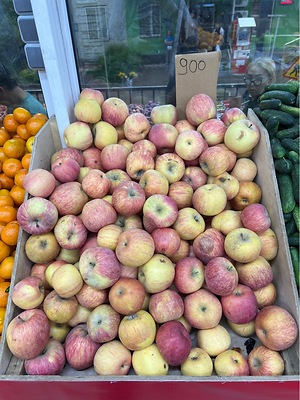
Базар
улица Исиналиева, Almaty
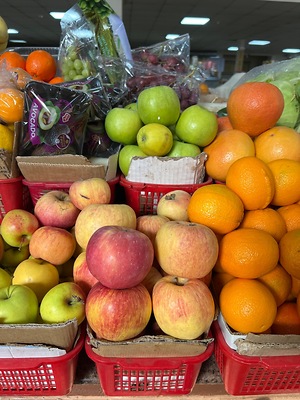
Kazakhstan variety Saltanat grown in China…Saltanat apples are known for their large, globular shape, with yellow-green to orange skin that may display bright red blushing or striping depending on sun exposure. These apples have a crisp, dense, and fine-grained flesh that is ivory to pale yellow, containing small brown-black seeds at its core. They are juicy and fragrant, offering a balanced sweet and sour flavor profile, making them a cherished variety.
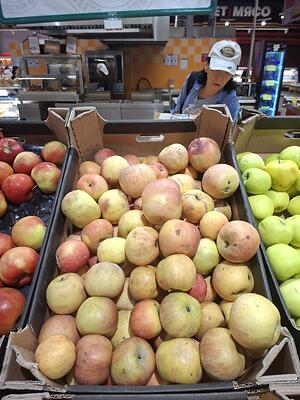
Magnum Hyper
Radostovets St 292, Almaty 050060, Kazakhstan
Saltanat apples grown in China...Saltanat apples are versatile and can be enjoyed in raw or cooked applications. Their tangy, sweet flesh is perfect for snacking, adding to salads, or pairing with cheese. They can be baked into pies, tarts, and muffins, or dried for longer storage. These apples pair well with fruits like cranberries and plums, nuts like almonds, and flavors like honey, vanilla, and caramel. Properly stored, they can last up to six months in professional facilities.
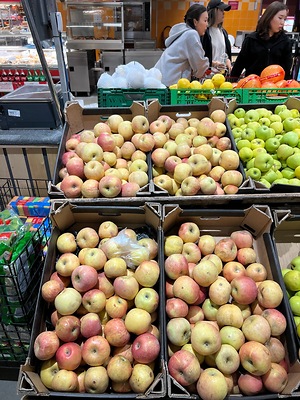
Magnum Cash & Carry
улица Радостовцa, Almaty, Almaty
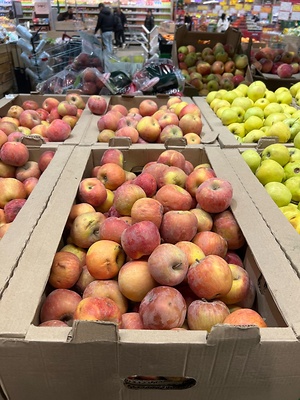
Saltanat apples grown in China in Almaty supermarket...Saltanat apples originated from free pollination of Rene Burchardt seedlings at the Kazakh Research Institute of Horticulture and Viticulture in Almaty, Kazakhstan. They are primarily cultivated by small farms in Central Asia, with presence in Kazakhstan and Eastern Europe, including Latvia.
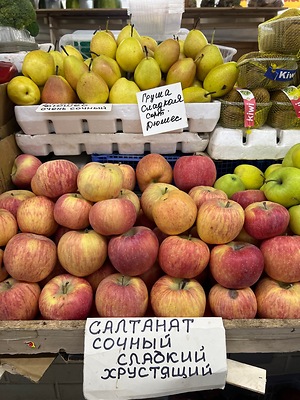
Зеленый базар
Zhybek Zholy prospekt, Almaty, Almaty
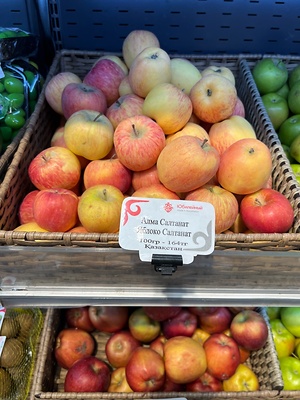
Sweet and crispy Saltanat apples imported from China...Saltanat apples originally come from Almaty, Kazakhstan, a region considered by many scientists to be the birthplace of all apple varieties. Local farmers in Almaty work to sustain apple diversity, growing multiple varieties in the surrounding mountainous areas. Historically, this region was part of the Silk Road, where dried apples were a favored snack for travelers due to their ability to be stored and transported over long distances.
Tau Samal
Saltanat apples of Kazakhstan grown in China...Saltanat apples are known for their large, globular shape with a smooth, waxy skin that ranges from yellow-green to orange, often displaying bright red blushing when exposed to sunlight. Beneath the thin skin lies crisp, ivory to pale yellow flesh with a dense, fine-grained texture. These apples are highly aromatic, juicy, and characterized by a balanced sweet and sour flavor, making them a delightful treat.
Supermarket Magnum
Radostovtsa st. 292,. Almaty, Kazakhstan
Saltanat apples of China imported to Kazakhstan...Saltanat apples are versatile and shine in both raw and cooked applications. Their tangy-sweet flavor complements cheese plates, salads, sandwiches, and can even serve as a base for dips. They are perfect for tarts, pies, muffins, and bread, and pair well with fruits like cranberries and pears, or flavors like caramel and nuts. Stored in refrigerators, they remain fresh for 1-2 months, or up to six months in professional storage.
Yubileinyi supermarket
Abylai Khan avenue, 74, Almaty, Kazakhstan
Saltanat apples originated at the Kazakh Research Institute of Horticulture and Viticulture in Almaty, Kazakhstan, through free pollination of Rene Burchardt seedlings. They are cultivated primarily in Kazakhstan and Central Asia, with some presence in Eastern Europe, including Latvia. Their rich heritage ties them to small farms, supporting local agriculture in these regions.
Galmart supermarket
улица Розыбакиева 247А, Алматы 050060, Казахстан
Saltanat apples of Kazakhstan…Saltanat apples are cultivated near Almaty, Kazakhstan, a region considered by scientists to be the origin of all apple varieties. Farmers in this area work to preserve original apple types while developing newer varieties like Saltanat. Almaty, once a Silk Road hub, is known for offering dried apples as a durable snack, showcasing the rich apple diversity in both fresh and preserved forms.
Supermarket Magnum
ул. Радостовца 292, Алматы 050060, Казахстан
Plenty of Saltanat apples of
China imported to Kazakhstan. Saltanat apples are not only visually appealing with their vibrant hues but also boast a fine-grained and dense texture under their thin, waxy skin. Their balanced sweet and sour flavor is paired with a juicy and fragrant bite, making them a versatile ingredient in culinary dishes and a delightful snack. These apples also feature a central core containing small, brown-black oval seeds, a detail that adds to their structured, classic appearance.
Check out our QR code Library to download QR Codes that link to our fruit encyclopedia. Use on your signage and other promotions to share the knowledge!