



Chilacayote Squash
Estimated Inventory, lb : 0

Description/Taste
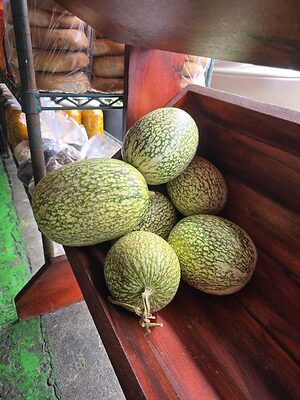
Chilacayote squash varies in size, depending on maturity at harvest and growing conditions. The squash can be picked young, as small as 10 to 12 centimeters in diameter, or left to mature, reaching 20 to 30 centimeters in diameter, sometimes larger. The variety is typically round to oblong in shape, with an elongated nature, and has a straight, cylindrical appearance with bluntly curved ends. The rind is tender, edible, smooth, and thin when young, becoming hard, tough, and inedible once mature. Chilacayote squash showcases several color variations. The squashes can be all white, dark green, or green and white with variegated mottling, striping, and dots. Underneath the surface, the white flesh is tender, aqueous, and succulent when young, with white, soft seeds. As the squash matures, it becomes more fibrous with a crisp, spongy, moist consistency. Mature squash often contains flat, dark brown-black hard seeds. Each squash varies in its seed quantity, but larger types can sometimes hold as many as 500 seeds. Chilacayote squash has a mild, slightly sweet, and subtly nutty taste. The flesh may sweeten in storage, but mostly remains neutral, readily absorbing flavors of ingredients in dishes.
Seasons/Availability
Chilacayote squash is available year-round in tropical climates. In temperate regions, it is harvested from late spring until the first frost in fall or winter.
Current Facts
Chilacayote, botanically classified as Cucurbita ficifolia, is an edible squash species belonging to the Cucurbitaceae family. The squashes develop on sprawling, spreading vines extending 15 meters in length and can be grown on the ground or trained on trellises and support structures. The moniker Chilacayote is derived from Tzilacayotli, an ancient name for the squash in Nahuatl, an indigenous language spoken in Mexico. Chilacayote has an extensive history in Mexico and other parts of the Americas, but it has also been naturalized and spread worldwide as a versatile culinary ingredient. The species is known as Chilacayote and Alcayota in Mexico and Guatemala, Chiclayo and Calabaze Serrana in Peru, Seven-Year melon, Malabar gourd, Mountain squash, Fig-Leaf squash, and Black-Seeded pumpkin in English-speaking communities, Cabell d’Àngel and Cidra in Spain, Yuchigua in China, Haizukogij in Japan, Fak Khao in Thailand, and Shark Fin melon as an additional general name in Asia. Chilacayote squash is revered for its multi-purpose nature, being consumed as a summer squash when young and cooked in its mature state. The species is productive, and full-grown squashes can be stored for extended periods, sometimes several years, contributing to its popularity worldwide. In the modern day, Chilacayote squash is eaten fresh and cooked in a wide array of savory and sweet culinary dishes and beverages.
Nutritional Value
Chilacayote squash is a source of vitamins A, B, C, and E, contributing to energy production, strengthening the immune system, guarding cells against free radical damage, and maintaining healthy organ functions. The squash also provides minerals like calcium, potassium, magnesium, phosphorus, and iron. These minerals help the body balance fluid levels, support bone and teeth health, control daily nerve functions, and produce protein for oxygen transport through the bloodstream. In the Americas, Chilacayote squash is occasionally used in natural medicines for its anti-inflammatory properties and fiber content, which helps cleanse the digestive tract. The flesh is also boiled into syrup and taken as a medicine to soothe respiratory issues.
Applications
Chilacayote squash is used at multiple stages of maturity in fresh and cooked culinary preparations. When young, Chilacayote squash is prepared like summer squash and can be eaten raw. The flesh is sliced and tossed into salads, blended into various juices and smoothies, or incorporated into grain bowls. Young Chilacayote squash is also stuffed and cooked, sauteed, or simmered into soups and stews similarly to zucchini. As the squash ages, it develops a tough, hard exterior that must be removed before cooking. Mature Chilacayote squash has a distinctly stringy, crisp consistency reminiscent of spaghetti squash. The flesh can be cooked as a filling for empanadas, used in mole, roasted as a simple side, or pan-fried and tossed into noodle dishes. In Oaxaca, Mexico, Chilacayote is famously used in an agua fresca made from the squash, pineapple, honey, brown sugar, and cinnamon. The drink is served chilled, has a sweet and savory taste, and is accompanied by a spoon to eat the chunks of squash floating in the drink. Chilacayote squash is also well-known throughout the Americas for its use in desserts. The flesh is cooked in sugar or simmered into jams and served on toast, added to various pastries, or baked into cakes. In Spain, Chilacayote jam is called Cabello de Angel, meaning Angel’s Hair, a name derived from the flesh’s stringy texture. Outside of the Americas, Chilacayote squash is used as a shark fin substitute in soups. The squash has a similar texture to shark fin and provides a more sustainable, vegetarian option to the revered dish, especially in China. Throughout Asia, Chilacayote squash is also stir-fried, simmered in soups, curries, and stews, added to meatballs, or used in variations of egg rolls and fresh spring rolls. Beyond the flesh, the seeds are roasted, tasting like a cross between sunflower seeds and peanuts. In Chiapas, Mexico, the seeds are also cooked and covered in honey as a sweet snack. Chilacayote squash pairs well with spices like anise, cloves, cinnamon, and allspice, fruits including pineapple, coconut, grapefruit, oranges, and lemons, aromatics such as garlic, ginger, and onions, and flavorings like tamarind, soy sauce, and sesame oil. Whole, unopened mature Chilacayote squash can be stored for several months to years, depending on its storage conditions. It is recommended to keep the squash in a cool, dry, and dark location. Younger Chilacayotes only keep for 1 to 2 weeks and should be stored in the refrigerator.
Ethnic/Cultural Info
Chilacayote is traditionally used in sweet preparations served during religious holidays in the Americas. The two most common sweets are known as Chilacayote en dulce, meaning candied Chilacayote, and Chilacayote en Miel, which is squash cooked in a syrup. Many variations of these sweets are made throughout Mexico, Central, and South America, and each region may also have its own additions and names for these recipes. In Mexico, Chilacayote squash is candied into a crystallized, chewy, rich, and sweet treat flavored with cinnamon and anise. This sweet is customarily shared between family and friends and given as an offering to the Virgin Mary on the Viernes de Dolores, or the Friday of Sorrows. The Friday of Sorrows is the Friday before Palm Sunday, and the candied squash is placed at altars constructed in homes to the Virgin Mary. Chilacayote en dulce is rumored to have been prepared for over 300 years for this religious remembrance and has become a sacred element of Holy Week. Chilacayote squash is also candied or cooked in syrup for Dia de Los Muertos on November 1st and 2nd in Guatemala. During the annual festivities of remembering loved ones who have passed, sweet Chilacayote treats are given as treats to ancestors and eaten among living family members in honor of the memories shared with the deceased relatives.
Geography/History
Chilacayote squash is believed to descend from a wild ancestor native to the Americas, possibly from Southern Mexico or areas of the Andes. Much of the species’ early wild ancestor is unknown, but archaeological records note that seed fragments dating back to 5,000 and 6,000 BCE were found in Peru along the central and northern coast. These findings indicate that early trade was occurring with the squashes as a food source and medicinal ingredient. Several ancient names for the species also arose from areas of Mexico, another hypothesized center of origin and domestication. Early types of Chilacayote squash were being grown and traded in pre-Incan times, and over time, the species spread throughout Central and South America and Mexico. Later in the 16th and 17th centuries, the arrival of European traders in the New World contributed to Chilacayote’s expansion worldwide. The squash was favored for its extended storage properties and was carried on ships to India, other parts of Asia, and eventually Europe. In the mid-19th century, Chilacayote squashes were introduced to France when they were used as food for yaks being transported from Shanghai to the menagerie of the Muséum d'Histoire Naturelle in Paris. Today, Chilacayote squash is cultivated worldwide as a culinary ingredient. When in season, the squashes are sold through fresh markets.
Recipe Ideas
Recipes that include Chilacayote Squash. One
 is easiest, three is harder.
| Kiwilimon |
|
CHILACAYOTES ENCHILADOS |
| Dora's Table |
|
ATAPAKUA - MEXICAN VEGETABLE STEW |
| Familia Kitchen |
|
Guisell's Dulce de Vitoria from Colombia |

Chilacayote Squash for sale around the world shared on the Specialty Produce App


Check out our QR code Library to download QR Codes that link to our fruit encyclopedia.
Use on your signage and other promotions to share the knowledge!
Use on your signage and other promotions to share the knowledge!



