



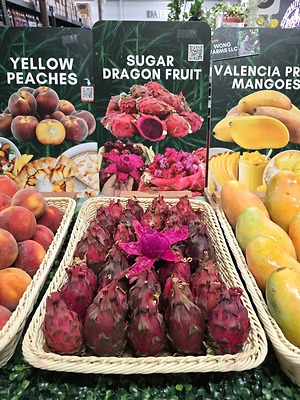
Sugar Dragon Fruit
Estimated Inventory, lb : 0
This item was last sold on : 09/26/26

Description/Taste
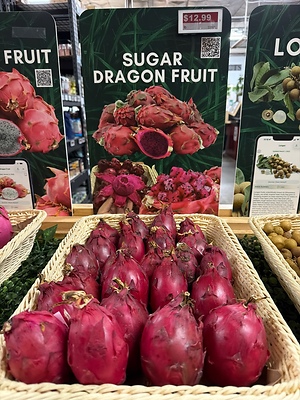
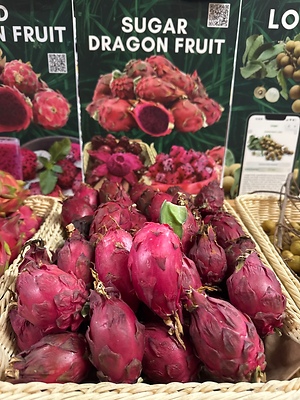
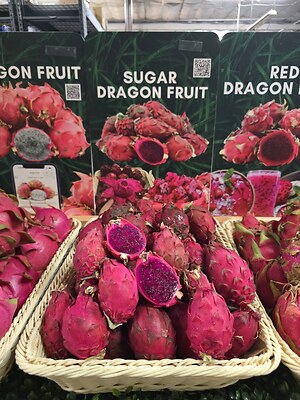
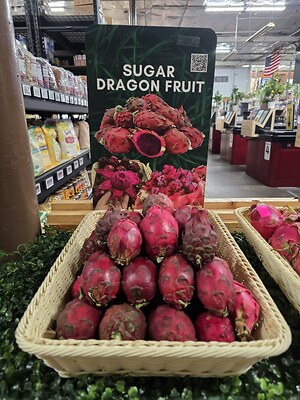
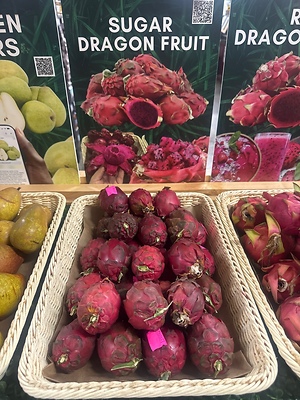
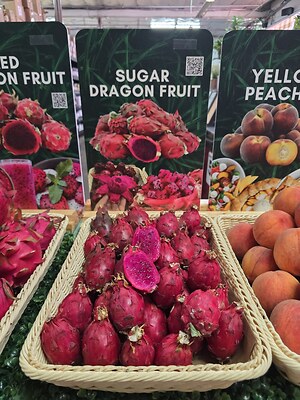
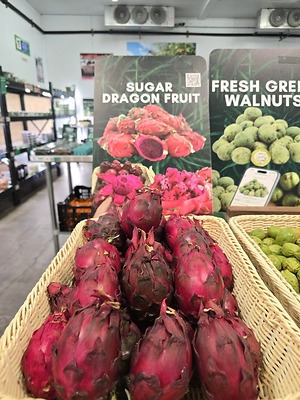
Sugar Dragon varies in size and shape depending on growing conditions, but is typically considered a smaller variety, averaging 100 to 400 grams. The fruits are oblong to oval, sometimes slightly tapered, and enveloped in thin skin with a few bracts, also called scales or fins. These bracts are notably small, pliable, fleshy, and protruding, with a rubbery texture. The bracts also develop green or brown hues, while the rest of the fruit showcases a red-pink exterior. The skin is tightly adhered to the flesh but can be peeled by hand once an incision is made into the surface. Underneath the skin, the red-pink, magenta, dark purple flesh is semi-firm, aqueous, tender, and succulent, encasing many tiny edible seeds that give it a crunchy consistency. Sugar Dragon releases a subtle floral aroma and is edible raw once ripe. The flesh ranges from 18 to 20 Brix, a measure of sugar content, giving the fruit a sweet, mild earthiness. This sweet flavor is nuanced with tropical, berry, and floral notes, combining tastes reminiscent of kiwis, coconut, raspberry, roses, and lychee.
Seasons/Availability
Sugar Dragon is typically available from late spring through winter.
Current Facts
Sugar Dragon, botanically a hybrid between Selenicereus guatemalensis and Selenicereus setaceus, is a variety of dragon fruit belonging to the Cactaceae family. The small, sweet-tasting fruits are known for their saturated, pigmented hues, berry and floral flavor nuances, and refreshing taste. Sugar Dragon is a sought-after variety among dragon fruit growers, as it is known for its growth and productive nature. The variety produces large, olive-green plants with long, branching stems and fruits for multiple cycles throughout the growing season. Sugar Dragon is one of the earliest and latest blooming varieties, and the plants are self-fertile, which means they do not require another plant for pollination. The variety produces large, showy blooms with ample pollen, which can also be used for other varieties, making it a universal pollinator in gardens. Sugar Dragon has high yields, and though the fruits are smaller than other varieties, they are valued for their sweet taste. The fruits are mainly marketed for fresh eating, but they are also utilized in various sweet and savory culinary preparations and beverages.
Nutritional Value
Sugar Dragon has not been studied for its nutritional properties. Dragon fruit, in general, is a source of fiber to regulate the digestive tract and contains vitamins B and C to strengthen the immune system and contribute to energy production. Dragon fruit also provides minerals in varying amounts, including calcium, copper, magnesium, iron, and potassium. These minerals help the body build red blood cells, balance fluid levels, control daily nerve functions, support bone and tooth development, and produce the protein hemoglobin for oxygen transport through the bloodstream. Sugar Dragon’s pigmented flesh indicates the presence of anthocyanins, which have antioxidant properties to reduce inflammation and protect overall bodily health.
Applications
Sugar Dragon has a refreshing, sweet, and berry-like flavor, suited to both raw and cooked preparations. The variety is primarily enjoyed fresh, out of hand, and is valued for its high sugar content. The skin can be easily peeled from the flesh once a portion is cut open, and the flesh is consumed whole, including the seeds. Sugar Dragon is often served chilled and can be mixed into green salads, served on fruit platters, or added to fruit medleys. The pigmented flesh can also be used as a topping over breakfast dishes, shaved ice, or other desserts. Try blending Sugar Dragon into smoothies, fruit juices, or cocktails to add color and flavor. The pink-red juice can also be added to sauces, used as coloring in various dishes like fried rice, or simmered into syrups, jellies, and jams. Beyond coloring, dragon fruit is sometimes incorporated into muffins, cakes, or tarts. Sugar Dragon pairs well with other fruits like kiwis, strawberries, blueberries, bananas, and mangoes, flavorings such as vanilla, ginger, and cinnamon, and herbs including mint, basil, and tarragon. Whole, unopened Sugar Dragon will keep for a few days at room temperature and for a week when stored in the refrigerator. The flesh can also be frozen for several months.
Ethnic/Cultural Info
Sugar Dragon is a variety closely related to 8-S, a seedling created by breeder Paul Thomson. Some growers consider Sugar Dragon to be the same variety as 8-S, but grower Linda Nickerson, who named the fruits Sugar Dragon, believes them to be slightly different. 8-S is the variety name given by Paul Thomson, with 8 representing the “8th hybrid cross” and S standing for “seedling.” As 8-S was shared between growers, the plants were thought to have naturally evolved, creating very similar types with slight variations. Nickerson acquired her 8-S cuttings directly from Paul Thomson, and as she grew the variety, she discovered her plants developed some variations. She noticed that Sugar Dragon does not have thorns on the fruit’s tips, also known as bracts, while 8-S exhibits small thorns. Nickerson named the variety Sugar Dragon in honor of its sweet flavor, to distinguish it from 8-S, and believed it would be a marketable moniker to attract consumers. There is also another variety in Florida, called Voodoo Child, that is closely related to 8-S. Some growers claim they are the same, while others state they are different varieties.
Geography/History
Sugar Dragon was developed from 8-S, a variety created by breeder Paul Thomson in Southern California. Thomson had a passion for dragon fruit breeding and was also known as one of the co-founders of the California Rare Fruit Growers organization. In his book, “Pitahaya – A Promising New Fruit Crop for Southern California,” Thomson notes that 8-S was created from a cross between varieties Rixford, Selenicereus guatemalensis, and Houghton, Selenicereus setaceus. The seedlings first fruited in 1999 and yielded well, were pigmented, and had a pleasing flavor. Cuttings of 8-S were later given to Linda Nickerson in Fallbrook, California, and as she cultivated the variety, slight variations began occurring in her plants. Nickerson named her fruits Sugar Dragon to distinguish them from typical 8-S cultivars. Today, Sugar Dragon is a specialty variety only grown in limited quantities. The variety is produced commercially on a small scale and is also planted in home gardens as a fresh-eating fruit, primarily in the United States. When in season, Sugar Dragon is sold directly from growers, at farmers’ markets, and at select retailers.
Recipe Ideas
Recipes that include Sugar Dragon Fruit. One
 is easiest, three is harder.
| The Sidesmith |
|
Pomegranate and Red Dragon Fruit Salad |
| Jennifer Meyering |
|
Red Dragon Fruit Margarita |

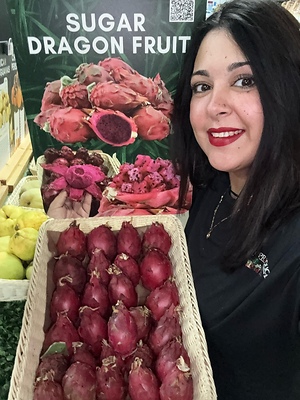
Sugar Dragon Fruit for sale around the world shared on the Specialty Produce App


Check out our QR code Library to download QR Codes that link to our fruit encyclopedia.
Use on your signage and other promotions to share the knowledge!
Use on your signage and other promotions to share the knowledge!



