



Red Holland Bell Peppers
Estimated Inventory, 10 lbs : 8.80
This item was last sold on : 11/03/26

Description/Taste
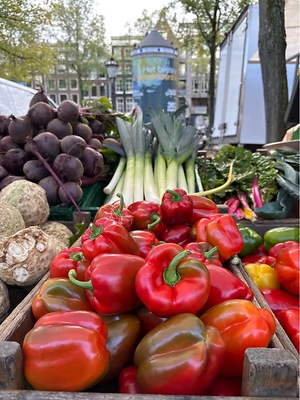
Red Holland bell peppers range in size from 7 to 10 centimeters in length and 5 to 13 centimeters in diameter, with a uniform shape and color. Each pepper has a block-like, angular, bulbous shape and bears 2 to 4 lobes, giving it a segmented, chambered appearance. The peppers are topped with a green, fibrous stem cap, and the skin is thick, smooth, glossy, firm, and taut. The skin of the peppers gives them a slightly chewy texture, and red varieties are traditionally sold when they are fully ripe, especially when grown for export. In local Dutch markets, some growers may offer peppers that are still transitioning from semi-ripe to fully ripe, bearing variegated hues. These peppers are different from the striped types. Beneath the surface, the pale red flesh is thick, dense, crunchy, and aqueous with a crisp, succulent texture. The pepper’s interior is hollow and features thick membranes, also called the placenta, which is spongy and contains a cluster of small, round, and flat ivory seeds at the top below the stem. Red Holland bell peppers are ripened before harvest. This leads red pepper types to have the highest sugar content among the colors, creating a mild, heatless, and sweet flavor.
Seasons/Availability
Red Holland bell peppers are available in the spring through late fall, typically between March and November. Though bell peppers are available year-round in the Netherlands, they are not locally grown in the winter as heating costs for the greenhouses exceed the value of the crop. Bell peppers found in Dutch markets during the winter are imported from other countries, including Spain, Morocco, and Israel.
Current Facts
Red Holland bell peppers, botanically classified as Capsicum annuum, are a category of bell pepper varieties grown in the Netherlands belonging to the family Solanaceae. Red bell peppers are the ripest type sold in markets, as the peppers mature on the plant before harvest, developing the highest sugar content and nutrient density. Red bell peppers are a familiar culinary ingredient worldwide, but the term "Red Holland bell peppers" is a distinctive marketing name for bell peppers grown in greenhouses in the Netherlands. When sold in markets, Holland bell peppers are a premium category, exhibiting uniform appearance, thick, dense flesh, vibrant colors, and mild, sweet flavor. These peppers are also exclusively grown in technologically advanced greenhouses under strict, controlled conditions to produce consistent, high-quality peppers. Red Holland bell peppers are the most popular color in the bell pepper group and are considered the signature type in Dutch cultivation. In the Netherlands, bell peppers are also known as Paprika, Geblokt, and Block peppers, which are general names for all color types. Several varieties used in production are sold under the collective name Red Holland bell pepper, and popular cultivars include California Wonder, Alzamora, Ridona, Capirossi, Bedena, Rubinaio, Nagano, and Redwing. Red Holland bell peppers are hand-harvested to maintain their pristine nature and are sold locally in Dutch markets and exported worldwide as a culinary delicacy. Chefs and home cooks seek out Red Holland bell peppers for their quality, flavor, and versatility, incorporating them fresh and cooked into a wide array of culinary preparations.
Nutritional Value
Red Holland bell peppers have not been exclusively studied for their nutritional properties. Red bell peppers, in general, are a source of fiber to aid digestion and contain vitamins A, B, C, E, and K, which protect cells against free radical damage, strengthen the immune system, assist in faster wound healing, contribute to energy production, and maintain organ health. Bell peppers also produce minerals in varying amounts, including potassium, magnesium, manganese, zinc, calcium, phosphorus, iron, and copper. These minerals help the body balance fluid levels, support bone and tooth development, produce the protein hemoglobin for oxygen transport through the bloodstream, regulate nerve function, and build red blood cells.
Applications
Red Holland bell peppers have a mild, sweet flavor suited for raw and cooked culinary preparations. The mature peppers are enjoyed out of hand and sliced for salads, julienned for slaws, or diced for relishes. They are also cut into sticks and served on crudité platters, often with creamy dips, or layered into sandwiches. A unique way to use red bell pepper halves is as a bread replacement on sandwiches for added crunch. Red Holland bell peppers also retain their color, even when cooked, and their sugar content is enhanced when heated. The peppers can be roasted, charred, or grilled to remove the skin. Once peeled, they can be pureed into sauces or used as a soup base. Red Holland bell peppers can also be diced into soups, curries, and stews, skewered on kabobs and grilled, tossed into stir-fries, or incorporated into casseroles. Combine multiple pepper colors for increased visual appeal in dishes. Red Holland bell peppers are also popularly stuffed and baked as a main dish. While less common, the peppers can be cooked and prepared in a mousse or used as a flavor note in savory-sweet desserts. In the Netherlands, peppers are sometimes added to savory Dutch baby recipes, sautéed with tomatoes and aromatics, or cooked into an omelet called boerenomelet. Red Holland bell peppers pair well with herbs like rosemary, marjoram, basil, oregano, and parsley, spices such as cumin, black pepper, and smoked paprika, and flavorings like balsamic, miso, and tahini. Fresh peppers should be kept in a ventilated container in the refrigerator’s crisper drawer for 3 to 7 days or sliced and frozen for extended use, around 10 to 12 months.
Ethnic/Cultural Info
Red Holland bell peppers are distinguished from other types worldwide by their entire cultivation method. The differences begin with the seed. Each seed used for greenhouse cultivation has been screened, cleaned, and prepped through scanners and high-tech machinery before it is even planted. A specialized company germinates the seeds and produces seedlings, which are evaluated before planting to ensure they are fit for production. The seedlings are then planted in greenhouses in rows on substrates rather than soil to protect against disease and regulate nutrient delivery. When planted outdoors, bell pepper plants average around 1 meter in height, but when grown in greenhouses, they can reach up to 4.5 meters. As the plants grow, they are tied to strings from the ceiling or support structures to keep the plants upright and better support fruit production. Each plant is watered using drip technology, and the water is collected from rainwater reservoirs. This irrigation water is also contained in a closed loop and is cleaned each cycle to create a more sustainable system. Dutch cultivation is centered on sustainability, and plants are protected by introducing predatory insects rather than using chemical sprays. The plants are also grown within their preferred temperature range, allowing each plant to produce high, consistent yields. These controlled ecosystems create bell peppers with an unblemished, vibrant appearance, thick flesh, and improved flavor.
Geography/History
Red Holland bell peppers are native to the Netherlands and have been cultivated since the mid to late 20th century. The Netherlands is one of the smallest countries in Europe, but it is one of the largest exporters of agricultural products in the world. Two-thirds of the country's available land is used for agriculture, and much of this agricultural focus arose from the events of World War II. During the war, the Axis Powers cut off food and fuel to western Netherlands, and this blockade, combined with one of the harshest winters on record from 1944 to 1945, created a crop shortage, causing more than 20,000 people to die from hunger. The slogan “nooit meer honger,” meaning “no more hunger,” was coined after this event, and new policies and reforms were instituted to industrialize agriculture and expand production to increase food security. In the 1960s, Wageningen University and the Naaldwijk Experimental Station began evaluating bell peppers as a new commercial crop, and greenhouse growers began replacing outdated grapevines with bell pepper plants to meet changing market demands. Bell pepper cultivation started in the Westland region, an area now known as “the glass city” for its vast number of greenhouses, and with Westland’s ideal location between the port city of Rotterdam, The Hague, Amsterdam, and Schiphol Airport, pepper cultivation thrived. Holland bell peppers were introduced internationally in the late 20th century and arrived in American markets in the early 1980s, where they became an in-demand premium item. Today, Holland bell peppers are still produced and sold worldwide, and are available through fresh markets, retailers, and distributors.
Featured Restaurants
Restaurants currently purchasing this product as an ingredient for their menu.
| Mission Bay Yacht Club | San Diego CA | 858-488-0501 |
| The Santaluz Club Inc - Bistro Kitchen | San Diego CA | 858-759-3150 |
| Food by Chef Ty | San Marcos CA | 424-278-8626 |
| Crudo Cevicheria & Oyster Bar | San Diego CA | 619-313-9127 |
| Comma | San Diego CA | 619-802-9183 |
| Extraordinary Desserts Union St. | San Diego CA | 619-294-7001 |
| The Plot | Oceanside CA | 422-266-8200 |
| Rustic Root Solana | Solana Beach CA | 619-955-5750 |
| Golden Door | San Marcos CA | 760-761-4142 |
| Cal A Vie | Vista CA | 760-945-2055 |
| Neptune | San Diego CA | 808-868-8639 |
| Chef Kirsten | San Marcos CA | 503-816-5777 |
| Dinners by David | San Diego CA | 619-518-3935 |
| Kingfisher | San Diego CA | 619-861-8074 |
| Claytons Bakery & Bistro | Coronado CA | 619-435-5425 |
| Boujiemana | San Diego CA | 415-710-0510 |
| Olivewood Gardens and Learning Center | National City CA | 619-434-4281 |
| Marine Group Global Services LLC | San Diego CA | 619-972-9345 |
| Lafayette Hotel - Quixote (Bar) | San Diego CA | 619-296-2101 |
| Jeune Et Jolie | Carlsbad CA | 858-231-0862 |
| Ballast Point Rest. - Little Italy | San Diego CA | 619-298-2337 |
| Juniper & Ivy | San Diego CA | 858-481-3666 |
| Botanica | San Diego CA | 619-310-6320 |
| Wayfarer Bread | La Jolla CA | 805-709-0964 |
| 264 Fresco (Kitchen) | Carlsbad CA | 760-720-3737 |
| Shoreside Support Boat | San Diego CA | 704-277-7929 |
| Kona Kai Resort and Marina | San Diego CA | 619-221-8000 |
| Luce | San Diego CA | 619-275-2094 |
| Small Barn | Temecula CA | 951-225-2822 |
| We Olive La Jolla | San Diego CA | 858-551-8250 |
| PFC Fitness Camp | Carlsbad CA | 888-488-8936 |
| US Grant Hotel Grill | San Diego CA | 619-232-3121 |
| Juniper & Ivy Bar | San Diego CA | 858-481-3666 |
| Kettle On Grand | Escondido CA | 707-980-4585 |
| College Cuisine - Chi Omega | San Diego CA | 310-402-6195 |
| Herb & Sea | Encinitas CA | 858-587-6601 |
| Cork & Stem LLC | San Diego CA | 619-354-0308 |
| C 2 C | San Diego CA | 619-972-9345 |
| Virtue Coffee & Juice | San Diego CA | 619-485-0485 |
| College Cuisine- Pi Beta Phi | San Diego CA | 310-634-2371 |
| Fernside | San Diego CA | 619-398-5156 |
| Cesarina | San Diego CA | 619-226-6222 |
| Mabel's Gone Fishing | San Diego CA | 619-228-9851 |
| Birdseye Rooftop | San Diego CA | 858-203-3565 |
| Aztec Shop Catering | San Diego CA | 619 594-3576 |
Recipe Ideas
Recipes that include Red Holland Bell Peppers. One
 is easiest, three is harder.
| No Recipes |
|
Sweet Pepper Upside-Down Cake |
| Half Baked Harvest |
|
Simple Grilled Kale + Red Pepper Tuscan Pasta Salad |

Red Holland Bell Peppers for sale around the world shared on the Specialty Produce App


Check out our QR code Library to download QR Codes that link to our fruit encyclopedia.
Use on your signage and other promotions to share the knowledge!
Use on your signage and other promotions to share the knowledge!



