

Q'achun Wakachi Potatoes
Estimated Inventory, lb : 0

Description/Taste
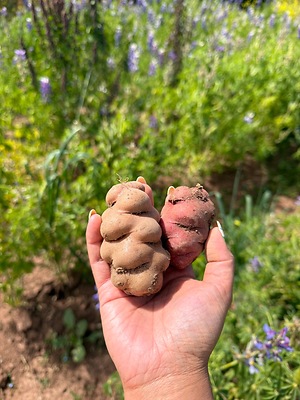
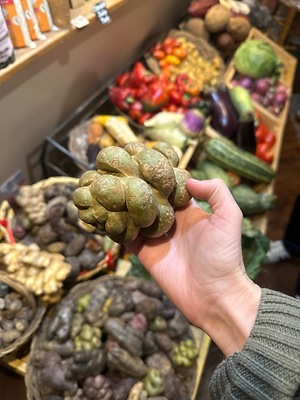
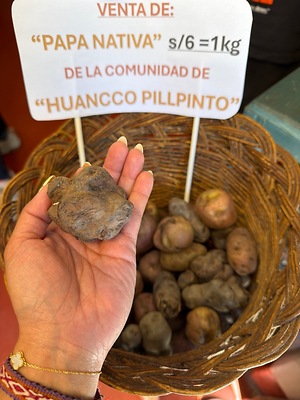
Q'achun Wakachi potatoes vary in size and appearance and have a knobby, bumpy shape, a distinct characteristic of the variety. The tubers range from small to large, averaging 5 to 7 centimeters in length and 4 to 5 centimeters in diameter, sometimes growing larger in ideal environments. The variety is generally round or oval and is covered with several protruding bumps, each surrounded by inset grooves that give the potato a lumpy facade, reminiscent of a pinecone or a blooming, multi-petaled flower. It also has several deep-set eyes found across the surface. The skin is both smooth and rough, semi-thin but tough, making it challenging to peel. The skin may also feature flaky spots and appear in shades of black, purple, red, and white. In markets, Q'achun Wakachi potatoes are often covered in a layer of brown soil, concealing their true skin coloring. Underneath the surface, the yellow to ivory flesh is solid, moist, firm, and slippery when raw, and the small knobs can be easily broken off the tuber by hand if handled too roughly. The flesh becomes dense, thick, and tender when cooked, with a mild, subtly starchy, faintly sweet, and earthy flavor.
Seasons/Availability
Q'achun Wakachi potatoes are harvested in Peru in the fall through winter, typically in May and June. This period marks the transition from the rainy to the dry season, and once the tubers are harvested, they are sold for several weeks to months.
Current Facts
Q'achun Wakachi potatoes, botanically classified as Solanum tuberosum, are a Peruvian variety belonging to the Solanaceae or nightshade family. The unusually shaped tubers are a type of native potato, meaning they are an ancient variety used throughout indigenous communities in the Andean highlands of Peru. Q'achun Wakachi is a Quechua name, a language spoken before the Inca empire, and is considered the official language of Peru in the present day. It is important to note that there are many variations of the name Q'achun Wakachi, depending on the specific community, and the tubers are often sold under spellings like Kachun Wakachi, Q’achun Waq’achi, Llunchuy Waqachi, Llumchuy Wagachi, and Cj’achun Wakachi. Q'achun Wakachi potatoes are traditionally associated with the Cusco region and are culturally intertwined with indigenous culinary and celebratory practices. The tuber is primarily cultivated and protected by local communities and is rare in commercial markets. Q'achun Wakachi potatoes come in four colors, and the tubers are used in fire-roasted preparations.
Nutritional Value
Q'achun Wakachi potatoes have not been extensively studied for their nutritional properties. Potatoes, in general, are a source of fiber to regulate the digestive tract and contain vitamins B and C, which contribute to energy production and strengthen the immune system. Potatoes also provide varying amounts of minerals, including potassium, phosphorus, iron, magnesium, and calcium. These minerals help the body balance fluid levels, produce the protein hemoglobin for oxygen transport through the bloodstream, control nerve functions, and support bone and tooth development. The red-purple pigments in the skin indicate the presence of anthocyanins, which have antioxidant properties that help reduce inflammation and protect overall bodily health.
Applications
Q'achun Wakachi potatoes are used in ceremonial dishes rather than everyday cooking. In Peru, potatoes are not an all-purpose ingredient. Varieties are hand-selected for specific preparations. Q'achun Wakachi is valued for its ancient roots and cultural significance. In the high-altitude communities of the Cusco area and the Sacred Valley, Q'achun Wakachi potatoes are customarily used in huatia and pachamanca, two ceremonial cooking methods dating to pre-Inca times that are still prepared during festivals, harvest celebrations, and familial gatherings. Huatia is an arched, convex Andean earth oven constructed from volcanic rocks over a hole dug in the ground. The stones are heated until they turn black, and then the potatoes are tossed into the oven. Once filled, the oven is purposely disassembled, with the stones placed on top of the tubers, and a layer of soil is added to cover the stones and cook the potatoes. Cooking times vary depending on the number of potatoes, but the tubers can often be heated in less than twenty minutes and are eaten with meats like fish, beef, pork, or lamb. Pachamanca is another preparation using heated stones. Layers of meat and Andean crops like potatoes, legumes, and corn are placed over the hot stones and buried under additional materials, such as straw, to retain heat and slow-cook the ingredients. Both preparations give potatoes an earthy, smoky, and savory aroma and flavor, and the potatoes are peeled and served with homemade chile and herb-based sauces. Q'achun Wakachi potatoes pair well with herbs such as huacatay, muña, parsley, and cilantro, yellow aji or rocoto peppers, and various cheeses. The tubers will keep for several weeks to months in a cool, dry, and dark location, depending on storage conditions.
Ethnic/Cultural Info
Q'achun Wakachi potatoes are well-known in an Andean pre-wedding tradition that has been passed between generations for centuries. The name Q'achun Wakachi derives from the Quechua words “llunchuy,” meaning “daughter-in-law,” and “waqachi,” meaning “to make cry.” When placed together, the potato’s name roughly translates to the “one that makes daughters-in-law cry.” This memorable name derives from the potato’s rough, bumpy shape. In some Andean communities, it is customary for mothers-in-law to send baskets of Q'achun Wakachi potatoes to their future daughters-in-law. The daughter-in-law must peel the irregularly shaped tuber with precision to show her skills as a potential suitor for the son. If the mother-in-law deems her work unsuitable, the daughter-in-law is declared not ready for marriage and cannot marry the son. Q'achun Wakachi potatoes are challenging to peel because of their protruding bumps, which require dexterity and persistence to peel cleanly. This practice is more than a physical test; it is also symbolic. Peeling tough potatoes shows a woman’s propensity for patience, determination, and resilience; all qualities needed to survive in the sometimes-harsh climate of the Andean highlands. It also shows a woman’s unwillingness to waste by peeling cleanly, foreshadowing her resourcefulness in marriage. The story surrounding Q'achun Wakachi potatoes has become a symbol of preserving and continuing ancient practices, and the story is often shared in a playful light due to the tuber’s name. Some Andean communities also host annual Q'achun Wakachi peeling competitions during celebrations and festivals to preserve the custom in a light-hearted way.
Geography/History
Q'achun Wakachi potatoes are native to Peru and arose through natural domestication. Potatoes, as a category, originated from several wild species found throughout the Andean highlands, also called the Sierra region, and were domesticated 8,000 to 10,000 years ago. It is hypothesized that several wild species were prevalent in the Altiplano. This high-altitude plateau extends from Lake Titicaca and spans several hundred miles to the southeast, encompassing regions of modern-day southern Peru and northwestern Bolivia. Wild potato species are not edible and contain high levels of solanine, which is toxic to humans, but a single wild potato fruit can contain 400 to 500 seeds, each capable of producing a distinct potato type. Ancient indigenous communities observed various animal species, notably birds, eating the fruits of the wild species with a specific mineral-rich clay, marking the initial phases of domestication. These communities began consuming the tubers with this clay, enabling them to eat them without getting sick, and began growing the plants in soil mixed with the clay. Natural cross-pollination also allowed these communities to combine various wild species, creating new types that formed larger, edible underground tubers, expanding diversity. Over time, natural crosses continued, and early potato varieties spread across the highlands. Later in the 13th through early 16th centuries, the Incas advanced potato domestication by growing the tubers in hand-built terraces on the sides of mountains. Each terrace had its own microclimate, allowing the Incas to grow crops suited to their desired conditions, significantly advancing potato cultivation. Potatoes continued to spread throughout the Andean highlands and became widely cultivated, creating new varieties, eventually leading to the development of Q'achun Wakachi. Today, Q'achun Wakachi potatoes are primarily grown in high-altitude regions in the Sacred Valley and Cusco area. The variety is not commonly sold in markets, but can sometimes be found through select local vendors. The Q'achun Wakachi potatoes featured in the photograph above were sourced through the San Pedro Market in Cusco, Peru.
Recipe Ideas
Recipes that include Q'achun Wakachi Potatoes. One
 is easiest, three is harder.
| Crop Trust |
|
Causa Tricolor |
| Crop Trust |
|
Dulce de Papa |

Q'achun Wakachi Potatoes for sale around the world shared on the Specialty Produce App