Do you believe in Non-violent agitation and democracy?
If “Yes”, then be aware of their principles and go ahead to read this article.
If “No”, then “get lost”.
What could be the reason for an agitation?
Let us see all the reasons;
- The law going to be enacted is unjust,
Write articles, conduct lectures, Conduct Talks and discussions. Select a representative who know the issue/topic better. Then write a formal letter cum notice to the government authority to give time to discuss. Prepare a list of the points needed to discuss including time limit of to give a date for a meeting. Side by side try to educate and convince the parties and party members to be aware of the likely negative results if the bill gets passed. If the bill has link with human rights or natural rights or constitutional rights then get a verdict from the judiciary. Till then no need to agitate. If the government wants some time to think on the issue, give it.
If the judiciary feels there is a clear scope of hurting fundamental rights, if the bill is passed, the agitation can be allowed to be conducted, that too, without disturbing the common route life of the public.
- Can a person go on indefinite fast as a part of agitation? Or when a person can adopt the weapon to go on fast?
If the government is unable to give logical answer/solutions of the issue likely to arise, in consequence to the passing the bill, and the government is passing the bill for the political reasons, and the loss damage would be irreparable, then to go on indefinite fast could be made justifiable. It cannot be against a person.
i.e. The government’s behaviour is like Duryodhana (दुर्योधन)
जानामि धर्मं न च मे प्रवृति, जानाम्यधर्मं न च मे निवृत्ति
He says; I know my duty, but I would not act according to it. I know what is improper, but I will not give away it.
- A specific law which is existing is unjust,
The judiciary can invalidate it, and make it Null and Void. No need to agitate,
- The government’s approach is not protecting human rights provided under the constitution,
It can be due to two reasons. The Ministry is responsible if its approach is wilful. i.e. The matter was brought to the notice of the Ministry, time to time, but the Ministry did not act on it wilfully.
In such situation there is a scope for to agitate, provided there are multiples cases against the same minister of the same ministry.
If the bad approach is due to the negligence of a government official the judiciary can ask the ministry to take action against the government official. No need to agitate.
- A minister fails to act as per constitutional provisions and judiciary also feels that the matters are controversial.
Opposition parties can prepare an appropriate bill which can eliminate the controversies. If the ruling party/parties do not support the bill, and simply reject it, A request letter to be issued to the President /Governor to dissolve the LS/Assembly. If the President does not dissolve the LS/Assembly, agitation can be launched peacefully without disturbing routine life of the public.
- If the Government fails to act as per constitutional provisions,
The agitators/opposition parties can suggest the procedural changes, to the points in LS/Assembly and also by way of writing articles, conducting lectures, conducting talks and discussions. Select a representative who knows the issue/topic better.
Judiciary can also be approached. Judiciary would advise the Government to make procedural changes.
If the Government fails, the agitators/opposition parties can request the president to dissolve the LS/Assembly.
- An/many administrative officer/s of the government acts/act unlawfully,
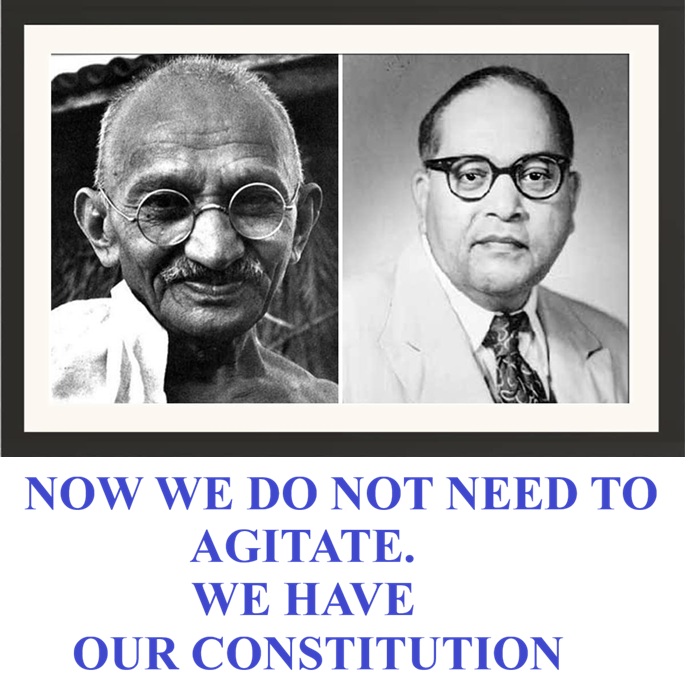
Judiciary can be approached. Judiciary will give verdict. This is in line with the principles of MK Gandhi and Baba Saheb Ambedkar.
Shirish Mohanlal Dave
खलः करोति दुर्वृत्तम् नूनम् फलति साधुषु,
दशानन हरेत् सीता, बन्धनम् स्यात् महोदधे
“A wicked person commits evil deeds, but the burden or consequence is surely borne by the righteous. For instance, the ten-headed Ravana abducted Sita, but it was the great ocean that had to be bound (bridged).”

