
Dylan Cease Placed On IL With Shoulder Inflammation
September 23: Cease is now on the IL due to that shoulder inflammation, per the team. It seems the Jays were waiting to be officially eliminated, which happened when they lost the first game of today’s doubleheader. The Jays also optioned righty José Rodríguez. Righties Chase Lee and CJ Van Eyk were recalled as the corresponding moves.
September 21: Dylan Cease will not pitch for the Blue Jays during this week’s series at Camden Yards. The likely AL Cy Young finalist tells reporters (including Keegan Matheson of MLB.com and Shi Davidi of Sportsnet) that he’s been diagnosed with shoulder inflammation coming out of Friday’s start in Texas.
Cease had his worst outing of the season last week. He walked six batters and surrendered three hits among 17 batters faced. Cease allowed four runs (one earned) while tossing a season-low 2 2/3 innings. His fastball averaged 93.6 mph, more than three ticks below his season average. Cease not coincidentally only recorded three strikeouts, his lowest tally this year.
The first-time All-Star stressed that there’s nothing off structurally that’d impact his availability for the 2027 season. It does seem likely to end his ’26 campaign a week early, though the Jays are holding off on placing him on the injured list. Toronto takes a 77-79 record into tonight’s series opener in Baltimore. They’re off on Thursday and will host the Reds to end the regular season.
Toronto is still alive but probably needs a 6-0 finish to have any chance at snagging the American League’s final playoff spot. They’re three games back of the White Sox, who also have the tiebreaker by virtue of going 5-1 against the Jays this season. The Jays do have the tiebreaker against the AL Central-leading Guardians, whose 81-75 record has them a game ahead of Chicago.
In either case, they essentially need to erase a 3.5-game deficit this week. Consecutive sweeps would put some pressure on the AL Central clubs, who’d need a 3-3 finish to stay ahead of Toronto in that event. The White Sox have an easy final week with series against the Royals and Rockies. Cleveland will finish with road sets in Boston and Kansas City.
Trey Yesavage returned from the injured list tonight and tossed two innings in an abbreviated appearance. Max Scherzer will go tomorrow opposite Chris Bassitt. Neither the Jays nor O’s have announced a starter for Wednesday, which would’ve been Cease’s scheduled outing. Toronto’s pitching plans for the final weekend are to be determined; Cincinnati has already listed Nick Lodolo, Rhett Lowder and Brandon Williamson to close the year.
Cease is going to finish among the top five in Cy Young balloting for the third time in his career. He has a decent chance at his second runner-up, though Cam Schlittler’s sub-2.00 ERA season might make him the unanimous winner. Cease has worked to a sterling 2.40 earned run average in his own right, tossing 169 innings across 29 starts. Only Jacob Misiorowski and Gavin Williams have recorded more strikeouts than Cease’s career-high 239 — the fourth highest single-season total in franchise history. It’s as good a performance as the Toronto front office could’ve wanted to kick off his seven-year, $210MM free agent deal.
Poll: Checking In On The AL Cy Young Race
Last weekend, the Yankees’ and Blue Jays’ hitters tried their best to help their respective aces gain some ground in the AL Cy Young race. Neither side had much luck. On Saturday, Cam Schlittler held Toronto to one run in 5 1/3 innings, striking out seven. The next day, it was Dylan Cease’s turn to dominate. He gave up two runs in 6 1/3, striking out 10 of the 24 batters he faced.
Much like he did against Toronto, Schlittler has consistently kept runs off the board all season. His latest start marked the 18th time he’s gone at least five frames without allowing more than one earned run. That’s more than two-thirds of his outings. Tarik Skubal only had 17 such starts when he won his first Cy Young in 2024. He only had 19 in 2025. And Schlittler still has seven or eight games left to pitch.
Cease ranks second to Schlittler in ERA, but his 201 strikeouts pace the American League. His double-digit punchout performance against the Yankees was his ninth of the season. It was the 15th time he struck out more than one-third of his opponents. He has always been a strikeout pitcher, but an improved changeup has helped him reach new heights of swing-and-miss dominance. In turn, all of the strikeouts have helped him post some truly outstanding ERA estimators. No qualified AL hurler has a lower FIP, xFIP, or xERA.
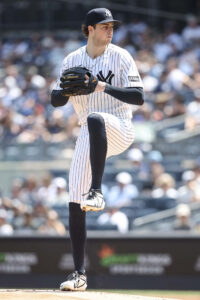
Of course, when it comes to the Cy Young, it’s ERA itself – not any of its more complicated cousins – that matters most. Nine of the last 10 winners had the lowest ERA in their respective leagues. The only exception was Sandy Alcantara in 2022. He managed to win the Cy with the NL’s second-lowest ERA because he threw so many more innings than any other pitcher that year. Given that precedent, it’s simple to understand why Schlittler has been the Cy Young favorite for months. He owns a league-best 2.19 ERA, and he’s only a few frames behind Michael Wacha for the AL lead in innings pitched.
Yet, Cease has been making the conversation far more interesting lately. Since returning from a brief IL stint in June, he has produced a sub-2.00 ERA in 12 starts. He held the Giants hitless through eight in his last start before the All-Star break. Two starts later, he shut down a red-hot Red Sox team in what was arguably the most dominant outing by an AL pitcher all season: 9 IP, 1 H, 0 R, 12 K.
Through the end of May, Cease’s ERA (3.05) was more than twice as high as Schlittler’s (1.50). Now, the gap between them is less than a quarter of a run. Cease is also averaging slightly more innings per start. With six weeks remaining in the season, he has time to close that ERA gap and make the difference between their inning counts negligible.
Schlittler has the head start. He would almost certainly win the AL Cy Young if the season ended today. But Cease has pitched better lately, his underlying metrics are equally impressive, and he has a much longer track record of success. That last point could be key. The 25-year-old Schlittler is playing his first full MLB season. He’s already thrown more innings than in any other year of his professional career. What he’s done so far is unbelievably impressive. However, he still has to prove he can finish what he’s started. Cease, on the other hand, already has a pair of top-five Cy Young finishes under his belt. Since 2021, no major league pitcher has started more games. The 30-year-old knows how to get through the rigors of the MLB season without giving in to fatigue. Indeed, his 3.27 ERA in September/October is his lowest in any month.
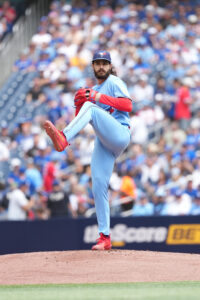
Cease and Schlittler aren’t the AL’s only aces. Sonny Gray of the Red Sox leads the American League with 15 wins. His 2.65 ERA would be the best of his career. Parker Messick of the Guardians might be leading the Rookie of the Year race in another season. His 2.59 ERA would be the lowest for a qualified AL rookie in 50 years. Drew Rasmussen of the Rays has kept runners off the bases like no one else. His opponents have a measly .247 OBP.
Yet, Schlittler and Cease hold the top two spots in ERA, xERA, FIP, SIERA, and every version of Wins Above Replacement. Schlittler’s ceiling is as high as anyone’s, while Cease is the picture of reliability. There’s still a chance an arm like Gray, Messick, or Rasmussen will surprise us, but as things stand, it’s hard to make a case for anyone other than Schlittler or Cease.
This weekend, the Yankees’ and Blue Jays’ hitters will get another chance to influence the AL Cy Young race. The two front-runners are both lined up to pitch in the Bronx: Schlittler on Friday night, and Cease the next afternoon. Before then, we’d like MLBTR readers to weigh in. Who do you think will win the AL Cy Young this season? Share your thoughts in the poll and the comments below.
Who will win the 2026 AL Cy Young?
-
Cam Schlittler 45% (2,055)
-
Dylan Cease 40% (1,831)
-
Other 16% (730)
Total votes: 4,616
Images courtesy of Nick Turchiaro and Wendell Cruz, Imagn Images.
Blue Jays Place Dylan Cease On 15-Day IL, Select Tanner Andrews
5:12pm: The Blue Jays have officially announced Cease’s IL placement. To take his 26-man roster spot, the Jays selected righty Tanner Andrews from Triple-A Buffalo. The Marlins drafted Andrews in the 10th round back in 2018, but he has still not pitched in the majors. Now 30 years old, Andrews has registered a 5.58 ERA in 129 Triple-A innings. He signed a minor league deal with the Blue Jays last winter and opened 2026 with 20 innings of 1.35 ERA pitching in Triple-A before his promotion. Andrews has struck out 22 batters and yielded just 11 hits as a Bison, but he has also issued 14 free passes. His selection gives the Jays a full 40-man roster.
3:29pm: The Blue Jays are placing right-hander Dylan Cease on the 15-day injured list, Ben Nicholson-Smith of Sportsnet was among those to report. Cease is dealing with a mild left hamstring strain, manager John Schneider announced.
This will be the first true IL stint for the durable Cease, who suffered the injury in a 4-1 loss to the Pirates on Sunday. Cease landed on the COVID-19 IL as a member of the White Sox back in 2021, but the team activated him after just two days on the shelf. Also a former Padre, Cease entered this season with five straight years of at least 32 starts on his resume. Whether he reaches the 30 mark for the sixth year in a row depends on how long this injury shelves him. Schneider said he’s “hoping it’s a minimal stay” on the IL (via Shi Davidi of Sportsnet).
Cease was a prized offseason acquisition for the Blue Jays, who added him on a seven-year, $210MM deal – the largest free agent contract in franchise history. Before the injury, the 30-year-old lived up to the billing. Over 11 starts, Cease has given Toronto 62 innings of 3.05 ERA ball with personal-best strikeout and ground-ball rates of 35.7% and 47.1%, respectively. His 10.1% walk rate is right in line with his career mark (10%), and advanced metrics such as xFIP (2.50), FIP (2.57), SIERA (2.73) and xERA (2.95) suggest Cease deserves even better results than he has gotten.
Despite Cease’s brilliance, the reigning American League champion Blue Jays have gotten off to an underwhelming 25-28 start. They already sit 10.5 games behind the AL East-leading Rays, but they are just a half-game out in a jam-packed wild-card race. Injuries have been a big part of the problem for Toronto, particularly in its rotation. Shane Bieber, acquired from the Guardians last season, stuck around on a $16MM player option, but he hasn’t pitched at all as a result of elbow inflammation. Cody Ponce suffered a season-ending knee injury just one start into a three-year, $30MM pact. José Berríos underwent Tommy John surgery last week, and Max Scherzer has been out for a month with right forearm tendinitis and left ankle inflammation. Eric Lauer stayed healthy for Toronto this year, but after he posted a dismal 6.69 ERA in 36 1/3 innings, the team traded him to the Dodgers earlier this month. That left one fewer depth option for the Blue Jays.
With Cease out for at least a couple of weeks, the sturdy Kevin Gausman will front the Jays’ rotation. Phenom Trey Yesavage missed most of April with a shoulder impingement, but he has been superb over five starts since he came off the 15-day IL. With a 3.86 ERA over nine starts and 44 1/3 innings, Patrick Corbin has given the club bang for its buck on a $1MM pact. Those three are locked into spots, but the rest of Toronto’s rotation is up in the air.
Photo courtesy of Kevin Sousa, Imagn Images.
Blue Jays’ Vladimir Guerrero Jr., Dylan Cease Leave With Injuries
8:35PM: Guerrero told Sportsnet’s Shi Davidi and other reporters postgame that he felt some numbness in his arm after being hit, but he described his status as just day-to-day. Manager John Schneider didn’t rule out Guerrero being in the lineup as early as Monday’s game with the Marlins, depending on how the All-Star feels after a night’s rest. Cease will undergo an MRI but also suggested to Schneider that he might not miss his next start, as the skipper said “all the [early] testing and stuff seemed pretty positive.”
1:51PM: The fifth inning on Sunday against the Pirates was a double whammy for the Blue Jays. Dylan Cease departed in the top of the frame with a leg injury. Vladimir Guerrero Jr. took a Mitch Keller sinker to the elbow in the bottom of the inning and was immediately replaced.
The team announced left hamstring discomfort as the reason for Cease’s removal. Guerrero has been diagnosed with a right elbow contusion. The first baseman had X-rays taken, which came back negative for a fracture, per the club.
Toronto has been among the most injured squads in the league. Catcher Alejandro Kirk, outfielder Nathan Lukes, and infielder/outfielder Addison Barger are currently on the injured list. Outfielder Anthony Santander had shoulder surgery will miss most or all of the season. On the pitching side, Jose Berrios, Bowden Francis, and Cody Ponce are done for the year. Shane Bieber has yet to appear this season. Max Scherzer remains out.
Cease is well-known for his impressive durability. The right-hander has never been on the 15-day injured list since debuting with the White Sox in 2019, apart from a brief stint in early 2021 for COVID-19 reasons. Cease has made 32+ starts in every season since the shortened 2020 campaign.
Guerrero also has a clean injury history. He’s never been on the injured list in his eight years in the big leagues. Guerrero has topped 155 games and 675 plate appearances in five consecutive seasons. An absence for either Cease or Guerrero would be challenging for Toronto to navigate, but neither injury seems like a major issue.
Photo courtesy of Nick Turchiaro, Imagn Images
MLBTR Podcast: An Agent’s Perspective with B.B. Abbott – Also, Cease, Williams, Helsley, And Gray
The latest episode of the MLB Trade Rumors Podcast is now live on Spotify, Apple Podcasts, and wherever you get your podcasts! Make sure you subscribe as well! You can also use the player at this link to listen, if you don’t use Spotify or Apple for podcasts.
This week, host Darragh McDonald is joined by B.B. Abbott of Wasserman Baseball to discuss…
- Abbott’s approach to free agency (3:30)
- The impact of the media on free agency (10:00)
- The different levels of player involvement in free agency (17:00)
- The decision to sign an extension instead of going to free agency (20:15)
- Chris Sale and his extensions with the White Sox, Red Sox and Braves (23:00)
- Byron Buxton and his extension with the Twins (28:50)
- Representing young players going into the draft (32:10)
- The general state of baseball (35:50)
Plus, Anthony Franco of MLB Trade Rumors joins the show to discuss…
- The Blue Jays signing Dylan Cease to a seven-year deal, recorded prior to the Cody Ponce agreement (40:30)
- The Mets agreeing to a three-year deal with Devin Williams (50:50)
- The Orioles signing Ryan Helsley to a two-year deal (55:40)
- The Cardinals trading Sonny Gray to the Red Sox for Richard Fitts and Brandon Clarke (1:06:30)
Check out our past episodes!
- Some “Classic Baseball Trades,” Nimmo For Semien, And Ward For Rodriguez – listen here
- Offseason Preview Megapod: Top 50 Free Agents – listen here
- Surprising Option Decisions, Qualifying Offers, And Paul DePodesta – listen here
The podcast intro and outro song “So Long” is provided courtesy of the band Showoff. Check out their Facebook page here!
Photo courtesy of Jerome Miron, Imagn Images
Blue Jays Open To Trading Jose Berrios
The Blue Jays’ early signings of Dylan Cease and KBO returnee Cody Ponce have deepened a rotation that already included Trey Yesavage, Kevin Gausman, Shane Bieber and Jose Berrios. Lefty Eric Lauer and righty Yariel Rodriguez give Toronto a pair of quality swing options, too, and the Jays still have Bowden Francis and former top prospect Ricky Tiedemann (who should be recovered from 2024 Tommy John surgery) in the upper minors as well.
The magnitude of Ponce’s three-year, $30MM contract presumably puts him squarely into the rotation. Barring a move to a six-man rotation or a spring injury, Toronto will have more starters than rotation places available. Injuries can turn a “surplus” into a deficiency pretty quickly, particularly when it comes to pitchers, but the Jays are willing to trade Berrios, Mitch Bannon of The Athletic reports.
It’s easy to frame this as the Jays adding enough depth that they’re now willing to deal Berrios. That’d be the charitable (to Berrios) way of shaping things. The other and perhaps more likely angle is simply that Toronto wasn’t enamored with Berrios continuing as its fourth starter and has acted decisively with a pair of additions pushing the veteran righty down the depth chart.
Berrios, 32 next May, has been an iron man for the Jays and Twins throughout his big league tenure. He’s started at least 30 games every year since 2018, with the exception of the shortened 2020 season, when he started a full slate of 12 games. No pitcher has started more games (234) or totaled more innings (1367 1/3) than Berrios in that span of eight years.
Along the way, Berrios has generally been an above-average starter. He’s logged a 3.94 ERA, set down 22.6% of his opponents on strikes and only walked 6.8% of the batters he’s faced. Few starters have been this reliable for this long.
Be that as it may, Berrios’ more recent seasons have seen him trend in the wrong direction. After punching out 23.7% of his opponents from 2018-23, he’s dropped to 19.6% over the past two seasons. Add in a 19.8% strikeout rate in 2022, and Berrios has now been under 20% in that regard in three of the past four years. League average in that time has been about 22.5%. Berrios has spent much of his career working with plus command, but this past season’s 8% walk rate — while still slightly better than the 8.4% league average — was up considerably from the 6.3% mark he posted across four prior seasons.
The worrying trends don’t stop there. Berrios’ 93 mph average four-seamer in 2025 was the lowest of his career, while the 92.2 mph average on his sinker was his second-lowest (leading only the 92.1 mph he averaged back in 2019). He also surrendered the highest average exit velocity (90.3 mph) and barrel rate (11.3%) of his career. His opponents’ 42.5% hard-hit rate was the second-highest mark in his MLB run. Berrios has only yielded a hard-hit rate north of 40% in three of his 10 major league seasons. All three have come within the past four years. Unsurprisingly, given the dips in velocity, command and whiffs, Berrios has become more homer-prone; after surrendering an average of 1.17 homers per nine frames from 2017-23, he’s up to 1.43 since Opening Day 2024.
None of this necessarily makes Berrios a bad pitcher. He’s an ultra-durable source of reliable, if unspectacular innings. However, coming off a down season that ended with what was incredibly the first IL stint of his big league career (elbow inflammation), would Berrios match the remaining three years and $66MM on his contract? He’d be hard-pressed to do so — certainly once factoring in the opt-out provision he has following the 2026 campaign and the escalators that could push his remaining guarantee from $66MM to $70MM.
Currently, Berrios is guaranteed $24MM in both 2027 and 2028. Both figures would rise by $1MM if the right-hander pitches a combined 300 innings in 2025-26 and another $1MM if he gets to a combined 350 innings. With 166 frames under his belt in 2025, he’d only need 134 innings in 2026 to secure an additional $2MM and a tougher but plausible 184 innings to tack on yet another $1MM per season. Given his durability, it’s likely that Berrios will at least be promised at least $50MM over two seasons when weighing his opt-out opportunity next winter — and possibly two years and $52MM.
All of that coalesces to make Berrios a difficult player to trade. He’ll pitch next year at 32, so it’s hardly out of the question that he rediscovers some of his waning ability to miss bats and/or limit walks and boosts his profile a bit. In that instance, however, Berrios might very well opt out of the two years left on his contract beyond the 2026 season. On the other hand, if the veteran righty continues to see his strikeouts dip and/or see his walks creep further north, he could be more of an innings-eating fifth starter who’s trending down and owed $24-26MM in both his age-33 and age-34 campaigns.
Essentially, any team trading for Berrios would probably do so with the hope that he’d rebound closer to his 2021-23 form — at which point he’d likely opt out. But to acquire him, they’d also have to take on the downside of Berrios maintaining his recent status quo or even slipping further, thus making that $48-52MM owed to him in 2027-28 wholly unappealing.
It’d be a surprise if the Jays were to find an interested team that was willing to both take on the entirety of Berrios’ remaining contract (to say nothing of doing so and surrendering young talent). In all likelihood, the Jays would need to include at least some cash or take back another contract of some note at a different position. That said, starting pitching is always in demand, and there are always teams looking for creative ways to swap weighty contracts that might better fit their current roster or payroll objectives.
One other fascinating wrinkle to consider: Berrios ended the 2025 season with 9.044 years of major league service time. That places him 128 days shy of 10 years. With MLB Opening Day set for March 25 and the trade deadline set to fall on Friday, July 31, Berrios would reach 10 years of service the day before next summer’s deadline. At that point, he’d acquire 10-and-5 rights — 10 years of MLB service, including the past five with the same team — thereby granting him full veto power over any trade scenarios. Currently, Berrios can block trades to a slate of eight teams.
Toronto can still carry Berrios into the 2026 season and enjoy the depth he provides. In all likelihood, injuries are going to thin out the top end of the current rotation options. That’s just reality for any big league club in today’s game. But the Jays have viable rotation alternatives, and the looming realization of Berrios’ 10-and-5 rights mean that trading him next winter will be even more complicated if he chooses to forgo his opt-out. There’d also be quite a bit of pressure to try to push a deal across the finish line in late July in the event that the Jays are intent on dealing him this summer.
It’s a complicated scenario, to say the least. Berrios’ contract is underwater but not an albatross. He’s a durable source of steady innings but no longer a borderline All-Star. The Jays can try to trade him this winter or during the season, but they’ll have not only the “clock” of the trade deadline but also the artificial clock of Berrios’ forthcoming full no-trade rights. Moving Berrios now would free up some more space for a run at re-signing Bo Bichette or trying to lure Kyle Tucker to Toronto, though the Jays would probably need to take on some other costs in order to get a deal done. It all makes for a fascinating thread to follow ahead of next week’s Winter Meetings, where convoluted trade packages and high-profile changes of scenery are the norm.
Blue Jays Sign Dylan Cease To Seven-Year Deal
December 3rd: The full breakdown is provided by Jon Heyman of The New York Post. Cease gets a $23MM signing bonus and then a $22MM salary in 2026. His salary then jumps to $30MM in 2027 and falls by $1MM in each subsequent season. $10MM of his 2026 salary is deferred followed by $9MM in each season after that. The deal also contains awards bonuses and a limited no-trade clause.
December 2nd: The Jays made it official today, announcing they have signed Cease to a seven-year deal. Ken Rosenthal of The Athletic reports that the MLBPA values the contract at roughly $184.6MM after adjusting for the deferred money.
November 26th: The Blue Jays are making a major splash at the top of the rotation. Toronto is in agreement with Dylan Cease on a seven-year contract, pending a physical. It’s reportedly a $210MM guarantee for the Boras Corporation client, though it includes deferred money that’ll drop the average annual value for luxury tax purposes to roughly $26MM. That puts the net present value closer to $182MM.
Even after adjusting for deferrals, it’s the largest free agent signing in franchise history. Though the Jays gave Vladimir Guerrero Jr. a $500MM extension earlier this year, they’d never gone beyond George Springer‘s six-year, $150MM deal on the open market.
Cease, 30 next month, entered free agency as a test case of how much modern front offices care about earned run average. In two of the past three seasons, his ERA has jumped to the mid-4.00s, including a 4.55 mark in 2025. However, in just about every other respect, he has been great. He has been incredibly durable. His control isn’t amazing but he has racked up strikeouts. He has kept his fastball velocity in the upper 90s, while also featuring a slider, knuckle curve and changeup.
Though Cease debuted back in 2019, he has actually never been on the major league injured list, apart from a very brief stint on the COVID list in 2021. He made 12 starts in the shortened 2020 season and has taken the ball at least 32 times in each full season since. In total, he’s made 174 starts since the start of 2020, which leads all major league pitchers. He generally doesn’t pitch deep into games, however, so he’s ninth in that span in terms of innings.
On top of the quantity, the quality has been strong. For that same 2020-25 span, he posted a 3.88 ERA. His 9.9% walk rate was a bit on the high side but he punched out 28.9% of batters faced with a 14.4% swinging strike rate.
As mentioned, his ERA has wobbled in recent years, but it has done so while other elements of his game have stayed more consistent. He actually saw his ERA drop to 2.20 in 2022. With the White Sox at that time, he finished second in American League Cy Young voting to Justin Verlander. His ERA then shot up to 4.58 in 2023, dropped to 3.47 in 2024 and then climbed back up to 4.55 this year.
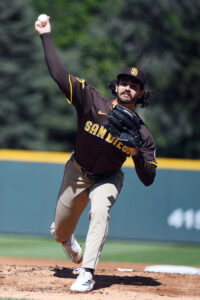
But during those ups and downs, his strikeout and walk rates have been less volatile. His strikeout rate did drop from 30.4% in 2022 to 27.3%, but then it climbed to 29.4% and 29.8% in the two most recent campaigns. His 10.4% walk rate in 2022 decreased to 10.1% and 8.5% in the next two years, followed by a slight uptick to 9.8% in 2025.
His batting average on balls in play, which tends to be a bit more luck based, has synched up more with his ERA shifts. A standard BABIP is usually around .290 but Cease was down at .260 in that 2022 season. It then swung the other way to .330 in 2023 as Cease’s ERA climbed, then went to .263 and .320 in the two most recent seasons as his ERA dipped and climbed again.
As such, ERA estimators have considered Cease to be far more steady than his actual ERA. His FIP has been between 3.10 and 3.72 for the past four years. His SIERA was at 3.48 in 2022, jumped a bit to 4.10 in 2023, and then has been at 3.46 and 3.58 in 2024 and 2025.
As we were deliberating our Top 50 Free Agents post at MLBTR, we had many debates about whether the inconsistent ERA would hurt his earning power, perhaps leading him to accept a short-term deal with opt-outs, or if teams would overlook the ERA and sign him based on his consistency in other areas. In the end, we opted for latter, predicting a seven-year, $189MM deal. Cease has surpassed that in terms of sticker price, though the deferrals will seemingly put the net present value closer just below that projection.
The Blue Jays are coming off their best season in years, as they charged all the way to Game Seven of the World Series, ultimately falling to the Dodgers in extra innings. However, the season ended with plenty of rotation uncertainty. Chris Bassitt and Max Scherzer became free agents. Shane Bieber had a $16MM player option he seemed likely to decline. In the long term, Kevin Gausman is a free agent after 2026. José Berríos has an opt-out in his deal after the upcoming campaign.
In the past few weeks and months, the long-term outlook has improved considerably. Trey Yesavage came up late in the year and was immediately able to get hitters out, quickly establishing himself as a rotation building block. Bieber surprisingly decided to trigger his player option and stick with the Jays for one more year. Now Cease is in the fold for the long run.
That gives the Jays a rotation of Gausman, Cease, Yesavage, Bieber and Berríos going into 2026, with guys like Eric Lauer, Ricky Tiedemann and Bowden Francis also in the mix. Though Bieber and Gausman are slated to depart after the upcoming campaign, with Berríos potentially joining them, Cease can serve as a bridge to another era. By then, it’s possible Jake Bloss has recovered from his Tommy John surgery and is back in the mix. Prospects like Gage Stanifer and Johnny King might have climbed into the picture by then as well.
Toronto is paying a significant cost to lock Cease in as a long-term anchor. RosterResource projected their 2026 payroll around $232MM, while their luxury tax number was right around the $244MM base threshold. It won’t be clear how much either number goes up until the payment and deferral structure is reported. The CBT number is based on the contract’s average annual value, so the salary breakdown doesn’t matter for tax purposes, but the deferrals reduce the contract’s actual value by around $4MM annually.
In any case, the Jays are clearly going to pay the tax in 2026, and this will push them beyond the $264MM first surcharge tier. They’re into CBT territory for a second consecutive season, meaning they’re taxed at a 30% rate for their first $20MM in overages. They’ll pay a 42% tax on spending between $264MM and $284MM, 75% for spending between $284MM and $304MM, and a 90% rate on any further spending. The Cease deal itself comes with roughly $8.5MM in taxes, but the penalties will get higher with any more significant additions.
The Jays almost certainly aren’t done. They’ve been loosely linked to Kyle Tucker and have interest in re-signing Bo Bichette. It seems fair to assume they won’t sign all three of this offseason’s top free agents, but a Bichette reunion could still be in play. They’ve also been linked to late-inning bullpen help, ideally a proven closer who’d push Jeff Hoffman into a leverage role in the seventh and eighth innings.
Cease rejected a qualifying offer from the Padres. The Jays are hit with the highest penalty to sign a qualified free agent because they paid the competitive balance tax this year. They’ll surrender their second- and fifth-highest selections in the 2026 draft plus $1MM from their international bonus pool in 2027. San Diego also paid the luxury tax this year, so they’re entitled to the lowest form of compensation: a selection after the fourth round next summer. They’ll get another of those if/when Michael King signs elsewhere.
Jon Heyman of The New York Post first reported the Blue Jays and Cease were in agreement on a seven-year, $210MM deal. Ken Rosenthal of The Athletic was first on the presence of deferrals, while Mitch Bannon of The Athletic reported the approximate $26MM AAV.
Image courtesy of Christopher Hanewinckel, Imagn Images.
Orioles Showing Interest In Kyle Schwarber, Tatsuya Imai, Framber Valdez
Earlier this month, Orioles president of baseball operations Mike Elias said his team is open to signing free agents who have rejected a qualifying offer, and would therefore cost the O’s their third-highest selection in the 2026 draft in addition to whatever the free agent would command in salary. Of the nine players who rejected the QO, Jon Heyman of the New York Post reports that Baltimore has shown some interest in Framber Valdez, Kyle Schwarber, and Dylan Cease (before Cease signed with the Blue Jays yesterday). In addition to qualified free agents, the Orioles have “checked in on” Tatsuya Imai, as part of the team’s explorations of the upper tiers of the pitching market.
Heyman also linked Baltimore to Pete Alonso a couple of weeks ago, but now notes that the chances of a signing may have dimmed since the Orioles retained Ryan Mountcastle past the non-tender deadline. This doesn’t mean that Mountcastle couldn’t still be traded or cut loose entirely if a premium bat became a realistic option for Baltimore, though Elias said earlier this week that the team thinks Mountcastle can rebound after a hamstring strain hampered his production in 2025.
Signing Alonso or Schwarber would further deepen what is already perhaps an overcrowded mix of position players in Baltimore. Schwarber can play a corner outfield spot on an occasional basis but is largely a DH-only player at this stage of his career, further reducing the Orioles’ flexibility in trying to find at-bats for the rest of its current players. A trade or two might ease up this logjam, of course, and the Orioles could then acquire pitching via the trade market rather than free agency.
Even if a Schwarber or an Alonso creates some questions about lineup construction, the Orioles would happily accept that as a proverbial “good problem to have” if it means adding an elite power bat. Schwarber and Alonso are also both known to be clubhouse leaders, and adding a veteran mentor to a young O’s team might carry benefits beyond just what either player can provide at the plate.
There is a widespread belief that the Phillies will pay top dollar to re-sign Schwarber, but naturally that hasn’t stopped other teams from looking into his market. The Orioles join the Red Sox and Pirates as teams known to have shown interest in Schwarber’s services, and clubs like the Reds and Yankees have been more speculatively linked. Alonso’s market hasn’t been as robust in terms of public interest, though the Mets remain in the mix for another reunion with their longtime slugger.
The Orioles have already added one prominent bat this offseason by acquiring Taylor Ward from the Angels for Grayson Rodriguez, in a move that surprised some pundits since it further reduced the Orioles’ list of rotation options. This could indicate that if the O’s do break the bank on a big-ticket signing, it will be for a starting pitcher to help stabilize the rotation. Cease’s rather quick departure from the market (and to an AL East rival) only puts more pressure on the Orioles to find another frontline arm.
Valdez or Imai would certainly fit the bill, albeit in two different fashions. Valdez is a proven commodity at the MLB level, and is particularly a known quantity to Elias since Valdez joined the Astros organization as an international signing and then broke into the majors when Elias was still working in Houston’s front office. Imai is over four and a half years younger than Valdez and perhaps has more pure upside based on his results in Japan, but it remains to be seen if Imai can translate that success over to the majors. The O’s also don’t have a long track record in signing Japanese talent, though the club did add Tomoyuki Sugano last winter.
Tyler O’Neill‘s three-year, $49.5MM contract remains the only multi-year free agent deal the Orioles have signed during Elias’ seven years running the front office, though in fairness, much of Elias’ tenure was spent either rebuilding or working under some ownership turmoil. David Rubenstein’s purchase of the franchise in early 2024 didn’t immediately lead to a huge payroll boost, though the club did ink star prospect Samuel Basallo to an eight-year, $67MM extension this past summer. Basallo and O’Neill represent the only contracts on Baltimore’s books beyond 2026, and while the Orioles certainly have interest in locking up other young stars to extensions, there is plenty of future financial room for the O’s to make a splashy signing (or two) this winter.
Nine Players Reject Qualifying Offer
The deadline to accept the qualifying offer has passed. Four players — Trent Grisham, Gleyber Torres, Brandon Woodruff, and Shota Imanaga — chose to accept the one-year, $22.025MM deal and remain with their current clubs. The remaining nine players rejected the deal. They are: Cubs outfielder Kyle Tucker, Phillies DH Kyle Schwarber, Blue Jays infielder Bo Bichette, Astros lefty Framber Valdez, Padres righty Dylan Cease, Phillies lefty Ranger Suarez, Mets closer Edwin Diaz, Diamondbacks righty Zac Gallen, and Padres righty Michael King. All nine are now free agents.
There’s not much surprise in any of the nine players who rejected. Tucker, Schwarber, Bichette, Valdez, Cease, Suarez and Diaz were all locks. Gallen may have given some brief thought to accepting after a rough showing in 2025, but he finished strong and has a track record as a high-end starter who’s garnered multiple top-five finishes in NL Cy Young balloting. King was hobbled by nerve and knee injuries in an odd season but was dominant in 2023-24 and through the first two months of the current season. He was healthy late in the year and fanned three in his lone inning of postseason work. He’ll test the waters in search of a multi-year deal as well.
Now that this nonet has rejected qualifying offers, they’ll all be subject to draft compensation. Interested teams will need to surrender a draft pick (or multiple picks) and, in some cases, space from their bonus pool for international amateurs in order to sign any of this group. The extent of that draft compensation depends on the revenue-sharing and luxury tax status of the new team. MLBTR broke down which pick(s) each club would forfeit by signing a “qualified” free agent last month.
Similarly, the compensation for each player’s former club is dependent on revenue-sharing and luxury tax status — as well as the size of the contract signed by the player in question. MLBTR also ran through the compensation each team would receive if their qualified free agents turned down the offer and signed elsewhere.
Cubs Among Teams Interested In Michael King
The Cubs are in the market for notable rotation upgrades this offseason, and right-hander Michael King is among the names on their radar, per Patrick Mooney and Sahadev Sharma of The Athletic. Mooney and Sharma also double down on the Cubs’ previously reported interest in Dylan Cease, noting that the Cubs are willing to forfeit the requisite draft pick and international funds to sign a player who has rejected a qualifying offer (which both Cease and King received from the Padres).
King, 31 next May, has had an atypical arc over the past few seasons. A swingman and multi-inning reliever for several years in the Bronx, he moved into the Yankees’ rotation late in the 2023 season and posted brilliant results in nine starts down the stretch. New York shipped him to San Diego as part of the Juan Soto blockbuster of the 2023-24 offseason, and King subsequently broke out as one of the top starters in MLB, starting 30 games for the Friars and turning in a 2.95 ERA with a hearty 27.7% strikeout rate against a solid 8.7% walk rate.
It was more of the same early in 2025. King sprinted out of the gates with a 2.59 ERA and even better rate stats (28.4 K%, 7.6 BB%) in his first 10 starts. By late May, he’d claimed the No. 6 spot on our Free Agent Power Rankings here at MLBTR. A nine-figure free agent deal seemed all but certain — provided King stayed healthy.
That proved to be a major caveat. The Padres placed King on the 15-day IL in late May with what was originally termed inflammation in his right shoulder. San Diego later called it a pinched nerve in his shoulder, but it wasn’t expected to be a prominent injury … at least not at first. King, however, wound up spending nearly three months on the shelf. In late June, King publicly voiced frustration with the injury, noting that there were days where he was in significant discomfort and could barely muster any baseball activity — and that he’d wake up a day later feeling close to 100% and ready to go.
King finally returned the mound in early August, giving the Padres hope that he’d be back atop their rotation down the stretch. His return lasted all of two innings, however — but not due to his previously problematic shoulder. Rather, King landed back on the 15-day IL due to a left knee issue that popped up in his return effort. An MRI revealed no structural damage, and King hoped to be back after a minimal stint but still wound up sidelined for another month.
King returned for good in early September, but his results in four starts were rocky. He pitched just 15 2/3 innings and yielded 10 runs on 18 hits (including six homers) with an 11-to-7 K/BB ratio. Brilliant as his start to the season was, King pitched a total of 17 2/3 innings with a 6.11 ERA following May 18. He made one appearance with San Diego in the postseason, pitching one inning of relief — and striking out the side in a perfect frame.
There’s little doubting that King is among the most talented arms in the sport, but his platform year before free agency finished with more of a whimper than a roar. The Padres seemingly don’t have any qualms about his health. They issued him a $22.025MM qualifying offer despite having minimal payroll flexibility this winter. San Diego would presumably be thrilled to have King back, given the need in their rotation, but they’re reportedly aiming for a similar payroll to 2025 and King accepting the QO would put them about $10MM over where they sat in ’25. If the Padres had major concerns about his shoulder and/or knee, they likely wouldn’t have risked the QO — particularly since their compensation for him signing elsewhere will only be a pick after the fourth round (rather than after the first) due to their status as a luxury tax payor.
King isn’t necessarily the sole focus of the Cubs’ hunt for rotation upgrades (nor is Cease). The Athletic duo note that Chicago has some interest in star NPB righty Tatsuya Imai and they could rekindle last offseason’s trade talks with the Marlins about their starting pitchers. Imai will be posted for major league teams next week. Marlins ace Sandy Alcantara is signed through 2026 with a club option for 2027, while 27-year-old righty Edward Cabrera is controlled via arbitration through 2028. It’s still possible that lefty Shota Imanaga returns, whether via accepting his own QO or perhaps working out a new two-year deal.
The Cubs currently project for a payroll of about $158MM, per RosterResource, which sits around $50MM shy of their end-of-season levels in 2025. They’re nowhere close to the luxury tax, currently sitting close to $75MM shy of next year’s $244MM first-tier threshold. Shortstop Dansby Swanson is currently the only Cubs player who’s guaranteed anything beyond the 2026 season. His seven-year, $177MM contract runs through 2029. There’s quite literally no free agent the deep-pocketed Cubs can’t afford to pursue, so the only limitations on their winter additions will be self-imposed if the bidding reaches a point that’s too far beyond the comfort zone of either the front office or owner Tom Ricketts.