Showing posts with label Cuisine: Finnish. Show all posts

Tuesday, October 04, 2016

It's cinnamon bun day (kanelbullens dag)!

Korvapuustit / Finnish cinnamon rolls / Soome kaneelisaiad

It's Cinnamon Bun Day in Sweden today. Cinnamon Bun Day was established in 1999, or 17 years ago, when Swedish Home Baking Council (Hembakningsrådet) came up with the idea when looking for a way to celebrate their 40th anniversary. Many Swedes rush to their favourite bakery today and buy some kanelbullar - or bake their own. You'll find a good recipe for Swedish kanelbullar over on Sweden.se site (written by Anne).

I've previously given you recipe for my traditional cinnamon rolls (with step-by-step photos), as well as the hugely popular cinnamon pull-apart bread. Today's recipe is for Finnish korvapuustit ('Slapped ears') - more or less the same thing, just shaped and braided slightly differently.

Korvapuustit/Finnish cinnamon buns
(Soomlaste kaneelisaiad)
Makes about 16 large buns

Korvapuustit / Finnish cinnamon rolls / Soome kaneelisaiad

450 g all-purpose flour (about 750 ml or 3 cups)
85 g caster sugar (100 ml)
1.5 tsp ground cardamom pods
0.5 tsp salt
1 packet of fast-action dried yeast (about 11 g)
250 ml lukewarm milk (1 cup)
1 egg (divided)
75 g butter, softened

Filling:
50 g butter, softened
4 Tbsp caster sugar
cinnamon

Topping:
pearl sugar (optional)

In a large mixing bowl, mix most of the flour, sugar, cardamom, salt and yeast. Stir in the milk and about half of the egg (leave some for brushing the buns before baking). Knead in the softened butter and the rest of the flour, if necessary. Knead until you've got a soft and pliable dough that releases from the sides of the bowl. Cover with clingfilm or a clean towel and leave to prove for about 45-60 minutes, until doubled in size. (The place for proving should be warm and draught-free).
Turn the dough onto a lightly floured table, knead gently couple of times. Roll into a reclangle sized 30x60 cm. Spread soft butter over the dough, then sprinkle generously with cinnamon and sugar. Roll up tightly, starting from the long side, leaving the "seam" under the roll.

Now use a sharp knife to cut into buns, following the scheme here. The buns should be about 2 cm wide on the narrow end and 5 cm on the wide end.

Korvapuustit / Finnish cinnamon rolls / Soome kaneelisaiad

Transfer onto a parchment-lined baking sheet, placing them upright. Using your thumbs or a large pencil, press a dent into the middle of each bun, just like this:

Korvapuustit / Finnish cinnamon rolls / Soome kaneelisaiad

Cover with a kitchen towel and leave to raise for another 30 minutes in a warm place. Meanwhile, preheat the oven to 225 C/450 F.

Brush with egg wash and sprinkle with pearl sugar. Bake in a preheated oven for 10-15 minutes, until the buns and golden brown.

Take the baking sheet out of the oven, and cover the buns with a kitchen towel and let them cool (a little) - this way they remain nice and soft.

Korvapuustit / Finnish cinnamon rolls / Soome kaneelisaiad

Saturday, March 21, 2015

A recipe for gluten-free hazelnut meringue roulade aka Budapestrulle (Budapestbakelse)

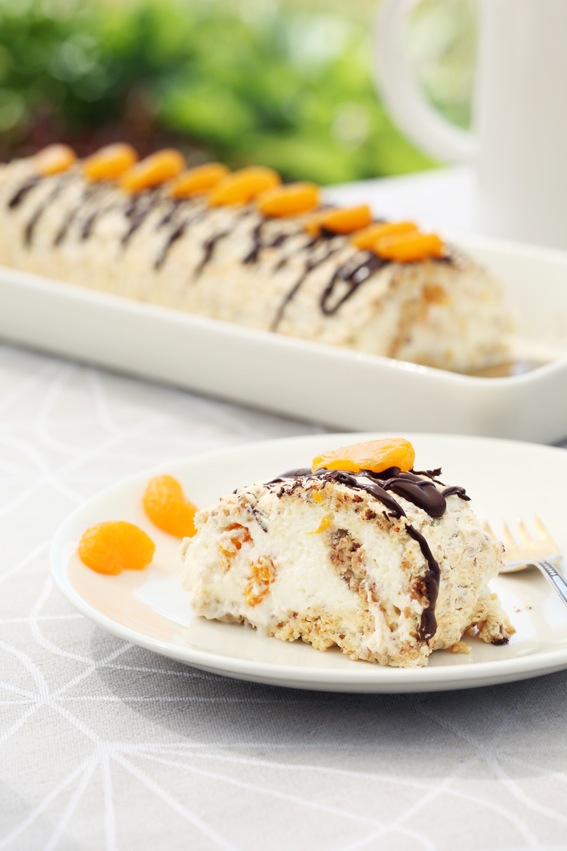
ROOTSI: Budapestrulle. Budapest hazelnut meringue roulade.

I am writing this post while sitting on a really comfortable bed in a brand new hotel in Helsinki, called Indigo Hotel. I'm in town for a long weekend to enjoy the Streat Helsinki street food festival. The press trip is organised and hosted by Visit Helsinki, and we have been taken very good care of. This morning Heather of Heather's Helsinki took us for a coffee and Budapest cake at Karl Fazer Café at Kluuvikatu 3. The cake in question was a Budapest slice.

It's a popular cake from Sweden, attributed to a pastry chef Ingvar Strid who was born in 1926 in Vetlanda. It's a hazelnut meringue roulade filled with whipped cream and peeled clementine slices. Delicious! The version popularised by Fazer in Finland is slightly different - the clementines/mandarine oranges are replaced with bananas and raspberries. Different - and sweeter - but still nice.

Here's my version of Budapestrulle - I make the classic Swedish version. The recipe below uses a popular and widely available Swedish product, Marsán snabb vaniljsås, but feel free to replace it with cornflour or potato starch or even all-purpose flour (in latter case it won't be gluten-free, of course).

Since 2013, May 1st has officially been the Budapestbakelsensdag in Sweden.

Budapest slice
(Besee-pähklirull)

Serves 8 to 10

Meringue:
4 large egg whites
100 g caster sugar
150 ml (about 90 g) vanilla custard powder
100 g toasted hazelnuts, finely chopped

Filling:
200 ml whipping cream
1 tsp caster sugar
300 g canned mandarine oranges/clementines, drained

Decoration:
50 g dark chocolate
some canned mangarine oranges/clementines

Heat the oven to 200 C. Grease and line a shallow Swiss roulade tin/baking tray with a parchment paper.

Using electric mizer, whisk the egg whites until stiff but not try. Add the sugar in 2-3 installments, continue whisking until the mix is shiny and white.

Combine the hazelnuts and vanilla custard powder, then gently fold into the meringue mixture. Spread the mixture into the prepared tin. Bake in the middle of pre-heated oven for 12-15 minutes, until the meringue is risen and slightly golden on edges.

Take out of the oven and cool completely. Then turn over onto a new piece of parchment paper and peel off the "baked" parchment paper.

For the filling, whisk the cream and sugar until thick and fluffy, then spread over the meringue. Put some mandarine slices aside for decoration, then scatter the rest over the cream. Roll up the roulade, starting with the long end, and using the paper underneath to help. Carefully lift onto a serving dish, leaving the "seam" underneath.

Melt the chocolate, drizzle over the meringue roulade. Garnish with mandarine orange slices. To serve, cut the cake into thick slices.

The photo above is by Juta Kübarsepp, taken for my cookbook "Nami-Nami. Maailma maitsed 1" (Varrak, 2013).

Wednesday, August 27, 2014

Creamy chantarelle sauce recipe (aka creamy girolle sauce)


My regular readers all know about my love for wild mushrooms. We had a long and hot and dry summer here in Estonia - not the time for forageing for wild mushrooms. However, the autumn rains have arrived, so soon I'll be heading to our regular mushroom forests to fill up the baskets (yes, the basket and my pink wellies are already in the boot of the car, waiting :))

Until then, I have to do with the fresh chantarelle/girolle mushrooms that are widely available at this time of the year. They actually appeared at the market stalls in early June, but were gone for a short while because of the heatwave. I'm glad they're back, for sure!

I make a popular Estonian dish - kukeseenekaste - quite regularly. It's a simple creamy chantarelle sauce that can be made either with fresh cream (then a spoonful of flour is often added for thickening) or sour cream. I prefer the latter these days, so the recipe is for that. While it's a typical dish in Estonia, it's not exclusively Estonian. The Finns make the same dish, calling it kantarellimuhennos. What is perhaps unique to Estonia is that we serve the chantarelle sauce as a dish on its own right - not as a delicious sauce alongside a steak or grilled elk or pan-fried fish or something along those lines. Kukeseenekaste is a perfectly satisfying meal on its own. (But then we're funny like that here in Estonia. We can also have a pile of _brilliant_ potatoes as the centrepiece of a meal - just read Alanna's overview about her trip to Estonia ;))

Chantarelle sauce
(Kukeseenekaste)
Serves 4 to 5

400 g fresh chanterelle/girolle mushrooms
1 Tbsp butter
1 yellow onion, finely chopped
200 g sour cream
salt and pepper
handful of chopped herbs (dill, parsley, spring onions)

Carefully clean the mushrooms, then chop coarsely and set aside.
Melt the butter on a large frying/skillet pan over medium heat. Add the onion and sauté gently for about 5-7 minutes, until just slightly golden.
Increase heat and add the mushrooms. Season with salt and pepper, then fry for about 5 minutes, stirring every now and then, until the mushrooms have wilted.
Add the sour cream, stir and just heat through.
Fold in the herbs and serve with boiled or mashed potatoes.

More chantarelle recipes:
Chantarelle pesto
Carrot and chantarelle quiche
Chantarelle bruschetta
Beef stroganoff with chantarelle mushrooms

Monday, July 21, 2014

Summer food: Estonian milk and vegetable soup

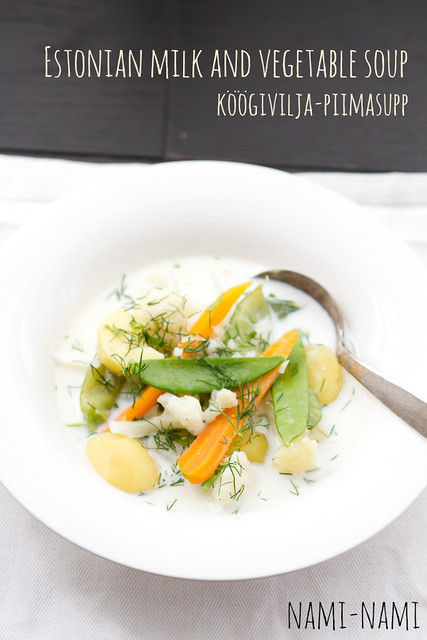
Köögivilja-piimasupp. Kesäkeitto. Estonian milk and baby vegetable soupl

It's mid-July, which here in Estonia means the peak of summer. We're having a beautiful summer here, with lots of sun and not much rain. It's the end of the wild strawberry season, it's the height of chantarelle mushroom season (but too early for most other wild mushrooms), and it's the start of the beautiful local vegetable harvest season. Here's a traditional milk soup that glorifies those early tiny vegetables that are still crisp and sweet. I bought the cauliflower and potatoes - simply because I don't grow these, but the carrots and snap peas were from our own little back yard.

Although the soup is part of the Estonian traditional cuisine, it's not just Estonian. Our Northern neighbours, the Finns, eat a similar soup, called kesäkeitto or summer soup (I've provided links to several recipes at the end of the post). The Swedish name for the soup is snålsoppa or sommarsoppa.

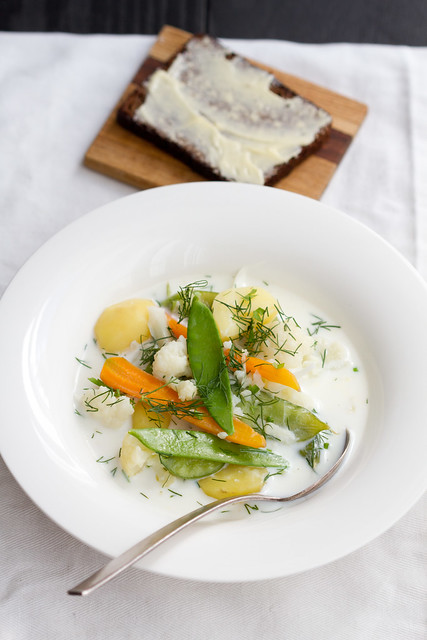
The soup is best served with some buttered dark rye bread. It's best on day one, though it reheats well. However, be careful not to burn the milk. There's nothing worse than burnt or simply overcooked milk soup, trust me :)

Estonian milk and vegetable soup
(Köögivilja-piimasupp)
Serves four to six

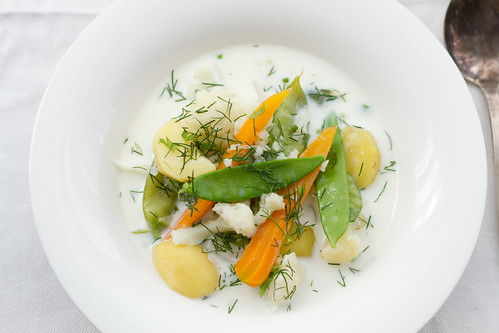
Piima-köögiviljasupp. Kesäkeitto. Estonian milk and vegetable soup.

a handful of baby carrots
1 small head of cauliflower or white cabbage
a large handful of (sugarsnap) peas
a large handful of new potatoes
500 ml (2 cups) water
1 tsp salt
2 Tbsp butter
1 litre (4 cups) full-fat milk
fresh dill, finely chopped

Scrub the carrots and potatoes clean, then cut the potatoes into small chunks and the carrots into slices about 3-4 mm thick (if you've got pretty slim carrots, then you can also halve or quarter them lengthwise instead, see the photos). Divide the cauliflower into small florets, or shred the cabbage into small thick slices. Pod the peas, if using regular green peas.

Place carrots, potatoes and cauliflower/cabbage into a medium saucepan. Add water, season with salt and butter. Bring into a boil. Half-cover with the lid and simmer for about 15-20 minutes, until the vegetables are almost cooked. Add the peas and cook for 5 more minutes.

Now pour in the milk. Bring slowly into a boil, stirring gently. Remove from the heat, add the dill and season to taste. Serve and enjoy.

Piima-köögiviljasupp. Kesäkeitto. Estonian milk and vegetable soup.

Similar recipes:
Finnish summer soup by Alanna @ Kitchen Parade
Kesäkeitto by Wendy @ A Wee Bit of Cooking
Summer soup (kesäkeitto) by Lakshmi @ Pure Vegetarian (no recipe, but, oh, the photos!)
Finnish summer soup @ The Kitchn
Summer Soup by Mia @ Cloudberry Quark
Summer soup (snålsoppa) by Katarina @ Hovkonditorn: Passion for Food and Baking

Thursday, October 25, 2012

Finnish mince and cabbage gratin

Finnish mince and cabbage dish / Soome kapsa-hakklihavorm

You've already got the recipe for the Estonian cabbage and mince stew (recommended!), here's a Finnish version that's similar, yet totally different. Whereas Estonians like their mince and cabbage as a stew alongside some boiled carrots, the Finns throw in some rice (and syrup or honey - they've got a sweeter tooth!), layer it into a oven dish and bake it slowly until done.

Both are lovely. You could even make a large batch of the Estonian one, and use any leftovers for the Finnish version on the next day :)

The traditional condiment is lingonberry jam (you'll find a jar in your nearest IKEA store), but sour cream works just as well.

Finnish mince and cabbage gratin
(Kapsa-hakklihavorm riisiga)
Serves 6

150 ml short-grain "porridge" rice, uncooked
400 ml water
0.5 tsp salt

about 1 kg white cabbage, finely shredded
1 onion
400 g beef mince
1 tsp salt
0.25 tsp black pepper
1 tsp dried oregano or marjoram
1-2 Tbsp sugar syrup or honey (or use cornsyrup, maple syrup or even agave nectar)
400 ml beef stock

Place rice, salt and water into a saucepan, bring into a boil. Reduce the heat and simmer gently until the rice has absorbed the water. Remove from the heat and put aside.
Chop the onion. Put beef mince and onion into a large and heavy frying pan and fry until slightly browned. Season with salt, pepper and marjoram, then add to the rice.
Add the cabbage to the frying pan, season with a bit of salt and heat, stirring regularly, until the cabbage is slightly coloured and "collapsed". Season with syrup, then combine with the rice and the fried minced beef.
Pour into a medium-sized oven casserole dish, pour beef stock on top.
Bake in a preheated 200 C oven for one hour to one hour and 15 minutes. Use your judgement and cover the dish with a piece of foil at the end, if necessary.

Friday, February 03, 2012

Estonian recipes: Alexander cake (Aleksandrikook)

Alexander cake / Aleksandrikook
Alexander cake, March 2011, dyed with sea-buckthorn juice concentrate

I'm dedicating February to various Estonian recipes, so if you've travelled to Estonia and want a specific recipe or two, let me know. Aleksandrikook aka Alexander cake has been requested here on Nami-Nami on several occasions, so it's about time to listen to my dear readers and post a recipe :)

To start with, Alexander cake is not actually Estonian in its origin, even though it's rather popular here and found in many traditional coffee and pastry shops. Our Nordic neighbours, Finns, claim the cake as their own. But then I've even come across recipes for Alexander cake in Latvian cookbooks, so it's popular in all over the North-Eastern corner of Europe.

Apparently its history goes back to 1814 or 1818, depending on your sources, when Alexander I of Russia, the reigning czar, visited Helsinki, and was served this concoction on his birthday. The cake is mentioned in Kullo manor's ledger books from 1819-1821. By 1850s, the cakes were sold in Café Ekberg (they still are, gorgeously pink in colour and sandwiched with apple spread).

In principle, it's a simple cake. Two layers of shorcrust pastry, sandwiched with thick raspberry (or other) jam, and topped with simple icing. However, as one talented Estonian food blogger has written somewhere, it's actually a tricky cake to do well. First, it's important not to overmix the pastry, as it won't have the right texture. It's important to roll out the pastry evenly, as otherwise it won't bake evenly. To lift one cake layer on top of the other is tricky as well - if you're unlucky, it'll break apart. If you're making this in a cafeteria, then you'll need to cut perfectly even-sized rectangles, and the glaze needs to be pretty and pink (or cocoa-brown, if you're opting for the cocoa glaze).

NOTE: this should be baked and put together a day before serving, otherwise it'll be too dry and crumbly!

Aleksander's cake / Aleksanterin leivos / Aleksandrikook
Alexander cake, September 2009, dyed with fresh black aronia juice and white chocolate

I've included some links to Estonian and Finnish foodbloggers that have written about the cake - you'll find them at the end of this post.

Alexander cake
(Aleksandrikook)
Cuts into 12 rectangles

Alexander cake / Aleksandrikook
Alexander cake, March 2011, dyed with sea-buckthorn juice concentrate

Pastry layers:
125 g caster sugar (150 ml)
300 g all-purpose flour (500 ml, about 2 cups)
1 tsp baking powder
200 g butter, at room temperature
1 egg

Filling:
250 ml (1 cup) thick raspberry jam

Glaze:
250 g icing sugar/confectioners sugar (about 400 ml)
3-4 Tbsp raspberry or black aronia juice

Make the pastry by mixing all dry ingredients in a large bowl. Add the butter, and using your fingers for mixing, mix until you've got large crumbs. Add the egg and quickly mix the pastry until it comes together.
Take a parchment paper that fits your baking sheet. Place the pastry on top of the paper and using a slightly floured rolling pin, roll the pastry to fit the baking sheet.
Bake in a preheated 175C/350F oven until dry and light golden brown (about 20 minutes).
Take out from the oven, and cut into two even-sized rectangles (the final cake will be half the size of your baking sheet). Cool lightly.*
Spread the jam over one shortcake base. Then very carefully lift the other shortcake layer on top of the one covered with jam.
Cut into squares (but don't separate the pieces) and leave to cool completely.
Make the glaze by mixing some colourful juice into the icing sugar until you've got a runny sugar glaze. Pour and spread that over the cake pieces and leave to set.

* Note that there is an alternative way of baking this cake - you'll sandwich two shortcake layers together with jam BEFORE baking (obviously you'll need to bake it a bit longer then). I've never tried this version.

Alexander cake / Aleksandrikook
Alexander cake, March 2011, dyed with sea-buckthorn juice concentrate

Fancy more? Here are some links to other foodbloggers' posts about Alexander cake - these give you a good idea about the different ways of glazing the cake.

ESTONIAN BLOGGERS:
Aniitram (a classic cocoa frosting and white frosting, zigzag pattern), MARU (Estonian designer and food writer), Qsti, Ragne, Liina, Sille

FINNISH BLOGGERS:
Kinuskikissa (one of the most popular Finnish foodbloggers, she used a cappuccino-flavoured glaze), Jaana, Sarppu (apple version), Maija (she uses marzipan in the filling!).

LATVIAN BLOGGERS:
Zitinja

Tuesday, September 27, 2011

Bruschette with chantarelle pesto

Chantarelle pesto / Kukeseenepesto

We've had another wonderul wild mushroom year in Estonia. With two small kids, I've only made it to the forest twice myself, but friends and family have supplied us with plenty of different wild mushrooms. Chanterelle is one of the most popular wild mushrooms - they're easy to recognise, versatile and taste lovely, and I've had more than my fair share of chantarelle dishes this summer. Chantarelle bruschetta, boiled potatoes with fried chantarelles, creamy chantarelle sauce, chantarelle quiche - you name it, I've had them all. Again. And again. So when I spotted a recipe for chantarelle pesto in the Finnish Kotiliesi magazine, it immediately caught my attention - something new, something that I hadn't tried with chantarelles before..

It turned out to be a lovely mushroom spread that I'll be making over and over again when I get fresh mushrooms.

Chanterelle pesto
(Krõbesaiad kukeseenepestoga)
Serves 4 to 6

Chanterelle pesto / Kukeseenepesto

Chantarelle pesto:
250 g fresh chantarelles
1 Tbsp butter
1 small garlic glove, coarsely chopped
salt and freshly ground black pepper
80 g toasted pinenuts
1 small bunch of fresh basil
5 Tbsp freshly grated parmesan
about 5 Tbsp extra virgin olive oil

To serve:
ciabatta or baguette
olive oil
garlic

Clean the mushrooms, avoid washing them, if possible. Transfer onto a hot dry non-stick frying pan and heat, until the liquid has evaporated.
Add butter and garlic, fry for a few minutes. Remove from the heat, season with salt and pepper and cool
Place the basil and pinenuts into a food processor and blitz for a few seconds. Add the cheese, fried mushrooms and about 2-3 Tbsp of oil. Process until you've got a coarse paste. Fold in the rest of the oil, check for seasoning.
 To make bruschette, cut the bread into thin slices and sprinkle with some oil. Bake under a grill until lightly golden and crispy, then smear some garlic over the bread slices.
Spread the chantarelle pesto on top, garnish with some Parmesan cheese shavings and serve.

Wednesday, July 07, 2010

Cottage Cheese and Egg Salad

Egg butter with farmer's cheese / Munavõi kodujuustuga

Egg Salad (called 'munavõi' or 'egg butter' in Estonian) is a popular sandwich spread in Estonia. The traditional version contains just softened butter and boiled eggs, seasoned with salt. However, I've come to prefer this slightly lighter version over the last few years. In addition to the butter and eggs, this version contains cottage cheese or farmer's cheese. As far as the herbs go, I love chives here, but dill, parsley, savory would work as well.

It can be kept in a fridge for a few days, covered, but it tastes best when freshly made. If you do make it in advance, then bring to the room temperature 15-20 minutes before serving. Serve with boiled potatoes, on home-baked rye bread, or as a sandwich filling.

Cottage Cheese and Egg Salad
(Kodujuustu-munavõi)
Serves four to six

Egg salad / Kodujuustu-munasalat

3 to 4 eggs
100 g butter, softened
150 g cottage cheese
sea salt
fresh chives, finely chopped

Hard-boil the eggs using your favourite method, cool to room temperature, then peel. Separate the cooked egg yolks and whites.
Place the butter and egg yolks into a bowl and use the back of a wooden spoon to cream the mixture (that gives the gorgeous yellow colour!).
Finely chop the cooked egg whites, stir into the rest of the ingredients alongside the chives. Season with salt.

Wednesday, November 21, 2007

Beef and Beer Oven Stew aka Finnish Merimiespata

Meremehehautis ehk veiselihahautis kartuli ja õllega. Sjömansbiff. Sailor's stew.
Photo by Juta Kübarsepp for the November 2013 issue of Kodu ja Aed magazine.

Last Sunday K. and I headed to a small village called Pedaspea in the beautiful nature reserve Lahemaa in Northern Estonia, to spend a day with his friends cooking, eating, walking, playing Scrabble and generally catching up. We were supposed to bring along the main course, and thus we spent hours last week trying to decide what to make. Eventually we packed along our trusty old 5-quart cast-iron cooking pot (Dutch oven?), my sharp cook's knife, and picked up some nice beef from our local butcher and some potatoes, a bottle of beer and a pot of thyme from the grocery store.

After an hour's drive we arrived in the beautiful location on the seaside, regretting that the weather wasn't good enough for a quick swim, as the house is about 20 metres from the sea:) We then unpacked our groceries, sliced and fried and layered and seasoned the meat and veg, carefully placed our cast iron pot into the oven full of hot coals, and ventured out for an hour to explore the surroundings.

When back, the hosts Ellen and Jaan served us two dishes from Tessa Kiros' beautiful book on Italian food, Twelve: A Tuscan Cookbook. For starters, we had grilled bread with stewed Savoy cabbage (Crostone di Cavolo). And for dessert we enjoyed her Almond Cantucci together with Zabaglione that I had the pleasure of whipping up quickly. And in between those two beautiful dishes we savoured our main course, a Beef and Beer Oven Stew. The recipe I used (actually recipes, as I used three slightly different ones to come up with my own version) is Finnish, and the dish is called Merimiespata or Sailor's Stew. It was my first time to make it, but definitely not the last. There are very few ingredients - beef, potatoes, onions, beer. After initial preparation you can just leave it to slowly cook away in the oven for about 2 hours. And as it already contains both the meat and the potatoes, then it's a meal on its own - no need for a side salad or such like, although crusty bread wouldn't be out of place. And I liked the slightly sharp flavour of the dish given by beer. We used a light Estonian beer (A Le Coq premium, 4.7%), but I imagine many other types of beer would be good, too.

Merimiespata aka Finnish Beef and Beer Stew
(Meremehepraad)
Adapted from various sources
Serves 6


600 g lean beef (sirloin is good)
1 Tbsp oil
1 Tbsp butter
1.5 tsp salt
1 tsp freshly ground black pepper
2 large onions
1 tsp sugar
1 kg potatoes, peeled and sliced
a 0.5 litre bottle beer (I used A Le Coq)
300 ml beef stock
a bay leaf or two
fresh thyme, to garnish

Lay half of the potatoes into the iron-cast cooking pot, season lightly with salt.
Cut the beef cross-wise into 1.5 cm slices. Heat oil and butter on a heavy frying pan on a high heat, brown the meat slices on both sides (about 3-5 minutes). Season with salt and pepper and place on top of the potatoes.
Peel and halve the onions, slice thinly. Fry gently on the frying pan for about 5 minutes, then add sugar and fry for another 4-5 minutes, until onions are translucent and softened. Take care not to burn them! Scatter on top of the beef slices, together with any pan juices.
Cover with the rest of the potato slices.
Now pour over the beer, then add enough beef stock to just cover the potatoes.
Tuck a bay leaf into the pot, cover tightly and place either into a 175 C preheated oven for about 2 hours, or into a oven full of hot coals.
When finished, test for doneness with a sharp knife (like I'm doing on the photo here). Remove from the oven, garnish with some thyme and serve.
Can be re-heated on the next day or even on the following day.

Wednesday, February 28, 2007

Burns Supper leftovers: Karelian pasties or karjalanpiirakat

Burns Supper 2007 left me not only with lots of leftover leeks that I had bought for the cock a leekie soup and ended up using in a savoury leek souffle. I also had some neeps & tatties left over (that's boiled and mashed turnips and potatoes for those of you who don't speak Scots; neeps and tatties are the traditional accompaniments for haggis:) The best way to use up those vegetable mashes, obviously, is to make karelian pasties or karelian pies. Yep, you've seen these Finnish goodies on this blog before - here, served with eggy butter. Karelian pasties are small rye-crusted pastries (usually)with rice porridge or potato mash filling, although carrot, carrot & potato, turnip & potato, carrot & rice, barley porridge, etc fillings are available, too. I usually simply buy them from a local supermarket, but they aren't so difficult to make. The crust is simple and inexpensive flour and water affair, the filling is simple and inexpensive, too. Yet, the resulting pasties are nothing less than delicious, especially with eggy butter or simply buttered and eaten with a slice of savoury ham, for instance.

Karelian pasties
(Karjala pirukad)


Dough:
200 ml cold water
1 tsp salt
250 ml rye flour
250 ml wheat flour

Potato and turnip filling:
500 grams potatoes
500 grams turnips
100 ml milk
1 tsp salt
1 tsp sugar
15 grams butter
1 Tbsp wheat flour

For the dough, mix water, salt and flour by hand. Knead into a dough (you may need a bit more flour, the dough should be dry-ish and pliable), divide into dozen pieces. Press each dough piece into a ball, then flatten and roll into thin discs on a desktop dusted with rye flour. Keep the dough balls and rolled discs under a large piece of cling film to keep them moist.
Place a heaped tablespoon or two of your chosen filling (I've given a recipe for turnip & potato one here), and crinkle (?) the edges over the filling (see photo). You should be able to see the filling, as it's an open pastry!
Bake at 300°C for 15-20 minutes, until the pasties are slightly golden brown at edges.
Meanwhile, heat some milk and butter in a small saucepan, keep warm!
When the pasties are done, take them out of the oven, dip into the hot milk-and-butter mixture, drain and place in a bowl, covered with a clean kitchen towel. This is the only way to get moist and soft Karelian pasties.

For the filling, peel turnips and potatoes and boil separately until soft. Mash, add the milk, butter and flour, season with salt and sugar.

Monday, December 18, 2006

A dessert of squeaky cheese and cloudberries

Now that I've settled into my new house and life in Estonia, the entertaining season has truly began. After a succession of housewarming parties, we've moved on to dinner and cocktail parties. We had a dinner party in our house last Friday. There's a cocktail party this Thursday where I'll meet some more friends of K. For Sunday afternoon we've invited our respective families* over for a large Christmas meal, featuring the traditional Estonian festive fare. Next week there will be two more parties and so on, and so on. Lots of cooking, which is great, of course.

On Friday, we had K's friend Meelik and his US-born wife Siobhan over together with their two lovely bi-lingual children. The husband is an old friend and one-time colleague of K., the wife is a sociologist like me, so we were off to a good start. But as this is a foodblog, after all, then I'm supposed to talk about what we ate. K. had been to Israel with Meelik a few years ago, where they had obviously had humungous amounts of hummus. Hummus, the famous chickpea spread, is virtually unknown here in Estonia. When I enquired about any special dietary requirements before the dinner, they replied that they want hummus. It was supposed to be a joke, but then we decided to turn the joke into a reality, and served them some home-made hummus as a starter:) This was followed by another regional dish, a wonderful lemon & sesame chicken, served with rice and vegetables, prepared according to a recipe from a Israeli cookbook I found at home.

The dessert, however, was very Nordic. We served some squeaky cheese with cloudberries and mascarpone cream. I had seen the recipe on an Estonian blog, and as I hadn't had squeaky cheese for a while, decided to go with it. Plus we have a huge jar of preserved cloudberries in our fridge waiting to be proudly served (yes, home-made from cloudberries we picked ourselves).

The squeaky cheese I'm talking about is of course the Finnish squeaky cheese or leipäjuusto (literally, 'bread cheese'). It has become popular in Estonia during the recent years, and there are couple of local producers now. The milk is curdled and then either baked or grilled, which gives the cheese its traditional dark dots. And it really does squeak under your teeth - hence the English name.

[If you live in the US and would like to try this particular Finnish cheese, then try Carr Valley Cheese Company in La Valley, WI]

Baked squeaky cheese with cloudberries and mascarpone cream
(Grillitud leibjuust murakate ja toorjuustukreemiga)
Serves 6


300 grams squeaky cheese
200 grams mascarpone
2 Tbsp icing sugar
0.5 tsp vanilla sugar
half a lime, juice and zest
200 grams cloudberries (fresh, compote, jam - it's up to you)
lemon balm leaves to decorate

Cut the cheese into six large wedges and place on a lined baking tray. Bake at 200C for about 15 minutes, until the cheese softens.
Mix mascarpone, icing sugar, vanilla sugar, lime zest and juice until creamy.
Plate the baked cheese wedges with mascarpone cream and a spoonful of cloudberries.
Dust with icing sugar, garnish with lemon balm and serve.
Best eaten with a small dessert fork.

* There's a bit of an unequal exchange here. 'Our respective families' means K's mum and auntie from his side, and my parents, sister, her partner and 2 sons from my side. I'm keeping the dinner a secret from my aunties and cousins, as I couldn't possibly fit them all in the house, too:)

Wednesday, October 26, 2005

A present from a northern neighbour

When I started blogging back in June, I knew only of one other foodblogger and Melissa of the beautiful Traveler’s Lunchbox also happens to be my fellow resident of Edinburgh. Over the last few months some other Edinburgh-based bloggers have been popping by – Anita (originally from Finland) of the Madness of Space Cat, Shauna (originally from Australia) of What’s Wrong Pussycat, 'everyday chef' of, well, everyday chef. And it looks there are other bloggers in Edinburgh and elsewhere in Scotland who read my blog. Thanks!

When I returned from Estonia in August, I met up with Anita for a chat and cuppa and gave her a bar of Fazer chocolate. Fazer is a really delicious Finnish chocolaterier – and as Anita, herself Finnish, hadn’t been at home for a while, she had asked me to bring something. (Fazer is widely available in Estonia, as is the Swedish Marabou. You’d probably have to search for Cadbury like a needle in a haystack).

Well, Anita did go to Finland in October and kindly asked me if there’s anything she can bring me from Finland. There are two food items that I always think of as related to Finland. One is the squishy-squeeky cheese juustoleipä/leipäjuusto, and the other are Karjalanpiirakkat or Karelian pasties (above). Both are widely available in Estonia as well. And though it is possible to make both of them – frying cottage cheese results (apparently) in leipäjuusto, and here is a recipe for Karelian pastries, but making the latter can be quite time consuming (I can personally say, after having baked them once. All worth it though..)

When I met Anita for a coffee last Thursday, she gave me six beauties that she had brought from Finland.

The traditional filling for Karelian pastries is cooked rice porridge, but my favourite is the potato mash stuffed kind (above), and I’m also partial to the carrot mash version. You pop them under a grill, heat them through and then cover with egg butter (well, egg, butter, salt and some parsley for instance).

And then you have these delicious and very filling pastries. They are very popular for breakfast in Finland, but I had them for dinner. And then again for breakfast. And then for lunch. Two each time:)

Kiitos, Anita! And good luck with the new job!