
Photo © neurobite/Adobe Stock
Important Bird and Biodiversity Areas (IBAs)
What are IBAs?
Biodiversity is not evenly distributed around the planet: some locations are disproportionately significant. To conserve biodiversity effectively, we must identify these places and target conservation action accordingly. Important Bird and Biodiversity Areas (IBAs) are sites identified as being internationally significant for the conservation of birds and other biodiversity, based on a set of standardised, data-driven criteria. Since the launch of the IBA concept by BirdLife (then ICBP) in 1979, IBAs have been identified in over 200 countries and territories worldwide, in both terrestrial and marine realms, and thousands of protected areas have been designated as a direct consequence.
Identifying IBAs
BirdLife Partners typically lead the process of identifying, monitoring and updating the IBA network in their countries. Locally gathered data are analysed nationally and assessed against a set of standardised criteria to identify sites of global importance. For each criterion, lists of the relevant species and associated thresholds have been developed, and IBA qualification requires the confirmed presence of one or more populations or sets of species that meet these thresholds under any criterion. BirdLife has also developed methods to identify a site from tracking data, that can be evaluated against the IBA/KBA criteria. This has been particularly valuable for the marine realm where there is often a lack of other data sources for site identification.
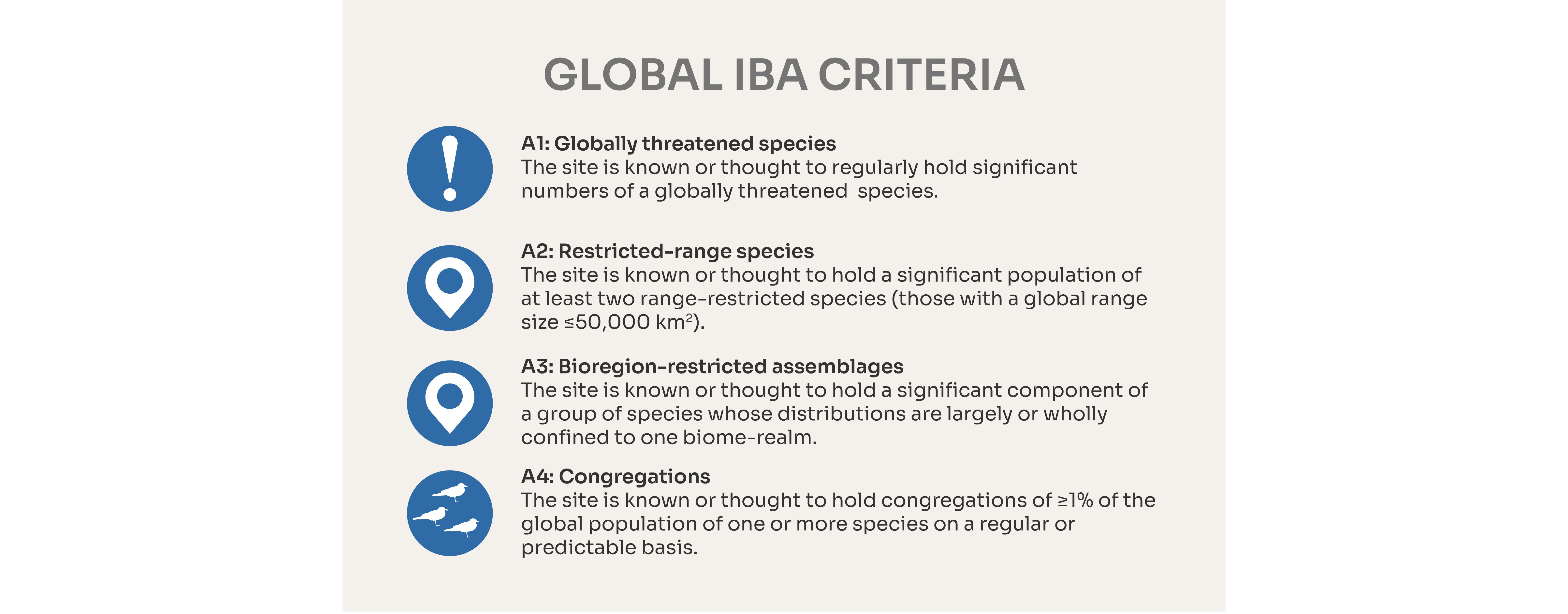
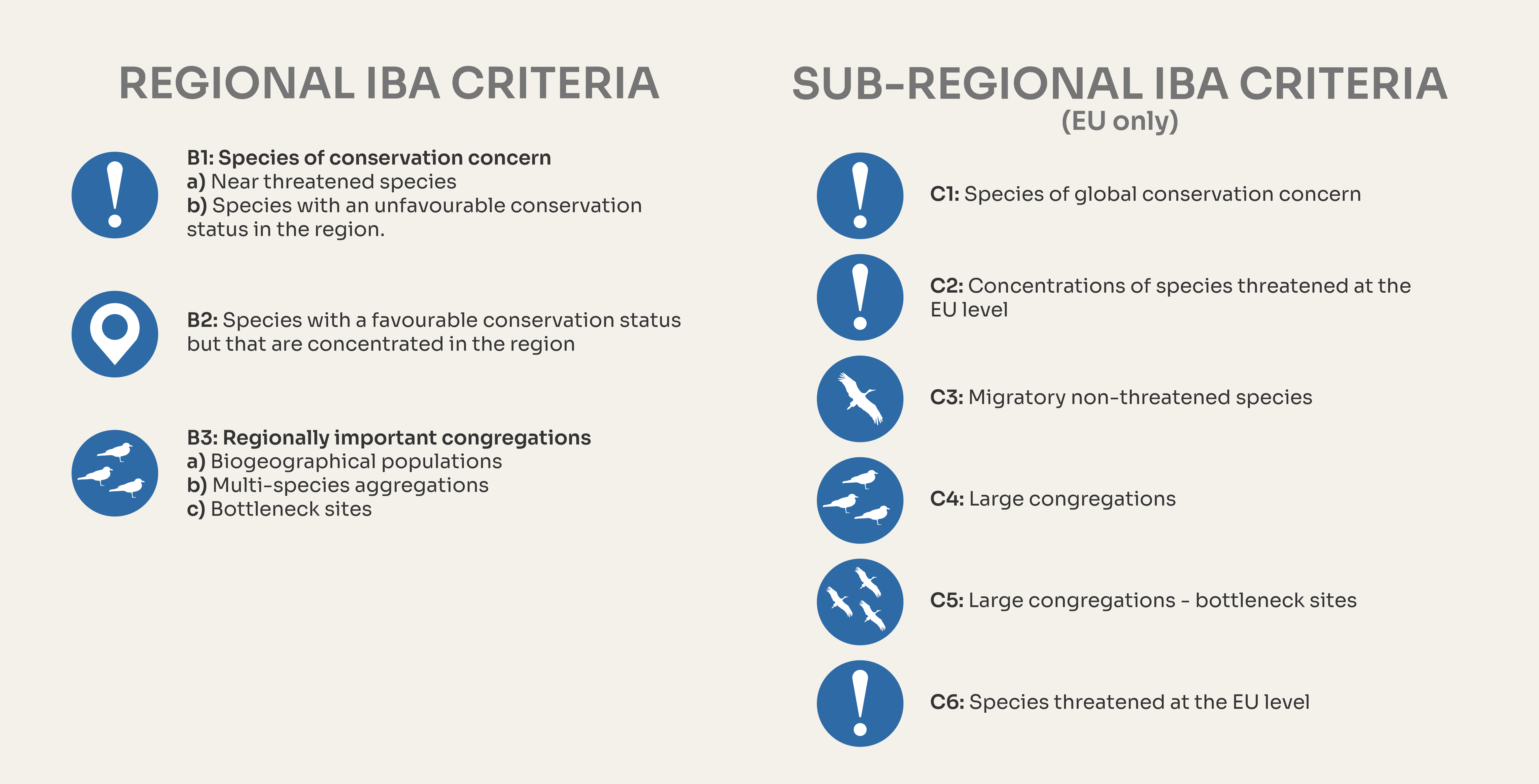
Criteria have also been developed to identify IBAs at regional and sub-regional levels. Regional IBA criteria have been developed for Europe, the Middle East, and North America, to identify sites of continental importance. Several of these regional criteria are now applicable globally. Sub-regional criteria are used to identify sites of importance in the European Union.
IBA monitoring
Monitoring IBAs is important in order to detect emerging threats, track trends in pressures, and assess the effectiveness of actions. IBAs are monitored using standardised methods that are simple, flexible and practical enough to be implemented effectively across a large number of sites. The IBA monitoring protocol uses a “Pressure-State-Response” framework to assess the condition of the sites, based on the key species and habitats within them, the threats that impact them, and the conservation responses in place.
Pressure: Indicators identify and track the major threats to important bird populations at the site, by measuring e.g. the levels of agricultural expansion, over-exploitation or pollution.
State: Indicators refer to the condition of the site, with respect to its important bird populations. State indicators include population counts of the birds themselves, or measures of the extent and quality of the habitat required by these birds.
Response: Indicators identify and track conservation actions at the site, e.g. changes in conservation designation, implementation of conservation projects and establishment of Local Conservation Groups (LCGs)
Such monitoring, carried out by local groups, volunteers, government staff and BirdLife Partners, generates invaluable data that can be used to detect and respond to emerging threats, and assess the effectiveness of conservation actions. National monitoring data can be summarised at sub-regional, regional and global levels, providing indices of biodiversity status and trends which can feed into reporting for national and international legislation and policy processes.
Relationship between IBAs and KBAs
Key Biodiversity Areas (KBAs) are sites of significance for the global persistence of biodiversity. Although the criteria for KBAs are broader than those for IBAs, nearly all IBAs also qualify as KBAs, and as a result the vast majority of the KBAs documented so far have been identified as important for birds. BirdLife continues to maintain and support both initiatives, with IBAs contributing significantly to the global agenda to conserve KBAs. BirdLife Partners are contributing to both processes to ensure that sites of significant importance for birds are aligned across both initiatives.
Support our science
We rely on donations to keep this service running and help birds thrive around the world. Please consider donating today.