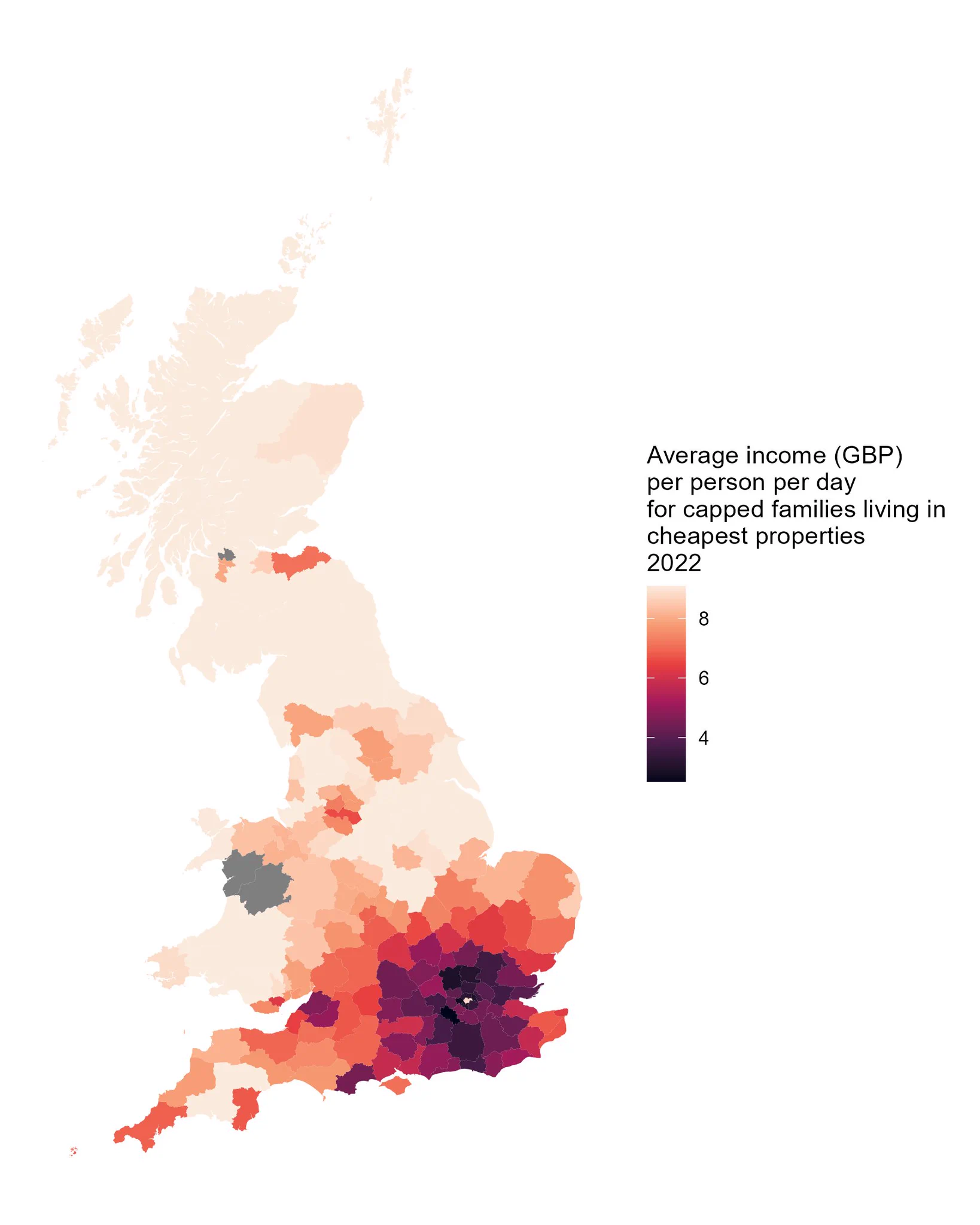
The entitlements towards housing costs that benefit capped families can claim are so far removed from the actual cost of housing that many families are finding themselves unable to heat, clothe and feed themselvesThe benefit cap works by limiting the amount that low income families who are not in work are entitled to claim in social security towards rental costs. If rent is higher than this, families must subsidise the rent from their core living costs entitlements, or find cheaper homesBut there are simply not enough rented homes that are affordable under the benefit cap. Taking one family type, in 2022 there were 28,400 single parent three child families affected by the cap - but only 4,400 affordable three-bed properties listed in the whole of BritainMost of these affordable homes are not in the places where capped families live. 72 per cent of capped families lived in areas with fewer than one affordable property per ten capped families.Capped families have to reduce their non-housing living costs, leaving them with little to live on. Living in the cheapest properties their average daily income would be just £6.60 per person per day - and less than £4 in much of London. The poverty line is £15 per person per day44% of these capped families would have incomes below destitution level. In interviews, they reported falling behind on utility bills, going into debt and relying on food banks - whilst living in expensive, overcrowded, damp housingEchoing our analysis of property listings, families affected by the benefit cap did not see moving to a cheaper property as an option, as they were already living in the cheapest available property, and were on long waiting lists for social housingFor these families, removing the two-child limit would not improve their living standards, as the additional entitlement would be immediately removed by the benefit cap. Removing the cap is a necessary step in tackling the extremely deep poverty that blights the UKRead the full reports here with co-authors @KateAndersen_, @ruthpatrick0, @aaronsreeves, @kittyjstewart sticerd.lse.ac.uk/CASE/_new/publ…Many thanks to our funders @NuffieldFound who funded these reports, and the wider programme of work on welfare reform and larger families. See more at largerfamilies.study