Post

Log inSign up

Post

Log inSign up

NASA on X: "These two images were taken by @astro_reid only minutes apart. The stark difference is the result of camera settings. In the first, a longer shutter speed let in much more light from Earth, while the shorter shutter speed in the second emphasizes our planet's nighttime glow."

@NASA
NASA
@NASA
These two images were taken by @astro_reid only minutes apart. The stark difference is the result of camera settings. In the first, a longer shutter speed let in much more light from Earth, while the shorter shutter speed in the second emphasizes our planet's nighttime glow.
A full disk image of Earth, as seen from the Orion capsule. The planet is a pale blue, swirling with white clouds and glowing slightly lighter blue in place from reflected light. From about 8 to 9 o'clock, a large brown landmass is Africa, with the Iberian peninsula twinkling with lights just where the planet curves. At the 1 o'clock spot, aurora glow in a thin green glow, just barely separated from the planet's surface. Earth is set against the black of space. Credit: NASA/Reid Wiseman
A full disk image of Earth at night, as seen from the Orion capsule. The planet is a dark midnight blue. Swirling white clouds are visible against the darker surface. From about 8 to 9 o'clock, a large, very brown landmass is Africa, with the Iberian peninsula twinkling with lights just where the planet curves. Other tiny yellow dots of electric lights are sprinkled across the planet's surface. From the 3 to the 6 o'clock spot, a very thin crescent of blue light hugs the edge of the planet. Earth is set against the black of space. Credit: NASA/Reid Wiseman
5:08 PM · Apr 3, 2026·
2.5M
Views
614

Log in or sign up for X

See what’s happening and join the conversation

Continue with phone
or
Log in with username or email

Relevant people

Avatar
NASA@NASAFollow
Making the seemingly impossible, possible. ✨

Trending now

Terms·Privacy·Cookies·Accessibility·US TIDA·Ads Info·© 2026 X Corp.
  • @NASA
    NASA
    @NASA
    Apr 3
    Even in darkness, we glow. In this image of Earth taken by the Artemis II crew, we can see the electric lights of human activity. In the lower right, sunlight illuminates the limb of the planet.
    Earth as seen from the Orion capsule. It is divided sharply in half, with a line running diagonally from the 11 o'clock to the 4 o'clock. The lower left half is a bright pale blue. Its surface is covered with swirly, puffy white clouds, with texture indicating different thicknesses. The upper right half is dark, with no illumination from the Sun. Earth is set against the black of space. Credit: NASA/Reid Wiseman
    3.8K
  • @NASA
    NASA
    @NASA
    These two images were taken by @astro_reid only minutes apart. The stark difference is the result of camera settings. In the first, a longer shutter speed let in much more light from Earth, while the shorter shutter speed in the second emphasizes our planet's nighttime glow.
    A full disk image of Earth, as seen from the Orion capsule. The planet is a pale blue, swirling with white clouds and glowing slightly lighter blue in place from reflected light. From about 8 to 9 o'clock, a large brown landmass is Africa, with the Iberian peninsula twinkling with lights just where the planet curves. At the 1 o'clock spot, aurora glow in a thin green glow, just barely separated from the planet's surface. Earth is set against the black of space. Credit: NASA/Reid Wiseman
    A full disk image of Earth at night, as seen from the Orion capsule. The planet is a dark midnight blue. Swirling white clouds are visible against the darker surface. From about 8 to 9 o'clock, a large, very brown landmass is Africa, with the Iberian peninsula twinkling with lights just where the planet curves. Other tiny yellow dots of electric lights are sprinkled across the planet's surface. From the 3 to the 6 o'clock spot, a very thin crescent of blue light hugs the edge of the planet. Earth is set against the black of space. Credit: NASA/Reid Wiseman
    5:08 PM · Apr 3, 2026·
    2.5M
    Views
    614
  • @NASA
    NASA
    @NASA
    Apr 3
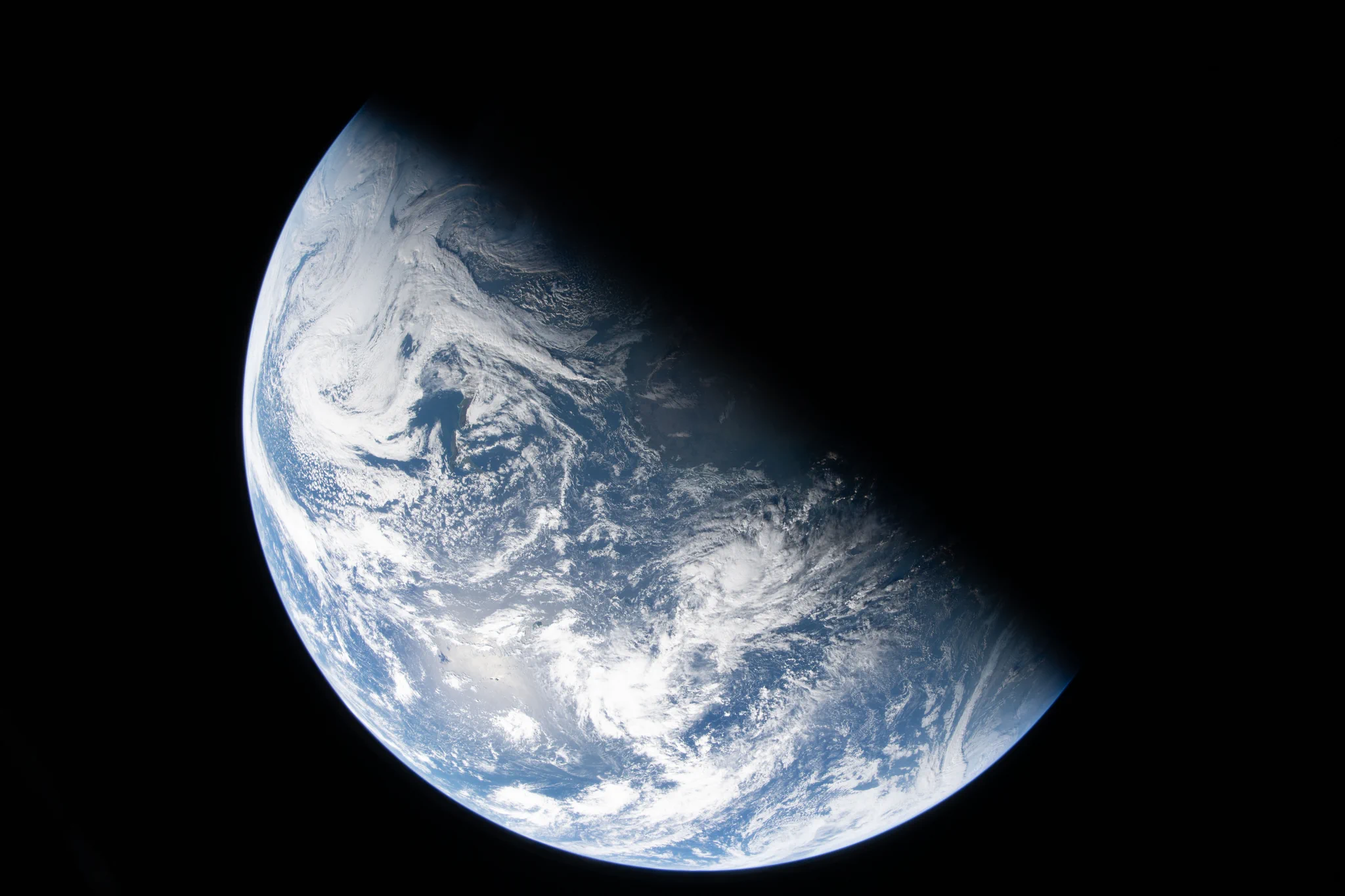
    In this image, also taken from the Orion capsule, we see the divide between night and day, known as the terminator, cutting across Earth. Whether awake or dreaming, we're all here on this planet together.
    Earth as seen from the Orion capsule. It is divided sharply in half, with a line running diagonally from the 11 o'clock to the 4 o'clock. The lower left half is a bright pale blue. Its surface is covered with swirly, puffy white clouds, with texture indicating different thicknesses. The upper right half is dark, with no illumination from the Sun. Earth is set against the black of space. Credit: NASA/Reid Weisman
    336
  • @bzhang02
    bzhang02
    @bzhang02
    Apr 3
    Similar angle recreation from Google Earth.
    6