Planetary Science
A ‘phoenix’ planet was born from the ashes of its dead star
Finding the potential planet hints that our sun’s death could lead to the creation of new worlds.
We summarize the week's scientific breakthroughs every Thursday.
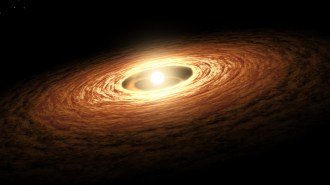
Ancient meteorites reveal a powerful magnetic field that may have helped feed the growing sun.
The gas giant Beta Pictoris b, about 63 light-years away, has the mass of 10 Jupiters and a magnetic field thousands of times as strong as Earth’s.
A space satellite that would offer light on demand has astronomers asking: Who controls the night sky?
A cryptic announcement raises questions about the type of weapons and how they could be used. We talked to an expert about the consequences.
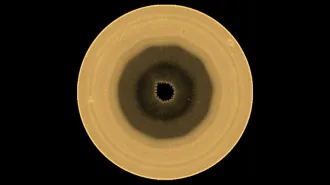
A hexagon darkens the clouds over Saturn’s north pole. Now, astronomers have found a similarly shaped atmospheric wave at the other pole.
Simulations suggest rocky planet building blocks could have formed just 100 million years after the Big Bang.
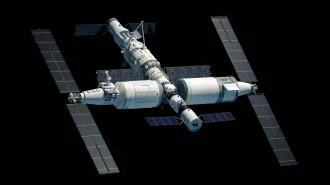
Rubidium atoms on China’s Tiangong space station fell with the same acceleration, upholding a cornerstone of Einstein’s general theory of relativity.
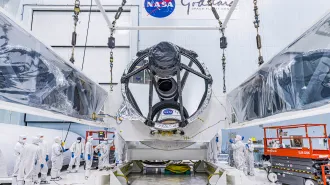
NASA’s new Nancy Grace Roman space telescope will tackle nearly every aspect of astrophysics, including dark matter, dark energy and alien planets.
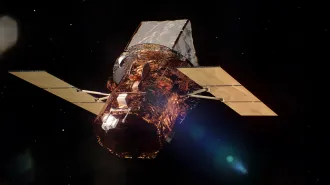
NASA’s attempt to save the falling Swift telescope failed, revealing the realities of the burgeoning field of satellite servicing.