Is it time for everyone to become AI power users?
Deloitte’s chief architect of cloud and AI solutions says that when employees use AI personally, they gain a deeper understanding of how to apply it at work.


One of the more provocative sentiments to come out of the recent AI in Finance Leaders Forum at the Nasdaq MarketSite in Times Square was the notion that increased personal use of AI can translate into more effective use of it in the workplace.
Panelist Gary Arora, chief architect of cloud and AI solutions at Deloitte, presented the idea that workers need to use AI at every opportunity during their own time, so they can be better prepared to test AI while on the job.
"Everyone in their personal lives should become a power user of AI for their everyday work. This is different from any other previous technology that came about," he said to an audience of financial executives.
AI differs from other breakthrough workplace technologies precisely because there are so many personal uses for the technology, Arora said. For example, there was not a mass push for everyone to run personal workflows on Kubernetes — "that would be ridiculous," he said.
Not ridiculous? "You've got to be using [generative] AI for every single thing," Arora said, if you want to understand the nuances of what it can and cannot do.
That includes coming up with birthday messages or a gift for a significant other, he noted. "You have to be using AI so you understand what a good output looks like, what bad output looks like," Arora said. The aim is to improve at challenging AI, which often attempts to please users, even if it means hallucinating to do so.
How power users can help ROI with AI
In a one-on-one interview with InformationWeek, Arora explained further that being a power user still requires a grounded approach to AI in the workplace to realize ROI for the organization.
"There is a pressure to be reporting some kind of progress on a quarter-by-quarter basis. These kinds of investments take time," he said.
It is essential to find the right metrics to show actual, relevant progress in solving problems via AI, Arora said. AI can be used to solve a pain point, whether it is a broken process, fragmented data that results in inaccuracies or just a lot of churn in connecting all the dots, he said.
How to get the right metrics? Organizations should start by quantifying their pain points that AI can assist with, rather than quantifying the value of AI, Arora said. This includes maintaining consistency, assessing the cost of systems being down, and figuring out what went wrong.
"If you have those numbers to begin with, then you can say, 'Can we deploy AI where this dollar number can go down?'" he said. That establishes a benchmark with which companies can start.
Indeed, the basic ROI formula has changed little over the years, Arora said, but AI has introduced a new wrinkle:
Real revenue-generation + Cost savings + Operational efficiencies - Cost to deploy AI = ROI
"That's it. It's how much it cost and what you got out of it," he said.
Another aspect Arora said should be taken into account is that not everything with AI will result in an ROI. "Are you looking at a pain point, which is a vertical slice, or productivity?"
He explained that productivity is about ensuring everyone has the right tools, but that will not directly affect ROI. It will make the workforce — with the right training — more productive and give staff members more time to fulfill other tasks that will have an impact on ROI.
And once the staff is trained, organizations can look at vertical slices for the pain points where AI can be deployed to reduce that pain. "The organizations that do well are attacking those problems," Arora said.
A panel of expectations for AI
The forum, hosted by data intelligence platform provider DDN, included Aser Blanco, global IBD head, banking at Nvidia; Moiz Kohari, vice president of enterprise AI and data intelligence at DDN; and John Watson, managing director of tactical opportunities at Blackstone, as moderator.
During the panel discussion, Blanco said Nvidia spoke recently with more than 1,000 financial institutions around the world, who said their AI plans for 2026 were already lined up.
"They're going to invest 10% or more in AI. The growth in AI investment is going to grow by more than 10% and I think almost half of them said they could be spending more," Blanco said.
Nvidia, of course, has a lot of skin in the AI market as a significant supplier of advanced GPUs that support AI development .
Kohari said while agentic AI gets a lot of attention at the moment, other forms of AI also have roles to play.
"There is predictive AI that is being leveraged to do different types of predictions, especially in financial markets. And then there is natural language processing … which allows us to take unstructured data and then provide some levels of insights," Kohari said.
The panel also discussed the MIT study from August that asserted most companies that launched AI pilots did not see any ROI from their efforts. Arora was not put off by the study’s claims.
"The interesting aspect is trying to understand why 95% of the companies are getting zero returns on their pilots. Once you can uncover that, you really understand what's going on," he said.
Arora went on to put the numbers in context, noting that 90% of all startups fail, and 70% of all change management initiatives also fail.
"The reason why a lot of the pilots are failing is not because the technology’s not there, but it's because the organization isn't ready to scale the technology that's been used in those pilots," he said.
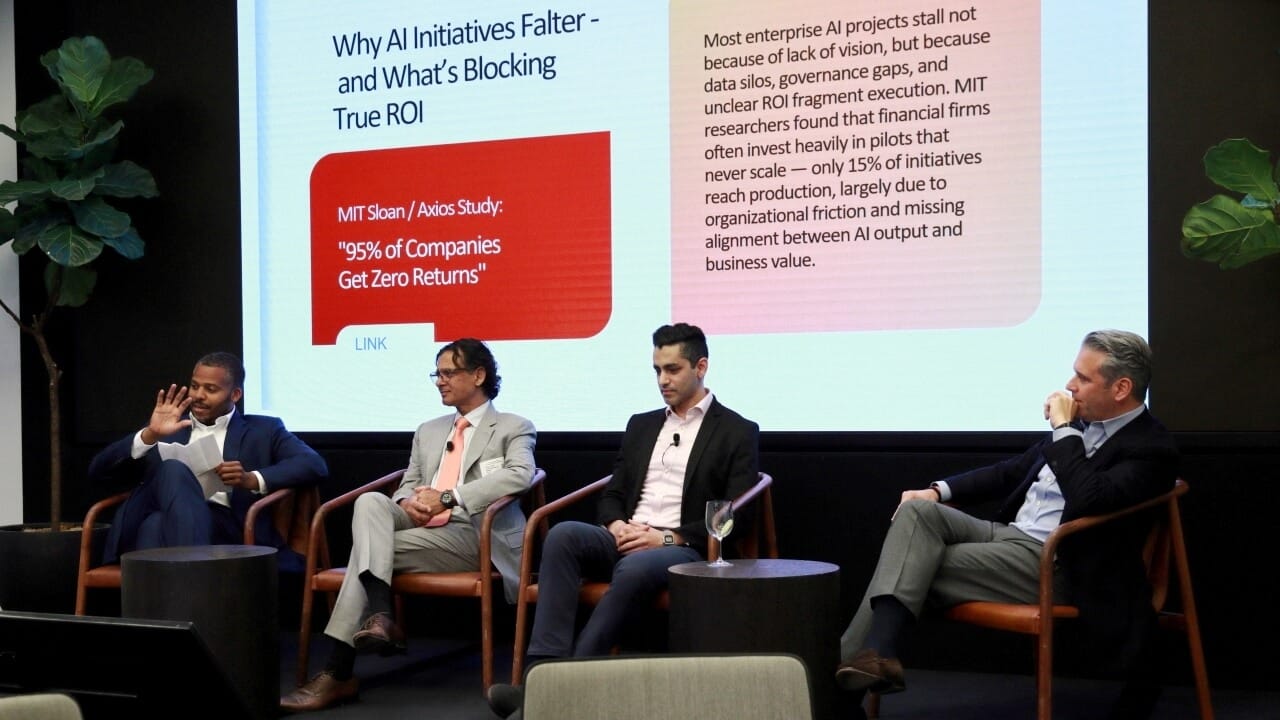
John Watson, Moiz Kohari, Gary Arora and Aser Blanco discuss the MIT study at the recent AI Finance Leader Forum. JOAO-PIERRE S. RUTH/INFORMATIONWEEK
Read more about:
Conference CoverageAbout the Author


Want more InformationWeek stories in your Google search results?
Add Us Now



Want more InformationWeek stories in your Google search results?