
Digital Enhanced Cordless Telecommunications New Radio plus is a new wireless communication protocol that promises to address many limitations of existing methods, filling the gap for reliable, low latency, long range communication, writes Mark Patrick of Mouser Electronics.

The advent of the IoT and IIoT (industrial IoT) has brought technology into homes, cars and factories. Most of it depends heavily on wireless communication. While Wi-Fi, Bluetooth and 3G/4G/5G cellular are familiar terms, technologies such as ultra-wideband, LoRa, Sigfox and ISM are less so, but are equally important methods.
The wireless evolution
Dependence on wireless communication, specifically wireless data communication, has risen significantly over the past couple of decades. When using wirelessly connected devices such as a laptop, external keyboard, trackpad, headset, smartphone, headphones, smartwatch or printer, it is not essential to know which wireless protocol they use or how they work; the fact they function reliably is sufficient. This applies in homes, vehicles, factories, retail outlets and distribution networks – all rely on continuously available wireless data communication.
The need for wireless communication continues to evolve as more applications that benefit from automation, particularly based on the IIoT, are found. Many wireless data protocols are optimised to suit specific use cases rather than being good all-rounders.
Looking at the evolution of wired data networking, there are many parallels. Industry heavyweights such as Ethernet have advanced significantly over the past four decades. Typical contemporary Ethernet deployments use 10Gbps transfer rates, that is 1,000 times faster than the initial release. It is not just speed that is important; latency, packet overhead and power consumption are some of the critical factors determining a protocol’s credentials and, ultimately, its success. The same is true for wireless data communication.
Factors to select a protocol
There are some essential factors to consider when selecting a protocol.
Transfer speed: the data transfer speed, typically measured in Mbps or Gbps, is crucial. Transferring large amounts of data in the shortest time span is essential for many applications. However, some use cases do not warrant high speeds, for example, a simple IoT temperature sensor sends only a few bytes every minute. Wi-Fi has advanced considerably, with Wi-Fi 6 promising Gbit speeds, almost matching those of Ethernet. By comparison, 4G cellular download data rates routinely achieve 30Mbps. 5G deployment is ongoing, but early tests indicate speeds of 150Mbps are possible. Low speed candidates include Bluetooth at 1Mbps, LoRa up to 27kbps and cellular NB-IoT at 127kbps.
Latency: Typically measured as a round trip, latency indicates the time a signal takes to reach its destination and an acknowledgement received at the origin. Latency can become a limiting factor for high-speed communication since waiting for an acknowledgement of a data packet reduces throughput. It also severely affects real-time applications that require deterministic and predictable response timing. Low latency is vital for industrial automation systems, a key target for 5G deployments. 5G promises to improve cellular latency significantly, quoting 5ms compared to an average of 80ms for 4G. Latency also depends on the response of the host system. Other applications affected by latency include online gaming and audio/video streaming.
Range: the effective range of a wireless link varies considerably. Within the home and workplace, walls and floors attenuate wireless signals, limiting most Wi-Fi communication to single-digit metre distances. The outdoor range is affected by terrain, plants and trees, and, at very high frequencies, precipitation.
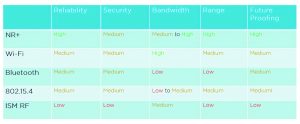
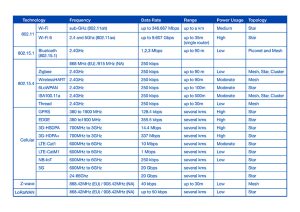
A comparison table of DECT NR+ and other popular wireless communication methods
(Source: Mouser)
Power consumption: power consumption is an essential consideration, especially for battery-powered embedded systems. The amount of current the wireless transceiver consumes to instigate and maintain a reliable link will significantly influence battery life, a key concern for many consumers. For example, despite its speed, Wi-Fi consumes considerable power, emphasising the need for other lower-power protocols in some applications.
Topology: popular topologies include star (cellular, Wi-Fi, LoRa) and mesh (Bluetooth). Dedicated direct point-to-point (P2P) wireless links also exist.
At a deeper technical level, the wireless protocol also sets the packet size. It defines the link-level ‘handshaking’ exchange, error correction methods if implemented, and onwards packet forwarding of data. For IoT and IIoT applications, the performance of a robust, resilient and reliable wireless link is imperative.
Introducing DECT NR+
Digital Enhanced Cordless Telecommunications (DECT) New Radio Plus (NR+) heralds ultra-reliable low latency communications for large-scale IIoT deployments. The International Telecommunications Union (ITU) and ETSI (European Telecommunications Standards Institute) recently ratified the DECT-2020 NR+ standard as part of the 5G standard set. The DECT Forum, the founder of the DECT standard for cordless telephones, developed DECT NR+. It has no origins in the cordless standard. DECT NR+ specifications meet the needs of large scale, ultra reliable, low latency IoT and IIoT deployments such as smart cities, smart metering, Industry 4.0 and pro-audio streaming (for example, in stadiums and large conference venues).
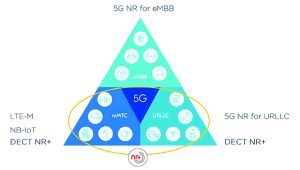
Unlike 5G, DECT NR+ is not a cellular standard, gaining ITU-R 5G approval against the 5G international mobile telecommunications (IMT-2020) standard based on its ultra-reliable, low latency communications and massive machine type communications capabilities (Figure 2).
Key features
DECT NR+ operates in the 1.9GHz licence-exempt wireless spectrum available globally (except in China, currently). This creates the potential to develop a single version of a product rather than regional variants, saving significant production and approval costs. DECT NR+ co-exists with legacy cordless DECT devices that already use the 1.9GHz band.
It functions in several topologies, including star, mesh and P2P, with self-organising and self-healing network capabilities.
It has extremely low latency, down to 1ms, which may allow the implementation of wireless communication in many applications for the first time. Another feature is better than 99.99% reliability, based on proven cellular techniques such as forward error correction and hybrid automatic repeat request (HARQ), which occur low in the protocol stack, saving higher levels from managing retransmissions.
The protocol uses AES and CCM security and is scalable; up to 4bn nodes and 16m networks. It also uses orthogonal frequency division multiplexing (OFDM) modulation with efficient channel coding and high-level modulation.
Its non-cellular network approach allows customers to create private networks without needing access to base stations or service provider infrastructure. It is suitable for large-scale deployment with a km range and a maximum data rate of 9Gbps. There is no need for subscriptions or SIM cards.
The physical layer (PHY) of the NR+ protocol stack permits binary phase shift keying, quadrature phase shift keying and quadrature amplitude modulation (QAM) of the OFDM signal (Figure 4). The DECT NR+ specification supports up to 1024QAM for up to 9Gbps. Reducing the data rate to match application requirements will optimise power consumption for low-power embedded applications.
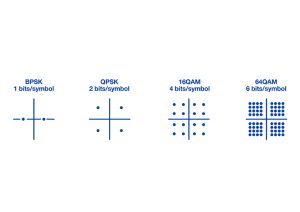
(Source: Nordic Semiconductor)
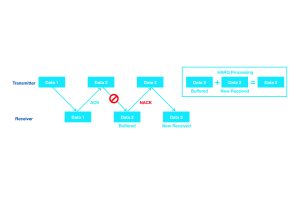
Another feature of the PHY layer is the HARQ error correction technique (Figure 5). Performing resends within the PHY removes the necessity for application layers to provide this functionality and permits eight concurrent HARQ processes. Since resends to improve reliability occur within the PHY, the retransmission latency is less than 417μs.
As IoT and IIoT deployments continue to scale upwards, the need for reliable, low latency and low power wireless communication becomes crucial. With its cellular-grade security and reliability characteristics, DECT NR+ is well-positioned to fulfil the requirements that other short-range wireless protocols cannot meet.
Companies rush to support DECT NR+
European Telecommunication Standards Institute (ETSI) DECT-2020 NR was approved in 2021 and is now referred to as DECT NR+. The IoT standard lets any enterprise set up and manage its own network autonomously, eliminates the network infrastructure and single point of failure at 10% of the cost in comparison to cellular solutions, announced ETSI. There are no subscription fees and data can be stored and consumed to suit the business; on the premises or in the public cloud.
It supports shared spectrum operation, enabling access and sharing of free, international spectrum operation and multiple local networks in mobile system frequencies.
Jussi Numminen, vice-chair of the ETSI technical committee DECT, described it as “a fundamental requirement for massive digitalisation for everyone… you get immediate access to a free, dedicated 1.9GHz frequency internationally. It is a perfect match for massive IoT.”
Nordic Semiconductor is the first semiconductor company to announce the support of the DECT NR+ protocol. Its low power nRF91 DECT NR+ wireless transceiver, reference designs and evaluation board will be available this year.
Building on the nRF91 cellular (LTE and NB-IoT) system-in-package, Nordic has partnered with IoT software provider Wirepas to integrate the Wirepas Mesh Connectivity Suite on the nRF91.