Restaurant loyalty has traditionally depended on familiarity: customers know the menu, trust the quality, and develop habits around places they enjoy. Digital ordering has changed how those relationships are built. Today, the experience between visits can be almost as important as what happens inside the restaurant.
A well-designed mobile app gives restaurants a direct channel to their customers without relying entirely on third-party delivery platforms. For businesses investing in restaurant app development, the opportunity is not simply to digitize ordering. It is to create a connected customer journey that encourages repeat visits, increases order value, and gives restaurants greater control over their customer relationships.
In This Article:
Turn Occasional Customers Into Regulars
A customer may enjoy a restaurant and still forget about it when deciding where to order next. An app can shorten that distance between intention and purchase.
Saved favorites, previous orders, personalized recommendations, location information, and simplified checkout make returning easier. Instead of asking customers to repeat the entire discovery process, the app remembers their preferences and reduces friction.
Convenience alone, however, rarely creates meaningful loyalty. The strongest apps combine convenience with reasons to return.
A restaurant might reward a fifth order, offer benefits based on visit frequency, or provide personalized incentives related to previous purchases. The objective is to make loyalty feel relevant rather than turning the app into a permanent discount channel.
Build a Loyalty Loop, Not Just a Points System
Traditional loyalty programs often follow a simple formula: spend money, collect points, receive a reward. Mobile apps can make this relationship more dynamic.
Restaurants can connect ordering behavior, rewards, personalization, and communication into a continuous cycle.
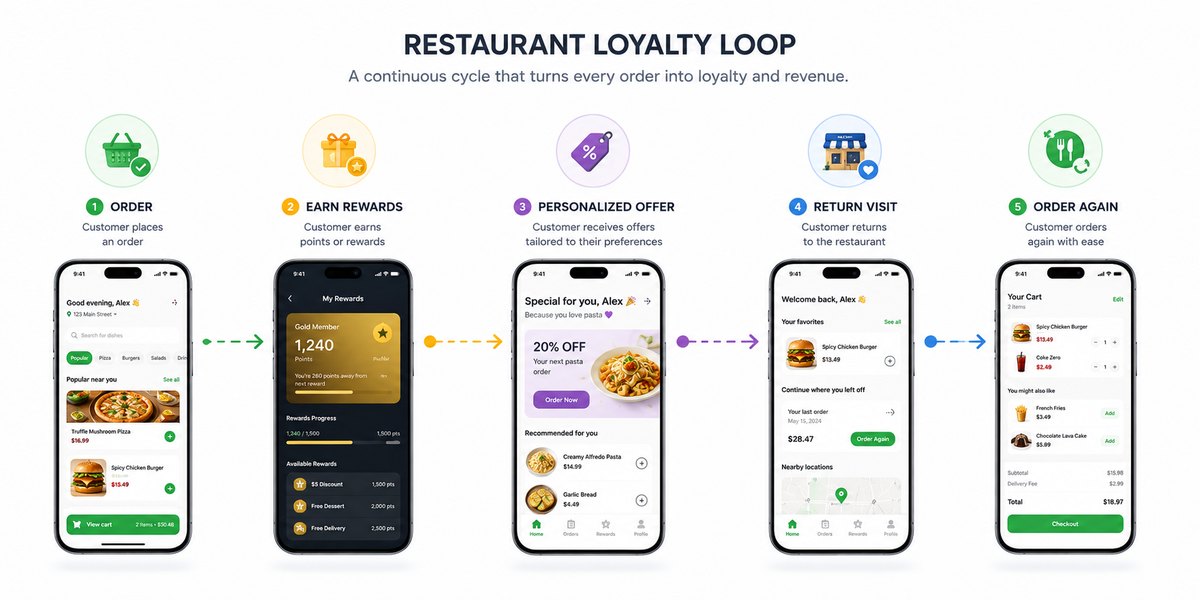
Each interaction generates additional context. A customer who regularly orders lunch may respond differently from someone who visits with family on weekends. A frequent coffee buyer may value convenience, while another customer may respond better to an exclusive menu item or birthday benefit.
The more relevant the experience becomes, the less the loyalty program feels like generic promotion.
Increase Revenue Through Better Ordering Experiences
Revenue growth does not always require attracting more customers. Improving the ordering experience for existing customers can also create significant opportunities.
A mobile app can intelligently introduce add-ons, sides, drinks, upgrades, or complementary products during the ordering journey. The key is relevance.
If a customer selects a burger, suggesting fries or a drink is useful. Displaying a long list of unrelated promotions creates additional decisions and can make checkout more cumbersome.
The same principle applies to menu design. Clear categories, high-quality imagery, customization options, transparent pricing, and an easy-to-edit cart can reduce friction before payment.
Reordering is another powerful feature. For customers who regularly purchase the same breakfast, coffee, or lunch, turning a previous order into a new purchase with a few taps can make the restaurant the easiest choice.
Use Personalization Without Overcomplicating It
Restaurants do not need sophisticated AI models from day one to create personalized experiences.
Useful personalization can begin with straightforward behavioral signals: previous orders, favorite categories, order frequency, preferred location, typical ordering time, or loyalty status.
These signals can support simple but relevant experiences. A customer who repeatedly orders vegetarian dishes can see appropriate recommendations first. Someone who orders every Friday evening might receive a timely reminder rather than a generic notification on Monday morning.
As the customer base and available data grow, personalization can become more advanced.
The important distinction is between communication and noise. Sending more push notifications does not automatically increase engagement. Messages should have a clear reason to reach the customer.
Reduce Dependence on Third-Party Platforms
Delivery marketplaces provide restaurants with valuable reach and customer acquisition, but they also place an intermediary between the restaurant and the customer.
A branded application creates a direct digital channel.
This does not necessarily mean abandoning aggregators. Third-party platforms can remain useful for discovery, while the restaurant’s own app serves returning customers who already know the brand.
The strategic advantage is greater control over the experience. Restaurants can determine how menus are presented, how loyalty works, what offers customers receive, and how the digital relationship develops over time.
Direct channels can also provide better access to first-party behavioral data, subject to appropriate consent and privacy practices. This helps restaurants understand which items are popular, when customers order, which promotions perform well, and where users leave the ordering journey.
Connect the App to Restaurant Operations
A customer-facing application is only one part of the system.
Orders may need to connect with POS infrastructure, kitchen workflows, payment providers, delivery services, reservation systems, inventory tools, CRM platforms, or loyalty programs.
Poor integration can undermine an otherwise attractive interface. If menu availability is inaccurate, loyalty points fail to update, or orders require manual re-entry by staff, the digital experience creates operational friction instead of removing it.
This is why the technical strategy should consider restaurant operations from the beginning.
For multi-location businesses, complexity increases further. Menus, prices, opening hours, availability, promotions, and delivery zones may differ between locations. The application needs to present the correct information without making management unnecessarily difficult for restaurant teams.
Measure What Happens After Download
Downloads are useful, but they reveal little about whether an app is contributing to the business.
Restaurants should look deeper at customer behavior. Relevant metrics may include repeat order rate, ordering frequency, average order value, loyalty participation, reward redemption, checkout completion, and the percentage of customers returning after their first purchase.
These metrics can also reveal where the experience needs improvement.
If customers frequently add products to their carts but fail to complete payment, the problem may be checkout friction. If many people join the loyalty program but rarely redeem rewards, the incentives may not feel valuable enough.
The app therefore becomes more than a sales channel. It creates a feedback system that helps the restaurant continuously refine its digital customer experience.
Make the App Worth Keeping
Customers have little reason to keep a restaurant app installed if it offers nothing beyond a mobile version of the website.
The strongest restaurant apps earn their place on the phone by making repeat interactions noticeably easier or more valuable. That might mean faster ordering, meaningful rewards, reservations, personalized offers, exclusive products, delivery tracking, or convenient access to multiple restaurant locations.
The exact feature set should follow the restaurant’s business model rather than a generic checklist.
Ultimately, custom mobile apps can strengthen both sides of restaurant growth: loyalty and revenue. They give customers a faster, more personal way to interact with a brand while giving restaurants greater control over ordering, engagement, and customer insight.
The goal is not simply to persuade someone to download an app. It is to create enough ongoing value that opening it becomes a natural part of deciding where to eat next.