

-
81 IC
- электромагнитная связь
- устройство внутреннего сгорания
- установленная мощность
- управление интерфейсом
- реактивная катушка
- промежуточный распределительный пункт
- погружной охладитель
- отключающая способность (коммутационного аппарата или плавкого предохранителя)
- непосредственно составляющая
- начальные условия
- межстанционный носитель
- ледовый конденсатор (АЭС)
- код идентификации
- карта, содержащая команду
- карта с интегральной схемой
- ионная хроматография
- интегральная схема
- индукционная связь
- индекс совпадения
- изолирующий конденсатор
- железо-константан
- входной контур
- входное устройство нормализации
- входная цепь
- внутреннее соединение
внутреннее соединение
—
[ http://www.iks-media.ru/glossary/index.html?glossid=2400324]Тематики
- электросвязь, основные понятия
EN
входная цепь
-.
[ ГОСТ Р 51321. 3-99 ( МЭК 60439-3-90)]distribution board
assembly containing different types of switchgear and controlgear associated with one or more outgoing electric circuits fed from one or more incoming electric circuits, together with terminals for the neutral and protective conductors.
[IEV number 826-16-08]распределительная панель
НКУ, состоящее из коммутационных устройств или устройств защиты (например, плавких предохранителей), присоединенных к одной или нескольким выходным цепям с питанием от одной или нескольких входящих цепей, а также зажимов для нейтрального проводника и проводников цепей защиты. Оно может также содержать сигнальные устройства и другие устройства контроля.
[ ГОСТ Р 51321. 3-99 ( МЭК 60439-3-90)]Тематики
- аппарат, изделие, устройство...
EN
входное устройство нормализации
—
[Я.Н.Лугинский, М.С.Фези-Жилинская, Ю.С.Кабиров. Англо-русский словарь по электротехнике и электроэнергетике, Москва, 1999 г.]Тематики
- электротехника, основные понятия
EN
входной контур
—
[Я.Н.Лугинский, М.С.Фези-Жилинская, Ю.С.Кабиров. Англо-русский словарь по электротехнике и электроэнергетике, Москва, 1999 г.]Тематики
- электротехника, основные понятия
EN
железо-константан
—
[Я.Н.Лугинский, М.С.Фези-Жилинская, Ю.С.Кабиров. Англо-русский словарь по электротехнике и электроэнергетике, Москва, 1999 г.]Тематики
- электротехника, основные понятия
EN
изолирующий конденсатор
(на АЭС)
[А.С.Гольдберг. Англо-русский энергетический словарь. 2006 г.]Тематики
EN
индекс совпадения
ИС
—
[[http://www.rfcmd.ru/glossword/1.8/index.php?a=index&d=23]]Тематики
Синонимы
- ИС
EN
индукционная связь
—
[Я.Н.Лугинский, М.С.Фези-Жилинская, Ю.С.Кабиров. Англо-русский словарь по электротехнике и электроэнергетике, Москва, 1999 г.]Тематики
- электротехника, основные понятия
EN
интегральная схема
(МСЭ-Т Q.1741).
[ http://www.iks-media.ru/glossary/index.html?glossid=2400324]Тематики
- электросвязь, основные понятия
EN
карта с интегральной схемой
Пластиковая карта, в которую встроена одна или более интегральных схем. Также называется картой с микропроцессором.
[Глоссарий терминов, используемых в платежных и расчетных системах. Комитет по платежным и расчетным системам Банка международных расчетов. Базель, Швейцария, март 2003 г.]Тематики
EN
карта, содержащая команду
программная карта
—
[Е.С.Алексеев, А.А.Мячев. Англо-русский толковый словарь по системотехнике ЭВМ. Москва 1993]Тематики
Синонимы
EN
код идентификации
Код, следующий за кодом страны для Сетей, который однозначно определяет какую-либо международную Сеть. (МСЭ-Т Е.164).
[ http://www.iks-media.ru/glossary/index.html?glossid=2400324]Тематики
- электросвязь, основные понятия
EN
ледовый конденсатор (АЭС)
—
[А.С.Гольдберг. Англо-русский энергетический словарь. 2006 г.]Тематики
EN
межстанционный носитель
(МСЭ-Т J.177).
[ http://www.iks-media.ru/glossary/index.html?glossid=2400324]Тематики
- электросвязь, основные понятия
EN
начальные условия
—
[Я.Н.Лугинский, М.С.Фези-Жилинская, Ю.С.Кабиров. Англо-русский словарь по электротехнике и электроэнергетике, Москва, 1999]
начальные условия
Начальное состояние - в динамических моделях экономики — совокупность сложившихся к началу исследуемого (или планового) периода значений экономических переменных, последующие значения которых определяются в ходе решения задачи. Начальное состояние, как и любое состояние системы, определяется значениями существенных для данной задачи переменных. От правильного выбора Н.у. зависит дальнейший расчет по модели; в моделях планирования они во многом характеризуют возможности развития моделируемой системы в плановом или прогнозном периоде.
[ http://slovar-lopatnikov.ru/]Тематики
- экономика
- электротехника, основные понятия
EN
непосредственно составляющая
—
[Е.С.Алексеев, А.А.Мячев. Англо-русский толковый словарь по системотехнике ЭВМ. Москва 1993]Тематики
EN
отключающая способность (коммутационного аппарата или плавкого предохранителя)
Значение ожидаемого тока отключения, который способен отключать коммутационный аппарат или плавкий предохранитель при установленном напряжении в предписанных условиях эксплуатации и поведения.
Примечания
1 Напряжение устанавливается и условия предписываются в стандарте на соответствующий аппарат.
2 Для переменного тока это симметричное действующее значение периодической составляющей.
МЭК 60050(441-17-08)
[ ГОСТ Р 50030. 1-2000 ( МЭК 60947-1-99)]
отключающая способность (коммутационного аппарата или предохранителя)
Значение ожидаемого тока отключения, который коммутационный аппарат или предохранитель способен отключить при заданном напряжении в предписанных условиях применения и поведения.
Примечание - Для коммутационных аппаратов отключающая способность может быть определена в соответствии с видом тока, предусмотренного в предписанных условиях, например отключающая способность при отключении ненагруженной линии, отключающая способность при отключении ненагруженного кабеля, отключающая способность при отключении одиночной конденсаторной батареи и т. д
[ ГОСТ Р 52726-2007]
отключающая способность коммутационного аппарата
Коммутационная способность коммутационного аппарата при отключении цепи.
[ ГОСТ 17703-72]EN
breaking capacity (of a switching device or a fuse)
a value of prospective current that a switching device or a fuse is capable of breaking at a stated voltage under prescribed conditions of use and behaviour
NOTE 1 – The voltage to be stated and the conditions to be prescribed are dealt with in the relevant publications.
NOTE 2 – For switching devices, the breaking capacity may be termed according to the kind of current included in the prescribed conditions, e.g. line-charging breaking capacity, cable charging breaking capacity, single capacitor bank breaking capacity, etc.
[IEV number 441-17-08]
[IEV number 441-01-49]FR
pouvoir de coupure (d'un appareil de connexion ou d'un fusible)
une valeur de courant présumé qu'un appareil de connexion ou un fusible est capable d'interrompre sous une tension fixée dans des conditions prescrites d'emploi et de comportement
NOTE 1 – La tension à fixer et les conditions à prescrire sont précisées dans les publications particulières.
NOTE 2 – Pour les appareils de connexion, le pouvoir de coupure peut être dénommé suivant le type de courant intervenant dans les conditions prescrites, par exemple: pouvoir de coupure de lignes à vide, pouvoir de coupure de câbles à vide, pouvoir de coupure d'une batterie de condensateurs unique, etc.
[IEV number 441-17-08]
[IEV number 441-01-49]
Недопустимые, нерекомендуемые
Примечание(1)- Мнение автора карточкиТематики
- выключатель автоматический
- выключатель, переключатель
- высоковольтный аппарат, оборудование...
Синонимы
EN
- BC
- breaking capacity
- breaking capacity (of a switching device or a fuse)
- breaking current capacity
- IC
- interrupting capability
- interrupting capacity
- rupture capacity
- rupture rupturing capacity
DE
FR
промежуточный распределительный пункт
промежуточный кросс
распределительный узел здания
распределительный пункт здания
распределительное устройство здания
Распределительный пункт, разделяющий СКС на магистральную подсистему 1-ого уровня и магистральную подсистему 2-ого уровня.
[Дмитрий Мацкевич. Справочное руководство. Основные понятия, требования, рекомендации и правила проектирования и инсталляции СКС LANMASTER. Версия 2.12]Тематики
Синонимы
- промежуточный кросс
- распределительный узел здания
- распределительный пункт здания
- распределительное устройство здания
EN
реактивная катушка
(электрический) реактор
—
[Я.Н.Лугинский, М.С.Фези-Жилинская, Ю.С.Кабиров. Англо-русский словарь по электротехнике и электроэнергетике, Москва, 1999 г.]Тематики
- электротехника, основные понятия
Синонимы
EN
управление интерфейсом
—
[Е.С.Алексеев, А.А.Мячев. Англо-русский толковый словарь по системотехнике ЭВМ. Москва 1993]Тематики
EN
установленная мощность
—
[Я.Н.Лугинский, М.С.Фези-Жилинская, Ю.С.Кабиров. Англо-русский словарь по электротехнике и электроэнергетике, Москва, 1999 г.]Тематики
- электротехника, основные понятия
EN
устройство внутреннего сгорания
—
[А.С.Гольдберг. Англо-русский энергетический словарь. 2006 г.]Тематики
EN
электромагнитная связь
—
[Я.Н.Лугинский, М.С.Фези-Жилинская, Ю.С.Кабиров. Англо-русский словарь по электротехнике и электроэнергетике, Москва, 1999 г.]Тематики
- электротехника, основные понятия
EN
Англо-русский словарь нормативно-технической терминологии > IC
-
82 van
- сеть с дополнительными услугами
- сеть с «добавленной стоимостью»
- сеть повышенного качества
- вэн
вэн
Метод оценки вероятности землетрясений
[ http://www.dunwoodypress.com/148/PDF/Biotech_Eng-Rus.pdf]Тематики
EN
сеть повышенного качества
специализированная сеть
Сеть с индивидуальными услугами за дополнительную плату.
[Л.Г.Суменко. Англо-русский словарь по информационным технологиям. М.: ГП ЦНИИС, 2003.]Тематики
Синонимы
EN
сеть с «добавленной стоимостью»
интегрированная сеть
—
[Е.С.Алексеев, А.А.Мячев. Англо-русский толковый словарь по системотехнике ЭВМ. Москва 1993]Тематики
Синонимы
EN
сеть с дополнительными услугами
—
[ http://www.iks-media.ru/glossary/index.html?glossid=2400324]Тематики
- электросвязь, основные понятия
EN
Англо-русский словарь нормативно-технической терминологии > van
-
83 advertising
1. n рек., марк. рекламування; реклама; 2. рекламна діяльність; 3. рекламне оголошення; a рекламний1. оплачене ідентифікованим спонсором поширення через ЗМІ інформації про товари, продукцію (product), послуги (service¹), ідеї, марки (brand), яка спрямована на цільову аудиторію (target audience) і покликана стимулювати попит на ці товари, послуги тощо; ♦ рекламування як один із компонентів маркетингу (marketing communication) поділяють на два основні види: рекламування для створення популярності організації (institutional advertising) і рекламування продукції (product advertising); 2. комерційна діяльність зі створення, розповсюдження та продажу реклами (advertisement); 3. рекламне оголошення (advertisement)═════════■═════════above-the-line advertising реклама з агентською знижкою; accessory advertising допоміжна реклама; advance advertising попередня реклама; adversary advertising реклама, що протидіє; advocacy advertising рекламно-пропагандистська кампанія; airline advertising реклама авіакомпанії; aisle advertising реклама у проході між полицями в крамниці; annoying advertising подразлива реклама; audiovisual advertising аудіовізуальна реклама; auditory advertising акустична реклама • звукова реклама; auxiliary advertising допоміжна реклама; bait advertising спокуслива реклама; bait and switch advertising реклама із мерехтливою принадою; bank advertising банківська реклама; bargain-basement advertising реклама, яка пропонує товар за низькими цінами; below-the-line advertising рекламні замовлення, які не дають агентської знижки; beverage advertising реклама напоїв; billboard advertising щитова реклама; block advertising блокова реклама; borax advertising настирлива реклама; brand advertising рекламування марки • рекламування торговельної марки; brand image advertising реклама товарної марки; brand name advertising реклама торгової назви фірмової марки; broadcast advertising рекламування засобами радіо; burst advertising короткострокове раптове рекламування; business-to-business (B-B) advertising реклама для підприємств; cable advertising реклама на кабельному телебаченні; cause-and-issue advertising проблемна реклама • реклама, яка спрямована на суспільні проблеми; cinema advertising кінореклама; classified advertising реклама, згрупована у рубрики; commercial advertising торговельна реклама • комерційна реклама; commodity advertising рекламування товару; comparative advertising реклама, розрахована на дискредитацію товару конкурента; comparison advertising порівняльне рекламування; competitive advertising конкурентне рекламування; concept advertising реклама задуму • реклама ідеї; consumer advertising рекламування споживчих товарів • споживча реклама; contemporary advertising сучасна реклама; controversial advertising суперечлива реклама • дискусійна реклама; cooperative advertising спільне рекламування; corporate advertising рекламування організації • рекламування для створення популярності організації; corrective advertising реклама, яка виправляє помилкову інформацію або помилкове враження; coupon advertising купонна реклама; creative advertising творча реклама; crossruff advertising колективна реклама; current advertising поточне рекламування; deceptive advertising облудна реклама • реклама неякісних товарів • неправдива реклама; demonstration advertising наочна реклама • переконлива реклама; denigratory advertising ганебна реклама конкурентів • ганебна реклама; direct advertising пряме рекламування; direct-mail advertising пряма поштова реклама; directory advertising рекламні оголошення в довідниках; direct response advertising пряма поштова реклама; display advertising вітринно-виставкове рекламування; domestic advertising рекламування місцевих товарів; effective advertising ефективна реклама; endorsement advertising рекламування з підтримкою; entertaining advertising розважальна реклама; ethical advertising етичне рекламування; existing advertising поточна реклама; expensive advertising дорога реклама; eye-catching advertising яскрава реклама; factual advertising реклама, яка обґрунтована фактами; false advertising облудна реклама • неправдива реклама; fashion advertising реклама моди; film advertising кінореклама • реклама з допомогою кінофільмів; financial advertising фінансове рекламування; flexform advertising реклама довільної форми; follow-up advertising повторна реклама; food advertising реклама харчових продуктів; foreign advertising закордонна реклама; fraudulent advertising шахрайська реклама; free advertising безплатна реклама; front-page advertising реклама на титульній сторонці; general advertising реклама на широку публіку; generic advertising рекламування групи товарів; global advertising всесвітня реклама; government advertising реклама від імені урядових органів • урядова реклама; grocery advertising реклама бакалійно-гастрономічних товарів; graphic advertising графічне рекламування; group advertising групова реклама; hard-sell advertising наполегливе рекламування • агресивне рекламування; heavy advertising інтенсивна реклама; high-pressure advertising настійне рекламування • агресивне рекламування; house advertising власне рекламування фірми • внутрішньофірмове рекламування; hype-type advertising гучне рекламування; image advertising рекламування образу • рекламування іміджу; impact advertising спонукальна реклама; indirect advertising непряме рекламування; indirect-action advertising реклама непрямого впливу; industrial advertising промислове рекламування; inferior advertising неякісне рекламування; information advertising реклама, насичена інформацією • інформаційна реклама; in-house advertising власне рекламування фірми • внутрішньофірмове рекламування; initial advertising початкова реклама; innovative advertising новаторське рекламування; institutional advertising рекламування організації • рекламування для популяризації організації; international advertising міжнародне рекламування; interstate advertising рекламування для міжштатного розповсюдження; introductory advertising вступна реклама; investor-solicitation advertising рекламування для зацікавлення вкладників; issue advertising реклама, яка висвітлює суспільні проблеми; journal advertising рекламування в спеціалізованих виданнях • рекламування в журналах; keyed advertising шифроване рекламне оголошення; large-scale advertising великомасштабне рекламування; launch advertising упроваджувальна реклама • реклама впровадження товару • реклама, що оголошує про випуск нового товару; legal advertising правове рекламування; litter-bin advertising рекламування на сміттєвих урнах; local advertising місцеве рекламування; long-term advertising довгострокове рекламування; low-pressure advertising ненав'язливе рекламування; mail-order advertising рекламування торгівлі «товари поштою» • реклама, передана поштою; magazine advertising журнальне рекламування • рекламування в журналах; mail advertising рекламування поштою • реклама, передана поштою; mass advertising масове рекламування • реклама масового охоплення; mass media advertising рекламування в засобах масової інформації; misleading advertising оманливе рекламування • неправдиве рекламування; mobile advertising реклама на транспортних засобах; multimedia advertising рекламування, що користується кількома засобами масової інформації; multinational advertising багатонаціональна реклама; name advertising реклама назви • реклама-назва; national advertising національне рекламування; natural break advertising рекламування в перервах між програмами; newspaper advertising газетна реклама; novelty advertising рекламування новинок; objective advertising об'єктивне рекламування; offbeat advertising нешаблонне рекламування • оригінальне рекламування; off-season advertising рекламування в міжсезонні • позасезонне рекламування; on-target advertising цілеспрямоване рекламування; opinion advertising експертна реклама; oral advertising усне рекламування; outdoor advertising вулична реклама; out-of-home advertising надвірне рекламування; package advertising реклама на упаковці; packaged-goods advertising рекламування фасованих товарів; persuasive advertising переконливе рекламування; point-of-purchase advertising рекламування на місці продажу-купівлі; point-of-sale advertising рекламування на місці продажу-купівлі; political advertising політична реклама; position media advertising вуличне рекламування; postal advertising поштове рекламування; postcard advertising реклама на поштових картках; poster advertising плакатне рекламування • реклама за допомогою плакатів; postmark advertising реклама на поштовому штампі; premium advertising високоякісна реклама; prestige advertising престижне рекламування; price advertising реклама цін; primary advertising основне рекламування; print advertising друковане рекламування; private sector advertising рекламування приватного сектору; problem-solution advertising рекламування щодо розв'язання проблем; producer advertising реклама від імені виробників; product advertising рекламування продуктів; product-centred advertising реклама, яка робить наголос на товарі; product-comparison advertising реклама на основі порівняння товарів; professional advertising професійне рекламування; promotional advertising заохочувальне рекламування • реклама, що заохочує попит; radio advertising радіорекламування; recruitment advertising реклама вакансій; regional advertising районне рекламування • регіональне рекламування; regular advertising систематичне рекламування; reinforcement advertising підсилювальне рекламування; repeat advertising повторне рекламування; retail advertising рекламування роздрібної торгівлі; sales advertising рекламування для збуту; screen advertising екранне рекламування; seasonal advertising сезонне рекламування; selective advertising добірна реклама; semi-display advertising тематичне вітринно-виставкове рекламування; short-term advertising короткострокове рекламування; show-window advertising вітринне рекламування; sky advertising повітряне рекламування; soft-sell advertising ненастійне рекламування; space advertising ілюстративно-зображальне рекламування • зображальне рекламування; split-run advertising рекламування з розбиттям тиражу; spot advertising рекламування у вставці; still-life advertising натюрмортне рекламування; store advertising реклама крамниці; strategic advertising стратегічне рекламування; subliminal advertising рекламування, спрямоване на підсвідомість; successful advertising успішне рекламування; superior advertising реклама вищої якості; tactical advertising тактичне рекламування; target advertising цілеспрямоване рекламування; teaser advertising подразливе рекламування; tie-in advertising супровідна реклама; tombstone advertising коротке рекламне оголошення інформаційного характеру; trade advertising торгова реклама • рекламне оголошення в торговельному виданні; trademark advertising реклама торговельного знака; traditional advertising традиційне рекламування; transit advertising реклама на транспорті; truthful advertising правдива реклама; unacceptable advertising неприпустима реклама; unfair advertising несумлінне рекламування; untruthful advertising неправдива реклама; vertical cooperative advertising вертикальна спільна реклама; viewpoint advertising рекламування точки зору; visual advertising зорова реклама; vocational advertising реклама, розрахована на професіоналів; word-of-mouth advertising реклама, яка твориться споживачами • реклама з уст в уста; written advertising письмове рекламування; year-round advertising цілорічне рекламування; yellow-pages advertising; zero-based advertising реклама з нуля═════════□═════════advertising account рахунок за рекламу; advertising activities рекламна діяльність; advertising agency рекламне агентство; advertising agency network мережа рекламних агентств; advertising agent рекламний агент; advertising aids рекламні матеріали; advertising allowance знижка для компенсації витрат на рекламування; advertising and publicity реклама і пропаганда • реклама і популяризація; advertising appeal привабливість реклами • рекламна концепція; advertising budget кошторис на рекламування; advertising campaign рекламна кампанія; advertising consultant порадник з рекламування • консультант з рекламування; advertising contract рекламний контракт; advertising copy рекламний текст; advertising costs витрати на рекламу; advertising department рекламний відділ; advertising director директор рекламного підприємства; advertising effect вплив реклами; advertising effectiveness ефективність реклами; advertising effort рекламна діяльність; advertising expenses витрати на рекламу; advertising expert спеціаліст з реклами; advertising exposure рекламний контакт; advertising film рекламний фільм; advertising industry рекламна галузь; advertising literature рекламне видання • рекламні проспекти; advertising malpractice зловживання в галузі реклами; advertising manager керівник рекламного агентства; advertising material рекламний матеріал; advertising media засоби рекламування; advertising medium засіб рекламування; advertising price рекламна ціна; advertising profit прибуток з рекламування; advertising rate рекламна ставка; advertising registers рекламні довідники; advertising research дослідження у галузі рекламування; advertising revenue дохід з рекламування; advertising slogan рекламний слоган; advertising space місце на рекламу; advertising spot рекламна вставка на телебаченні або радіомовленні; advertising standards норми рекламування • стандарти рекламування; advertising standards authority орган стандартизації в галузі реклами; advertising value вартість реклами; advertising weight ефект реклами; to arrange advertising організувати рекламу; to do the advertising виготовляти/виготовити рекламу; to finance advertising фінансувати рекламуadvertising¹ ‡ A. four principles of marketing (386)пр. publicity▹▹ promotion¹* * *розміщення оголошень; розміщення реклами; рекламування -
84 SF
- функция коммутации
- функция безопасности ядерного реактора
- с автоматической подачей
- растворимая фракция
- пропадание (потеря) сигнала
- показатель серьёзности (отказа, события)
- показатель источника
- площадь оребрённой поверхности
- плавкий предохранитель
- относительное число неудачных сканирований
- одноволоконный
- коэффициент расширения спектра
- конкретные результаты
- безопасный сбой
безопасный сбой
—
[Е.С.Алексеев, А.А.Мячев. Англо-русский толковый словарь по системотехнике ЭВМ. Москва 1993]Тематики
EN
коэффициент расширения спектра
Показатель, характеризующий степень избыточности расширенной полосы частот относительно спектра информационного сигнала. Численно определяется как отношение ширины полосы частот в радиоканале к скорости передачи информации.
[Л.М. Невдяев. Телекоммуникационные технологии. Англо-русский толковый словарь-справочник. Под редакцией Ю.М. Горностаева. Москва, 2002]Тематики
- электросвязь, основные понятия
EN
одноволоконный
(МСЭ-Т L.13).
[ http://www.iks-media.ru/glossary/index.html?glossid=2400324]Тематики
- электросвязь, основные понятия
EN
относительное число неудачных сканирований
Показывает вероятность того, что в зоне обслуживания сети WiMAX нет ни одной доступной абонентской станции.
[ http://www.morepc.ru/dict/]Тематики
EN
плавкий предохранитель
Коммутационный аппарат, который посредством плавления одного или нескольких своих специально спроектированных и калиброванных элементов размыкает цепь, в которую он включен, и отключает ток, когда он превышает заданную величину в течение достаточного времени. Плавкий предохранитель содержит все части, образующие укомплектованный аппарат.
МЭК 60050(441-18-01).
[ ГОСТ Р 50030. 1-2000 ( МЭК 60947-1-99)]
плавкий предохранитель
Аппарат, который вследствие расплавления одного или нескольких специально спроектированных и рассчитанных элементов размыкает цепь, в которую он включен, отключая ток, превышающий заданное значение в течение достаточно продолжительного времени. В состав плавкого предохранителя входят все части, образующие аппарат в комплекте
[ ГОСТ Р 50339. 0-2003 ( МЭК 60269-1-98)]
предохранитель
Коммутационный электрический аппарат, предназначенный для отключения защищаемой цепи посредством разрушения специально предусмотренных для этого токоведущих частей под действием тока, превышающего определенную величину.
[ ГОСТ 17703-72]
предохранитель
Устройство для разрыва электрических цепей при силе тока, превышающей допустимое значение
[Терминологический словарь по строительству на 12 языках (ВНИИИС Госстроя СССР)]EN
fuse
a device that by the fusing of one or more of its specially designed and proportioned components, opens the circuit in which it is inserted by breaking the current when this exceeds a given value for a sufficient time. The fuse comprises all the parts that form the complete device
[IEV number 441-18-01 ]FR
fusible
coupe-circuit à fusibles
appareil dont la fonction est d'ouvrir par la fusion d'un ou de plusieurs de ses éléments conçus et calibrés à cet effet le circuit dans lequel il est inséré en coupant le courant lorsque celui-ci dépasse pendant un temps suffisant une valeur donnée. Le fusible comprend toutes les parties qui constituent l'appareil complet
[IEV number 441-18-01 ]Настоящий стандарт распространяется на плавкие предохранители на номинальный ток от 2 до 2500 А, номинальное напряжение переменного тока до 1000 В и постоянного тока до 1200 В, устанавливаемые в комплектные устройства и предназначенные для защиты при перегрузках и коротких замыканиях силовых и вспомогательных цепей электроустановок промышленных предприятий, общественных и жилых зданий, изготовляемые для нужд народного хозяйства и экспорта и номинальное напряжение до 3000 В для защиты полупроводниковых устройств.
3.2.14. Предохранители должны быть сконструированы таким образом, чтобы отключать электрическую цепь при токах отключения в пределах: от условного тока плавления — для предохранителей с плавкими вставками типов g и gR или от наименьшего тока отключения, установленного в стандартах или технических условиях на предохранители конкретных серий и типов, для предохранителей с плавкими вставками типов а и aR — до наибольшего тока отключения
[ ГОСТ 17242-86]... токи, при которых проводят испытания, предназначенные для проверки способности данного плавкого предохранителя срабатывать удовлетворительно в диапазоне малых сверхтоков.
[ ГОСТ Р 50339.0-2003]... Если неисправность заканчивается срабатыванием плавкого предохранителя или если плавкий предохранитель не срабатывает примерно в течение 1 с, то...
[ ГОСТ Р 52319-2005]ЭЛЕКТРИЧЕСКИЕ ПАРАМЕТРЫ И ХАРАКТЕНИСТИКИ ПРЕДОХРАНИТЕЛЕЙ
(взято из ГОСТ 17242-86)-
Для держателя (или основания) предохранителя:
- номинальное напряжение;
- номинальный ток;
- род тока и номинальная частота для переменного тока;
- допустимые потери мощности;
- число полюсов, если их более одного.
-
Для плавкой вставки:
- номинальное напряжение;
- номинальный ток;
- род тока и номинальная частота для переменного тока;
- потери мощности;
- время-токовые характеристики с указанием коэффициентов K1 и K2 для плавких вставок типа а;
- перегрузочная способность;
- диапазон токов отключения;
- наибольшая отключающая способность;
- наименьший ток отключения для плавких вставок типа а;
- характеристика пропускаемого тока;
- характеристики интегралов Джоуля;
- перенапряжение и характеристика перенапряжения для плавких вставок типов aR и gR;
- условия селективности (при необходимости);
- электрическое сопротивление плавкой вставки в холодном состоянии (допускается указать в рабочих чертежах, утвержденных в установленном порядке).
-
Для предохранителя:
- степень защиты по ГОСТ 14255—69;
- номинальное напряжение, номинальный ток и коммутационная способность свободных контактов (при их наличии).
Параллельные тексты EN-RU
Check to make sure that fuse F1 on power supply module V is not fused.
If the fuse is defective, it should not be replaced without determining the cause of failure.
If a fuse is replaced without eliminating the problem, there is the danger that the damage will spread.
[Schneider Electric]Убедитесь в исправности предохранителя F1 в модуле питания V.
Если предохранитель оказался неисправным, то прежде чем заменить его необходимо установить причину возникновения неисправности.
Замена предохранителя без выяснения причины его срабатывания может привести к повторению срабатывания.
[Перевод Интент]High voltage system may embrace a fuse.
Note that a fuse may not be manually adjusted as the circuit breaker relay does so the fuse choice for the appropriate purpose/circuit adaptation is deemed most important.
[LS Industrial Systems]Высоковольтная система < электропитания> может содержать предохранители.
Обратите внимание! Предохранитель нельзя настроить, как это можно сделать с расцепителем автоматического выключателя. Поэтому предохранитель необходимо выбрать так, чтобы он как можно точнее соотвествовал конкретным условиям защиты аппарата или участка цепи.
[Перевод Интент]
Тематики
Классификация
>>>Обобщающие термины
Действия
- защищать при перегрузках и коротких замыканиях
- отключать электрическую цепь
- срабатывание предохранителя
Синонимы
EN
- cutoff
- electric fuse
- fu
- fuse
- fuse switch
- fusible cutout
- fusible plug
- fusible switch
- plug fuse
- protective fuse
- safety cutoff
- safety fuse
- safety plug
- SF
- thermal fuse
DE
FR
площадь оребрённой поверхности
—
[А.С.Гольдберг. Англо-русский энергетический словарь. 2006 г.]Тематики
EN
показатель источника
(напр. излучения)
[А.С.Гольдберг. Англо-русский энергетический словарь. 2006 г.]Тематики
EN
показатель серьёзности (отказа, события)
—
[А.С.Гольдберг. Англо-русский энергетический словарь. 2006 г.]Тематики
EN
пропадание (потеря) сигнала
Сигнал, указывающий, что соответствующие данные пропали в том смысле, что стало активным состояние дефекта перекрестной наводки (не являющееся дефектом ухудшения). (МСЭ-T G.806).
[ http://www.iks-media.ru/glossary/index.html?glossid=2400324]Тематики
- электросвязь, основные понятия
EN
с автоматической подачей
—
[А.С.Гольдберг. Англо-русский энергетический словарь. 2006 г.]Тематики
EN
функция безопасности ядерного реактора
—
[А.С.Гольдберг. Англо-русский энергетический словарь. 2006 г.]Тематики
EN
функция коммутации
(МСЭ-Т Х.145).
[ http://www.iks-media.ru/glossary/index.html?glossid=2400324]Тематики
- электросвязь, основные понятия
EN
Англо-русский словарь нормативно-технической терминологии > SF
-
85 rise
1. past tense - rose; verb1) (to become greater, larger, higher etc; to increase: Food prices are still rising; His temperature rose; If the river rises much more, there will be a flood; Her voice rose to a scream; Bread rises when it is baked; His spirits rose at the good news.) aumentar; subir2) (to move upwards: Smoke was rising from the chimney; The birds rose into the air; The curtain rose to reveal an empty stage.) elevarse3) (to get up from bed: He rises every morning at six o'clock.) levantarse4) (to stand up: The children all rose when the headmaster came in.) levantarse5) ((of the sun etc) to appear above the horizon: The sun rises in the east and sets in the west.) levantarse6) (to slope upwards: Hills rose in the distance; The ground rises at this point.) elevarse7) (to rebel: The people rose (up) in revolt against the dictator.) levantarse/sublevarse contra8) (to move to a higher rank, a more important position etc: He rose to the rank of colonel.) ascender, subir9) ((of a river) to begin or appear: The Rhône rises in the Alps.) nacer10) ((of wind) to begin; to become stronger: Don't go out in the boat - the wind has risen.) levantarse; hacerse/soplar más fuerte11) (to be built: Office blocks are rising all over the town.) alzarse, erigirse12) (to come back to life: Jesus has risen.) resucitar
2. noun1) ((the) act of rising: He had a rapid rise to fame; a rise in prices.) ascenso, subida2) (an increase in salary or wages: She asked her boss for a rise.) aumento3) (a slope or hill: The house is just beyond the next rise.) subida, cuesta4) (the beginning and early development of something: the rise of the Roman Empire.) grandeza, auge•- rising
3. adjectivethe rising sun; rising prices; the rising generation; a rising young politician.) saliente; creciente, en aumento, en alza- early- late riser
- give rise to
- rise to the occasion
rise1 n aumento / subidarise2 vb1. subir2. aumentar / subirthe price of petrol has risen by 12% this year el precio de la gasolina ha subido un 12% este año3. crecer4. salirtr[raɪz]1 ascenso, subida2 (increase) aumento3 (slope) subida, cuesta1 ascender, subir2 (increase) aumentar3 (stand up) ponerse de pie4 (get up) levantarse5 (sun) salir6 (river) nacer7 (level of river) crecer8 (mountains) elevarse\SMALLIDIOMATIC EXPRESSION/SMALLto give rise to dar origen ato rise to the occasion ponerse a la altura de las circunstancias1) get up: levantarseto rise to one's feet: ponerse de pie2) : elevarse, alzarsethe mountains rose to the west: las montañas se elevaron al oeste3) : salir (dícese del sol y de la luna)4) : subir (dícese de las aguas, del humo, etc.)the river rose: las aguas subieron de nivel5) increase: aumentar, subir6) originate: nacer, proceder7)to rise in rank : ascender8)to rise up rebel: sublevarse, rebelarserise n1) ascent: ascensión f, subida f2) origin: origen m3) elevation: elevación f4) increase: subida f, aumento m, alzamiento m5) slope: pendiente f, cuesta fn.n.• alza s.f.• crecimiento s.m.• cuesta s.f.• elevación s.f.• levantamiento s.m.• origen s.m.• peralte s.m.• salida s.f.• subida s.f.• subido s.m.v.(§ p.,p.p.: rose, risen) = crecer v.• encumbrar v.• enriscar v.• leudar v.• levantarse v.• nacer v.• salir v.(§pres: salgo, sales...) fut/c: saldr-•)• subir v.• surgir v.
I raɪz1)a) (upward movement - of tide, level) subida f; (- in pitch) elevación fto get a rise out of somebody — (colloq) conseguir* que alguien se fastidie
to take the rise out of somebody — (colloq) tomarle el pelo a alguien (fam)
b) (increase - in prices, interest rates) subida f, aumento m, alza f‡ (frml), suba f (RPl); (- in pressure, temperature) aumento m, subida f; (- in number, amount) aumento mto be on the rise — ir* en aumento, estar* aumentando
c) ( in pay) (BrE) aumento m, incremento m (frml)a pay rise — un aumento or (frml) un incremento salarial
d) ( improvement) mejora f2) ( advance) ascenso m, ascensión fthe rise and fall of somebody/something — la grandeza y decadencia de alguien/algo, el auge y (la) caída de alguien/algo
to give rise to something — \<\<to belief\>\> dar* origen or lugar a algo; \<\<to dispute\>\> ocasionar or causar algo; \<\<to ideas\>\> suscitar algo
3) ( slope) subida f, cuesta f
II
1)a) (come, go up) subir; \<\<mist\>\> levantarse; \<\<sun/moon\>\> salir*; \<\<river\>\> crecer*; \<\<dough\>\> crecer*, subir; \<\<cake\>\> subir; \<\<fish\>\> picar*a few eyebrows rose when... — más de uno se mostró sorprendido cuando...
to rise to the surface — salir* or subir a la superficie
the color rose to her cheeks — se le subieron los colores, se ruborizó
b) ( increase) \<\<price/temperature/pressure\>\> subir, aumentar; \<\<wind\>\> arreciar; \<\<wage/number/amount\>\> aumentar; \<\<tension\>\> crecer*, aumentarto rise in price — subir or aumentar de precio
c) \<\<sound\>\> ( become louder) aumentar de volumen; ( become higher) subir de tonod) ( improve) \<\<standard\>\> mejorartheir spirits rose — se les levantó el ánimo, se animaron
2)a) ( slope upward) \<\<ground/land\>\> elevarseb) ( extend upwards) \<\<building/hill\>\> levantarse, alzarse*, erguirse* (liter)3)a) ( stand up) \<\<person/audience\>\> (frml) ponerse* de pie, levantarse, pararse (AmL)to rise to one's feet — ponerse* de pie, levantarse
b) ( out of bed) levantarserise and shine! — (colloq) vamos, arriba y a espabilarse! (fam)
4) (in position, status)5) ( adjourn) (BrE) \<\<court/parliament\>\> levantar la sesión6) ( revolt)to rise (up) (AGAINST somebody/something) — levantarse or alzarse* (contra alguien/algo)
7) ( originate) \<\<river\>\> (frml) nacer*•Phrasal Verbs:- rise to[raɪz] (vb: pt rose) (pp risen)1. N1) (=upward movement) subida f, ascenso m ; [of tide] subida f ; [of river] crecida f ; (in tone, pitch) subida f, elevación f- get a rise out of sb- take the rise out of sb2) (=increase) (in number, rate, value) aumento m ; (in price, temperature) subida f, aumento m ; (Brit) (in salary) aumento m (de sueldo)he was given a 30% pay rise — le dieron un aumento de sueldo del 30%
•
a rise in interest rates — un aumento de los tipos de interés•
prices are on the rise — los precios están subiendo3) (fig) (=advancement) ascenso m, subida f ; (=emergence) desarrollo mhis meteoric rise to fame — su ascenso meteórico or su subida meteórica a la fama
Napoleon's rise to power — el ascenso or la subida de Napoleón al poder
the rise and fall of — [of organization] el auge y (la) decadencia de; [of person] el ascenso y (la) caída de
4) (=small hill) colina f, loma f ; (=upward slope) cuesta f (arriba), pendiente f ; [of stairs] subida f5) (=origin) [of river] nacimiento mto give rise to — [+ innovation] dar origen a; [+ problems, impression] causar; [+ interest, ideas] suscitar; [+ speculation, doubts, suspicion, fear] suscitar, dar lugar a
2. VI1) (=get up) (from bed) levantarse; (=stand up) ponerse de pie, levantarse; (=rear up) [building, mountain] elevarse, alzarseto rise early — madrugar, levantarse temprano
the mountains rose up before him — las montañas se elevaban or se alzaban frente a él
ash II, 1.rise and shine! — ¡levántate y espabila!
2) (=get higher) [sun, moon] salir; [smoke, mist, balloon] subir, ascender, elevarse liter; [dust, spray, theatre curtain] levantarse; [water, tide, level, aircraft, lift] subir; [dough, cake] aumentar, subir; [river] crecer; [hair] ponerse de puntathe plane rose to 4,000 metres — el avión subió a 4.000 metros
to rise above — (fig) [+ differences, poverty] superar; [+ prejudice] estar por encima de
to rise to the bait — (lit, fig) picar or morder el anzuelo
to rise to the surface — (lit) salir a la superficie; (fig) [tensions, contradictions] surgir, aflorar
challenge, occasionit is a time when these tensions may rise to the surface — es un momento en el que puede que surjan or afloren estas tensiones
3) (=increase) [price, temperature, pressure] subir, aumentar; [number, amount, tension] aumentar; [barometer, stocks, shares] subir; [wind] arreciar, levantarse; [sound] hacerse más fuerteit has risen 20% in price — su precio ha subido or aumentado en un 20%
her voice rose in anger — levantó or alzó la voz enfadada
4) [ground] subir (en pendiente)5) (in rank) ascenderprominenceto rise from or through the ranks — (Mil) ascender de soldado raso
6) (=improve) [standards] mejorar7) (=come forth)from the people, a cheer rose up — la gente empezó a vitorear todos a una
she could feel a blush rising to her cheeks — sentía que se le subía el color a las mejillas, sentía que se le subían los colores
8) (=originate) [river] nacerthe people rose (up) against their oppressors — el pueblo se sublevó or levantó contra sus opresores
to rise (up) in revolt — sublevarse, rebelarse
10) (=adjourn) [parliament, court] levantar la sesiónthe House rose at 2a.m. — se levantó la sesión parlamentaria a las 2 de la madrugada
* * *
I [raɪz]1)a) (upward movement - of tide, level) subida f; (- in pitch) elevación fto get a rise out of somebody — (colloq) conseguir* que alguien se fastidie
to take the rise out of somebody — (colloq) tomarle el pelo a alguien (fam)
b) (increase - in prices, interest rates) subida f, aumento m, alza f‡ (frml), suba f (RPl); (- in pressure, temperature) aumento m, subida f; (- in number, amount) aumento mto be on the rise — ir* en aumento, estar* aumentando
c) ( in pay) (BrE) aumento m, incremento m (frml)a pay rise — un aumento or (frml) un incremento salarial
d) ( improvement) mejora f2) ( advance) ascenso m, ascensión fthe rise and fall of somebody/something — la grandeza y decadencia de alguien/algo, el auge y (la) caída de alguien/algo
to give rise to something — \<\<to belief\>\> dar* origen or lugar a algo; \<\<to dispute\>\> ocasionar or causar algo; \<\<to ideas\>\> suscitar algo
3) ( slope) subida f, cuesta f
II
1)a) (come, go up) subir; \<\<mist\>\> levantarse; \<\<sun/moon\>\> salir*; \<\<river\>\> crecer*; \<\<dough\>\> crecer*, subir; \<\<cake\>\> subir; \<\<fish\>\> picar*a few eyebrows rose when... — más de uno se mostró sorprendido cuando...
to rise to the surface — salir* or subir a la superficie
the color rose to her cheeks — se le subieron los colores, se ruborizó
b) ( increase) \<\<price/temperature/pressure\>\> subir, aumentar; \<\<wind\>\> arreciar; \<\<wage/number/amount\>\> aumentar; \<\<tension\>\> crecer*, aumentarto rise in price — subir or aumentar de precio
c) \<\<sound\>\> ( become louder) aumentar de volumen; ( become higher) subir de tonod) ( improve) \<\<standard\>\> mejorartheir spirits rose — se les levantó el ánimo, se animaron
2)a) ( slope upward) \<\<ground/land\>\> elevarseb) ( extend upwards) \<\<building/hill\>\> levantarse, alzarse*, erguirse* (liter)3)a) ( stand up) \<\<person/audience\>\> (frml) ponerse* de pie, levantarse, pararse (AmL)to rise to one's feet — ponerse* de pie, levantarse
b) ( out of bed) levantarserise and shine! — (colloq) vamos, arriba y a espabilarse! (fam)
4) (in position, status)5) ( adjourn) (BrE) \<\<court/parliament\>\> levantar la sesión6) ( revolt)to rise (up) (AGAINST somebody/something) — levantarse or alzarse* (contra alguien/algo)
7) ( originate) \<\<river\>\> (frml) nacer*•Phrasal Verbs:- rise to -
86 par
(the normal level, standard, value etc.) paridade- on a par with* * *[pa:] n 1 paridade, nível. 2 equivalência. 3 valor nominal. • vt colocar a par. • adj a par, nominal. above par Com acima do par. below/ under par Com abaixo do par. not up to par abaixo do padrão. on a par em média. par of exchange Com = link=par%20value par value. to be at par Com estar a par (moeda). to be on a par with estar no mesmo nível que. -
87 fair
I [feə(r)]nome (market) fiera f., mercato m.; (funfair) fiera f., luna park m., parco m. dei divertimenti; (exhibition) fiera f., salone m.II 1. [feə(r)]1) (just) [person, trial, wage] giusto, equo (to verso, nei confronti di); [comment, question, decision, point] giusto, buono, lecito; [ competition] leale, correttoto give sb. a fair deal o shake AE trattare qcn. in modo equo; to be fair he did try to pay bisogna ammettere che provò a pagare; fair's fair quel che è giusto è giusto; it (just) isn't fair! non è giusto! fair enough! — mi sembra giusto! va bene!
2) (moderately good) [chance, condition, skill] discreto, abbastanza buono; scol. discreto3) (quite large) [amount, number, size] discreto, buonoto go at a fair old pace o speed colloq. andare di buon passo o a una certa velocità; he's had a fair bit of luck — colloq. ha avuto un bel po' di fortuna
5) (light-coloured) [ hair] biondo; [complexion, skin] chiaro6) lett. (beautiful) [lady, city] bellowith her own fair hands — scherz. con le sue belle manine
2.the fair sex — scherz. il gentil sesso
••to be fair game for sb. — essere considerato una preda o un bersaglio legittimo da qcn.
* * *I [feə] adjective1) (light-coloured; with light-coloured hair and skin: fair hair; Scandinavian people are often fair.)2) (just; not favouring one side: a fair test.)3) ((of weather) fine; without rain: a fair afternoon.)4) (quite good; neither bad nor good: Her work is only fair.)5) (quite big, long etc: a fair size.)6) (beautiful: a fair maiden.)•- fairness- fairly
- fair play II [feə] noun1) (a collection of entertainments that travels from town to town: She won a large doll at the fair.)2) (a large market held at fixed times: A fair is held here every spring.)3) (an exhibition of goods from different countries, firms etc: a trade fair.)* * *fair (1) /fɛə(r)/n.1 fiera; mercato: trade fair, fiera campionaria; craft fair, fiera dell'artigianato; book fair, fiera del libro; world fair, fiera universale3 sagra; festa (paesana)4 luna park; parco divertimenti● (fig.) a day after the fair, troppo tardi; al fumo delle candele.♦ fair (2) /fɛə(r)/A a.1 giusto; equo; equanime; imparziale; leale; onesto; legittimo: fair price, prezzo giusto (o onesto); fair treatment, trattamento imparziale; fair criticism (o comments) critiche giuste (o oggettive); a fair judge, un giudice equanime; fair trial, processo equo; fair share, parte equa; giusta parte; (econ.) fair competition, concorrenza leale; fair question, domanda legittima (o pertinente); my fair share of work, la mia giusta parte di lavoro; DIALOGO → - Chores- That's not fair!, non è giusto!; fair deal, accordo equo; trattamento equo3 discreto; soddisfacente; abbastanza (+ agg.): a fair knowledge of English, una discreta conoscenza dell'inglese; a fair amount, una discreta quantità; un bel po'; a fair size, dimensioni abbastanza grandi; a fair-sized house, una casa abbastanza grande; We still have a fair way to go, abbiamo ancora un bel po' di strada da fare; a fair amount of, un bel po'; parecchio4 discretamente probabile; verosimile; abbastanza chiaro (o preciso): a fair chance of success, una discreta possibilità di successo; I've got a fair idea of what he wants, ho un'idea abbastanza chiara di quello che vuole5 biondo; chiaro (di carnagione): fair hair, capelli biondi; fair-haired, biondo; dai capelli biondi; a fair complexion, una carnagione chiara6 ( del tempo o degli elementi) bello; sereno; buono; favorevole: fair weather, tempo bello (o buono); a fair wind, vento favorevoleB avv.1 correttamente; lealmente; sportivamente: to play fair, fare un gioco corretto; agire correttamente3 decisamente; letteralmenteC n. (arc.)2 cosa bella; bellezza● fair and equal, giusto; equo □ fair and square, (agg.) onesto, equo; (avv.) correttamente, onestamente, a carte scoperte; ( anche) proprio al centro, in pieno □ (comm.) fair average quality, buona qualità media □ fair copy, bella copia □ fair dealing, comportamento corretto; correttezza negli affari; rispetto delle regole □ (fam. Austral.) fair dinkum ► dinkum □ (infant. o fam. GB) Fair do's (o dos)!, facciamo le parti giuste!; ( per estens.) siamo giusti!, un po' di giustizia! □ Fair enough!, mi sembra giusto!; d'accordo, e va bene □ fair game, preda consentita; (fig.) bersaglio facile, bersaglio lecito (di critiche, interesse mediatico, ecc.) □ (fam. Austral.) Fair go!, sii giusto!; un po' di giustizia! □ Fair's fair!, quel che è giusto è giusto! □ (fam. USA) fair-haired boy, beniamino; prediletto; cocco (fam.) □ fair-minded, equanime; imparziale; giusto □ fair-mindedness, equanimità; imparzialità □ fair play, fair play; comportamento corretto; correttezza; rispetto delle regole □ fair rent, equo canone □ (antiq.) the fair sex, il gentil sesso □ (fam. USA) fair shake, accordo leale; trattamento equo □ (antiq.) fair-spoken, gentile, cortese (nel parlare) □ fair-to-middling, discreto; sufficiente; così così □ fair trade, commercio equo e solidale □ (market.) fair-trade agreement, accordo di mantenimento dei prezzi □ fair-trade practices, correttezza commerciale □ (market.) fair-trade price, prezzo imposto □ fair wear and tear, deterioramento normale ( di un bene strumentale) □ (econ., fin., rag.) fair value, valore equo; ‘fair value’ □ fair-weather friend, amico della buona sorte; amico inaffidabile □ to bid fair, avere buone probabilità □ by fair means, con mezzi leciti □ by fair means or foul, con ogni mezzo, lecito o illecito; con le buone o con le cattive; di riffa o di raffa □ (fam. USA) for fair, completamente □ in a fair way to do st., sulla buona strada (o ben avviato) per fare qc.; con buone probabilità di fare qc. □ (antiq.) in fair or foul weather, col buono o col cattivo tempo; (fig.) nella buona e nella cattiva sorte □ (fam. GB) It's a fair cop!, ( detto da un arrestato alla polizia) O.K., mi arrendo! □ ( del tempo) to be set fair, essersi messo al bello; essere sul bello stabile □ through fair and foul, nella buona e nella cattiva sorte; nel bene e nel male □ to be fair, a onor del vero; a essere onesti □ (prov.) All's fair in love and war, in amore e in guerra tutto è lecito.(to) fair /fɛə(r)/v. t.3 (autom., aeron.) carenare.* * *I [feə(r)]nome (market) fiera f., mercato m.; (funfair) fiera f., luna park m., parco m. dei divertimenti; (exhibition) fiera f., salone m.II 1. [feə(r)]1) (just) [person, trial, wage] giusto, equo (to verso, nei confronti di); [comment, question, decision, point] giusto, buono, lecito; [ competition] leale, correttoto give sb. a fair deal o shake AE trattare qcn. in modo equo; to be fair he did try to pay bisogna ammettere che provò a pagare; fair's fair quel che è giusto è giusto; it (just) isn't fair! non è giusto! fair enough! — mi sembra giusto! va bene!
2) (moderately good) [chance, condition, skill] discreto, abbastanza buono; scol. discreto3) (quite large) [amount, number, size] discreto, buonoto go at a fair old pace o speed colloq. andare di buon passo o a una certa velocità; he's had a fair bit of luck — colloq. ha avuto un bel po' di fortuna
5) (light-coloured) [ hair] biondo; [complexion, skin] chiaro6) lett. (beautiful) [lady, city] bellowith her own fair hands — scherz. con le sue belle manine
2.the fair sex — scherz. il gentil sesso
••to be fair game for sb. — essere considerato una preda o un bersaglio legittimo da qcn.
-
88 Median
['miːdɪən] 1.1) mat. statist. mediana f.2) AE aut. (anche median strip) aiuola f. spartitraffico2.* * *Median /ˈmi:dɪən/a. e n.(stor.) medo; (abitante o nativo) della Media.* * *['miːdɪən] 1.1) mat. statist. mediana f.2) AE aut. (anche median strip) aiuola f. spartitraffico2. -
89 list
1) список || вести [составлять] список2) перечень; перечисление3) таблица•- access control list- access list
- accession list
- actual parameter list
- adjacency list
- A-list
- argument list
- array list
- assignment list
- association list
- attribute list
- attribute-value list
- available list
- available storage list
- backward-linked list
- bidirectional list
- both way list
- capability list
- chained list
- circular list
- command list
- connectivity list
- constant list
- control list
- cross reference list
- data list
- dense list
- description list
- distribution list
- double-linked list
- drive list
- empty list
- error check list
- error list
- export list
- fan-in list
- fan-out list
- FIFO list
- first item list
- first-in, first-out list - free-storage list
- goal list
- identifier list
- input-output list
- intermediate list
- inverted list
- LAMBDA list
- last-in, last-out list
- LIFO list
- linked list
- list of choices
- list of modifications
- list of pairs
- loose list
- mailing list
- media defect list
- memory-map list
- net list
- null list
- one-of-a-kind list
- one-way list
- ordered list
- orthogonal list
- parallel list
- parameter list
- pick list
- polling list
- punch-down list
- push-down list
- push-up list
- queueing list
- ranked list
- ready list
- scrollable list
- singly linked list
- space list
- stack-history list
- subscript list
- superdense list
- switch list
- threaded list
- truncate list
- two-way list
- type list
- uncommitted storage list
- unidirectional list
- value list
- waiting list
- wait list
- wiring listEnglish-Russian dictionary of computer science and programming > list
-
90 going forward
•• * Выражение going forward получило распространение в основном в среде бизнеса. Пример с сайта http://business.iafrica.com:
•• The cost base adjustment made by London-listed specialist banker Investec last year is paying off and the group is a lot more confident going forward, CEO Stephen Koseff said on Monday.
•• Большого смысла в добавлении этого словосочетания в данном случае нет. Можно перевести просто:
•• <...> компания чувствует себя гораздо более уверенно/более уверенно смотрит в будущее.
•• Из этой среды выражение просачивается и в лексикон политиков. Так, на сайте Народной национальной партии Ямайки я обнаружил:
•• Going forward, the Party as well as the government and the nongovernmental community, must take those steps which are possible within existing resources, to promote a culture of production.
•• И здесь я не вижу особой added value (см. это выражение в статье value в «Моем несистематическом словаре») в употреблении этого выражения:
•• В своей ( дальнейшей) деятельности партия, так же как и правительство и неправительственные организации, должна в рамках имеющихся возможностей способствовать формированию общественной атмосферы, стимулирующей производство (перевод культура производства был бы неверен, так как это выражение употребляется у нас в другом значении).
•• Неплохое определение выражения going forward находим на сайте http://whatis.techtarget.com:
•• Going forward is a relatively new and apparently convenient way to indicate a progression in time from the present. The term suggests a continuing and progressive movement rather than, as “ in the future” can sometimes mean, some specific future date. Like many such expressions, it means enough to be useful while also being suitably vague. The term is widely used in annual reports and other corporate statements and, like such terms as venue and cautionary tale, seems to have been readily adopted by news media writers. The term has become increasingly popular in press releases from Internet start-ups and newly public companies.
•• По-русски лучше всего не мудрить: в перспективе, в дальнейшем. Кстати, на сайте http://whatis.techtarget.com можно найти немало интересных определений. Например:
•• In information technology, vanilla (pronounced vah-NIHL-uh) is an adjective meaning plain or basic. The unfeatured version of a product is sometimes referred to as the vanilla version. [То есть без наворотов.]
•• The term is based on the fact that vanilla is the most popular or at least the most commonly served flavor of ice cream. Or, as Eric Raymond, editor of The New Hacker’s Dictionary, puts it, the default ice cream. (См. статью default)
•• Интересно, что на том же сайте отмечается и другое употребление:
•• “ Going forward” also has a longer-standing usage as the starting, continuing, or resumption of activity on something that has been planned previously, such as an engineering project or a summit conference.
•• Перевод, как видно по весьма эластичному определению, должен быть контекстуальным. Пример с сайта CNN.com:
•• Justice going forward with probe into leak of CIA name. – Министерство юстиции приняло решение/ намерено провести расследование (или просто проведет расследование) утечки информации о сотруднике ЦРУ.
•• Надо сказать, что неумеренное употребление этого выражения вызывает у многих раздражение. Вот реплика посетителя сайта http://www.darwinmag.com:
•• The term “ going forward” in relation to the time in which any particular solution is to be implemented irks me to no end.
•• Близко к going forward выражение down the road, которое тоже любят бизнесмены и журналисты, пишущие о бизнесе. По-русски это тоже в перспективе, но down the road чаще говорят о более неопределенных перспективах – когда-нибудь в будущем. Характерный пример из International Herald Tribune:
•• Severstal management owns roughly 83 percent of the company’s stock, <...> and that concentration of ownership in management’s hands could present a risk for minority investors down the road.
-
91 analysis
n1) (pl analyses)2) анализ, изучение, исследование3) статистическая таблица (цифровой материал)
- accuracy analysis
- activity analysis
- aggregate analysis
- approximate analysis
- balance-sheet analysis
- batch analysis
- benefit-risk analysis
- break-even analysis
- budget analysis
- business analysis
- business cycle analysis
- careful analysis
- cash flow analysis
- check analysis
- commodity analysis
- comparative analysis
- competitiveness analysis
- complete analysis
- complex analysis
- comprehensive analysis
- computer-aided analysis
- consumer analysis
- continuous analysis
- contrastive analysis
- cost analysis
- correlation analysis
- cost-benefit analysis
- cost-effectiveness analysis
- cost-performance analysis
- cost-sensitivity analysis
- country collectibility analysis
- critical path analysis
- cross-impact analysis
- cyclical analysis
- data analysis
- decision analysis
- decision-flow analysis
- demand analysis
- demand-consumption analysis
- demand-supply analysis
- design analysis
- detailed analysis
- diagnostic analysis
- discriminant analysis
- discriminatory analysis
- downward analysis
- ecological analysis
- economic analysis
- economical analysis
- empirical analysis
- end-point analysis
- engineering analysis
- engineering-economic analysis
- environmental analysis
- equipment quality analysis
- error analysis
- ex ante analysis
- expenses analysis
- ex post analysis
- express analysis
- factor analysis
- failure analysis
- feasibility analysis
- field analysis
- field complaint analysis
- field return analysis
- financial analysis
- financial ratio analysis
- financial statement analysis
- fiscal analysis
- flow-of-funds analysis
- formal analysis
- functional-cost analysis
- fundamental analysis
- funds analysis
- game-theoretic analysis
- gap analysis
- global analysis
- graphical analysis
- gross profit analysis
- horizontal analysis
- income analysis
- income-expenditure analysis
- in-depth analysis
- indicator analysis
- input-output analysis
- interaction analysis
- interindustry analysis
- inventory analysis
- investment analysis
- job analysis
- laboratory analysis
- least-square
- liquidity preference analysis
- long-run analysis
- loss analysis
- lot analysis
- macroeconomic analysis
- maintainability analysis
- maintenance analysis
- marginal analysis
- market analysis
- marketing cost analysis
- marketing plan analysis
- market opportunity analysis
- market situation analysis
- market structure analysis
- market trend analysis
- mechanical analysis
- media analysis
- money-flow analysis
- motion analysis
- motivation research analysis
- needs analysis
- network analysis
- normative analysis
- numerical analysis
- observational analysis
- on-line analysis
- operating analysis
- operating cost analysis
- operation analysis
- opportunity analysis
- order analysis
- organizational structure analysis
- overhead analysis
- partial analysis
- performance analysis
- performance degradation analysis
- periodic analysis
- pilot analysis
- population analysis
- portfolio analysis
- preinvestment analysis
- preliminary analysis
- price analysis
- primary analysis
- priority analysis
- process analysis
- product analysis
- product quality analysis
- profit analysis
- profitability analysis
- qualitative analysis
- quality analysis
- quality cost analysis
- quantitative analysis
- queueing analysis
- quick analysis
- ranging analysis
- rapid analysis
- ratio analysis
- real-time analysis
- relevance analysis
- reliability analysis
- reliability variation analysis
- risk analysis
- safety analysis
- sales analysis
- sales mix analysis
- sample analysis
- sampling analysis
- savings-investment analysis
- scrap-cost analysis
- sensitivity analysis
- sequential analysis
- short-cut analysis
- short-run analysis
- short-term analysis
- simulation analysis
- solvency analysis
- statement analysis
- statistical analysis
- stock analysis
- structural analysis
- subjective analysis
- supply analysis
- system's analysis
- tabular analysis
- team analysis
- thorough analysis
- time analysis
- time-series analysis
- total time analysis
- trade-off analysis
- trend analysis
- transaction cost analysis
- upward trend analysis
- value analysis
- value engineering analysis
- variance analysis
- vector analysis
- weather analysis
- worst-case analysis
- workload analysis
- X-ray analysis
- analysis by economic sector
- analysis of accounts
- analysis of assets and liabilities by maturities
- analysis of business activity
- analysis of corporate cash flows
- analysis of economic activity
- analysis of the economic performance of an enterprise
- analysis of feasibility
- analysis of foreign currency position
- analysis of the future development
- analysis of indices dynamics
- analysis of the market situation
- analysis of prediction
- analysis of profitability
- analysis of results
- carry out analysis
- make analysisEnglish-russian dctionary of contemporary Economics > analysis
-
92 news
-
93 red, green, blue, alpha
"A model that augments the red, green, blue (RGB) method of combining colors in light-based media, with a fourth color component, alpha, which is used to control color blending. In Open GL, an alpha value of 1.0 corresponds to complete opacity and a value of 0.0 corresponds to complete transparency.""أحمر، أخضر، أزرق، ألفا" -
94 RGBA
"A model that augments the red, green, blue (RGB) method of combining colors in light-based media, with a fourth color component, alpha, which is used to control color blending. In Open GL, an alpha value of 1.0 corresponds to complete opacity and a value of 0.0 corresponds to complete transparency." -
95 Bibliography
■ Aitchison, J. (1987). Noam Chomsky: Consensus and controversy. New York: Falmer Press.■ Anderson, J. R. (1980). Cognitive psychology and its implications. San Francisco: W. H. Freeman.■ Anderson, J. R. (1983). The architecture of cognition. Cambridge, MA: Harvard University Press.■ Anderson, J. R. (1995). Cognitive psychology and its implications (4th ed.). New York: W. H. Freeman.■ Archilochus (1971). In M. L. West (Ed.), Iambi et elegi graeci (Vol. 1). Oxford: Oxford University Press.■ Armstrong, D. M. (1990). The causal theory of the mind. In W. G. Lycan (Ed.), Mind and cognition: A reader (pp. 37-47). Cambridge, MA: Basil Blackwell. (Originally published in 1981 in The nature of mind and other essays, Ithaca, NY: University Press).■ Atkins, P. W. (1992). Creation revisited. Oxford: W. H. Freeman & Company.■ Austin, J. L. (1962). How to do things with words. Cambridge, MA: Harvard University Press.■ Bacon, F. (1878). Of the proficience and advancement of learning divine and human. In The works of Francis Bacon (Vol. 1). Cambridge, MA: Hurd & Houghton.■ Bacon, R. (1928). Opus majus (Vol. 2). R. B. Burke (Trans.). Philadelphia, PA: University of Pennsylvania Press.■ Bar-Hillel, Y. (1960). The present status of automatic translation of languages. In F. L. Alt (Ed.), Advances in computers (Vol. 1). New York: Academic Press.■ Barr, A., & E. A. Feigenbaum (Eds.) (1981). The handbook of artificial intelligence (Vol. 1). Reading, MA: Addison-Wesley.■ Barr, A., & E. A. Feigenbaum (Eds.) (1982). The handbook of artificial intelligence (Vol. 2). Los Altos, CA: William Kaufman.■ Barron, F. X. (1963). The needs for order and for disorder as motives in creative activity. In C. W. Taylor & F. X. Barron (Eds.), Scientific creativity: Its rec ognition and development (pp. 153-160). New York: Wiley.■ Bartlett, F. C. (1932). Remembering: A study in experimental and social psychology. Cambridge: Cambridge University Press.■ Bartley, S. H. (1969). Principles of perception. London: Harper & Row.■ Barzun, J. (1959). The house of intellect. New York: Harper & Row.■ Beach, F. A., D. O. Hebb, C. T. Morgan & H. W. Nissen (Eds.) (1960). The neu ropsychology of Lashley. New York: McGraw-Hill.■ Berkeley, G. (1996). Principles of human knowledge: Three Dialogues. Oxford: Oxford University Press. (Originally published in 1710.)■ Berlin, I. (1953). The hedgehog and the fox: An essay on Tolstoy's view of history. NY: Simon & Schuster.■ Bierwisch, J. (1970). Semantics. In J. Lyons (Ed.), New horizons in linguistics. Baltimore: Penguin Books.■ Black, H. C. (1951). Black's law dictionary. St. Paul, MN: West Publishing.■ Bloom, A. (1981). The linguistic shaping of thought: A study in the impact of language on thinking in China and the West. Hillsdale, NJ: Erlbaum.■ Bobrow, D. G., & D. A. Norman (1975). Some principles of memory schemata. In D. G. Bobrow & A. Collins (Eds.), Representation and understanding: Stud ies in Cognitive Science (pp. 131-149). New York: Academic Press.■ Boden, M. A. (1977). Artificial intelligence and natural man. New York: Basic Books.■ Boden, M. A. (1981). Minds and mechanisms. Ithaca, NY: Cornell University Press.■ Boden, M. A. (1990a). The creative mind: Myths and mechanisms. London: Cardinal.■ Boden, M. A. (1990b). The philosophy of artificial intelligence. Oxford: Oxford University Press.■ Boden, M. A. (1994). Precis of The creative mind: Myths and mechanisms. Behavioral and brain sciences 17, 519-570.■ Boden, M. (1996). Creativity. In M. Boden (Ed.), Artificial Intelligence (2nd ed.). San Diego: Academic Press.■ Bolter, J. D. (1984). Turing's man: Western culture in the computer age. Chapel Hill, NC: University of North Carolina Press.■ Bolton, N. (1972). The psychology of thinking. London: Methuen.■ Bourne, L. E. (1973). Some forms of cognition: A critical analysis of several papers. In R. Solso (Ed.), Contemporary issues in cognitive psychology (pp. 313324). Loyola Symposium on Cognitive Psychology (Chicago 1972). Washington, DC: Winston.■ Bransford, J. D., N. S. McCarrell, J. J. Franks & K. E. Nitsch (1977). Toward unexplaining memory. In R. Shaw & J. D. Bransford (Eds.), Perceiving, acting, and knowing (pp. 431-466). Hillsdale, NJ: Lawrence Erlbaum Associates.■ Breger, L. (1981). Freud's unfinished journey. London: Routledge & Kegan Paul.■ Brehmer, B. (1986). In one word: Not from experience. In H. R. Arkes & K. Hammond (Eds.), Judgment and decision making: An interdisciplinary reader (pp. 705-719). Cambridge: Cambridge University Press.■ Bresnan, J. (1978). A realistic transformational grammar. In M. Halle, J. Bresnan & G. A. Miller (Eds.), Linguistic theory and psychological reality (pp. 1-59). Cambridge, MA: MIT Press.■ Brislin, R. W., W. J. Lonner & R. M. Thorndike (Eds.) (1973). Cross- cultural research methods. New York: Wiley.■ Bronowski, J. (1977). A sense of the future: Essays in natural philosophy. P. E. Ariotti with R. Bronowski (Eds.). Cambridge, MA: MIT Press.■ Bronowski, J. (1978). The origins of knowledge and imagination. New Haven, CT: Yale University Press.■ Brown, R. O. (1973). A first language: The early stages. Cambridge, MA: Harvard University Press.■ Brown, T. (1970). Lectures on the philosophy of the human mind. In R. Brown (Ed.), Between Hume and Mill: An anthology of British philosophy- 1749- 1843 (pp. 330-387). New York: Random House/Modern Library.■ Bruner, J. S., J. Goodnow & G. Austin (1956). A study of thinking. New York: Wiley.■ Calvin, W. H. (1990). The cerebral symphony: Seashore reflections on the structure of consciousness. New York: Bantam.■ Campbell, J. (1982). Grammatical man: Information, entropy, language, and life. New York: Simon & Schuster.■ Campbell, J. (1989). The improbable machine. New York: Simon & Schuster.■ Carlyle, T. (1966). On heroes, hero- worship and the heroic in history. Lincoln: University of Nebraska Press. (Originally published in 1841.)■ Carnap, R. (1959). The elimination of metaphysics through logical analysis of language [Ueberwindung der Metaphysik durch logische Analyse der Sprache]. In A. J. Ayer (Ed.), Logical positivism (pp. 60-81) A. Pap (Trans). New York: Free Press. (Originally published in 1932.)■ Cassirer, E. (1946). Language and myth. New York: Harper and Brothers. Reprinted. New York: Dover Publications, 1953.■ Cattell, R. B., & H. J. Butcher (1970). Creativity and personality. In P. E. Vernon (Ed.), Creativity. Harmondsworth, England: Penguin Books.■ Caudill, M., & C. Butler (1990). Naturally intelligent systems. Cambridge, MA: MIT Press/Bradford Books.■ Chandrasekaran, B. (1990). What kind of information processing is intelligence? A perspective on AI paradigms and a proposal. In D. Partridge & R. Wilks (Eds.), The foundations of artificial intelligence: A sourcebook (pp. 14-46). Cambridge: Cambridge University Press.■ Charniak, E., & McDermott, D. (1985). Introduction to artificial intelligence. Reading, MA: Addison-Wesley.■ Chase, W. G., & H. A. Simon (1988). The mind's eye in chess. In A. Collins & E. E. Smith (Eds.), Readings in cognitive science: A perspective from psychology and artificial intelligence (pp. 461-493). San Mateo, CA: Kaufmann.■ Cheney, D. L., & R. M. Seyfarth (1990). How monkeys see the world: Inside the mind of another species. Chicago: University of Chicago Press.■ Chi, M.T.H., R. Glaser & E. Rees (1982). Expertise in problem solving. In R. J. Sternberg (Ed.), Advances in the psychology of human intelligence (pp. 7-73). Hillsdale, NJ: Lawrence Erlbaum Associates.■ Chomsky, N. (1957). Syntactic structures. The Hague: Mouton. Janua Linguarum.■ Chomsky, N. (1964). A transformational approach to syntax. In J. A. Fodor & J. J. Katz (Eds.), The structure of language: Readings in the philosophy of lan guage (pp. 211-245). Englewood Cliffs, NJ: Prentice-Hall.■ Chomsky, N. (1965). Aspects of the theory of syntax. Cambridge, MA: MIT Press.■ Chomsky, N. (1972). Language and mind (enlarged ed.). New York: Harcourt Brace Jovanovich.■ Chomsky, N. (1979). Language and responsibility. New York: Pantheon.■ Chomsky, N. (1986). Knowledge of language: Its nature, origin and use. New York: Praeger Special Studies.■ Churchland, P. (1979). Scientific realism and the plasticity of mind. New York: Cambridge University Press.■ Churchland, P. M. (1989). A neurocomputational perspective: The nature of mind and the structure of science. Cambridge, MA: MIT Press.■ Churchland, P. S. (1986). Neurophilosophy. Cambridge, MA: MIT Press/Bradford Books.■ Clark, A. (1996). Philosophical Foundations. In M. A. Boden (Ed.), Artificial in telligence (2nd ed.). San Diego: Academic Press.■ Clark, H. H., & T. B. Carlson (1981). Context for comprehension. In J. Long & A. Baddeley (Eds.), Attention and performance (Vol. 9, pp. 313-330). Hillsdale, NJ: Lawrence Erlbaum Associates.■ Clarke, A. C. (1984). Profiles of the future: An inquiry into the limits of the possible. New York: Holt, Rinehart & Winston.■ Claxton, G. (1980). Cognitive psychology: A suitable case for what sort of treatment? In G. Claxton (Ed.), Cognitive psychology: New directions (pp. 1-25). London: Routledge & Kegan Paul.■ Code, M. (1985). Order and organism. Albany, NY: State University of New York Press.■ Collingwood, R. G. (1972). The idea of history. New York: Oxford University Press.■ Coopersmith, S. (1967). The antecedents of self- esteem. San Francisco: W. H. Freeman.■ Copland, A. (1952). Music and imagination. London: Oxford University Press.■ Coren, S. (1994). The intelligence of dogs. New York: Bantam Books.■ Cottingham, J. (Ed.) (1996). Western philosophy: An anthology. Oxford: Blackwell Publishers.■ Cox, C. (1926). The early mental traits of three hundred geniuses. Stanford, CA: Stanford University Press.■ Craik, K.J.W. (1943). The nature of explanation. Cambridge: Cambridge University Press.■ Cronbach, L. J. (1990). Essentials of psychological testing (5th ed.). New York: HarperCollins.■ Cronbach, L. J., & R. E. Snow (1977). Aptitudes and instructional methods. New York: Irvington. Paperback edition, 1981.■ Csikszentmihalyi, M. (1993). The evolving self. New York: Harper Perennial.■ Culler, J. (1976). Ferdinand de Saussure. New York: Penguin Books.■ Curtius, E. R. (1973). European literature and the Latin Middle Ages. W. R. Trask (Trans.). Princeton, NJ: Princeton University Press.■ D'Alembert, J.L.R. (1963). Preliminary discourse to the encyclopedia of Diderot. R. N. Schwab (Trans.). Indianapolis: Bobbs-Merrill.■ Dampier, W. C. (1966). A history of modern science. Cambridge: Cambridge University Press.■ Darwin, C. (1911). The life and letters of Charles Darwin (Vol. 1). Francis Darwin (Ed.). New York: Appleton.■ Davidson, D. (1970) Mental events. In L. Foster & J. W. Swanson (Eds.), Experience and theory (pp. 79-101). Amherst: University of Massachussetts Press.■ Davies, P. (1995). About time: Einstein's unfinished revolution. New York: Simon & Schuster/Touchstone.■ Davis, R., & J. J. King (1977). An overview of production systems. In E. Elcock & D. Michie (Eds.), Machine intelligence 8. Chichester, England: Ellis Horwood.■ Davis, R., & D. B. Lenat (1982). Knowledge- based systems in artificial intelligence. New York: McGraw-Hill.■ Dawkins, R. (1982). The extended phenotype: The gene as the unit of selection. Oxford: W. H. Freeman.■ deKleer, J., & J. S. Brown (1983). Assumptions and ambiguities in mechanistic mental models (1983). In D. Gentner & A. L. Stevens (Eds.), Mental modes (pp. 155-190). Hillsdale, NJ: Lawrence Erlbaum Associates.■ Dennett, D. C. (1978a). Brainstorms: Philosophical essays on mind and psychology. Montgomery, VT: Bradford Books.■ Dennett, D. C. (1978b). Toward a cognitive theory of consciousness. In D. C. Dennett, Brainstorms: Philosophical Essays on Mind and Psychology. Montgomery, VT: Bradford Books.■ Dennett, D. C. (1995). Darwin's dangerous idea: Evolution and the meanings of life. New York: Simon & Schuster/Touchstone.■ Descartes, R. (1897-1910). Traite de l'homme. In Oeuvres de Descartes (Vol. 11, pp. 119-215). Paris: Charles Adam & Paul Tannery. (Originally published in 1634.)■ Descartes, R. (1950). Discourse on method. L. J. Lafleur (Trans.). New York: Liberal Arts Press. (Originally published in 1637.)■ Descartes, R. (1951). Meditation on first philosophy. L. J. Lafleur (Trans.). New York: Liberal Arts Press. (Originally published in 1641.)■ Descartes, R. (1955). The philosophical works of Descartes. E. S. Haldane and G.R.T. Ross (Trans.). New York: Dover. (Originally published in 1911 by Cambridge University Press.)■ Descartes, R. (1967). Discourse on method (Pt. V). In E. S. Haldane and G.R.T. Ross (Eds.), The philosophical works of Descartes (Vol. 1, pp. 106-118). Cambridge: Cambridge University Press. (Originally published in 1637.)■ Descartes, R. (1970a). Discourse on method. In E. S. Haldane & G.R.T. Ross (Eds.), The philosophical works of Descartes (Vol. 1, pp. 181-200). Cambridge: Cambridge University Press. (Originally published in 1637.)■ Descartes, R. (1970b). Principles of philosophy. In E. S. Haldane & G.R.T. Ross (Eds.), The philosophical works of Descartes (Vol. 1, pp. 178-291). Cambridge: Cambridge University Press. (Originally published in 1644.)■ Descartes, R. (1984). Meditations on first philosophy. In J. Cottingham, R. Stoothoff & D. Murduch (Trans.), The philosophical works of Descartes (Vol. 2). Cambridge: Cambridge University Press. (Originally published in 1641.)■ Descartes, R. (1986). Meditations on first philosophy. J. Cottingham (Trans.). Cambridge: Cambridge University Press. (Originally published in 1641 as Med itationes de prima philosophia.)■ deWulf, M. (1956). An introduction to scholastic philosophy. Mineola, NY: Dover Books.■ Dixon, N. F. (1981). Preconscious processing. London: Wiley.■ Doyle, A. C. (1986). The Boscombe Valley mystery. In Sherlock Holmes: The com plete novels and stories (Vol. 1). New York: Bantam.■ Dreyfus, H., & S. Dreyfus (1986). Mind over machine. New York: Free Press.■ Dreyfus, H. L. (1972). What computers can't do: The limits of artificial intelligence (revised ed.). New York: Harper & Row.■ Dreyfus, H. L., & S. E. Dreyfus (1986). Mind over machine: The power of human intuition and expertise in the era of the computer. New York: Free Press.■ Edelman, G. M. (1992). Bright air, brilliant fire: On the matter of the mind. New York: Basic Books.■ Ehrenzweig, A. (1967). The hidden order of art. London: Weidenfeld & Nicolson.■ Einstein, A., & L. Infeld (1938). The evolution of physics. New York: Simon & Schuster.■ Eisenstein, S. (1947). Film sense. New York: Harcourt, Brace & World.■ Everdell, W. R. (1997). The first moderns. Chicago: University of Chicago Press.■ Eysenck, M. W. (1977). Human memory: Theory, research and individual difference. Oxford: Pergamon.■ Eysenck, M. W. (1982). Attention and arousal: Cognition and performance. Berlin: Springer.■ Eysenck, M. W. (1984). A handbook of cognitive psychology. Hillsdale, NJ: Lawrence Erlbaum Associates.■ Fancher, R. E. (1979). Pioneers of psychology. New York: W. W. Norton.■ Farrell, B. A. (1981). The standing of psychoanalysis. New York: Oxford University Press.■ Feldman, D. H. (1980). Beyond universals in cognitive development. Norwood, NJ: Ablex.■ Fetzer, J. H. (1996). Philosophy and cognitive science (2nd ed.). New York: Paragon House.■ Finke, R. A. (1990). Creative imagery: Discoveries and inventions in visualization. Hillsdale, NJ: Lawrence Erlbaum Associates.■ Flanagan, O. (1991). The science of the mind. Cambridge MA: MIT Press/Bradford Books.■ Fodor, J. (1983). The modularity of mind. Cambridge, MA: MIT Press/Bradford Books.■ Frege, G. (1972). Conceptual notation. T. W. Bynum (Trans.). Oxford: Clarendon Press. (Originally published in 1879.)■ Frege, G. (1979). Logic. In H. Hermes, F. Kambartel & F. Kaulbach (Eds.), Gottlob Frege: Posthumous writings. Chicago: University of Chicago Press. (Originally published in 1879-1891.)■ Freud, S. (1959). Creative writers and day-dreaming. In J. Strachey (Ed.), The standard edition of the complete psychological works of Sigmund Freud (Vol. 9, pp. 143-153). London: Hogarth Press.■ Freud, S. (1966). Project for a scientific psychology. In J. Strachey (Ed.), The stan dard edition of the complete psychological works of Sigmund Freud (Vol. 1, pp. 295-398). London: Hogarth Press. (Originally published in 1950 as Aus den AnfaЁngen der Psychoanalyse, in London by Imago Publishing.)■ Freud, S. (1976). Lecture 18-Fixation to traumas-the unconscious. In J. Strachey (Ed.), The standard edition of the complete psychological works of Sigmund Freud (Vol. 16, p. 285). London: Hogarth Press.■ Galileo, G. (1990). Il saggiatore [The assayer]. In S. Drake (Ed.), Discoveries and opinions of Galileo. New York: Anchor Books. (Originally published in 1623.)■ Gassendi, P. (1970). Letter to Descartes. In "Objections and replies." In E. S. Haldane & G.R.T. Ross (Eds.), The philosophical works of Descartes (Vol. 2, pp. 179-240). Cambridge: Cambridge University Press. (Originally published in 1641.)■ Gazzaniga, M. S. (1988). Mind matters: How mind and brain interact to create our conscious lives. Boston: Houghton Mifflin in association with MIT Press/Bradford Books.■ Genesereth, M. R., & N. J. Nilsson (1987). Logical foundations of artificial intelligence. Palo Alto, CA: Morgan Kaufmann.■ Ghiselin, B. (1952). The creative process. New York: Mentor.■ Ghiselin, B. (1985). The creative process. Berkeley, CA: University of California Press. (Originally published in 1952.)■ Gilhooly, K. J. (1996). Thinking: Directed, undirected and creative (3rd ed.). London: Academic Press.■ Glass, A. L., K. J. Holyoak & J. L. Santa (1979). Cognition. Reading, MA: AddisonWesley.■ Goody, J. (1977). The domestication of the savage mind. Cambridge: Cambridge University Press.■ Gruber, H. E. (1980). Darwin on man: A psychological study of scientific creativity (2nd ed.). Chicago: University of Chicago Press.■ Gruber, H. E., & S. Davis (1988). Inching our way up Mount Olympus: The evolving systems approach to creative thinking. In R. J. Sternberg (Ed.), The nature of creativity: Contemporary psychological perspectives. Cambridge: Cambridge University Press.■ Guthrie, E. R. (1972). The psychology of learning. New York: Harper. (Originally published in 1935.)■ Habermas, J. (1972). Knowledge and human interests. Boston: Beacon Press.■ Hadamard, J. (1945). The psychology of invention in the mathematical field. Princeton, NJ: Princeton University Press.■ Hand, D. J. (1985). Artificial intelligence and psychiatry. Cambridge: Cambridge University Press.■ Harris, M. (1981). The language myth. London: Duckworth.■ Haugeland, J. (Ed.) (1981). Mind design: Philosophy, psychology, artificial intelligence. Cambridge, MA: MIT Press/Bradford Books.■ Haugeland, J. (1981a). The nature and plausibility of cognitivism. In J. Haugeland (Ed.), Mind design: Philosophy, psychology, artificial intelligence (pp. 243-281). Cambridge, MA: MIT Press.■ Haugeland, J. (1981b). Semantic engines: An introduction to mind design. In J. Haugeland (Ed.), Mind design: Philosophy, psychology, artificial intelligence (pp. 1-34). Cambridge, MA: MIT Press/Bradford Books.■ Haugeland, J. (1985). Artificial intelligence: The very idea. Cambridge, MA: MIT Press.■ Hawkes, T. (1977). Structuralism and semiotics. Berkeley: University of California Press.■ Hebb, D. O. (1949). The organisation of behaviour. New York: Wiley.■ Hebb, D. O. (1958). A textbook of psychology. Philadelphia: Saunders.■ Hegel, G.W.F. (1910). The phenomenology of mind. J. B. Baille (Trans.). London: Sonnenschein. (Originally published as Phaenomenologie des Geistes, 1807.)■ Heisenberg, W. (1958). Physics and philosophy. New York: Harper & Row.■ Hempel, C. G. (1966). Philosophy of natural science. Englewood Cliffs, NJ: PrenticeHall.■ Herman, A. (1997). The idea of decline in Western history. New York: Free Press.■ Herrnstein, R. J., & E. G. Boring (Eds.) (1965). A source book in the history of psy chology. Cambridge, MA: Harvard University Press.■ Herzmann, E. (1964). Mozart's creative process. In P. H. Lang (Ed.), The creative world of Mozart (pp. 17-30). London: Oldbourne Press.■ Hilgard, E. R. (1957). Introduction to psychology. London: Methuen.■ Hobbes, T. (1651). Leviathan. London: Crooke.■ Holliday, S. G., & M. J. Chandler (1986). Wisdom: Explorations in adult competence. Basel, Switzerland: Karger.■ Horn, J. L. (1986). In R. J. Sternberg (Ed.), Advances in the psychology of human intelligence (Vol. 3). Hillsdale, NJ: Erlbaum.■ Hull, C. (1943). Principles of behavior. New York: Appleton-Century-Crofts.■ Hume, D. (1955). An inquiry concerning human understanding. New York: Liberal Arts Press. (Originally published in 1748.)■ Hume, D. (1975). An enquiry concerning human understanding. In L. A. SelbyBigge (Ed.), Hume's enquiries (3rd. ed., revised P. H. Nidditch). Oxford: Clarendon. (Spelling and punctuation revised.) (Originally published in 1748.)■ Hume, D. (1978). A treatise of human nature. L. A. Selby-Bigge (Ed.), Hume's enquiries (3rd. ed., revised P. H. Nidditch). Oxford: Clarendon. (With some modifications of spelling and punctuation.) (Originally published in 1690.)■ Hunt, E. (1973). The memory we must have. In R. C. Schank & K. M. Colby (Eds.), Computer models of thought and language. (pp. 343-371) San Francisco: W. H. Freeman.■ Husserl, E. (1960). Cartesian meditations. The Hague: Martinus Nijhoff.■ Inhelder, B., & J. Piaget (1958). The growth of logical thinking from childhood to adolescence. New York: Basic Books. (Originally published in 1955 as De la logique de l'enfant a` la logique de l'adolescent. [Paris: Presses Universitaire de France])■ James, W. (1890a). The principles of psychology (Vol. 1). New York: Dover Books.■ James, W. (1890b). The principles of psychology. New York: Henry Holt.■ Jevons, W. S. (1900). The principles of science (2nd ed.). London: Macmillan.■ Johnson, G. (1986). Machinery of the mind: Inside the new science of artificial intelli gence. New York: Random House.■ Johnson-Laird, P. N. (1983). Mental models: Toward a cognitive science of language, inference, and consciousness. Cambridge, MA: Harvard University Press.■ Johnson-Laird, P. N. (1988). The computer and the mind: An introduction to cognitive science. Cambridge, MA: Harvard University Press.■ Jones, E. (1961). The life and work of Sigmund Freud. L. Trilling & S. Marcus (Eds.). London: Hogarth.■ Jones, R. V. (1985). Complementarity as a way of life. In A. P. French & P. J. Kennedy (Eds.), Niels Bohr: A centenary volume. Cambridge, MA: Harvard University Press.■ Kant, I. (1933). Critique of Pure Reason (2nd ed.). N. K. Smith (Trans.). London: Macmillan. (Originally published in 1781 as Kritik der reinen Vernunft.)■ Kant, I. (1891). Solution of the general problems of the Prolegomena. In E. Belfort (Trans.), Kant's Prolegomena. London: Bell. (With minor modifications.) (Originally published in 1783.)■ Katona, G. (1940). Organizing and memorizing: Studies in the psychology of learning and teaching. New York: Columbia University Press.■ Kaufman, A. S. (1979). Intelligent testing with the WISC-R. New York: Wiley.■ Koestler, A. (1964). The act of creation. New York: Arkana (Penguin).■ Kohlberg, L. (1971). From is to ought. In T. Mischel (Ed.), Cognitive development and epistemology. (pp. 151-235) New York: Academic Press.■ KoЁhler, W. (1925). The mentality of apes. New York: Liveright.■ KoЁhler, W. (1927). The mentality of apes (2nd ed.). Ella Winter (Trans.). London: Routledge & Kegan Paul.■ KoЁhler, W. (1930). Gestalt psychology. London: G. Bell.■ KoЁhler, W. (1947). Gestalt psychology. New York: Liveright.■ KoЁhler, W. (1969). The task of Gestalt psychology. Princeton, NJ: Princeton University Press.■ Kuhn, T. (1970). The structure of scientific revolutions (2nd ed.). Chicago: University of Chicago Press.■ Langer, E. J. (1989). Mindfulness. Reading, MA: Addison-Wesley.■ Langer, S. (1962). Philosophical sketches. Baltimore: Johns Hopkins University Press.■ Langley, P., H. A. Simon, G. L. Bradshaw & J. M. Zytkow (1987). Scientific dis covery: Computational explorations of the creative process. Cambridge, MA: MIT Press.■ Lashley, K. S. (1951). The problem of serial order in behavior. In L. A. Jeffress (Ed.), Cerebral mechanisms in behavior, the Hixon Symposium (pp. 112-146) New York: Wiley.■ LeDoux, J. E., & W. Hirst (1986). Mind and brain: Dialogues in cognitive neuroscience. Cambridge: Cambridge University Press.■ Lehnert, W. (1978). The process of question answering. Hillsdale, NJ: Lawrence Erlbaum Associates.■ Leiber, J. (1991). Invitation to cognitive science. Oxford: Blackwell.■ Lenat, D. B., & G. Harris (1978). Designing a rule system that searches for scientific discoveries. In D. A. Waterman & F. Hayes-Roth (Eds.), Pattern directed inference systems (pp. 25-52) New York: Academic Press.■ Levenson, T. (1995). Measure for measure: A musical history of science. New York: Touchstone. (Originally published in 1994.)■ Leґvi-Strauss, C. (1963). Structural anthropology. C. Jacobson & B. Grundfest Schoepf (Trans.). New York: Basic Books. (Originally published in 1958.)■ Levine, M. W., & J. M. Schefner (1981). Fundamentals of sensation and perception. London: Addison-Wesley.■ Lewis, C. I. (1946). An analysis of knowledge and valuation. LaSalle, IL: Open Court.■ Lighthill, J. (1972). A report on artificial intelligence. Unpublished manuscript, Science Research Council.■ Lipman, M., A. M. Sharp & F. S. Oscanyan (1980). Philosophy in the classroom. Philadelphia: Temple University Press.■ Lippmann, W. (1965). Public opinion. New York: Free Press. (Originally published in 1922.)■ Locke, J. (1956). An essay concerning human understanding. Chicago: Henry Regnery Co. (Originally published in 1690.)■ Locke, J. (1975). An essay concerning human understanding. P. H. Nidditch (Ed.). Oxford: Clarendon. (Originally published in 1690.) (With spelling and punctuation modernized and some minor modifications of phrasing.)■ Lopate, P. (1994). The art of the personal essay. New York: Doubleday/Anchor Books.■ Lorimer, F. (1929). The growth of reason. London: Kegan Paul. Machlup, F., & U. Mansfield (Eds.) (1983). The study of information. New York: Wiley.■ Manguel, A. (1996). A history of reading. New York: Viking.■ Markey, J. F. (1928). The symbolic process. London: Kegan Paul.■ Martin, R. M. (1969). On Ziff's "Natural and formal languages." In S. Hook (Ed.), Language and philosophy: A symposium (pp. 249-263). New York: New York University Press.■ Mazlish, B. (1993). The fourth discontinuity: the co- evolution of humans and machines. New Haven, CT: Yale University Press.■ McCarthy, J., & P. J. Hayes (1969). Some philosophical problems from the standpoint of artificial intelligence. In B. Meltzer & D. Michie (Eds.), Machine intelligence 4. Edinburgh: Edinburgh University Press.■ McClelland, J. L., D. E. Rumelhart & G. E. Hinton (1986). The appeal of parallel distributed processing. In D. E. Rumelhart, J. L. McClelland & the PDP Research Group (Eds.), Parallel distributed processing: Explorations in the mi crostructure of cognition (Vol. 1, pp. 3-40). Cambridge, MA: MIT Press/ Bradford Books.■ McCorduck, P. (1979). Machines who think. San Francisco: W. H. Freeman.■ McLaughlin, T. (1970). Music and communication. London: Faber & Faber.■ Mednick, S. A. (1962). The associative basis of the creative process. Psychological Review 69, 431-436.■ Meehl, P. E., & C. J. Golden (1982). Taxometric methods. In Kendall, P. C., & Butcher, J. N. (Eds.), Handbook of research methods in clinical psychology (pp. 127-182). New York: Wiley.■ Mehler, J., E.C.T. Walker & M. Garrett (Eds.) (1982). Perspectives on mental rep resentation: Experimental and theoretical studies of cognitive processes and ca pacities. Hillsdale, NJ: Lawrence Erlbaum Associates.■ Mill, J. S. (1900). A system of logic, ratiocinative and inductive: Being a connected view of the principles of evidence and the methods of scientific investigation. London: Longmans, Green.■ Miller, G. A. (1979, June). A very personal history. Talk to the Cognitive Science Workshop, Cambridge, MA.■ Miller, J. (1983). States of mind. New York: Pantheon Books.■ Minsky, M. (1975). A framework for representing knowledge. In P. H. Winston (Ed.), The psychology of computer vision (pp. 211-277). New York: McGrawHill.■ Minsky, M., & S. Papert (1973). Artificial intelligence. Condon Lectures, Oregon State System of Higher Education, Eugene, Oregon.■ Minsky, M. L. (1986). The society of mind. New York: Simon & Schuster.■ Mischel, T. (1976). Psychological explanations and their vicissitudes. In J. K. Cole & W. J. Arnold (Eds.), Nebraska Symposium on motivation (Vol. 23). Lincoln, NB: University of Nebraska Press.■ Morford, M.P.O., & R. J. Lenardon (1995). Classical mythology (5th ed.). New York: Longman.■ Murdoch, I. (1954). Under the net. New York: Penguin.■ Nagel, E. (1959). Methodological issues in psychoanalytic theory. In S. Hook (Ed.), Psychoanalysis, scientific method, and philosophy: A symposium. New York: New York University Press.■ Nagel, T. (1979). Mortal questions. London: Cambridge University Press.■ Nagel, T. (1986). The view from nowhere. Oxford: Oxford University Press.■ Neisser, U. (1967). Cognitive psychology. New York: Appleton-Century-Crofts.■ Neisser, U. (1972). Changing conceptions of imagery. In P. W. Sheehan (Ed.), The function and nature of imagery (pp. 233-251). London: Academic Press.■ Neisser, U. (1976). Cognition and reality. San Francisco: W. H. Freeman.■ Neisser, U. (1978). Memory: What are the important questions? In M. M. Gruneberg, P. E. Morris & R. N. Sykes (Eds.), Practical aspects of memory (pp. 3-24). London: Academic Press.■ Neisser, U. (1979). The concept of intelligence. In R. J. Sternberg & D. K. Detterman (Eds.), Human intelligence: Perspectives on its theory and measurement (pp. 179-190). Norwood, NJ: Ablex.■ Nersessian, N. (1992). How do scientists think? Capturing the dynamics of conceptual change in science. In R. N. Giere (Ed.), Cognitive models of science (pp. 3-44). Minneapolis: University of Minnesota Press.■ Newell, A. (1973a). Artificial intelligence and the concept of mind. In R. C. Schank & K. M. Colby (Eds.), Computer models of thought and language (pp. 1-60). San Francisco: W. H. Freeman.■ Newell, A. (1973b). You can't play 20 questions with nature and win. In W. G. Chase (Ed.), Visual information processing (pp. 283-310). New York: Academic Press.■ Newell, A., & H. A. Simon (1963). GPS: A program that simulates human thought. In E. A. Feigenbaum & J. Feldman (Eds.), Computers and thought (pp. 279-293). New York & McGraw-Hill.■ Newell, A., & H. A. Simon (1972). Human problem solving. Englewood Cliffs, NJ: Prentice-Hall.■ Nietzsche, F. (1966). Beyond good and evil. W. Kaufmann (Trans.). New York: Vintage. (Originally published in 1885.)■ Nilsson, N. J. (1971). Problem- solving methods in artificial intelligence. New York: McGraw-Hill.■ Nussbaum, M. C. (1978). Aristotle's Princeton University Press. De Motu Anamalium. Princeton, NJ:■ Oersted, H. C. (1920). Thermo-electricity. In Kirstine Meyer (Ed.), H. C. Oersted, Natuurvidenskabelige Skrifter (Vol. 2). Copenhagen: n.p. (Originally published in 1830 in The Edinburgh encyclopaedia.)■ Ong, W. J. (1982). Orality and literacy: The technologizing of the word. London: Methuen.■ Onians, R. B. (1954). The origins of European thought. Cambridge, MA: Cambridge University Press.■ Osgood, C. E. (1960). Method and theory in experimental psychology. New York: Oxford University Press. (Originally published in 1953.)■ Osgood, C. E. (1966). Language universals and psycholinguistics. In J. H. Greenberg (Ed.), Universals of language (2nd ed., pp. 299-322). Cambridge, MA: MIT Press.■ Palmer, R. E. (1969). Hermeneutics. Evanston, IL: Northwestern University Press.■ Peirce, C. S. (1934). Some consequences of four incapacities-Man, a sign. In C. Hartsborne & P. Weiss (Eds.), Collected papers of Charles Saunders Peirce (Vol. 5, pp. 185-189). Cambridge, MA: Harvard University Press.■ Penfield, W. (1959). In W. Penfield & L. Roberts, Speech and brain mechanisms. Princeton, NJ: Princeton University Press.■ Penrose, R. (1994). Shadows of the mind: A search for the missing science of conscious ness. Oxford: Oxford University Press.■ Perkins, D. N. (1981). The mind's best work. Cambridge, MA: Harvard University Press.■ Peterfreund, E. (1986). The heuristic approach to psychoanalytic therapy. In■ J. Reppen (Ed.), Analysts at work, (pp. 127-144). Hillsdale, NJ: Analytic Press.■ Piaget, J. (1952). The origin of intelligence in children. New York: International Universities Press. (Originally published in 1936.)■ Piaget, J. (1954). Le langage et les opeґrations intellectuelles. Proble` mes de psycho linguistique. Symposium de l'Association de Psychologie Scientifique de Langue Francёaise. Paris: Presses Universitaires de France.■ Piaget, J. (1977). Problems of equilibration. In H. E. Gruber & J. J. Voneche (Eds.), The essential Piaget (pp. 838-841). London: Routlege & Kegan Paul. (Originally published in 1975 as L'eґquilibration des structures cognitives [Paris: Presses Universitaires de France].)■ Piaget, J., & B. Inhelder. (1973). Memory and intelligence. New York: Basic Books.■ Pinker, S. (1994). The language instinct. New York: Morrow.■ Pinker, S. (1996). Facts about human language relevant to its evolution. In J.-P. Changeux & J. Chavaillon (Eds.), Origins of the human brain. A symposium of the Fyssen foundation (pp. 262-283). Oxford: Clarendon Press. Planck, M. (1949). Scientific autobiography and other papers. F. Gaynor (Trans.). New York: Philosophical Library.■ Planck, M. (1990). Wissenschaftliche Selbstbiographie. W. Berg (Ed.). Halle, Germany: Deutsche Akademie der Naturforscher Leopoldina.■ Plato (1892). Meno. In The Dialogues of Plato (B. Jowett, Trans.; Vol. 2). New York: Clarendon. (Originally published circa 380 B.C.)■ Poincareґ, H. (1913). Mathematical creation. In The foundations of science. G. B. Halsted (Trans.). New York: Science Press.■ Poincareґ, H. (1921). The foundations of science: Science and hypothesis, the value of science, science and method. G. B. Halstead (Trans.). New York: Science Press.■ Poincareґ, H. (1929). The foundations of science: Science and hypothesis, the value of science, science and method. New York: Science Press.■ Poincareґ, H. (1952). Science and method. F. Maitland (Trans.) New York: Dover.■ Polya, G. (1945). How to solve it. Princeton, NJ: Princeton University Press.■ Polanyi, M. (1958). Personal knowledge. London: Routledge & Kegan Paul.■ Popper, K. (1968). Conjectures and refutations: The growth of scientific knowledge. New York: Harper & Row/Basic Books.■ Popper, K., & J. Eccles (1977). The self and its brain. New York: Springer-Verlag.■ Popper, K. R. (1959). The logic of scientific discovery. London: Hutchinson.■ Putnam, H. (1975). Mind, language and reality: Philosophical papers (Vol. 2). Cambridge: Cambridge University Press.■ Putnam, H. (1987). The faces of realism. LaSalle, IL: Open Court.■ Pylyshyn, Z. W. (1981). The imagery debate: Analog media versus tacit knowledge. In N. Block (Ed.), Imagery (pp. 151-206). Cambridge, MA: MIT Press.■ Pylyshyn, Z. W. (1984). Computation and cognition: Towards a foundation for cog nitive science. Cambridge, MA: MIT Press/Bradford Books.■ Quillian, M. R. (1968). Semantic memory. In M. Minsky (Ed.), Semantic information processing (pp. 216-260). Cambridge, MA: MIT Press.■ Quine, W.V.O. (1960). Word and object. Cambridge, MA: Harvard University Press.■ Rabbitt, P.M.A., & S. Dornic (Eds.). Attention and performance (Vol. 5). London: Academic Press.■ Rawlins, G.J.E. (1997). Slaves of the Machine: The quickening of computer technology. Cambridge, MA: MIT Press/Bradford Books.■ Reid, T. (1970). An inquiry into the human mind on the principles of common sense. In R. Brown (Ed.), Between Hume and Mill: An anthology of British philosophy- 1749- 1843 (pp. 151-178). New York: Random House/Modern Library.■ Reitman, W. (1970). What does it take to remember? In D. A. Norman (Ed.), Models of human memory (pp. 470-510). London: Academic Press.■ Ricoeur, P. (1974). Structure and hermeneutics. In D. I. Ihde (Ed.), The conflict of interpretations: Essays in hermeneutics (pp. 27-61). Evanston, IL: Northwestern University Press.■ Robinson, D. N. (1986). An intellectual history of psychology. Madison: University of Wisconsin Press.■ Rorty, R. (1979). Philosophy and the mirror of nature. Princeton, NJ: Princeton University Press.■ Rosch, E. (1977). Human categorization. In N. Warren (Ed.), Studies in cross cultural psychology (Vol. 1, pp. 1-49) London: Academic Press.■ Rosch, E. (1978). Principles of categorization. In E. Rosch & B. B. Lloyd (Eds.), Cognition and categorization (pp. 27-48). Hillsdale, NJ: Lawrence Erlbaum Associates.■ Rosch, E., & B. B. Lloyd (1978). Principles of categorization. In E. Rosch & B. B. Lloyd (Eds.), Cognition and categorization. Hillsdale, NJ: Lawrence Erlbaum Associates.■ Rose, S. (1970). The chemistry of life. Baltimore: Penguin Books.■ Rose, S. (1976). The conscious brain (updated ed.). New York: Random House.■ Rose, S. (1993). The making of memory: From molecules to mind. New York: Anchor Books. (Originally published in 1992)■ Roszak, T. (1994). The cult of information: A neo- Luddite treatise on high- tech, artificial intelligence, and the true art of thinking (2nd ed.). Berkeley: University of California Press.■ Royce, J. R., & W. W. Rozeboom (Eds.) (1972). The psychology of knowing. New York: Gordon & Breach.■ Rumelhart, D. E. (1977). Introduction to human information processing. New York: Wiley.■ Rumelhart, D. E. (1980). Schemata: The building blocks of cognition. In R. J. Spiro, B. Bruce & W. F. Brewer (Eds.), Theoretical issues in reading comprehension. Hillsdale, NJ: Lawrence Erlbaum Associates.■ Rumelhart, D. E., & J. L. McClelland (1986). On learning the past tenses of English verbs. In J. L. McClelland & D. E. Rumelhart (Eds.), Parallel distributed processing: Explorations in the microstructure of cognition (Vol. 2). Cambridge, MA: MIT Press.■ Rumelhart, D. E., P. Smolensky, J. L. McClelland & G. E. Hinton (1986). Schemata and sequential thought processes in PDP models. In J. L. McClelland, D. E. Rumelhart & the PDP Research Group (Eds.), Parallel Distributed Processing (Vol. 2, pp. 7-57). Cambridge, MA: MIT Press.■ Russell, B. (1927). An outline of philosophy. London: G. Allen & Unwin.■ Russell, B. (1961). History of Western philosophy. London: George Allen & Unwin.■ Russell, B. (1965). How I write. In Portraits from memory and other essays. London: Allen & Unwin.■ Russell, B. (1992). In N. Griffin (Ed.), The selected letters of Bertrand Russell (Vol. 1), The private years, 1884- 1914. Boston: Houghton Mifflin. Ryecroft, C. (1966). Psychoanalysis observed. London: Constable.■ Sagan, C. (1978). The dragons of Eden: Speculations on the evolution of human intel ligence. New York: Ballantine Books.■ Salthouse, T. A. (1992). Expertise as the circumvention of human processing limitations. In K. A. Ericsson & J. Smith (Eds.), Toward a general theory of expertise: Prospects and limits (pp. 172-194). Cambridge: Cambridge University Press.■ Sanford, A. J. (1987). The mind of man: Models of human understanding. New Haven, CT: Yale University Press.■ Sapir, E. (1921). Language. New York: Harcourt, Brace, and World.■ Sapir, E. (1964). Culture, language, and personality. Berkeley: University of California Press. (Originally published in 1941.)■ Sapir, E. (1985). The status of linguistics as a science. In D. G. Mandelbaum (Ed.), Selected writings of Edward Sapir in language, culture and personality (pp. 160166). Berkeley: University of California Press. (Originally published in 1929).■ Scardmalia, M., & C. Bereiter (1992). Literate expertise. In K. A. Ericsson & J. Smith (Eds.), Toward a general theory of expertise: Prospects and limits (pp. 172-194). Cambridge: Cambridge University Press.■ Schafer, R. (1954). Psychoanalytic interpretation in Rorschach testing. New York: Grune & Stratten.■ Schank, R. C. (1973). Identification of conceptualizations underlying natural language. In R. C. Schank & K. M. Colby (Eds.), Computer models of thought and language (pp. 187-248). San Francisco: W. H. Freeman.■ Schank, R. C. (1976). The role of memory in language processing. In C. N. Cofer (Ed.), The structure of human memory. (pp. 162-189) San Francisco: W. H. Freeman.■ Schank, R. C. (1986). Explanation patterns: Understanding mechanically and creatively. Hillsdale, NJ: Lawrence Erlbaum Associates.■ Schank, R. C., & R. P. Abelson (1977). Scripts, plans, goals, and understanding. Hillsdale, NJ: Lawrence Erlbaum Associates.■ SchroЁdinger, E. (1951). Science and humanism. Cambridge: Cambridge University Press.■ Searle, J. R. (1981a). Minds, brains, and programs. In J. Haugeland (Ed.), Mind design: Philosophy, psychology, artificial intelligence (pp. 282-306). Cambridge, MA: MIT Press.■ Searle, J. R. (1981b). Minds, brains and programs. In D. Hofstadter & D. Dennett (Eds.), The mind's I (pp. 353-373). New York: Basic Books.■ Searle, J. R. (1983). Intentionality. New York: Cambridge University Press.■ Serres, M. (1982). The origin of language: Biology, information theory, and thermodynamics. M. Anderson (Trans.). In J. V. Harari & D. F. Bell (Eds.), Hermes: Literature, science, philosophy (pp. 71-83). Baltimore: Johns Hopkins University Press.■ Simon, H. A. (1966). Scientific discovery and the psychology of problem solving. In R. G. Colodny (Ed.), Mind and cosmos: Essays in contemporary science and philosophy (pp. 22-40). Pittsburgh: University of Pittsburgh Press.■ Simon, H. A. (1979). Models of thought. New Haven, CT: Yale University Press.■ Simon, H. A. (1989). The scientist as a problem solver. In D. Klahr & K. Kotovsky (Eds.), Complex information processing: The impact of Herbert Simon. Hillsdale, N.J.: Lawrence Erlbaum Associates.■ Simon, H. A., & C. Kaplan (1989). Foundations of cognitive science. In M. Posner (Ed.), Foundations of cognitive science (pp. 1-47). Cambridge, MA: MIT Press.■ Simonton, D. K. (1988). Creativity, leadership and chance. In R. J. Sternberg (Ed.), The nature of creativity. Cambridge: Cambridge University Press.■ Skinner, B. F. (1974). About behaviorism. New York: Knopf.■ Smith, E. E. (1988). Concepts and thought. In J. Sternberg & E. E. Smith (Eds.), The psychology of human thought (pp. 19-49). Cambridge: Cambridge University Press.■ Smith, E. E. (1990). Thinking: Introduction. In D. N. Osherson & E. E. Smith (Eds.), Thinking. An invitation to cognitive science. (Vol. 3, pp. 1-2). Cambridge, MA: MIT Press.■ Socrates. (1958). Meno. In E. H. Warmington & P. O. Rouse (Eds.), Great dialogues of Plato W.H.D. Rouse (Trans.). New York: New American Library. (Original publication date unknown.)■ Solso, R. L. (1974). Theories of retrieval. In R. L. Solso (Ed.), Theories in cognitive psychology. Potomac, MD: Lawrence Erlbaum Associates.■ Spencer, H. (1896). The principles of psychology. New York: Appleton-CenturyCrofts.■ Steiner, G. (1975). After Babel: Aspects of language and translation. New York: Oxford University Press.■ Sternberg, R. J. (1977). Intelligence, information processing, and analogical reasoning. Hillsdale, NJ: Lawrence Erlbaum Associates.■ Sternberg, R. J. (1994). Intelligence. In R. J. Sternberg, Thinking and problem solving. San Diego: Academic Press.■ Sternberg, R. J., & J. E. Davidson (1985). Cognitive development in gifted and talented. In F. D. Horowitz & M. O'Brien (Eds.), The gifted and talented (pp. 103-135). Washington, DC: American Psychological Association.■ Storr, A. (1993). The dynamics of creation. New York: Ballantine Books. (Originally published in 1972.)■ Stumpf, S. E. (1994). Philosophy: History and problems (5th ed.). New York: McGraw-Hill.■ Sulloway, F. J. (1996). Born to rebel: Birth order, family dynamics, and creative lives. New York: Random House/Vintage Books.■ Thorndike, E. L. (1906). Principles of teaching. New York: A. G. Seiler.■ Thorndike, E. L. (1970). Animal intelligence: Experimental studies. Darien, CT: Hafner Publishing Co. (Originally published in 1911.)■ Titchener, E. B. (1910). A textbook of psychology. New York: Macmillan.■ Titchener, E. B. (1914). A primer of psychology. New York: Macmillan.■ Toulmin, S. (1957). The philosophy of science. London: Hutchinson.■ Tulving, E. (1972). Episodic and semantic memory. In E. Tulving & W. Donaldson (Eds.), Organisation of memory. London: Academic Press.■ Turing, A. (1946). In B. E. Carpenter & R. W. Doran (Eds.), ACE reports of 1946 and other papers. Cambridge, MA: MIT Press.■ Turkle, S. (1984). Computers and the second self: Computers and the human spirit. New York: Simon & Schuster.■ Tyler, S. A. (1978). The said and the unsaid: Mind, meaning, and culture. New York: Academic Press.■ van Heijenoort (Ed.) (1967). From Frege to Goedel. Cambridge: Harvard University Press.■ Varela, F. J. (1984). The creative circle: Sketches on the natural history of circularity. In P. Watzlawick (Ed.), The invented reality (pp. 309-324). New York: W. W. Norton.■ Voltaire (1961). On the Penseґs of M. Pascal. In Philosophical letters (pp. 119-146). E. Dilworth (Trans.). Indianapolis: Bobbs-Merrill.■ Wagman, M. (1991a). Artificial intelligence and human cognition: A theoretical inter comparison of two realms of intellect. Westport, CT: Praeger.■ Wagman, M. (1991b). Cognitive science and concepts of mind: Toward a general theory of human and artificial intelligence. Westport, CT: Praeger.■ Wagman, M. (1993). Cognitive psychology and artificial intelligence: Theory and re search in cognitive science. Westport, CT: Praeger.■ Wagman, M. (1995). The sciences of cognition: Theory and research in psychology and artificial intelligence. Westport, CT: Praeger.■ Wagman, M. (1996). Human intellect and cognitive science: Toward a general unified theory of intelligence. Westport, CT: Praeger.■ Wagman, M. (1997a). Cognitive science and the symbolic operations of human and artificial intelligence: Theory and research into the intellective processes. Westport, CT: Praeger.■ Wagman, M. (1997b). The general unified theory of intelligence: Central conceptions and specific application to domains of cognitive science. Westport, CT: Praeger.■ Wagman, M. (1998a). Cognitive science and the mind- body problem: From philosophy to psychology to artificial intelligence to imaging of the brain. Westport, CT: Praeger.■ Wagman, M. (1998b). Language and thought in humans and computers: Theory and research in psychology, artificial intelligence, and neural science. Westport, CT: Praeger.■ Wagman, M. (1998c). The ultimate objectives of artificial intelligence: Theoretical and research foundations, philosophical and psychological implications. Westport, CT: Praeger.■ Wagman, M. (1999). The human mind according to artificial intelligence: Theory, re search, and implications. Westport, CT: Praeger.■ Wagman, M. (2000). Scientific discovery processes in humans and computers: Theory and research in psychology and artificial intelligence. Westport, CT: Praeger.■ Wall, R. (1972). Introduction to mathematical linguistics. Englewood Cliffs, NJ: Prentice-Hall.■ Wallas, G. (1926). The Art of Thought. New York: Harcourt, Brace & Co.■ Wason, P. (1977). Self contradictions. In P. Johnson-Laird & P. Wason (Eds.), Thinking: Readings in cognitive science. Cambridge: Cambridge University Press.■ Wason, P. C., & P. N. Johnson-Laird. (1972). Psychology of reasoning: Structure and content. Cambridge, MA: Harvard University Press.■ Watson, J. (1930). Behaviorism. New York: W. W. Norton.■ Watzlawick, P. (1984). Epilogue. In P. Watzlawick (Ed.), The invented reality. New York: W. W. Norton, 1984.■ Weinberg, S. (1977). The first three minutes: A modern view of the origin of the uni verse. New York: Basic Books.■ Weisberg, R. W. (1986). Creativity: Genius and other myths. New York: W. H. Freeman.■ Weizenbaum, J. (1976). Computer power and human reason: From judgment to cal culation. San Francisco: W. H. Freeman.■ Wertheimer, M. (1945). Productive thinking. New York: Harper & Bros.■ Whitehead, A. N. (1925). Science and the modern world. New York: Macmillan.■ Whorf, B. L. (1956). In J. B. Carroll (Ed.), Language, thought and reality: Selected writings of Benjamin Lee Whorf. Cambridge, MA: MIT Press.■ Whyte, L. L. (1962). The unconscious before Freud. New York: Anchor Books.■ Wiener, N. (1954). The human use of human beings. Boston: Houghton Mifflin.■ Wiener, N. (1964). God & Golem, Inc.: A comment on certain points where cybernetics impinges on religion. Cambridge, MA: MIT Press.■ Winograd, T. (1972). Understanding natural language. New York: Academic Press.■ Winston, P. H. (1987). Artificial intelligence: A perspective. In E. L. Grimson & R. S. Patil (Eds.), AI in the 1980s and beyond (pp. 1-12). Cambridge, MA: MIT Press.■ Winston, P. H. (Ed.) (1975). The psychology of computer vision. New York: McGrawHill.■ Wittgenstein, L. (1953). Philosophical investigations. Oxford: Basil Blackwell.■ Wittgenstein, L. (1958). The blue and brown books. New York: Harper Colophon.■ Woods, W. A. (1975). What's in a link: Foundations for semantic networks. In D. G. Bobrow & A. Collins (Eds.), Representations and understanding: Studies in cognitive science (pp. 35-84). New York: Academic Press.■ Woodworth, R. S. (1938). Experimental psychology. New York: Holt; London: Methuen (1939).■ Wundt, W. (1904). Principles of physiological psychology (Vol. 1). E. B. Titchener (Trans.). New York: Macmillan.■ Wundt, W. (1907). Lectures on human and animal psychology. J. E. Creighton & E. B. Titchener (Trans.). New York: Macmillan.■ Young, J. Z. (1978). Programs of the brain. New York: Oxford University Press.■ Ziman, J. (1978). Reliable knowledge: An exploration of the grounds for belief in science. Cambridge: Cambridge University Press.Historical dictionary of quotations in cognitive science > Bibliography
-
96 circuit breaker
автоматический выключатель
Механический коммутационный аппарат1), способный включать, проводить и отключать токи при нормальном состоянии электрической цепи, а также включать, проводить в течение заданного времени и автоматически отключать токи в указанном аномальном состоянии электрической цепи, например, при коротком замыкании.
(МЭС 441-14-20)
[ ГОСТ Р 50030. 2-99 ( МЭК 60947-2-98)]
автоматический выключатель
-
[IEV number 442-05-01]EN
circuit breaker
a mechanical switching device, capable of making, carrying and breaking currents under normal circuit conditions and also making, carrying for a specified time and breaking currents under specified abnormal circuit conditions such as those of short circuit.
[IEC 62271-100, ed. 2.0 (2008-04)]
[IEV number 442-05-01]
circuit breaker
A device designed to open and close a circuit by nonautomatic means and to open the circuit automatically on a predetermined overcurrent without damage to itself when properly applied within its rating.
NOTE The automatic opening means can be integral, direct acting with the circuit breaker, or remote from the circuit breaker.
Adjustable (as applied to circuit breakers). A qualifying term indicating that the circuit breaker can be set to trip at various values of current, time, or both within a predetermined range. Instantaneous-trip (as applied to circuit breakers). A qualifying term indicating that no delay is purposely introduced in the tripping action of the circuit breaker.
Inverse-time (as applied to circuit breakers). A qualifying term indicating a delay is purposely introduced in the tripping action of the circuit breaker, which delay decreases as the magnitude of the current increases.
Nonadjustable (as applied to circuit breakers). A qualifying term indicating that the circuit breaker does not have any adjustment to alter the value of current at which it will trip or the time required for its operation.
Setting (of a circuit breaker). The value of current, time, or both at which an adjustable circuit breaker is set to trip.
[National Electrical Cod]FR
disjoncteur
1) Должно быть контактный коммутационный аппарат
appareil mécanique de connexion capable d’établir, de supporter et d’interrompre des courants dans les conditions normales du circuit, ainsi que d’établir, de supporter pendant une durée spécifiée et d’in- terrompre des courants dans des conditions anormales spécifiées du circuit telles que celles du court-circuit.
[IEC 62271-100, ed. 2.0 (2008-04)]
[IEV number 442-05-01]
[Интент]КЛАССИФИКАЦИЯ
- По роду тока
- По напряжению
- По числу полюсов
- По виду корпуса
- По месту установки
- По изолирующей среде
- По установленным расцепителям
- По дополнительным защитам
- По назначению
- По категории применения
- По виду привода взвода пружины
- По выполняемой функции
-
По влиянию монтажного положения
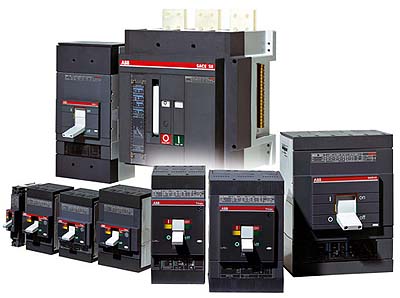 Автоматические выключатели ABB
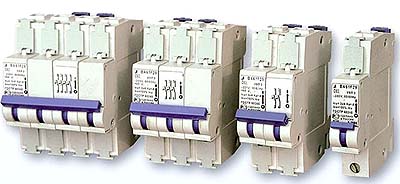 Модульные автоматические выключатели
1. НЕКОТОРЫЕ СВЕДЕНИЯ ОБ АВТОМАТИЧЕСКИХ ВЫКЛЮЧАТЕЛЯХ Автоматический выключатель — это электрический аппарат, который автоматически отключает (и тем самым защищает) электрическую цепь при возникновении в ней аномального режима. Режим становится аномальным, когда в цепи начинает недопустимо изменяться (т. е. увеличиваться или уменьшаться относительно номинального значения) ток или напряжение.
Другими словами (более "инженерно") можно сказать, что автоматический выключатель защищает от токов короткого замыкания и токов перегрузки отходящую от него питающую линию, например, кабель и приемник(и) электрической энергии (осветительную сеть, розетки, электродвигатель и т. п.).
Как правило, автоматический выключатель может применятся также для нечастого (несколько раз в сутки) включения и отключения защищаемых электроприемников (защищаемой нагрузки).
[Интент]Выключатель предназначен для проведения тока в нормальном режиме и отключения тока при коротких замыканиях, перегрузках, недопустимых снижениях напряжения, а также до 30 оперативных включений и отключений электрических цепей в сутки и рассчитан для эксплуатации в электроустановках с номинальным рабочим напряжением до 660 В переменного тока частоты 50 и 60 Гц и до 440 В постоянного тока.
[Типовая фраза из российской технической документации] 2. ПРИНЦИП ДЕЙСТВИЯ Для защиты цепи от короткого замыкания применяется автоматический выключатель с электромагнитным расцепителем.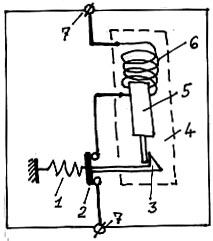
1 - Пружина (в данном случае во взведенном положении растянута)
Автоматический выключатель устроен таким образом, что сначала необходимо взвести пружину и только после этого его можно включить. У многих автоматических выключателей для взвода пружины необходимо перевести ручку вниз. После этого ручку переводят вверх. При этом замыкаются главные контакты.
2 - Главный контакт автоматического выключателя
3 - Удерживающее устройство
4 - Электромагнитный расцепитель;
5 - Сердечник
6 - Катушка
7 - Контактные зажимы автоматического выключателя
На рисунке показан один полюс автоматического выключателя во включенном положении: пружина 1 взведена, а главный контакт 2 замкнут.
Как только в защищаемой цепи возникнет короткое замыкание, ток, протекающий через соответствующий полюс автоматического выключателя, многократно возрастет. В катушке 6 сразу же возникнет сильное магнитное поле. Сердечник 5 втянется в катушку и освободит удерживающее устройство. Под действием пружины 1 главный контакт 2 разомкнется, в результате чего автоматический выключатель отключит и тем самым защитит цепь, в которой возникло короткое замыкание. Такое срабатывание автоматического выключателя происходит практически мгновенно (за сотые доли секунды).
Для защиты цепи от тока перегрузки применяют автоматические выключатели с тепловым расцепителем.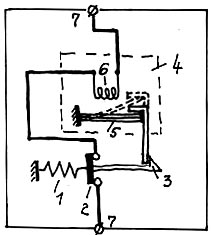
1 - Пружина (в данном случае во взведенном положении растянута)
Принцип действия такой же как и в первом случае, с той лишь разницей, что удерживающее устройство 3 освобождается под действием биметаллической пластины 5, которая изгибается от тепла, выделяемого нагревательным элементом 6. Количество тепла определяется током, протекающим через защищаемую цепь.
2 - Главный контакт автоматического выключателя
3 - Удерживающее устройство
4 - Тепловой расцепитель
5 - Биметаллическая пластина
6 - Нагревательный элемент
7 - Контактные зажимы автоматического выключателя
[Интент]Недопустимые, нерекомендуемые
Тематики
Классификация
>>>Обобщающие термины
Действия
- включение автоматического выключателя
- оперирование автоматического выключателя
- отключение автоматического выключателя
- срабатывание автоматического выключателя
EN
- auto-cutout
- automatic circuit breaker
- automatic cutout
- automatic switch
- breaker
- CB
- circuit breaker
- circuit-breaker
- cutout
DE
FR
Смотри также
выключатель
Коммутационный электрический аппарат, имеющий два коммутационных положения или состояния и предназначенный для включении и отключения тока.
Примечание. Под выключателем обычно понимают контактный аппарат без самовозврата. В остальных случаях термин должен быть дополнен поясняющими словами, например, «выключатель с самовозвратом», «выключатель тиристорный» и т. д.
[ ГОСТ 17703-72]
выключатель
Контактный коммутационный аппарат, способный включать, проводить и отключать токи при нормальных условиях в цепи, а также включать, проводить в течение нормированного времени и отключать токи при нормированных анормальных условиях в цепи, таких как короткое замыкание.
[ ГОСТ Р 52565-2006]
выключатель
Устройство для включения и отключения тока и напряжения в одной или более электрических цепях.
Примечание. При отсутствии других указаний под понятиями «напряжение» и «ток» подразумевают их среднеквадратичные значения.
[ ГОСТ Р 51324.1-2005]
выключатель
Прибор для включения и отключения электрического оборудования и устройств
[Терминологический словарь по строительству на 12 языках (ВНИИИС Госстроя СССР)]EN
(on-off) switch
switch for alternatively closing and opening one or more electric circuits
Source: 581-10-01 MOD
[IEV number 151-12-23]FR
interrupteur, m
commutateur destiné à fermer et ouvrir alternativement un ou plusieurs circuits électriques
Source: 581-10-01 MOD
[IEV number 151-12-23]При отключении воздушных и кабельных линий тупикового питания первым рекомендуется отключать выключатель со стороны нагрузки, вторым — со стороны питания.
[РД 153-34.0-20.505-2001]
... так чтобы она с меньшей выдержкой времени отключала выключатели с той стороны, на которой защита отсутствует;
[ПУЭ]
б) блокировка между выключателями нагрузки или разъединителем и заземляющим разъединителем, не позволяющая включать выключатель нагрузки или разъединитель при включенном заземляющем разъединителе и включать заземляющий разъединитель при включенном выключателе нагрузки или разъединителе;
[ ГОСТ 12.2.007.4-75]
Испытания изоляции выключателей и разъединителей должны быть проведены при включенном и отключенном положениях.
[ ГОСТ 1516_1-76]
Выключатели предназначены для оперативной и аварийной коммутации в энергосистемах, т.е. выполнения операций включения и отключения отдельных цепей при ручном или автоматическом управлении. Во включенном состоянии выключатели должны беспрепятственно пропускать токи нагрузки. Характер режима работы этих аппаратов несколько необычен: нормальным для них считается как включенное состояние, когда они обтекаются током нагрузки, так и отключенное, при котором они обеспечивают необходимую электрическую изоляцию между разомкнутыми участками цепи. Коммутация цепи, осуществляемая при переключении выключателя из одного положения в другое, производится нерегулярно, время от времени, а выполнение им специфических требований по отключению возникающего в цепи короткого замыкания чрезвычайно редко. Выключатели должны надежно выполнять свои функции в течение срока службы, находясь в любом из указанных состояний, и одновременно быть всегда готовыми к мгновенному эффективному выполнению любых коммутационных операций, часто после длительного пребывания в неподвижном состоянии. Отсюда следует, что они должны иметь очень высокий коэффициент готовности: при малой продолжительности процессов коммутации (несколько минут в год) должна быть обеспечена постоянная готовность к осуществлению коммутаций.
[ http://relay-protection.ru/content/view/46/8/]Тематики
- выключатель, переключатель
- релейная защита
Действия
Сопутствующие термины
EN
DE
FR
прерыватель цепи
(МСЭ-Т K.66).
[ http://www.iks-media.ru/glossary/index.html?glossid=2400324]Тематики
- электросвязь, основные понятия
EN
рубильник
Выключатель ручного действия с ножеобразными подвижными контактами, входящими в неподвижные пружинящие зажимы-гнёзда
[Терминологический словарь по строительству на 12 языках (ВНИИИС Госстроя СССР)]Тематики
- выключатель, переключатель
EN
- bladed switch
- bladed-type switch
- circuit breaker
- cutout
- cutout knife switch
- knife switch
- knife-blade switch
- knife-break switch
- lever switch
DE
FR
Англо-русский словарь нормативно-технической терминологии > circuit breaker
97 surge
- помпаж
- перенапряжение
- колебание (числа оборотов турбины)
- импульсное перенапряжение
- значительное колебание оборотов (двигателя)
- гидравлический удар
- выброс тока
- выброс напряжения
- бросок напряжения
бросок напряжения
Волна напряжения переходного процесса, распространяющаяся по линии или по цепи и характеризующаяся быстрым нарастанием, за которым следует более медленное снижение напряжения (МСЭ-Т K.43, МСЭ-Т K.48).
[ http://www.iks-media.ru/glossary/index.html?glossid=2400324]Тематики
- электросвязь, основные понятия
EN
выброс напряжения
Динамическое изменение напряжения в сети электропитания в виде повышения напряжения за верхний допустимый предел.
[ ГОСТ 19542-93]Выброс напряжения – динамическое кратковременное отклонение напряжения с последующим возвращением к исходному значению.
В отличие от заброса напряжения причинами выброса напряжения могут быть не только изменение нагрузки, но и повреждения электрических сетей, процессы коммутации и др.
С точки зрения электромагнитной совместимости выброс напряжения рассматривается как помеха, воздействующая на работу технического средства. По длительности и амплитуде выброса напряжения нормативные документы различают несколько степеней жесткости испытаний.
При испытаниях на устойчивость ТС должно быть подвергнуто воздействию выбросов напряжения не менее трёх раз, с интервалом между ними не менее 10 с.
Информация об устойчивости цифровых устройств релейной защиты к выбросам напряжения содержится в работе [3].
Литература
1. ГОСТ Р 51317.4.1-99 (МЭК 61000-4-11-94). Устойчивость к динамическим изменениям напряжения электропитания. Требования и методы испытаний.
2. ГОСТ Р 50932-96 Совместимость технических средств электромагнитная. Устойчивость оборудования проводной связи к электромагнитным помехам. Требования и методы испытаний
3. Захаров О.Г. Требования к портам оперативного питания в технических условиях цифровых устройств релейной защиты. // Вести в электроэнергетике. №5, 2010.//Статью также можно прочесть и на портале «Всё о релейной защите» http://www.rza.org.ua
4. ГОСТ 23875-88 Качество электрической энергии.Термины и определения [2].
5. РД 34.35.310-97. Общие технические требования к микропроцессорным устройствам защиты и автоматики энергосистем. М.: ОРГГЭС, 1997 (с изменением №1).
[ http://maximarsenev.narod.ru/links.html]
Тематики
EN
выброс тока
бросок тока
экстраток
—
[Я.Н.Лугинский, М.С.Фези-Жилинская, Ю.С.Кабиров. Англо-русский словарь по электротехнике и электроэнергетике, Москва, 1999 г.]Тематики
- электротехника, основные понятия
Синонимы
EN
гидравлический удар
Резкое повышение или понижение давления движущейся жидкости при внезапном уменьшении или увеличении скорости потока
[ ГОСТ 26883-86]
гидравлический удар
Удар, создаваемый путем повышения или понижения гидромеханического давления в напорном трубопроводе, вызываемого изменением во времени скорости движения жидкости (газа) в сечении трубопровода.
[ ГОСТ 15528-86]
гидравлический удар
Повышение или понижение гидродинамического давления в напорном трубопроводе, вызванное резким изменением во времени скорости движения жидкости в каком-либо сечении трубопровода.
Примечание
Гидравлический удар имеет место при открытии или закрытии затворов, направляющих аппаратов турбин и т.п.
[СО 34.21.308-2005]
удар гидравлический
Резкое повышение давления жидкости в трубопроводе при внезапном изменении скорости потока в случае остановки насосов или быстрого перекрытия трубопровода
[Терминологический словарь по строительству на 12 языках (ВНИИИС Госстроя СССР)]Тематики
- внешние воздействующие факторы
- гидравлика и пневматика
- гидропривод объемный и пневмопривод
- гидротехника
- измерение расхода жидкости и газа
Обобщающие термины
EN
- hammer blow
- hydraulic hammer
- hydraulic impact
- hydraulic shock
- hydraulic transient
- jar of water
- knocking
- pressure shock
- pressure surge
- reverberation
- surge
- surging shock
- transient shock
- water hammer
- water hammering
- water ram
DE
FR
значительное колебание оборотов (двигателя)
—
[ http://slovarionline.ru/anglo_russkiy_slovar_neftegazovoy_promyishlennosti/]Тематики
EN
импульсное перенапряжение
В настоящее время в различных литературных источниках для описания процесса резкого повышения напряжения используются следующие термины:- перенапряжение,
- временное перенапряжение,
- импульс напряжения,
- импульсная электромагнитная помеха,
- микросекундная импульсная помеха.
Мы в своей работе будем использовать термин « импульсное перенапряжение», понимая под ним резкое изменение напряжения с последующим восстановлением
амплитуды напряжения до первоначального или близкого к нему уровня за промежуток времени до нескольких миллисекунд вызываемое коммутационными процессами в электрической сети или молниевыми разрядами.
В соответствии с классификацией электромагнитных помех [ ГОСТ Р 51317.2.5-2000] указанные помехи относятся к кондуктивным высокочастотным переходным электромагнитным апериодическим помехам.
[Техническая коллекция Schneider Electric. Выпуск № 24. Рекомендации по защите низковольтного электрооборудования от импульсных перенапряжений]EN
surge
spike
Sharp high voltage increase (lasting up to 1mSec).
[ http://www.upsonnet.com/UPS-Glossary/]Параллельные тексты EN-RU
The Line-R not only adjusts voltages to safe levels, but also provides surge protection against electrical surges and spikes - even lightning.
[APC]Автоматический регулятор напряжения Line-R поддерживает напряжение в заданных пределах и защищает цепь от импульсных перенапряжений, в том числе вызванных грозовыми разрядами.
[Перевод Интент]
Surges are caused by nearby lightning activity and motor load switching
created by air conditioners, elevators, refrigerators, and so on.
[APC]
ВОПРОС: ЧТО ЯВЛЯЕТСЯ ИСТОЧНИКОМ ИМПУЛЬСНЫХ ПЕРЕНАПРЯЖЕНИЙ И ПОМЕХ?
Основных источников импульсов перенапряжений - всего два.
1. Переходные процессы в электрической цепи, возникающие вследствии коммутации электроустановок и мощных нагрузок.
2. Атмосферный явления - разряды молнии во время грозыВОПРОС: КАК ОПАСНОЕ ИМПУЛЬСНОЕ ПЕРЕНАПРЯЖЕНИЕ МОЖЕТ ПОПАСТЬ В МОЮ СЕТЬ И НАРУШИТЬ РАБОТУ ОБОРУДОВАНИЯ?
Импульс перенапряжения может пройти непосредственно по электрическим проводам или шине заземления - это кондуктивный путь проникновения.
Электромагнитное поле, возникающее в результате импульса тока, индуцирует наведенное напряжение на всех металлических конструкциях, включая электрические линии - это индуктивный путь попадания опасных импульсов перенапряжения на защищаемый объект.ВОПРОС: ПОЧЕМУ ПРОБЛЕМА ЗАЩИТЫ ОТ ИМПУЛЬСНЫХ ПЕРЕНАПРЯЖЕНИЙ ОСТРО ВСТАЛА ИМЕННО В ПОСЛЕДНЕЕ ВРЕМЯ?
Эта проблема приобрела актуальность в связи с интенсивным внедрением чувствительной электроники во все сферы жизни. Учитывая возросшее количество информационных линий (связь, телевидение, интернет, ЛВС и т.д.) как в промышленности, так и в быту, становится понятно, почему защита от импульсных перенапряжений и приобрела сейчас такую актуальность.[ http://www.artterm-m.ru/index.php/zashitaseteji1/faquzip]
Защита от импульсного перенапряжения. Ограничитель перенапряжения - его виды и возможности
Перенапряжением называется любое превышение напряжения относительно максимально допустимого для данной сети. К этому виду сетевых помех относятся как перенапряжения связанные с перекосом фаз достаточно большой длительности, так и перенапряжения вызванные грозовыми разрядами с длительностью от десятков до сотен микросекунд. Методы и средства борьбы зависят от длительности и амплитуды перенапряжений. В этом отношении импульсные перенапряжения можно выделить в отдельную группу.
Под импульсным перенапряжением понимается кратковременное, чрезвычайно высокое напряжение между фазами или фазой и землей с длительностью, как правило, до 1 мс.
Грозовые разряды - мощные импульсные перенапряжения возникающие в результате прямого попадания молнии в сеть электропитания, громоотвод или импульс от разряда молнии на расстоянии до 1,5 км приводящий к выходу из строя электрооборудования или сбою в работе аппаратуры. Прямое попадание характеризуется мгновенными импульсными токами до 100 кА с длительностью разряда до 1 мС.
При наличии системы громоотвода импульс разряда распределяется между громоотводом, сетью питания, линиями связи и бытовыми коммуникациями. Характер распределения во многом зависит от конструкции здания, прокладки линий и коммуникаций.

Переключения в энергосети вызывают серию импульсных перенапряжений различной мощности, сопровождающуюся радиочастотными помехами широкого спектра. Природа возникновения помех приведена на примере ниже.
Например при отключении разделительного трансформатора мощностью 1кВА 220\220 В от сети вся запасенная трансформатором энергия "выбрасывается" в нагрузку в виде высоковольтного импульса напряжением до 2 кВ.
Мощности трансформаторов в энергосети значительно больше, мощнее и выбросы. Кроме того переключения сопровождаются возникновением дуги, являющейся источником радиочастотных помех.
Электростатический заряд, накапливающийся при работе технологического оборудования интересен тем, что хоть и имеет небольшую энергию, но разряжается в непредсказуемом месте.
Форма и амплитуда импульсного перенапряжения зависят не только от источника помехи, но и от параметров самой сети. Не существует два одинаковых случая импульсного перенапряжения, но для производства и испытания устройств защиты введена стандартизация ряда характеристик тока, напряжения и формы перенапряжения для различных случаев применения.
Так для имитации тока разряда молнии применяется импульс тока 10/350 мкс, а для имитации косвенного воздействия молнии и различных коммутационных перенапряжений импульс тока с временными характеристиками 8/20 мкс.
Таким образом, если сравнить два устройства с максимальным импульсным током разряда 20 кА при 10/ 350 мкс и 20 кА при импульсе 8/20 мкс у второго, то реальная "мощность" первого примерно в 20 раз больше.
Существует четыре основных типа устройств защиты от импульсного перенапряжения:
1. Разрядник
Представляет собой ограничитель перенапряжения из двух токопроводящих пластин с калиброванным зазором. При существенном повышении напряжения между пластинами возникает дуговой разряд, обеспечивающий сброс высоковольтного импульса на землю. По исполнению разрядники делятся на воздушные, воздушные многоэлектродные и газовые. В газовом разряднике дуговая камера заполнена инертным газом низкого давления. Благодаря этому их параметры мало зависят от внешних условий (влажность, температура, запыленность и т.д.) кроме этого газовые разрядники имеют экстремально высокое сопротивление (около 10 ГОм), что позволяет их применять для защиты от перенапряжения высокочастотных устройств до нескольких ГГц.При установке воздушных разрядников следует учитывать выброс горячего ионизированного газа из дуговой камеры, что особенно важно при установке в пластиковые щитовые конструкции. В общем эти правила сводятся к схеме установки представленной ниже.
Типовое напряжение срабатывания в для разрядников составляет 1,5 - 4 кВ (для сети 220/380 В 50 Гц). Время срабатывания порядка 100 нс. Максимальный ток при разряде для различных исполнений от 45 до 60 кА при длительности импульса 10/350 мкс. Устройства выполняются как в виде отдельных элементов для установки в щиты, так и в виде модуля для установки на DIN - рейку. Отдельную группу составляют разрядники в виде элементов для установки на платы с токами разряда от 1 до 20 кА (8/20 мкс).
2. Варистор
Керамический элемент, у которого резко падает сопротивление при превышении определенного напряжения. Напряжение срабатывания 470 - 560 В (для сети 220/380 В 50 Гц).Время срабатывания менее 25 нс. Максимальный импульсный ток от 2 до 40 кА при длительности импульса 8/20 мкс.
Устройства выполняются как в виде отдельных элементов для установки в радиоаппаратуру, так и в виде DIN - модуля для установки в силовые щиты.
3. Разделительный трансформатор
Эффективный ограничитель перенапряжения - силовой 50 герцовый трансформатор с раздельными обмотками и равными входным и выходным напряжениями. Трансформатор просто не способен передать столь короткий высоковольтный импульс во вторичную обмотку и благодаря этому свойству является в некоторой степени идеальной защитой от импульсного перенапряжения.Однако при прямом попадании молнии в электросеть может нарушиться целостность изоляции первичной обмотки и трансформатор выходит из строя.
4. Защитный диод
Защита от перенапряжения для аппаратуры связи. Обладает высокой скоростью срабатывания (менее 1 нс) и разрядным током 1 кА при токовом импульсе 8/20 мкс.Все четыре выше описанные ограничителя перенапряжения имеют свои достоинства и недостатки. Если сравнить разрядник и варистор с одинаковым максимальным импульсным током и обратить внимание на длительность тестового импульса, то становится ясно, что разрядник способен поглотить энергию на два порядка больше, чем варистор. Зато варистор срабатывает быстрее, напряжение срабатывания существенно ниже и гораздо меньше помех при работе.
Разделительный трансформатор, при определенных условиях, имеет безграничный ресурс по защите нагрузки от импульсного перенапряжения (у варисторов и разрядников при срабатывании происходит постепенное разрушение материала элемента), но для сети 100 кВА требуется трансформатор 100кВА (тяжелый, габаритный и довольно дорогой).
Следует помнить, что при отключении первичной сети трансформатор сам по себе генерирует высоковольтный выброс, что требует установки варисторов на выходе трансформатора.
Одной из серьезных проблем в процессе организации защиты оборудования от грозового и коммутационного перенапряжения является то, что нормативная база в этой области до настоящего времени разработана недостаточно. Существующие нормативные документы либо содержат в себе устаревшие, не соответствующие современным условиям требования, либо рассматривают их частично, в то время как решение данного вопроса требует комплексного подхода. Некоторые документы в данный момент находятся в стадии разработки и есть надежда, что они вскоре выйдут в свет. В их основу положены основные стандарты и рекомендации Международной Электротехнической Комиссии (МЭК).
[ http://www.higercom.ru/products/support/upimpuls.htm]
Чем опасно импульсное перенапряжение для бытовых электроприборов?
Изоляция любого электроприбора рассчитана на определенный уровень напряжения. Как правило электроприборы напряжением 220 – 380 В рассчитаны на импульс перенапряжения около 1000 В. А если в сети возникают перенапряжения с импульсом 3000 В? В этом случае происходит пробои изоляции. Возникает искра – ионизированный промежуток воздуха, по которому протекает электрический ток. В следствии этого – электрическая дуга, короткое замыкание и пожар.
Заметьте, что прибой изоляции может возникнуть, даже если у вас все приборы отключены от розеток. Под напряжением в доме все равно останутся электропроводка, распределительные коробки, те же розетки. Эти элементы сети также не защищены от импульсного перенапряжения.
Причины возникновения импульсного перенапряжения.
Одна из причин возникновения импульсных перенапряжений это грозовые разряды (удары молнии). Коммутационные перенапряжения которые возникают в результате включения/отключения мощной нагрузки. При перекосе фаз в результате короткого замыкания в сети.
Защита дома от импульсных перенапряжений
Избавиться от импульсных перенапряжений - невозможно, но для того чтобы предотвратить пробой изоляции существуют устройства, которые снижают величину импульсного перенапряжения до безопасной величины.
Такими устройствами защиты являются УЗИП - устройство защиты от импульсных перенапряжений.
Существует частичная и полная защита устройствами УЗИП.
Частичная защита подразумевает защиту непосредственно от пробоя изоляции (возникновения пожара), в этом случае достаточно установить один прибор УЗИП на вводе электрощитка (защита грубого уровня).
При полной защите УЗИП устанавливается не только на вводе, но и возле каждого потребителя домашней электросети (телевизора, компьютера, холодильника и т.д.) Такой способ установки УЗИП дает более надежную защиту электрооборудованию.
[ Источник]
Тематики
EN
колебание (числа оборотов турбины)
—
[А.С.Гольдберг. Англо-русский энергетический словарь. 2006 г.]Тематики
EN
перенапряжение в системе электроснабжения
Превышение напряжения над наибольшим рабочим напряжением, установленным для данного электрооборудования.
[ ГОСТ 23875-88]
перенапряжение
Напряжение между двумя точками электротехнического изделия (устройства), значение которого превосходит наибольшее рабочее значение напряжения.
[ ГОСТ 18311-80]
перенапряжение (в сети)
Любое напряжение между одной фазой и землей или между фазами, имеющее значение, превышающее соответствующий пик наибольшего рабочего напряжения оборудования
[ ГОСТ Р 52565-2006]
перенапряжение
Всякое повышение напряжения сверх амплитуды длительно допустимого рабочего фазного напряжения.
[Методические указания по защите распределительных электрических сетей напряжением 0,4-10 кВ от грозовых перенапряжений]
перенапряжение
Временное увеличение напряжения в конкретной точке электрической системы выше порогового значения.
[ ГОСТ Р 51317.4.30-2008 (МЭК 61000-4-30:2008)]
перенапряжение
Возникновение избыточного напряжения, возникающего при сбросе нагрузки или кратковременном воздействии мощных помех. Одним из основных источников перенапряжения являются грозовые разряды в атмосфере, которые могут повредить интерфейсное оборудование, подключенное к кабельным линиям связи.
[Л.М. Невдяев. Телекоммуникационные технологии. Англо-русский толковый словарь-справочник. Под редакцией Ю.М. Горностаева. Москва, 2002]
перенапряжение
-
[IEV number 151-15-27]EN
over-voltage
over-tension
voltage the value of which exceeds a specified limiting value
[IEV number 151-15-27]
voltage swell
temporary increase of the voltage magnitude at a point in the electrical system above a threshold
[IEC 61000-4-30, ed. 2.0 (2008-10)]FR
surtension, f
tension électrique dont la valeur dépasse une valeur limite spécifiée
[IEV number 151-15-27]
surtension temporaire à fréquence industrielle
augmentation temporaire de l’amplitude de la tension en un point du réseau d’énergie électrique au-dessus d’un seuil donné
[IEC 61000-4-30, ed. 2.0 (2008-10)]Тематики
- качество электрической энергии
- электросвязь, основные понятия
- электроустановки
Синонимы
Сопутствующие термины
EN
- o.v.
- over voltage
- over-tension
- over-voltage
- overpotential
- overvoltage
- ovv
- super potential
- supertension
- surge
- voltage overload
- voltage swell
DE
FR
- surtension temporaire à fréquence industrielle
- surtension, f
Смотри также
помпаж
Неустойчивый режим работы турбокомпрессора, характеризующийся последовательно чередующимся нагнетанием газа в сеть и выбрасыванием газа из сети на всасывание.
[ ГОСТ 28567-90]Тематики
EN
3.1.24 импульсное перенапряжение (surge): Резкий подъем напряжения, вызванный электромагнитным импульсом удара молнии и проявляющийся в виде повышения электрического напряжения или тока до значений, представляющих опасность для изоляции или потребителя.
Источник: ГОСТ Р МЭК 62305-2-2010: Менеджмент риска. Защита от молнии. Часть 2. Оценка риска оригинал документа
3.35 импульсное перенапряжение (surge): Резкий подъем напряжения, вызванный электромагнитным импульсом удара молнии и проявляющийся в виде повышения электрического напряжения или тока до значений, представляющих опасность для изоляции или потребителя.
Источник: ГОСТ Р МЭК 62305-1-2010: Менеджмент риска. Защита от молнии. Часть 1. Общие принципы оригинал документа
Англо-русский словарь нормативно-технической терминологии > surge
98 irr
- ответ на запрос информации
- внутренняя ставка дохода
- внутренняя норма рентабельности
- внутренняя норма прибыли
- внутренняя норма доходности (в информационных технологиях)
- внутренняя норма доходности
внутренняя норма доходности
внутренняя ставка доходности
внутренняя ставка отдачи
Один из основных критериев оценки инвестиционных проектов (доходности единицы вложенного капитала) - ставка дисконта, при которой выполняется равенство суммы дисконтированных доходов по проекту (положительного денежного потока) дисконтированной сумме инвестиций (отрицательному денежному потоку), т.е. чистая приведенная стоимость (NPV) равна нулю. В.н.д. отражает как отдачу инвестированного капитала в целом, так и отдачу первоначальных инвестиций, является основным вознаграждением потенциальных инвесторов. Главное правило: если В.н.д. меньше требуемой инвесторами ставки дохода на вложенный капитал, проект отвергается, если больше - может быть принят.
[ОАО РАО "ЕЭС России" СТО 17330282.27.010.001-2008]
внутренняя норма доходности
IRR
Иногда называется также внутренней нормой прибыли, рентабельности, возврата инвестиций; один из основных критериев оценки инвестиционных проектов (доходности единицы вложенного капитала) - ставка дисконта, при которой выполняется равенство суммы дисконтированных доходов по проекту (положительного денежного потока) дисконтированной сумме инвестиций (отрицательному денежному потоку, приведенному объему инвестиций), т. е. чистая приведенная стоимость (NPV) равна нулю. В.н.д. отражает как отдачу инвестированного капитала в целом, так и отдачу первоначальных инвестиций, является основным вознаграждением потенциальных инвесторов. Анализ В.н.д. (прибыли) отвечает на главный вопрос размещения капиталов: насколько ожидаемый от проекта денежный поток оправдает затраты на инвестиции в этот проект. Поэтому компании рассчитывают ожидаемый IRR каждого проекта и сравнивают с требуемой нормой прибыли (рентабельности), т. е. со стоимостью своего капитала. Этот расчет обычно ведется методом проб и ошибок, путем последовательного применения к чистому денежному потоку приведенных стоимостей при различных ставках процента. Главное правило: если В.н.д. меньше требуемой инвесторами ставки дохода на вложенный капитал — проект отвергается, если больше — может быть принят. То же: Внутренняя ставка доходности, Внутренняя ставка отдачи. См. также Коэффициент окупаемости капитальных вложений.
[ http://slovar-lopatnikov.ru/]Тематики
Синонимы
EN
внутренняя норма доходности
ВНД
(ITIL Service Strategy)
Техника, используемая для принятия решений относительно капитальных затрат. Внутренняя норма доходности (irr) - это численный показатель для сравнения двух или нескольких альтернативных инвестиций. Более высокий показатель внутренней нормы доходности указывает на более выгодные инвестиции.
См. тж. чистая приведенная стоимость; возврат инвестиций.
[Словарь терминов ITIL версия 1.0, 29 июля 2011 г.]EN
internal rate of return
IRR
(ITIL Service Strategy)
A technique used to help make decisions about capital expenditure. It calculates a figure that allows two or more alternative investments to be compared. A larger internal rate of return indicates a better investment.
See also net present value; return on investment.
[Словарь терминов ITIL версия 1.0, 29 июля 2011 г.]Тематики
Синонимы
EN
внутренняя норма прибыли
норма прибыли с поправкой на время
Ставка дисконтирования, при которой чистая текущая стоимость денежных выплат и поступлений равна нулю. Называется также Нормой прибыли с поправкой на время (Time-Adjusted Rate of Return). В соответствии с Распоряжением федерального управления по делам о несостоятельности (банкротстве) от 5 декабря 1994 г. N 98-р, внутренняя норма прибыли (внутренний предельный уровень доходности, IRR) - специальная ставка дисконта, при которой суммы поступлений и отчислений денежных средств дают нулевую чистую текущую приведенную стоимость, т.е. приведенная стоимость денежных поступлений равна приведенной стоимости отчислений денежных средств.
[ http://www.lexikon.ru/dict/uprav/index.html]Тематики
Синонимы
EN
внутренняя норма рентабельности
показатель окупаемости
—
[Л.Г.Суменко. Англо-русский словарь по информационным технологиям. М.: ГП ЦНИИС, 2003.]Тематики
Синонимы
EN
внутренняя ставка дохода
Норма прибыли, которая дисконтирует чистую текущую стоимость (net present value) проекта до нуля. Этот метод используется в сочетании с методом дисконтирования поступлений наличности (discounted cash flow) для того, чтобы исходя из поступлений наличности от проекта определить норму прибыли на инвестиционные затраты. Если внутренняя ставка дохода превышает рыночную ставку процента-проект является прибыльным. Для оценки проекта внутренняя ставка дохода обычно считается менее надежным показателем, чем действительная чистая текущая стоимость.
Во-первых, если доходы в различные периоды колеблются и могут быть то положительными, то отрицательными, получить единую внутреннюю ставку невозможно.
Во-вторых, обычно ее показатели выше для проектов более прибыльных в начальный период эксплуатации, даже если их чистая текущая стоимость мала.
См. также: payback period (период окупаемости инвестиций).
[ http://www.vocable.ru/dictionary/533/symbol/97]Тематики
EN
ответ на запрос информации
(МСЭ-Т Н.225).
[ http://www.iks-media.ru/glossary/index.html?glossid=2400324]Тематики
- электросвязь, основные понятия
EN
Англо-русский словарь нормативно-технической терминологии > irr
99 ROI
- рассматриваемая область
- прибыль от инвестиций
- прибыль на инвестированный капитал
- представляющая интерес область (знаний, решений и т.п.)
- область интересов
- доходность инвестиций
- возврат инвестиций (ROI)
- возврат инвестиций
возврат инвестиций
ROI
(ITIL Continual Service Improvement)
(ITIL Service Strategy)
Мера ожидаемых выгод от инвестиций. В простейшем случае это чистая прибыль от инвестиций, поделённая на стоимость инвестированных активов.
См. тж. чистая приведенная стоимость; добавленная ценность от инвестиций.
[Словарь терминов ITIL версия 1.0, 29 июля 2011 г.]EN
return on investment
ROI
(ITIL Continual Service Improvement)
(ITIL Service Strategy)
A measurement of the expected benefit of an investment. In the simplest sense, it is the net profit of an investment divided by the net worth of the assets invested.
See also net present value; value on investment.
[Словарь терминов ITIL версия 1.0, 29 июля 2011 г.]Тематики
Синонимы
EN
доходность инвестиций
Показатель прибыльности (рентабельности) по версии МСФО, используемый при анализе эффективности менеджмента и выявлении целесообразности производства той или иной продукции. Рассчитывается как частное от деления суммарной прибыли компании после вычета налогов, процентов и дивидендов (чистой прибыли) на сумму ее собственного и заемного капитала (или на суммарные активы). Упрощенная формула: Чистая прибыль ???100% — Обязательства + Акционерный капитал. Важное преимущество показателя в том, что его можно использовать при межотраслевых сравнениях. Недостаток же в том, что он может быть ниже у компаний, которые ведут активную инвестиционную деятельность, и наоборот.
[ http://slovar-lopatnikov.ru/]Тематики
EN
область интересов
Наборы коэффициентов, которые рассматривают как особо важные по определенным некоторыми пользователями критериям (МСЭ-Т T.800).
[ http://www.iks-media.ru/glossary/index.html?glossid=2400324]Тематики
- электросвязь, основные понятия
EN
представляющая интерес область (знаний, решений и т.п.)
—
[А.С.Гольдберг. Англо-русский энергетический словарь. 2006 г.]Тематики
EN
прибыль на инвестированный капитал
Отношение прибыли к инвестициям, направленным на получение данной прибыли. Прибыль может быть выражена как чистый доход до уплаты налога на прибыль, либо как доход без учета экстраординарных событий. Инвестиции могут быть выражены либо как акционерный капитал, общий основной капитал, либо как активы. То или иное значение используется в зависимости от контекста.
[ http://www.lexikon.ru/dict/uprav/index.html]Тематики
EN
прибыль от инвестиций
Метод экономической оценки бурения и эксплуатации скважины. ROI - это частное от деления ожидаемого дохода от реализации добытой нефти/газа на величину затрат на бурение и на добычу нефти/газа
[ http://slovarionline.ru/anglo_russkiy_slovar_neftegazovoy_promyishlennosti/]Тематики
EN
рассматриваемая область
—
[А.С.Гольдберг. Англо-русский энергетический словарь. 2006 г.]Тематики
EN
Англо-русский словарь нормативно-технической терминологии > ROI
100 OL
воздушная линия
—
[ http://www.iks-media.ru/glossary/index.html?glossid=2400324]
воздушная линия
-
[Лугинский Я. Н. и др. Англо-русский словарь по электротехнике и электроэнергетике. 2-е издание - М.: РУССО, 1995 - 616 с.]Тематики
- электросвязь, основные понятия
- электротехника, основные понятия
Синонимы
- ВЛ
EN
лицензия на эксплуатацию АЭС
—
[А.С.Гольдберг. Англо-русский энергетический словарь. 2006 г.]Тематики
EN
перегрузка
Условия появления сверхтока в электрически не поврежденной цепи.
МЭК 60050(441-11-08).
[ ГОСТ Р 50030. 1-2000 ( МЭК 60947-1-99)]
перегрузка
Условия оперирования в электрически неповреждённой цепи, которые вызывают сверхток.
В электрических цепях электроустановки здания могут возникать сверхтоки при отсутствии в них электрических повреждений. Причиной появления этих сверхтоков является перегрузка электрических цепей. Перегрузка характеризуется током перегрузки, который превышает номинальный ток электрической цепи и допустимые длительные токи её проводников. Длительная перегрузка проводников может вызвать их сильный нагрев и стать причиной пожара в здании. Поэтому в электроустановках зданий выполняют защиту от перегрузок с помощью устройств защиты от сверхтока. Перегрузки могут также возникать при переходных процессах в электрических цепях, например, при включении электрооборудования.
[ http://www.volt-m.ru/glossary/letter/%CF/view/46/]
перегрузка
Отношение время/электрический ток для цепи, в которой превышена максимальная допустимая нагрузка, когда цепь находится в исправном состоянии.
Примечание - Не следует использовать термин «перегрузка» как синоним термина «сверхток».
[ГОСТ ЕН 1070-2003]
перегрузка (цепи)
Времятоковая зависимость для цепи, в которой превышена максимальная нагрузка, когда цепь находится в исправном состоянии.
Примечание
Не следует использовать термин «перегрузка» как синоним сверхтока.
[ ГОСТ Р МЭК 60204-1-2007]
перегрузка
Превышение фактического значения мощности или тока электротехнического изделия (устройства) над номинальным значением.
Примечание. Допускается с введением соответствующего пояснения оценивать перегрузку полным значением параметра, превышающим номинальное значение.
[ ГОСТ 18311-80]
перегрузка
-
[IEV number 314-02-09]EN
overload
operating conditions in an electrically undamaged circuit which cause an over-current.
[IEC 60947-1, ed. 5.0 (2007-06)]
overload, noun
excess of the actual load over the full load, expressed by their difference
Source: 151-15-16
[IEV number 151-15-30]
overflow
condition which occurs when the numerical value of the output information exceeds the maximum possible value which can be displayed or represented
[IEV number 314-02-09]FR
surcharge
conditions de fonctionnement d’un circuit électriquement sain, qui provoquent une surintensité.
[IEC 60947-1, ed. 5.0 (2007-06)]
surcharge, f
excédent de la charge réelle sur la pleine charge, exprimé par leur différence
Source: 151-15-16
[IEV number 151-15-30]
débordement
condition de fonctionnement pour lequel la valeur numérique de l'information de sortie dépasse la possibilité maximale d'affichage ou de représentation de l'appareil
[IEV number 314-02-09]Тематики
- электротехника, основные понятия
Синонимы
EN
- OL
- overcharge
- overdrive
- overflow
- overload
- overload of a circuit
- overloading
- ovId
- surcharge load
- thermal overload situation
DE
FR
- débordement
- surcharge
- surcharge d’un circuit
Англо-русский словарь нормативно-технической терминологии > OL
СтраницыСм. также в других словарях:
Media ethics — is the subdivision of applied ethics dealing with the specific ethical principles and standards of media, including broadcast media, film, theatre, the arts, print media and the internet. The field covers many varied and highly controversial… … Wikipedia
Value menu — A selection of value menu hamburgers from McDonald s, Burger King, Sonic Drive In and Wendy s. A value menu is a group of items on a fast food restaurant menu that are designed to be the least expensive items available. In the US, the items are… … Wikipedia
Media coverage of climate change — has significant effects on public opinion on climate change,[1] as it mediates the scientific opinion on climate change that the global instrumental temperature record shows increase in recent decades and that the trend is caused mainly by human… … Wikipedia
Media ecology — is a contested term within media studies having different meanings within European and North American contexts. The North American definition refers to an interdisciplinary field of media theory and media design involving the study of media… … Wikipedia
Media buying — is a sub function of Advertising management. Media Buying is the procurement of the best possible placement and price of a piece of media real estate within any given media. The main task of Media Buying lies within the negotiation of price and… … Wikipedia
Media Control Charts — Media Control GfK International Formation 1976 Type Market research, Service Provider of Media Monitoring, Analysis and Evaluation Headquarters … Wikipedia
Media systems dependency theory — (MSD) was first proposed by Sandra Ball Rokeach and Melvin DeFleur in 1976, and consists of a complex system in which the media, individuals, their interpersonal environment, and the social environment have dependency relationships with each… … Wikipedia
Media-system dependency — Media System Dependency, first introduced by Ball Rokeach and DeFleur (1976), is defined as “a relationship in which the capacity of individuals to attain their goals is contingent upon the information resources of the media system.” Those… … Wikipedia
Media in The Simpsons — Media is a recurring theme of satire on The Simpsons. The show is known for its satire of American popular culture and especially television culture, but has since its inception covered all types of media such as animation, journalism,… … Wikipedia
Media Chinese International — Limited Format Broadsheet Owner Media Chinese International Limited Language Chinese Headquarters Malaysia Official website [1] … Wikipedia
Media evaluation — is a discipline of the social sciences and centres on the analysis of media content rating the exposure using a number of pre designated criteria commonly including tonal value and presence of key messages. It is said to be one of the fastest… … Wikipedia
 18+© Академик, 2000-2026
- Обратная связь: Техподдержка, Реклама на сайте
Экспорт словарей на сайты, сделанные на PHP, Joomla, Drupal, WordPress, MODx.
Перевод: с английского на все языки
со всех языков на английский- Со всех языков на:
- Английский
- С английского на:
- Все языки
- Арабский
- Испанский
- Итальянский
- Немецкий
- Португальский
- Русский
- Украинский
- Французский