
Welcome
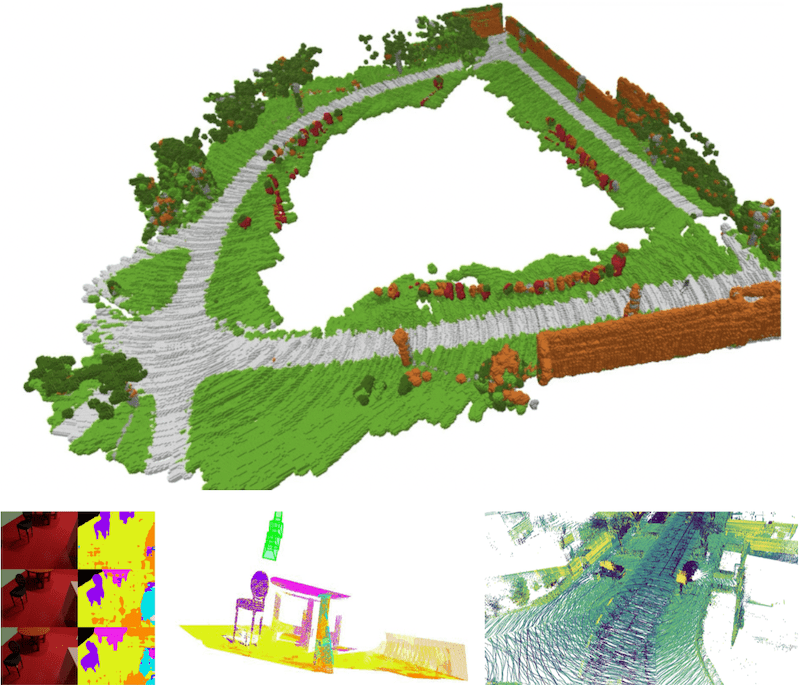
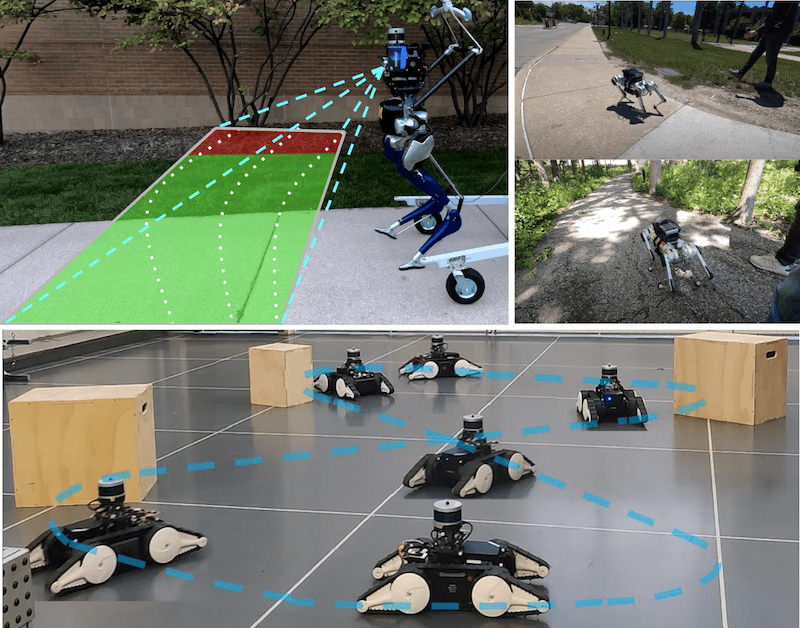

The Lu’s Navigation and Autonomous Robotics (Lunar) Lab at Georgia Tech studies problems related to perception and navigation for robots and autonomous systems in ground, air, and space applications. The lab’s primary goal is to enable robotic systems to operate autonomously in highly unstructured environments under harsh sensing conditions for tasks including search and rescue, daily housework, scientific exploration and discovery. The main research areas of the lab include computer vision, machine learning, deep learning, estimation, and probabilistic inference.
Current research interests:
- Humanoid loco-manipulation and navigation in the wild
- Physics-informed world models for deformable object manipulation
- 3D vision and physical scene understanding
- Multi-robot active simultaneous localization and mapping
If you are interested in joining us to work on these topics, feel free to reach out!
Selected Projects
MorphMimic: Morphology-Conditioned World Model and Policy Sharing Across Humanoids
Lizhi Yang, Fengze Xie*, Yuyang Wang*, Lu Gan, Yisong Yue, Aaron D. Ames
MorphMimic is a cross-embodiment world model and whole-body motion tracker built on SuperMimic, capable of controlling the Unitree G1, AgiBot X2 Ultra, and Booster T2 humanoid robots.
PhysCoRe: Physics-Corrected Residual World Models for Material-Aware Deformable Dynamics
Haocheng Yin*, Shuohan Tao*, Yongsheng Chen, Lu Gan
CoRL 2026
PhysCoRe is a physics-aware residual world model for deformable object dynamics that generalizes to unseen objects and enables uncertainty-guided online active exploration.

ShelfGaussian: Shelf-Supervised Open-Vocabulary Gaussian-based 3D Scene Understanding
Lingjun Zhao*, Yandong Luo*, James Hays, Lu Gan
CVPR 2026 Findings
ShelfGaussian is an open-vocabulary multi-modal Gaussian-based 3D scene understanding framework supervised by off-the-shelf vision foundation models.

HERCULES: An Open-Source Simulation Framework for Heterogeneous Multi-Robot SLAM, Collaborative Perception, and Exploration
Sandilya Sai Garimella, Daniel Chase Butterfield, Sean Wilson, Lu Gan
CVPR 2026 Workshop on Multi-Agent Robotic Systems
HERCULES is a UE5-based multi-robot simulator with out-of-the-box support for heterogeneous multi-robot SLAM, collaborative perception, and closed-loop coordination.


WestWorld: A Knowledge-Encoded Scalable Trajectory World Model for Diverse Robotic Systems
Yuchen Wang*, Jiangtao Kong*, Sizhe Wei, Xiaochang Li, Haohong Lin, Hongjue Zhao, Tianyi Zhou, Lu Gan, Huajie Shao
ICML 2026, Spotlight (Top 2.2%)
WestWorld is a cross-embodied trajectory world model for robot control, pretrained on 89 environments spanning diverse robot morphologies across simulation and real-world data.

GaussianFormer3D: Multi-Modal Gaussian-based Semantic Occupancy Prediction with 3D Deformable Attention
Lingjun Zhao, Sizhe Wei, James Hays, Lu Gan
ICRA 2026, RSS 2025 Gaussian Representations for Robot Autonomy Workshop
GaussianFormer3D is a LiDAR-camera semantic occupancy prediction framework based on a compact and continuous object-centric scene representation.

STATE-NAV: Stability-Aware Traversability Estimation for Bipedal Navigation on Rough Terrain
Ziwon Yoon, Lawrence Y. Zhu, Jingxi Lu, Lu Gan, Ye Zhao
IEEE RA-L, 2025
STATE-NAV is a learning-based humanoid traversability estimation framework for generalized rough terrain navigation by incorporating bipedal locomotion stability.

Morphological-Symmetry-Equivariant Heterogeneous Graph Neural Network for Robotic Dynamics Learning
Fengze Xie*, Sizhe Wei*, Yue Song, Yisong Yue, Lu Gan
L4DC, 2025
MS-HGNN is an efficient deep learning model for robotic dynamics learning, that integrates both robotic kinematic structures and morphological symmetries.

MI-HGNN: Morphology-Informed Heterogeneous Graph Neural Network for Legged Robot Contact Perception
Daniel Butterfield, Sandilya Sai Garimella, Nai-Jen Cheng, Lu Gan
ICRA, 2025
MI-HGNN is a structured deep learning model that incorporates robot morphological constraints; designed as a learning-based contact estimator for legged robots.
See more.
Latest News
- 10/14/2025: Ziwon delivered a Guest Lecture on Legged-Robot State Estimation in AE 8803: Advanced Mobile Robotics.
- 10/14/2026: Lu will serve as an Area Chair for RSS 2027.
- 10/10/2026: Haocheng received a CoRL 2026 Travel Award. Congrats!
- 10/09/2026: Lu and Haocheng gave a Georgia Tech Lab Spotlight talk at NVIDIA Robotics Day.
- 10/01/2026: Our lab received support from VinMotion to advance research in humanoid robots. Thanks!
- 09/30/2026: Lunar Lab attended IROS 2026. Lu gave an invited talk in the SeMaNa workshop, and was named a finalist for the Outstanding Associate Editor Award at IROS 2026.
- 09/20/2026: Shaya and Om received SGA Conference Funds to attend IROS. Congrats!
See more.
Lunar Lab Robotics Seminar
- 11/14/2025: Dr. Minghan Zhu is visiting our lab and will give a talk titled 3D Robot Vision for Structured World Understanding: A Physics and Symmetry Perspective.
- 05/27/2025: Dr. Frederike Dümbgen is visiting our lab and will give a talk titled On the Use of Samples for Effortless Certifiable Optimization.
See more.