
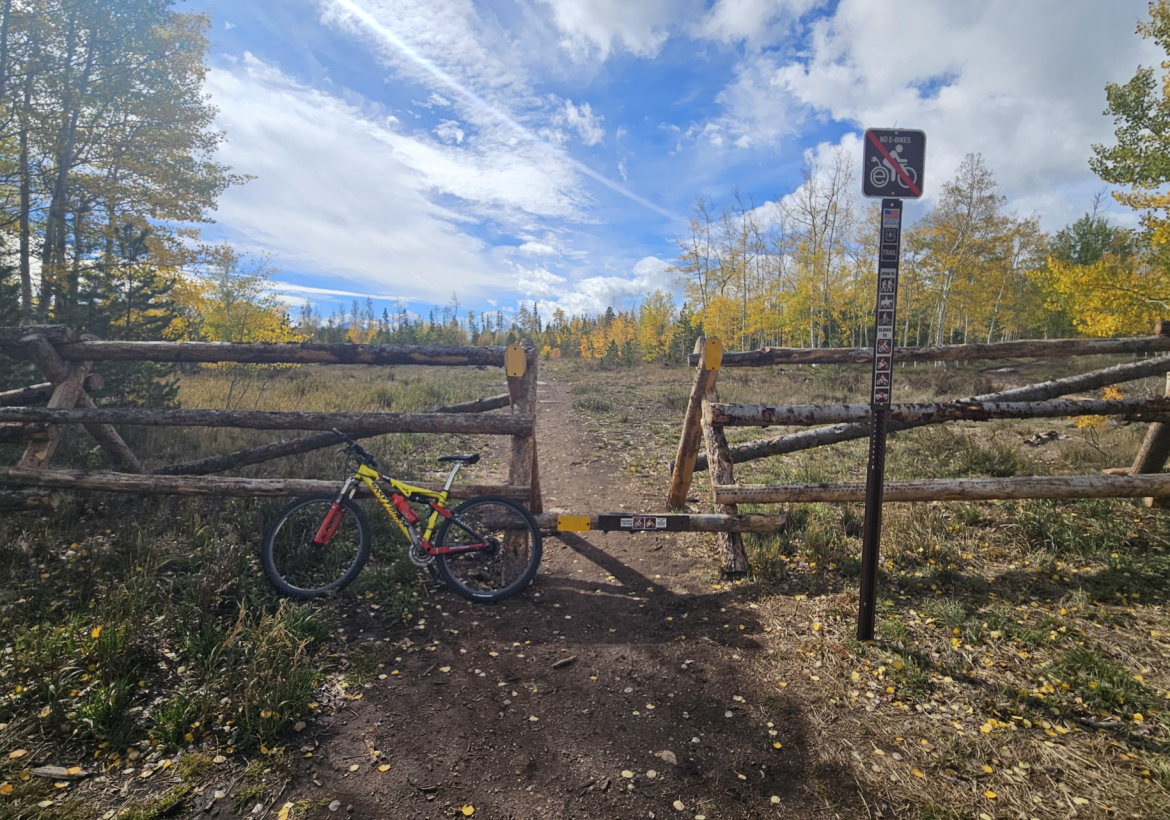
What concerns? Is that it’s going to generate a bunch of hospital visits and a dozen “hold my feed tube” videos?
Or because it makes it extremely hard for people in mobility scooters but trivial for e-moto and dirt bike users defeating what sounds like the purpose?
Ebikes are heavy, but these people probably drove to the trailhead and lifted their bikes off trailers/racks. Why would a knee-high fence stop them?
It makes sense as long as you don’t think about it at all.
Ebikes aren’t even that heavy compared to normal bikes. Normal bikes are like 15 kg, ebikes more like 25 kg. That seems like a lot in %, but when you include the rider at like 70-95 kg, it seems negligible. Even when talking about lifting them, if seems not really like an issue?
I don’t think this “barrier” is gonna stop any rider under the age of like 75 or so.
I think they’re probably trying to keep out the electric motorcycles which are very heavy even though they’re usually classified as “ebikes”
What good idea fairy came up with this genius concept? I would have loved to be a fly on the wall in that meeting of minds.
Originally, I was going to compare these barriers to the ones that Evan Edinger in the UK recently referenced, when discussing an under-river pedestrian crossing in London that nominally disallows cycling but is also the only available crossing for miles. The local council there tried adding barriers but had to remove them due to blocking wheelchair users, whom must not ever be treated as second-class citizens.
But instead, I want to focus on what White River NF said about these “step over” bars. As a fencing strategy, the practice predates the USA national forest system by a lot, with examples being found in the English countryside whenever private land is crossed by a public footpath. Such easements have existed since antiquity, so landowners demarcated their boundaries by fencing, with an opening that requires one or two steps so that animals would not necessarily migrate to adjacent land.
In an era before bicycles or wheelchairs, this works fine for filtering humans through, on paths that are explicitly for non-wheeled people traffic. But in the modern day, even the British look at such inaccessible steps as a historical quirk, not as a template to be carried forward to designated multi-use trails.
To that end, I believe White River NF when they say that such “step over” bars have been in use by the Forest Service for a long while. But I question whether they have correctly updated their design standards to conform to the Architectural Barriers Act (ABA) governing federal lands. How I understand it, the terrain exemption can only be applied to the portion of a trail where accessibility accommodations are impractical. There is no blanket exemption for a whole trail if only one part is exempt by terrain. And seeing how these bars are constructed, it seems very possible to remove them. Even if insurmountable terrain lays 100 meters beyond the bars, to keep the bars is to tell wheelchair users that no, they cannot enjoy even those 100 meters, and they are not welcome.
Every NF unit is managed separately, but ultimately each has to choose if they will continue to ratify the now-probably-disallowed choices from yesteryear, or if they will break with precedence and work to solve modern challenges as good stewards of the land. To be clear, I don’t want e-motos on trail system, but I refuse to exclude adaptive riders and wheelchair users to achieve that end. White River NF has to try again.
A reciprocating saw should fix that problem easy, or you could just lift it over the barrier.
But the saw sends a message.
While I don’t agree this is a great solution, as someone that enjoys hiking I’d much prefer to solve the problem by taking the sawzall to the ebikes. Fucking things are absolutely destroying my local trails.

