


'Undaunted' Mark Carney faces an extraordinary moment
The Liberal leader asks voters of Nepean — and the nation — to give him the mandate to confront an extraordinary moment in Canadian history.

As he delivered an Easter Sunday speech to thousands of supporters gathered outside the Lusitania Portuguese Club in Nepean, Liberal leader Mark Carney sometimes seemed bemused by the political passions he stirred.

“We love you, Mark!” someone yelled as Carney sought to enlist support in what he described as the most consequential election of our lifetimes.
The central banker turned retail politician didn’t miss a beat. “Hey, I love you too,” Carney said. “That’s why I’m here.”

He listed his achievements as the country’s newly-minted prime minister: cutting the GST for first-time homebuyers, cancelling the capital gains tax hike, committing to the removal of federal barriers to inter-provincial trade, and eliminating the “divisive” consumer carbon tax.
“Axe Poilievre!” a Liberal supporter shouted, parodying the Conservative leader’s “axe the tax” mantra.
“You know, we just need to remove him. No violence, no violence,” Carney deadpanned. “He’s had his time, he’s got his pension.”
Carney talked about U.S. President Donald Trump, his punishing import tariffs and the economic emergency that now confronts Canada. “So what do we do?” Carney asked. “What do we do?”
“Vote for you!” one man shouted.
“Voting for me, I’m going to get to that,” Carney told the crowd. “There is an ask at the end of this speech, and it’s a big one.”
Carney’s big ask of voters is to send him to the House of Commons as Nepean’s Member of Parliament, and to give his party the mandate to govern in a time of profound crisis. It’s an extraordinary moment for a man who has never before contested an election, a man who declared his candidacy for the Liberal leadership three short months ago.
Carney’s sudden ascension to the prime ministership in mid-March cast him into a political whirlwind.


He has had to plot an election campaign – against an opponent long spoiling for one – while managing Canada’s response to Trump’s tariffs. He has also had to campaign for a seat in Nepean, a riding to which he has only passing acquaintance, against a Conservative opponent, Barbara Bal, who has been knocking on doors for years.
Carney’s wife, Diana, told Sunday’s gathering that her husband takes it all in stride. “He’s undaunted by the kinds of challenges that would fell most of us,” she said.
The two met at Oxford University, where they both studied economics and played varsity hockey. In their more than 30 years together, Diana Fox Carney said, she has never known her husband to take a sick day or to be unprepared.
She has been campaigning for him in Nepean while he travels the country.
“I think that rising to the challenge is one of Mark’s defining features,” Carney said of her husband, with whom she shares four children. “His cool and calm demeanour under pressure really makes him suited to this moment of great uncertainty that we face.”
- Advertisement 2Story continues below



***

The direction of Mark Carney’s life changed utterly at the age of 38 while reading The Economist magazine.
At the time, in 2003, Carney was managing director of investment banking for Goldman Sachs in Toronto. He had already worked in New York and Tokyo for the legendary firm, and was well on his way to being named a partner.
Making partner would usher him into an exclusive Wall Street club whose members regularly earn more than $10 million a year in salary and bonuses.
But an advertisement in The Economist caught Carney’s attention: It sought applicants for the position of senior deputy governor of the Bank of Canada. Carney applied even though some of his Goldman colleagues told him it was a foolish gambit.
Carney had a long-standing fascination with economic policy and considered himself an accidental investment banker. He also felt an old-fashioned obligation to public service.
“Some people feel an obligation to public service, and if they do, then they should pursue it,” he once told an interviewer.
Then Bank of Canada governor David Dodge hired Carney in August 2003, but he was quickly seconded to the Department of Finance where he became the senior associate deputy minister.
For the next three years, Carney worked closely with Liberal Finance Minister Ralph Goodale and his successor, Conservative Jim Flaherty, on many of the government’s most sensitive policy files, including the sale of Petro-Canada and new curbs on the use of income trusts.
In late 2007, to the surprise of many observers, Carney was named governor of the Bank of Canada. He assumed the helm of the central bank in February 2008 as the global financial crisis unfolded in real time with the dramatic collapse of a U.S. housing bubble. International investment banks teetered on the verge of collapse while hundreds of thousands of homeowners and investors suffered deep losses. Canada skidded into recession.
In an effort to limit the damage, Carney moved quickly to slash short-term interest rates, and in March 2008, he pledged to leave those rates at rock bottom for a full year.
His monetary policy restored some market confidence and contributed to Canada’s safe navigation through the crisis. According to a 2011 Statistics Canada report, Canada suffered less than other major economies and recovered more quickly and completely.
Carney’s performance brought him the kind of international acclaim rarely accorded a central banker, and an unprecedented opportunity. In July 2013, Carney left Canada to take over as governor of the Bank of England, the first foreigner to hold the post since the institution was founded in 1694.
There, crisis again confronted him. Three years into Carney’s bank governorship, Britain held a referendum to decide whether to leave the European Union. Before the vote, Carney warned that leaving the EU could send the British economy into a “technical recession.” After British voters narrowly decided in favour of Brexit, Carney warned a disorderly exit could lop eight per cent from the country’s GDP.
It put Carney in the crosshairs of Brexiteers: He was accused of politicizing the central bank, and fearmongering in favour of those who wanted to remain in the EU.
For his part, Carney argued it was his duty to discuss the project’s risks and present the bank’s best economic forecasts. (A Goldman Sachs report issued last year estimated Brexit cost the British economy somewhere between 4 and 8 per cent of its GDP – a more precise calculation made difficult by other events such as the COVID-19 pandemic.)
The British press could be both adoring and sneering towards Carney: Some compared him to movie star George Clooney while others damned him as the banker with the “reverse Midas touch.”
The Guardian’s economics editor Larry Elliott said Carney was feared for his temper but respected for his calm in a crisis. Elliott called him smart, smooth, tough and egotistical.
“From the moment Carney took over as governor in 2013,” Elliott wrote recently, “it was clear Carney considered himself to be the smartest man in the room and wanted to make sure everybody knew it.”
Carney returned to Ottawa after his term as Bank of England governor expired in March 2020, and served as the United Nations Special Envoy on Climate Action and Finance.
He also pondered a move into federal politics.
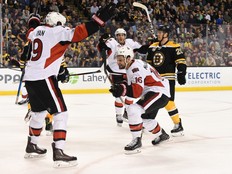
Among those he consulted was Nepean’s Peter Chiarelli, the former general manager of the Boston Bruins and Edmonton Oilers. The two met in 1983 while they were both freshmen, dormitory neighbours and hockey teammates at Harvard University.
Within a year of meeting him, Chiarelli told Carney he would someday be prime minister.
“We’ve been talking about it about it ever since – for almost 40 years,” Chiarelli said in an interview.
Even at Harvard, Chiarelli said, in a place with so many exceptional people, Carney stood out because of his drive, focus and intellect. Carney would arrive at breakfast every day, he said, with a checklist of things he wanted to accomplish. Chiarelli would marvel at its ambition.
“Seriously,” he’d say, “you want to get all that done, and go to hockey practice?”
Friends for four decades, Chiarelli describes Carney as funny, modest and genuine. Carney was best man at Chiarelli’s wedding at Cedarhill Golf and Country Club. Chiarelli was in the crowd for Carney’s speech on Easter Sunday, and has campaigned for him door-to-door in Nepean.
He believes Carney is the right man for the moment: “I mean, the guy gets things done, you know.”
***

Carney often draws on hockey for political analogies and life lessons.
“My coaches taught me to play hard, to be ambitious, and because it’s Canada, to stay humble,” he tells the Liberals gathered in Nepean on Easter Sunday.
“These are Nepean values. These are Canadian values. And I kept these values close when I was fighting crises and building economies around the world. And I’m drawing on them now to stand up to President Trump and to build the strongest economy in the G7.”
His values, Carney said, were forged early in life.
Carney was born on March 16, 1965, in Fort Smith, N.W.T., where his father, Bob, was the principal of a local high school. His mother, Verlie, stayed home to look after the family’s four children and would later return to school to earn a teaching degree.
The family moved to Edmonton when Carney was six years old. His father worked as a senior Alberta government official and later moved to the University of Alberta as a professor of education history. (Bob Carney ran as a Liberal candidate in the 1980 federal election in Edmonton South, and finished a distant second to the Progressive Conservative candidate.)
Mark Carney remembers his childhood home as a place filled with books and political discussion. He played hockey, delivered newspapers, and competed on his high school’s Reach for the Top teams.
His academic excellence earned him a partial scholarship to Harvard University, where he planned to concentrate on math and English literature. But after listening to the lectures of Canadian-born John Kenneth Galbraith, Carney embraced a new academic passion: economics.
He would go on to earn a master’s degree and PhD in economics from Oxford University. (Carney is only the second Canadian prime minister to hold a PhD; the country’s longest-serving prime minister, William Lyon Mackenzie King, is the other.)
For his Easter Sunday speech, Carney wears a closely tailored navy-blue suit, purple tie and a white shirt with a British wide spread collar. (He’s so highly polished you’d swear he’s taking the piss when he says of the turmoil wrought by Trump’s tariffs: “We need solutions, not slogans. We need calm, not chaos.”)
The current crisis demands a plan, Carney tells the crowd, and he enumerates his post-election action list: cut taxes for the middle-class, rebuild the Canadian Armed Forces, defend Canadian auto workers, diversify Canadian trade, double the pace of the country’s housing construction, and make Canada an energy superpower.
Carney sells himself as a leader who can stand up to Trump, as someone experienced, tested and pragmatic. “I’m not a career politician,” he says.
He ends his only major public appearance in Nepean with a hockey metaphor – and a shoutout to his Harvard teammate – while exhorting supporters to knock on more door, to make more phone calls, to talk to more people, and to vote.
“There are five minutes left in the third period of game seven in the Stanley Cup finals. It’s time to act like a great son of Nepean, Peter Chiarelli…and leave everything on the ice.”
Our website is your destination for up-to-the-minute news, so make sure to bookmark our homepage and sign up for our newsletters so we can keep you informed.
Postmedia is committed to maintaining a lively but civil forum for discussion. Please keep comments relevant and respectful. Comments may take up to an hour to appear on the site. You will receive an email if there is a reply to your comment, an update to a thread you follow or if a user you follow comments. Visit our Community Guidelines for more information.