
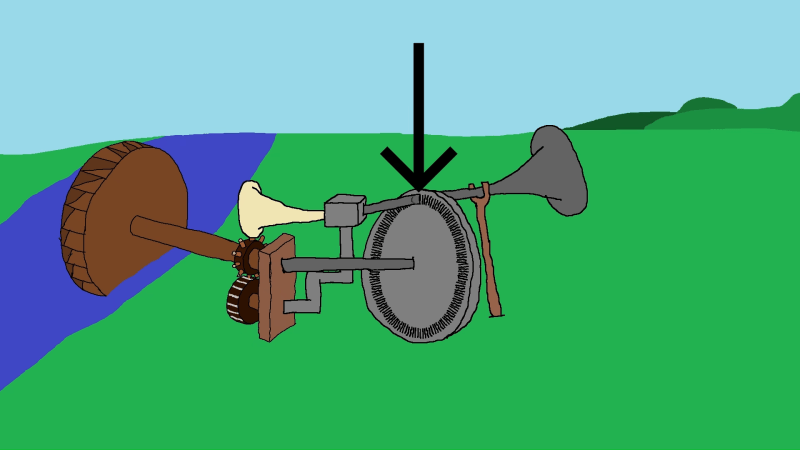
[The Mike Stuff] has an interesting proposition. He asserts that ancient people like the Greeks could have built a form of radio that was purely mechanical. We aren’t sure we agree, but even if it were possible, we are sure it would have sounded awful. You can see the details in the video below.
The idea is that you can compress air with a waterwheel, blow it through a rotating disk with slots in it, and a valve to amplitude modulate the airflow through the disk. Horns like an old gramophone speaker would amplify the signal at both ends. The demodulation is straightforward and doesn’t even require power, like compressed air.
This is a fun idea, but even [Mike] notes it wouldn’t be very good. We suspect you’d just hear a 10 kHz buzz. On the other hand, this would be pretty easy to build if you wanted to test it. Use an electric motor to spin the disk — after all, we’ll stipulate that you could turn a disk with water power, even if speed control is a little challenging.
If you build it, we’d love to hear about it. Just don’t use it to send us an air-radio message. Try e-mail instead. What do you think? Would this work? We get that if it did, it wouldn’t work well, but would it work at all? Let us know what you think.
If you think about it, building regular receivers that are of low performance is easy enough. With a little work, simple receivers can actually work quite well.












Sound is not radio.
I think somewhere along the way someone got too sloppy and “wireless” became “radio”. But just because there is some synonym overlap doesn’t mean that one word is a drop-in replacement for the other.
LLMs amplify this tendency, but humans have been screwing up in this fashion since long before we got around to automating it.
Seems more akin to an optical link, than a radio
Seems to be an audio link… if only there were a word for amplitude and frequency modulated audio…
… talk to me guys, I’m sure we can come up with a a word…
With no radio waves involved I guess I’d call it a transmitter, not a radio?
I wonder if there is any advantage to sending voice over modulated sound waves instead of just regular sound waves. I’m skeptical that this is any better than just amplifying the voice directly. (That has actually been done mechanically. https://en.wikipedia.org/wiki/Compressed_air_gramophone)
That youtube channel is annoying and low effort.
isnt that the point of yt?
No, the point of YouTube is to sell advertising for free-energy, miracle drugs, food that makes you loose more weight than what you’ve eaten, and many other wonderful real things you can trust 111%.
This is a new low. I thought he would have built something, but it’s just a slideshow…
The same reasoning that applies to radio applies to this “acoustic transmitter” as well:
You can use different carrier wave frequencies to transmit multiple signals through the same medium and pick out just the one you want to hear.
It is easier to build an amplifier for a narrow bandwidth signal. You don’t gain as much advantage using a carrier frequency of 10kHz for the acoustic transmitter as you do with a radio transmitter (AM band 540kHz and above,) but you do get some.
It is easier to build resonant circuits for more efficient transmission and reception with a narrower bandwidth. Again, you don’t gain as much asvantage with a low carrier frequency as you would at higher frequencies.
The carrier makes it easier to pick the transmitted signal out of the noise.
The biggest down side is that you don’t gain as much advantage from the acoustic carrier as you do from a radio frequency carrier. The signal bandwidth is simply too close to the carrier frequency
The other thing is that normal people can hear a 10kHz audio carrier. It is going to be really loud and annoying
All that said, I think I’m going to have to have a go at building one. Using Gnu Radio, a speaker, and a microphone to test the concept, then see about a mechanical transmitter and receiver if the idea is… sound.
Well, that sucked. My numbered list tirned into plain text.
Oh, well. Whatever.
youtube recommended this video to me earlier today and it sounded like some kind of joke, and the actual content more or less confirmed it
This is actually quite a fascinating idea honestly. I will admit I have thought of acoustic transmitters before (aka speakers) for wireless communication
I also had the bright idea of using 100W loudspeakers to transmit ultrasonic signals that could be then picked up by my wireless nodes and decoded. The idea sounded great, no one would be aware that the speaker on my roof is actually blasting audio far above what humans can hear 24/7, and i wouldn’t be bound by the pesky fair use policy and power limits of ISM band transmissions!
That’s until i searched around and found out that mechanical waves are TERRIBLE compared to RF. In such applications RF beats mechanical waves ever single time. Every maybe underwater
and blasting hundreds a watts of ultrasonic is a major disturbance to (wild) animals, especially at night.
Yes, and it’s not because you can’t hear it that the air pressure isn’t there, which you can feel anyway.
Light would have been easier to work with.
Germany had the incredible Lichtsprechgerät light beam communications system in WW2:
https://www.youtube.com/watch?v=7JE5rgbr-2U
They also had Fickscheißen mit Gaskammern als Duschen.
Ew, that’s disgusting.
The USN during WW2 used Nancy Infrared Signaling for optical communications between ships and presumably between land stations and ships
Phidippides could have used this! Clearly this is about technology in the era before string and tin cans were invented (think relay stations like in the Canary Islands). Still, a separate article about how the horns amplify sound would be of great interest.
Use multiple disks that turn at different RPMs (or have different numbers of slots). Then switch between disks in a known pattern…and get spread spectrum transmission.
My kids built a “radio”. You just (de)modulate at either end of a string with a tin can
I heard about that type of “phone” but never built it myself, thought it was a cartoon phantasy.
When I was little, I was using two old analog telephone handsets (those with the coal mic and 600 ohms speaker), loudspeaker wire and an 4,5v battery to build a simple house telephone.
There also seemingly were commercial kids toys that were built that way.
I know of an East German version, for example.
Build quality of these toys isn’t as good as using some real old handsets, I think.
But you can hang up the handset on them, at least.
Well at least it’s not AI slop. Now to stop typing this comment before I tell you the rest of my opinion
A real coherer-based radio probably wouldn’t have been out of reach of the Greek either, as far as craftsmanship goes. The hardest part is the fine, high-purity copper wire for coils. They just lacked the knowledge.
“The hardest part is the fine, high-purity copper wire for coils. They just lacked the knowledge.”
It’s a safe bet that copper is the oldest metal technology. I question the specification for copper and further for “fine, high-purity”. The hardest part is indeed the knowledge. Revise, resubmit.
For whistling aficionados, the original Ocean’s Eleven.
The first radios were mostly mechanical, with a sparkgap and a coherer. Replace the sparkgap and its battery with a some piezoelectric spark generator, and you have a mostly mechanical radio. No voice, just Morse, but still more useful than whatever this is supposed to be. Of course if you try to use it, FCC will get you.
All radios are mechanical. You’re just drawing the line between radios with few components and radios with many. The thing in the article is not a radio. I blame HaD editors. Oh, wait, there aren’t any!
Rapidly shakes a neodymium magnet…
Shouts at the magnet…
… inside a coil …
DARPA’s AMEBA project is something closer to the clickbait title here: https_://_www.darpa.mil/news/2016/underwater-radio
However, not very successfull – I’ve heard.
Funny enough, loud whistling has been around as long as animals including humans. Groundhogs, too, whistle rather quite loudly when/if disturbed. AM modulation/demodulation, no, not THAT advanced, more like close to simple Morse code kind of deal.
When I was a teen I remember my buddies telling me certain loud whistle codes exist for a reason, for example, ascending whistle – drop everything and run as fast a you can, repeated descending whistle – a call, look up/down/sideways to see the source, maybe he is trying to alert you to something, or just saying “hi”, staccato of two or three whistles repeated … something else, I don’t remember all of them, but point being, higher-pitched sound travels farther overall, compared with, say, loud yelling.
Or, if you are on one bank of a mountain river, and there is another person on the other bank of the river, whistling is basically the only way to sound something across loud stream.
On a separate thought, didgeridoo seem to fall somewhere between flute and alpine horn, but it is rather neat, because it has multiple harmonics/standing-waves that are interesting in the sense that they may actually travel far using multiple carrier frequencies, so to speak. If I remember right, vocoder is the electronic analog of didgeridoo, ie, bandpass modulation, makes me think maybe upgraded version would be a didgeridoo whistle with multiple carrier frequencies with the matching didgeridoo receiver, no?
Well… yah. If you described this system to the right ancient Greek they probably could build it.
But… you could also describe Baghdad batteries, a spark gap and a coherer and they could build all that too. It would probably be much easier build and work better too.
But none of that means they would ever be likely to think of it all themselves without the many steps we took in between here in the real timeline.
Actually building this even in today’s time though would make a really great hack. I can’t wait to see that article here!
It is really easy to make a 10khz audio notch filter out of the right length tube.
Also, making a cell phone produce near ultrasonic frequencies through the speaker and microphone is easy. You could spread spectrum modulate that in software, and select the receiver.
And the spies a long time ago got a resonant rf tube with a diaphragm microphone in the Russian embassy, hidden in a wooden gift from the boy scouts, or something. Totally passive until you send the correct radio frequency at it.
And my TRS-80 model 1 had a BASIC program with a bunch of REM statements at the end that would play a song on an AM radio near it. It would put snow on every TV in the house with a local antenna, too. The model II had some rf shielding on it …
Do you realize that’s illegal?
“Do you realize that’s illegal?” Not everyone lives in a country where that is true. Also the legal principle of Nulla laesio, nulla culpa applies here.
That’s why they don’t make computers like the TRS-80 model I any more.
Completely unshielded, blasting electromagnetic interference in all directions. That was the TRS-80 model I.
We used to park an AM radio close to the computer while playing games. Most had no real sound effects, or very few. With radio, you could hear the computer “thinking” as it carried out its program.
The FCC cracked down on such crap some time in the late 1970s, early 1980s and required home computers to be “cleaner.”
The model I was so noisy that it was cheaper for Radio Shack to drop it and bring out new models than to fix the model I to allow further sales.
Many professionally installed home security systems can easily be detected from the street outside the house with a $10 AM radio. Johnny Cochrane’s advice to burglars: “If it shits you must quit.”
Dick Marcinko taught us that a cheap black and white TV could be used to alert one to law enforcement or other non-cared-about-by-the-FCC-or-equivalent gummint radios on their way to assault the bad buys.