
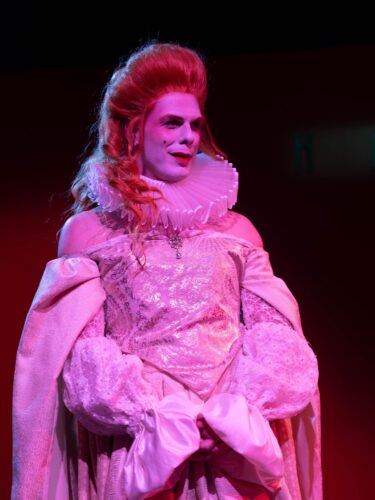
Tyler Anthony Smith, 33, thinks of himself as the Barbra Streisand of Chicago’s independent gay theater scene: His insistence on having a say in all decisions and writing himself roles worthy of his craft speak to his exacting standards and desire for the audience to experience theater as magic. That’s not to say that he’s an authoritarian of the stage; Smith works best with a core group of directors, writers, co-stars, and costume designers to bring his visions to life.
Over the past decade, Smith has progressed from performing student shows at Columbia College, to working with Chicago’s legendary gay production company Hell in a Handbag, to writing and starring in his own female-driven extravaganzas, such as People Do Do Such Things, a spoof of Hedda Gabler; Out, Darn Spot!, his take on Lady Macbeth as a 1960s American housewife; and We Are Not Ugly People, a parody of the film Carol. Caught up among these works’ intelligence, endless references to the depths of 20th-century gay culture, and surprising poignancy, the viewer doesn’t know whether to howl with laughter or shed tears for Smith’s heroines—this is where the exhilarating pleasure of his art lies.
Smith spoke with me in July, fresh off his sold-out run of {The} Hour, a hilarious riff on Michael Cunningham’s The Hours, in which he played Nicole Kidman playing Virginia Woolf, alongside Ed Jones as Meryl Streep as Clarissa Vaughan and co-writer Alex Grelle as Julianne Moore as Laura Brown. He’s now preparing for the New York debut of his original show Queen for a Day, a fantasia encounter between Queen Elizabeth I, Halston, and Liza Minnelli (playing at The Tank, Sept. 4–6 and Sept. 12-14).
Tyler Anthony Smith: It was weird. I’ve always been someone that, once I see through a facade, I can’t unsee it. At Columbia College, I immediately realized that theater is all made up. I am paying all this money to learn these things that I’m being taught are “the way to do it.” But this is just how you do it. By watching these people tell me that “this is the way to do it,” I’m going to come up with my own way. I want to create things and let people do things they don’t get to do anywhere else.
DD: What is your process when developing shows? How do you work with your collaborators?
TAS: I am a very stereotypical gay in that I love Barbra Streisand, who famously loves to do everything and loves to have control over everything. Queen for a Day is the first show of mine that I want to see through as far as I can. It’s what I’m proudest of, and it’s the most me. But I think even if it was being produced by a company in New York, I would still have to be involved in everything. I would have to have it in my contract that I have to have final say in everything.
When I write, I think of everything: What’s the wig going to be? What’s the set going to look like? But then I love to be hands-off. I don’t like to micromanage. That comes from me wanting to be surrounded by people who I love and respect.
When you’re writing a play, it can’t just live in your Google Docs. It’s not only meant to be seen by other people; it’s meant to be worked on by other people. Once someone reads it or agrees to do it, it’s not mine anymore. It’s all of ours.
Of course, I am the creator, so I want to be involved in everything. But I can’t design a set; I don’t know how to build a costume. This is why I love the John Waters method, working with the same people over and over again, because you then start to work with the people who you trust and who trust you. We all get it.
DD: I imagine you are frequently compared to Cole Escola and Oh, Mary! How do you see yourself in relation to them?
TAS: Well, I love Cole. I get compared to them all the time. It’s a very useful shorthand to explain what I do, to say, “I’m the Cole Escola of Chicago.” When I was out of college, and I was trying to put my shows up and trying to find my identity here, Cole came through on tour, and I saw them, and I was like, “Oh, wow!” I never think that I can’t do it, because they’ve shown that it can be done.
But the shorthand helps to show where the differences are, too. I’m also not like Cole. It doesn’t piss me off that people are comparing me to Cole, but then they do not get the point of my plays. I’m gonna do whatever the fuck I want to do, and you can either hop on and get it or you can be out in the lobby afterward saying, “It’s your Oh, Mary!” Whatever helps you process it.
DD: Like Cole’s work, yours is frequently discussed as distinctly camp. Do you consider your plays campy?
TAS: I think I just am campy, and what I love is camp. I don’t think camp is just strictly men in dresses. It’s when someone is able to circle in on themselves. I love nothing more than committing so hard—the camp of it all. I love nothing more than hamming it up. I think that is camp. The shock value of it all, the tragedy of it all, because there is a tragedy behind all of it. You have to commit yourself so fully to it that you flip not only your audience but yourself. You have to believe it to the point where the audience asks itself, “Should I be laughing?”
DD: Your more famous roles have all been women. You parody them, but when watching you perform, I sense that you love them dearly. What is your relationship to your characters?
TAS: I genuinely want to be these women. Even if it’s fiction, I am in my characters. The characters are me. I use every bit of myself because I’m all I have. You can’t parody anything you don’t love; if you’re parodying something that you hate, I have no respect for you. It’s cheap. It’s not good. You don’t understand the material. But I love Cate Blanchett, and I love Carol. I love The Hours. And even with my plays that are not parodies, I identify with these characters. I identify with Halston so much in Queen for a Day, which is why I’m so proud of the writing of him, because that was me getting a demon out.
DD: Do you consider your work political?
TAS: I don’t try to be political, but I am because I am someone with a dick wearing a wig and a dress. But I’m against topical plays. I don’t want to see a play about the pandemic. I’m really against plays that have no sense of magic. For me, theater is magic.
I don’t want realism. I don’t want to prove a point in my plays, because the shows that have changed our lives weren’t trying to shove a message down our throats. And as more and more time goes by, the opinion is that plays have to have a message. What happened to characters? What happened to stories? Let’s bring back stories! Remember stories?
DD: Do you see yourself as part of a queer theater lineage? Who has influenced you?
TAS: Charles Ludlam! I love him! I’m closer to Ludlam because he would go there, sometimes to the point where you’re like, “Whoa.” I was just truly gobsmacked by Ludlam. Just his fearlessness—I mean, this motherfucker would announce a show without a script being completely written. I don’t want to write my own Camille. I want to do Ludlam’s Camille. That’s my dream role.
I took from Ludlam that theater is all make-believe, it’s all magic, this is all a story. We do not hide the fact that we’re doing theater. So much of Broadway tries so hard to hide the fact that this is theater. But you’re watching me! The audience is in the room—I’m not going to act like they’re not there. There’s never a fourth wall. We’re all here together, all the time. Use the fact that we’re all here together. That’s the impossible dream: to all be together and experience it all together.
DD: You’re taking Queen for a Day to New York City in September. How are you feeling?
TAS: With Queen for a Day, it is truly a dream team, where we all get it. And everyone just ran with it, and watching it all come together was truly just like, “Oh, my God. This is all because I had a psychotic idea.”
DD: What are your hopes for it in New York?
TAS: I’m just happy that I’m doing the show in New York, and if this is it, then this is it. But at the same time, it’s the same as your sex drive, right? The next time you have sex, you can’t just be like, “Well, if this is it, then this is it.” Like, no, you want to keep fucking! I want the show to keep going.
DD: Who’s in your dream New York audience?
TAS: I want artistic directors from Off-Broadway houses to come see it. I would die if Amy Sedaris saw it. Let’s get Liza in there.
Domenic DeSocio, PhD, is an assistant professor of instruction of German at Northwestern University.