

This essay is bonus content for The G&LR’s September-October 2026 issue, “Cruising.” To see the full issue, click here.
One autumn evening during the pandemic, crossing a park at sunset, I stumbled upon a gathering like nothing I’d seen before. While much of New York City remained eerily empty, roughly thirty men had assembled in a secluded area, hidden from the rare passerby by trees and rocky outcroppings. Wearing surgical masks, they stood in loose formations, watching one another.
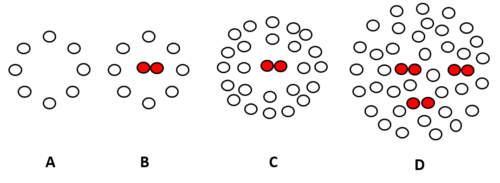
As the gathering evolved, the crowd broke into smaller groups. Two recurrent formations emerged. In what I came to think of as hollow circles, men stood around an open center, watching one another and masturbating. In centered circles, attention converged on a sexual encounter in the middle, while some observers masturbated and others only watched.
The scene stayed with me, and I went on to notice many similar gatherings. In the daytime, men wandered through the park. Very little sexual activity occurred. Mostly they were looking: observing one another from a distance, making themselves visible, gauging interest without necessarily approaching anyone. As night fell, the circles tightened and groups of varying sizes formed.
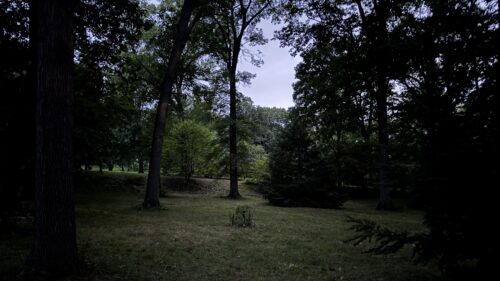
Large formations appeared only in areas that were relatively dark after sunset. These sexual circles required space, concealment, and limited illumination. Some gatherings formed in well-lit parks, but they rarely developed into large circles.
The gatherings changed as the pandemic receded. Once masks were no longer required, most men stopped wearing them, though a few continued, perhaps to conceal their identities. At the height of the pandemic, hollow circles were common, but they grew rarer as people became less wary of contact.
Even after most of the circles became centered on pairs or groups having sex, observers typically outnumbered participants. Most men remained engaged only by watching.
From 2022 to 2026, I’ve seen no hollow circles. I don’t know whether this demonstrates declining concern about infection, changing social norms, or other factors. What’s clear is that the balance shifted.
The centered circles varied in size and complexity. The simplest included a single ring of observers. The largest developed multiple concentric layers. Observers watched the men having sex in the center but also one another, producing a layered field of visibility as they both observed other men and displayed themselves. Sometimes these formations became multicentered circles, as eyes turned toward several simultaneous encounters.
There were, of course, exceptions. Some men moved rapidly from partner to partner and appeared unconcerned with the risk of infection. But they were rare. There were also men who drifted from one circle to another, hovering between observation and involvement. Without taking the risk of direct contact, they seemed to be doing more than passively watching, deriving their erotic thrills from the tension between approach and restraint, standing on an uncrossed boundary.
The conventional understanding of cruising is that its aim is to find a sexual partner. The behavior of these men suggested a culture organized as much around spectatorship as around sex itself. For many, its pleasures were proximity, anticipation, voyeurism, exhibitionism, and the erotic charge of mutual recognition. What matters is often the encounter itself, not its consummation.
Of course, some men appeared to be seeking a specific partner. Many times I saw pairs and small groups moving to more secluded areas of the park in search of more privacy. Before leaving, they often signaled that others weren’t welcome to follow, usually with a brief shake of the head. Many later returned and resumed their search.
These gatherings were always near-silent. Eventually I understood that silence made the gathering possible. Whenever individuals, couples, or groups of friends began talking among themselves, the formation often dissolved, only to reassemble at a distance. Loud sounds of almost any kind seemed unwelcome. Sometimes observers dispersed when someone played music or sexual sounds or when encounters became unusually noisy.
Obviously, the men were worried about attracting attention. But the consistency of these behaviors suggested that silence itself was part of the erotic structure of the event.
These gatherings offered erotic interactions largely free from the social obligations governing most intimate encounters. They allowed the men to signal, reciprocate, ignore, or withdraw their interest in another man through subtle gestures. A diverted gaze, a slight turn of the head, or simply walking away was often enough.
While these practices are complex and persistent, discussions of cruising rarely describe them in such terms. Writers and scholars have extensively documented cruising for generations. John Rechy explored its erotic and political dimensions. Laud Humphreys examined its social organization and behavioral codes. Leo Bersani reflected on its forms of impersonal intimacy and its challenge to conventional ideas of identity and attachment.
Much contemporary discussion remains frozen in the shadow of AIDS. The dominant narrative is that anonymous public sex flourished before the epidemic, AIDS devastated the culture, bathhouses were closed, public sexual spaces disappeared, and digital technologies eventually replaced them.
This account, while largely accurate, assumes that cruising was primarily organized around getting laid. What I’ve seen suggests many men are more excited by the possibility of sex: seeing and being seen, the awareness of another body nearby, the exchange of glances, the choreography of approach and retreat, and the tension produced by uncertainty.
When men have sex in front of an audience, each sexual act becomes a theatrical act—a performance. The boundary between participant and spectator begins to dissolve. The result is a collective erotic experience organized around sight.
There’s another dimension that has rarely been explored. Men don’t gather outdoors just out of necessity. The park itself becomes part of the erotic experience: the night air, the smell of soil and decaying wood, the darkness between trees, the living environment pressing against their exposed skin. While society tells us that sex must take place indoors, these men seek the freedom of the open air.
José Esteban Muñoz described cruising as a utopian practice, a reaching toward a different social world organized around desire and mutual recognition rather than identity. What I observed suggests he was right, and that the natural environment is itself part of that utopian space.
Men have been having sex in the Ramble in Central Park at least since the early 20th century. Through wars, the Great Depression, AIDS, Covid-19, and repeated moral panics, men have continued to gather there after dark. Police surveillance and prosecution haven’t stopped them. That persistence is evidence of something deeper than habit. What the law calls deviance, the body insists is nature.
The AIDS epidemic made sex frightening and may have intensified attention to forms of eroticism that depended on visibility, proximity, and desire itself. For many who cruise, the practice has always been about the electric charge of proximity, a form of erotic life that carried its own wisdom about desire and safety long before anyone named it harm reduction.
Sexual risk affects not only the people having sex but also their partners, spouses, families, or other intimate relationships. Whether consciously or not, people who cruise in a way that focuses on looking rather than touching have found a way to experience desire while reducing potential risks.
In an era of dating apps and digitally mediated sexuality, the question of what constitutes a sexual encounter has never been more open. The men getting off through voyeurism and exhibitionism were asking that question with their bodies long before the internet made it theoretical.
To see and be seen by men with similar desires, and to find in that exchange something complete, isn’t a lesser form of desire. It’s desire in one of its most ancient and human forms. Beneath the history of sex, another history has persisted: that of attention, visibility, and the enduring human need to encounter oneself in the gaze of another.

Oleg Olizev is a Siberian-born American writer, poet, and artist. His recent work has appeared or is forthcoming in B O D Y, The Plentitudes, Heavy Feather Review, Washington Square Review, PHIL LIT, Thirteen Bridges Review, The Emerson Review, Molecule, BULL: Men’s Fiction, Panorama, Wicked Gay Ways, Beyond Queer Words, Pink Disco, Our Bold Voices, and Night Picnic, among others.







Discussion1 Comment
Thanks for writing this essay. The attraction to find like-minded souls is a powerful one that often overcomes the fear of AIDS or COVID. Men seek to be with others, intent on enjoying what their bodies offer them in the form of relief. Sometimes no touching is required, but what a wonder it is when human touch actually happens.