

CENTRAL PARK in Pasadena, California, is a nine-acre, rectangular expanse of grass and trees just steps from the city’s turn-of-the-century downtown and a mile west of the Caltech campus. First opened in 1902 as a simple green space, a late-1920s redesign in the Beaux-Arts style featured a broad elliptical footpath encircling a central lawn, fringed with looping walkways that led to an aviary, formal gardens, lawn bowling greens, clay courts for roque (a hard-court version of croquet), and, of course, public restrooms.
Park visitors complained in the summer of 1938 that men were using the restrooms for immoral purposes. The Pasadena Police Department recruited park caretakers to keep watch and report suspicious activities to Sergeant Sam Bailey and his two-man vice squad. The operation began in early September, and within a short time nine men had been arrested, all of whom “made a full confession to having committed practically every degenerate sex act,” according to Chief of Detectives Stanley Decker. The local papers referred to the roundup as a “morals purge.” In New York, the tabloid Daily News teased its audience with a lurid reference to “members of a cult practicing strange sex rites.”
By the end of the month, fifteen men had been corralled. By mid-October, the count stood at 26. All were identified by name in the L.A. newspapers; in some cases even their home addresses were listed. They ranged in age from eighteen to 67. Several local businessmen were snared, as well as members of Pasadena’s music and performing arts community. Investigators said some of the men had been meeting at a group of exclusive homes at the southern end of the city. The papers didn’t mention whether any of the 26 had been arrested outside the park.
Many had been caught during sexual acts and booked by police on felony charges that could have meant years in prison. In court, all the charges were reduced to “lewd vagrancy,” a misdemeanor and the most commonly prosecuted homosexual offense. Under California law, “every idle, lewd, or dissolute person” was guilty of vagrancy, punishable by a fine of as much as $500 and up to six months in jail. No sexual contact was required for the charge to be made; in essence, it was a law against being gay.
The judges had chosen to be merciful, but they weren’t interested in letting anyone off with a simple fine. Each man was sentenced to the maximum term of six months’ hard labor and put to work at a jail camp near the Rose Bowl, clearing dry brush from the firebreaks. Autumn in Southern California is wildfire season.
Things could have gone much worse. One of the justices handling the caseload was Frank C. Collier, who just the year before had instituted a novel judicial scheme already famously known as “Collier’s Choice.” Men convicted of certain sex offenses were given the option of serving a long prison sentence or being castrated and released on probation. Since the court had no power to impose such a sentence or to authorize funds for the purpose, a convicted man who chose to be “fixed” would pay for his own operation. He was also required to sign a release absolving both judge and surgeon of any wrongdoing and, if married, to obtain the consent of his wife.
Ten years later, Collier would claim that the scheme had been a resounding success. None of the more than fifty men who went under the knife had committed another sex crime. He felt his remedy, which he characterized as having “no physical or mental ill effects,” would be an effective cure for all who suffered from the “virulent disease” of homosexuality, but due to the rules governing sentencing and probation it was offered only to those who had molested children. The Pasadena defendants had committed their offenses with men over age eighteen.
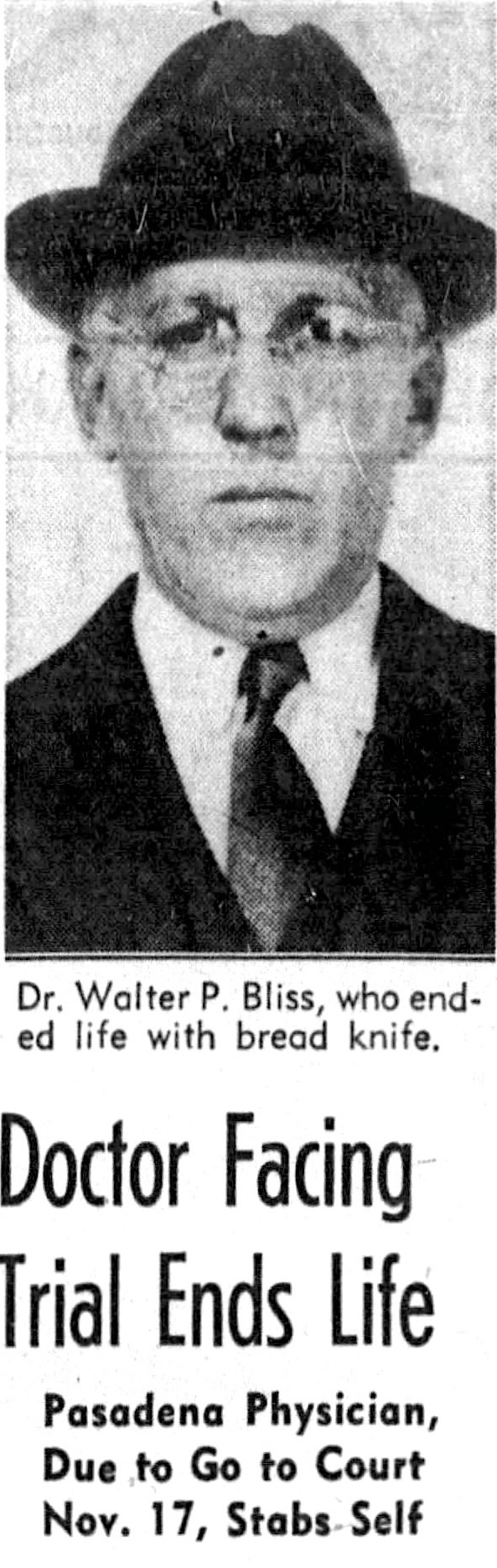
A later target of the sweep was Dr. Walter Bliss, age 49, who was the chief of staff at Pasadena’s Huntington Memorial Hospital, a major medical facility just a few blocks south of Central Park. He was turned in by 24-year-old Savino Luna, who’d been arrested in the park on October 19th, and both were booked on charges of “sexual perversion,” the California legislature’s term for oral sex. A few days later, 42-year-old furniture store owner Christopher Weber became the 29th and final victim of Pasadena’s morals purge. Like Bliss, Weber was arrested at his home and probably was also given up by Luna under police interrogation.
The arrests of Weber and Bliss signaled a fateful shift in tactics for the vice squad. The operation had at some point transitioned from a stakeout, in which men were caught in the act of having illicit sex in a public place, to a witch hunt, with arrests made on the basis of confessions wrested from fellow suspects—the intent being to round up every gay man they could find.
Bliss was born in Brooklyn and grew up in New Jersey. He attended medical school at Columbia University and began practicing in Boston before moving to the West Coast at the end of World War I. Bliss was married, with a son at Stanford and two daughters attending a Pasadena private school. He was the lone holdout of the 29, the only one who refused to plead guilty even after the charge was reduced to a misdemeanor, and he insisted on a jury trial. The sexual perversion law had been passed in 1915. Bliss was 26 years old when California made blowjobs illegal.
On Thursday, November 3rd, fifteen days after his arrest and two weeks before his scheduled court date, Bliss left his office just before noon and returned home. He found a bread knife in the kitchen with an eight-inch serrated blade and went downstairs to the basement laundry room. As an internal medicine specialist, Bliss knew just what to do. He positioned the knife between two ribs, held it in place with his left hand, and gave it a sharp blow with his right, driving it directly into his heart. His wife, Luella, found the body, still warm, a short time later. She told police her husband was humiliated by the arrest and the subsequent media coverage and had been despondent ever since. The Los Angeles Times noted Bliss had been the personal physician to many of Pasadena’s leading citizens.
As Bliss was laid to rest and the others served their jail terms, a new player entered the arena. Dr. Clifford Wright was an endocrinologist on the staff of the Los Angeles Orthopaedic Hospital and the Psychoendocrine Clinic of L.A. who had conducted studies on the hormonal makeup of sex offenders and homosexuals. He believed that gay men suffered from a deficiency of male hormones and that supplemental injections of those hormones would cause them to straighten out. Wright claimed to have already treated sixty men with good results; they had allegedly ceased being gay and showed no inclination of returning to their old ways. He thought it should be possible to detect homosexuality in young boys and girls at two years of age and recommended laboratory testing and treatments for hormone-deficient toddlers to ward off the potential “misery and unwholesomeness” that came with sexual abnormality. In the 28 convicted Pasadena men, Wright saw a golden opportunity to further his research and garner wide acceptance for his pet theories.
The treatment Wright proposed was a combination of pituitary extract and testosterone. The injections would be continued regularly for somewhere between six months and two years, depending on the subject’s progress. All participants would be closely supervised. In time, he claimed, it should be possible “to relieve the tendency toward abnormalcy completely and to make strictly normal citizens out of these afflicted persons.”
This was a highly experimental program; testosterone had only very recently been isolated. Wright’s earlier work had involved only pituitary extract, which was expected to stimulate the body’s natural testosterone production. He told the press he considered those earlier tests to have been only partially successful but didn’t explain exactly what that meant. Essentially, the Pasadena men were to be used as human guinea pigs.
Police officials and the judges who’d imposed the men’s sentences welcomed the plan. They agreed that sending gay men to jail was useless as either punishment or rehabilitation. A nameless donor, identified only as a female attorney who was married to a Caltech scientist, contributed $1,000 to establish a fund for the venture, but Pasadena’s board of directors refused to participate, uncomfortable with taking a leap into “socialized medicine” and possibly being held accountable for what it termed “primitive research.” Instead, at the urging of the city prosecutor, two four-person boards were created, one consisting of businessmen to handle the finances, and the other made up of nationally known scientists to oversee Wright’s work. It was said to be the first time a city had attempted to solve the problem of homosexuality through scientific means.
Offered a chance to reduce their jail terms, all 28 men in custody volunteered for the program. They were paroled from jail in the middle of November on the condition they submit to study and treatment at Wright’s clinic. Wright began reporting positive results after only a couple of weeks. Rumors spread that an L.A.-area college president was establishing a fund to make the program nationwide and that the wife of one of the wealthier convicts would kick in a quarter-million dollars. Of course, there was no way to measure what effect the treatments actually had on the men; the experimental results were based solely on their own word regarding their sexual desires. Obviously, they had a stake in appearing to be “cured.”
Wright nonetheless proclaimed the program a success and published his findings. Later studies using non-prisoners would fail to duplicate his results. Other researchers, including Dr. Samuel Glass, who’d collaborated with Wright in his earlier work and assisted in the Pasadena study, found his underpinning theories to be invalid; there was little or no difference between the male hormone levels of gay and straight men, and while increasing testosterone would boost a man’s sex drive, it did not change his orientation. The men would not be “cured”; they’d only become more interested in being gay. Ultimately, the hormone theory of homosexuality would reach a dead end and peter out.
§
But Pasadena hadn’t finished messing around with homos just yet. Early in 1941, the Pasadena morals purge would find its way back into the headlines, thanks to the city’s vice squad and some even more dubious science. In a scandal that rocked the town’s police department, vice officers were accused of coercing gay men to pay exorbitant fees to an unlicensed quack “doctor” in order to avoid prosecution. Victims were lured by a decoy to an apartment where police were hiding. Compromising photographs were taken, the men were hauled to jail as “suspects,” and then they were given instructions to seek therapy at a downtown Pasadena clinic that was alleged to be splitting the treatment fees with the officers. L.A. newspapers had no doubt that the scam was inspired by the 1938 vice operation and the ensuing medical venture.
The “doctor” was Paul Wheeless, proprietor of the Wheeless Psy-Culture Bureau. He had no college degree, no formal training, and no certification of any kind. Before opening the clinic, he’d been a worker for the Works Progress Administration, the Depression-era federal agency that employed unskilled laborers for infrastructure and public works projects. The therapy Wheeless offered was a combination of hypnotism and homespun psychology. He was brought directly into the city jail by vice officers, in some cases, to join in the interrogations of potential customers.
Pasadena’s city manager and an agent from the State Board of Medical Examiners had begun investigating Wheeless in January. They’d hidden a listening device in his office and recorded his conversations for two weeks, until Wheeless discovered the bug and immediately prepared to leave town. Pasadena detectives moved in and arrested him on February 5th. Meanwhile, the city manager confiscated all the vice squad’s records.
Wheeless was charged with conspiracy and seven counts of violating the state’s Medical Practices Code by treating patients without a license. At first, he professed his innocence even as he admitted to having treated more than fifty men, many of whom were gay and had been arrested by the Pasadena vice squad. In the end, he pleaded guilty to one count, and the district attorney’s office dropped the rest. Wheeless was defiant to the end, telling the press he’d made the plea bargain only to protect his clients from harassment. The court levied a fine of $500 but then suspended all but $100 on the condition that he pause his clinical work for two years.
Sam Bailey, the vice squad sergeant who’d led the operation in Central Park, denied sending the men he’d entrapped to Wheeless and claimed he had only furnished them with a list of psychiatrists for reference. However he couldn’t explain why the list would include a man who wasn’t licensed to practice medicine. The vice records seized by the city manager confirmed he did indeed order “numerous persons to go to a certain Dr. Paul Wheeless for treatments of a psychological or psychiatric nature.”
With no proof of the profit-sharing scheme, however, Bailey and his vice officers avoided prosecution and remained on the force. The two men on Bailey’s team were returned to active duty in uniform. Bailey was reduced in rank from sergeant to patrolman and suspended without pay for three months. Upon returning to duty, he was required to take an examination on “the proper scope of police activities.” The Pasadena vice squad was disbanded and its caseload transferred to the detective bureau. When a new squad was formed, it was placed under a more restrictive chain of command with greater departmental oversight.
The Pasadena morals purge can be considered the first modern gay witch hunt. It established a pattern that would appear over and over again for decades: overzealous and corrupt police, public shaming of homosexuals by newspapers eager to satisfy their readers’ hunger for dirt, and a justice system that turned minor offenders into human guinea pigs in a misguided search for a “scientific cure.” The view of sexuality as a treatable condition had played a key role in bringing the subject out of the back alleys and into the open, and it gave a fresh sense of purpose to those who would control the goings-on in America’s bedrooms. The days of hiding gay men and lesbians from the public eye were over.
Denny Nivens is an independent researcher based in Hermosa Beach, CA, with a special interest in LGBT history of the early Cold War.