

A static, reactive browser for spatial transcriptomics and snRNA-seq.
One pip install turns a SpatialExperiment or AnnData into a dataset you can open locally or publish as a website.
Documentation · Getting started · Live demo · Changelog


Browsing a spatial transcriptomics or snRNA-seq dataset should feel immediate: every section of a study in view at once, a new gene in milliseconds, a link that reopens the exact view, and nothing to run but a static web host. spatialscape is a viewer built for that, and the command line that turns your data into something it can show.
- Every sample on one canvas. All sections of a study sit side by side under identical settings. Double-click to focus, step through donors with the arrow keys, switch platforms with one click.
- Instant. Expression is stored one byte per cell per gene in sharded Zarr, so a gene is one HTTP range request and a cached switch is a GPU upload. A million cells pan at 60 fps.
- Linked snRNA-seq. Paired references render as embeddings beside the tissue with one shared cell type vocabulary, so a color means the same thing everywhere.
- Nothing to run. The viewer is files and the data is files. Host them on GitHub Pages, S3, Cloudflare R2 or a lab server; every view state lives in the URL.
pip install spatialscape
spatialscape synth demo-src                      # two fake sections, an embedding and a dataset.yaml
spatialscape build demo-src/dataset.yaml         # -> demo-src/bundles/synthetic
spatialscape serve demo-src/bundles --open # viewer + data at http://127.0.0.1:8787/From a folder of your project, from a saved R object (SpatialExperiment / SingleCellExperiment / Seurat as .rds or .rda, parsed in Python, no R needed) or from AnnData / SpatialData files:
mkdir -p spatialscape && cd spatialscape
spatialscape init ../analysis/spe_dlpfc.rds --id dlpfc --name "Human DLPFC"   # writes ./dlpfc.yaml, a menu of the data, and prints what it assumed
# edit dlpfc.yaml: keep the annotations you want, name them, pick colors and the opening gene
spatialscape build dlpfc.yaml                                                 # -> bundles/dlpfc; rerun after any edit
spatialscape serve bundles --open
spatialscape site build bundles -o site                                       # viewer + gallery + data, ready to upload
init maps the columns that look like spatial domains, cell types and QC metrics, lists every other column as a comment, and says which platform, coordinate units and layer it took for granted, so most edits are deleting or uncommenting a line. build is incremental: a rename or a new palette takes seconds, a re-exported file rebuilds that one sample. For a gallery of several datasets with a title, paper links and "coming soon" cards, spatialscape site init writes a site.yaml and spatialscape site build site.yaml builds it.
myproject/
  analysis/spe_dlpfc.rds        your object, never modified
  spatialscape/
    dlpfc.yaml                  yours to edit: samples, annotations, names, colors
    site.yaml                   yours to edit: title, cards, paper links (optional)
    bundles/dlpfc/              the built dataset: upload this to a data host
    bundles/.cache/             R objects converted to AnnData; local only
    site/                       the finished website: upload this
The documentation walks through every step: how it fits together, writing dataset.yaml, making changes, publishing a site and the CLI reference.
No yaml, no site: show the object you have in memory, lasso cells, take them back out.
import spatialscape
s = spatialscape.show(adata, color="cell_type")   # builds once into a cache, opens under the cell
cells = s.selection()                              # obs names inside the last lasso
sub = adata[cells]                                 # straight into a DE test
From R, reticulate::py_require("spatialscape"), one saveRDS, and ss$show("spe.rds") does the same for a SpatialExperiment (guide).
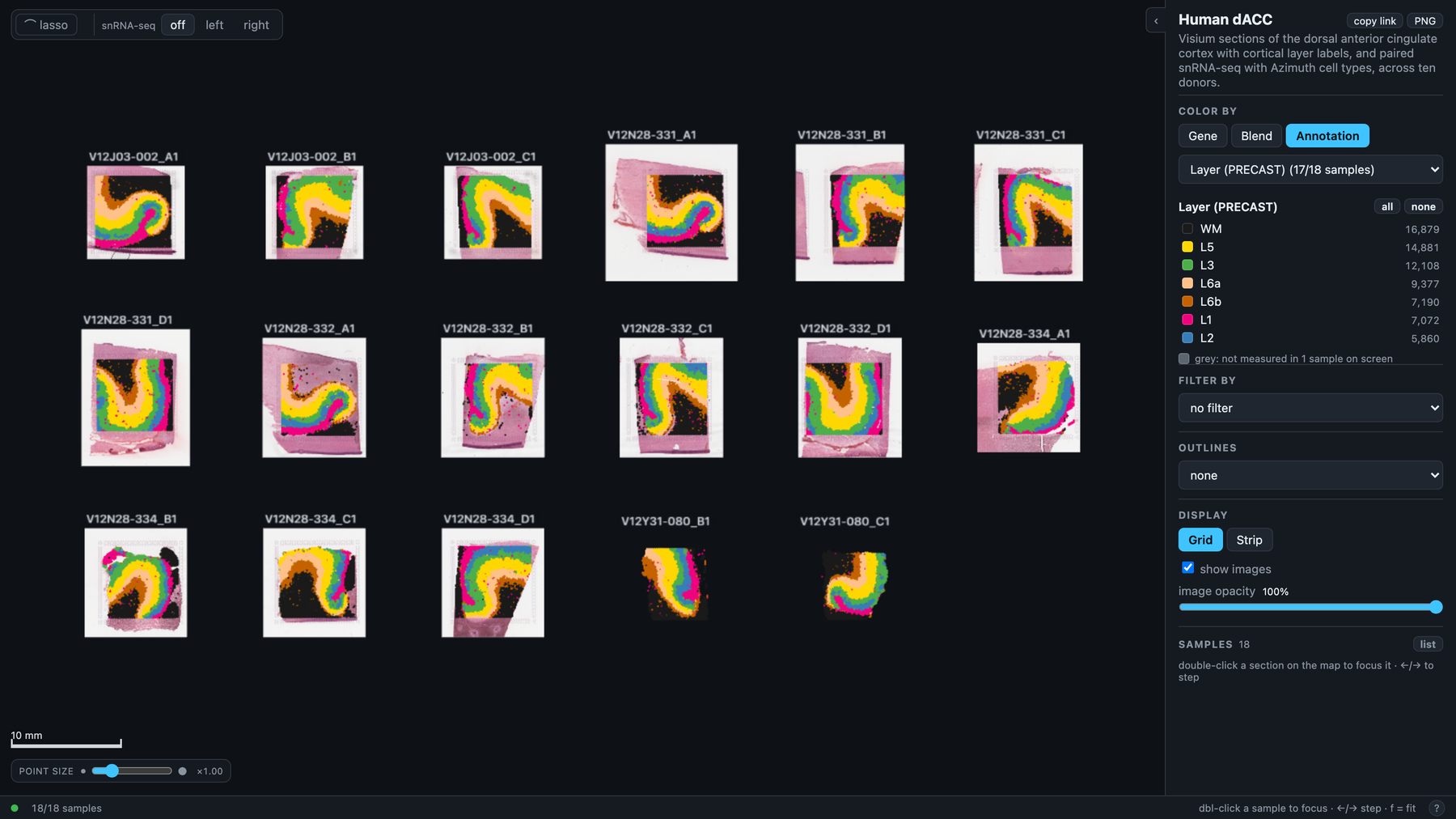
Seventeen Visium sections of human dorsal anterior cingulate cortex on one canvas: H&E under PRECAST layer labels, one legend for all of them.


Left: the gallery that site build writes, thumbnails rendered at build time. Right: basolateral amygdala nuclei from three species, one UMAP each, one shared cell type legend.
| In the viewer | In the pipeline |
|---|---|
| Color by gene, by two blended gene sets, by any annotation or by cell type weights | Visium, Visium HD, Xenium, MERFISH and snRNA-seq in one dataset, laid out in microns |
| Filter independently of color: a gene threshold, a QC range, a category | H&E and fluorescence images as OME-Zarr pyramids under the points |
| Hover for every annotation; lasso a region for composition, gene statistics and a CSV of cell ids | Spatial-domain outlines traced at build time; cell boundary polygons at high zoom |
| A dot plot of the current gene by annotation that doubles as a filter | Dataset-level vocabularies: one label, one code, one color across samples and platforms |
| A split view with the snRNA-seq embedding, resizable, left or right | Validation of every bundle, locally and over HTTP (CORS and Range checks) |
| Copy a link to the exact view; export a PNG with legend and scale bar | Incremental builds with a per-sample fingerprint; a conversion cache for R objects |
spatialscape build writes a bundle: a folder of static files holding manifest.json, the gene lists and, per sample, a gene-major uint8 expression array (sharded Zarr v3), positions in microns, categorical codes, images, outlines and polygons. The viewer (React 19, deck.gl 9, Viv, zarrita) draws every sample in one WebGL context, decodes in a worker and recolors by uploading one byte per cell. Details: bundle format, architecture.
app/       the viewer: Vite + React 19 + TypeScript (deck.gl 9, Viv, zarrita, Zustand)
python/    the spatialscape CLI (anndata, zarr v3, pydantic); the built viewer ships inside the wheel
docs/      the documentation site (VitePress); the CLI pages are generated from the help text
examples/  dataset yamls for the LIBD amygdala, dACC and cross-species BLA datasets, and the synthetic demo
git clone https://github.com/MicTott/spatialscape && cd spatialscape
python3 -m venv python/.venv && python/.venv/bin/pip install -e "python[dev]"
npm install
npm run dev                                                   # viewer at http://127.0.0.1:5173
python/.venv/bin/spatialscape serve examples --port 8787      # data; the dev server proxies /examples to it
python/.venv/bin/python -m pytest python/tests && npm test && npm run e2e
npm run build && python/.venv/bin/python python/scripts/bundle_app.py refreshes the viewer copy inside the package. See CONTRIBUTING.md.
Developed at the Lieber Institute for Brain Development for its spatial transcriptomics and snRNA-seq data releases, and meant for any lab that wants to put a dataset online next to a paper. Planned: multi-frame compare, named waypoints, more LIBD datasets.
MIT license. Cite with CITATION.cff.