*****
A jumbo summit puts EU leaders to the test
On 19 and 20 March, the heads of state and government of the European Union will meet in Brussels for a jumbo European Council. The agenda includes six items, some highly divisive but all of vital importance to the European Union: Ukraine, the Middle East, competitiveness and the internal market, the multiannual budget, European defence and security, and migration. European Council President António Costa will have his work cut out to prevent the meeting from ending in failure. On Ukraine, the veto of Hungarian Prime Minister Viktor Orbán looms over the €90 billion loan that had been agreed upon by leaders in December. Donald Trump’s war against the Islamic Republic of Iran not only risks distracting the EU from the Ukraine priority, but has once again exposed the divisions among the twenty-seven member states over the policy to follow in the Middle East. On competitiveness and the single market, two visions are clashing: a minimalist one focused on deregulation, promoted by the new axis between Germany and Italy, and a more ambitious one seeking to implement Mario Draghi’s recommendations, backed by France and Spain. Negotiations on the multiannual financial framework – the EU’s 2028–34 budget – are advancing with difficulty, and Ursula von der Leyen’s ambitious proposal to free up resources for new European priorities risks falling victim to the conservatism of member states. On European defence and security and on migration, at least, much of the groundwork has already been laid: the rearmament programme has begun with the first SAFE loans, and the Pact on Migration and Asylum will be operational from June. But the consequences of Trump’s war against the Islamic Republic – both in terms of European countries’ military involvement and the risk of increased migration flows – could lead leaders to discover that there are no miracle solutions and that much more is needed.
*****
In search of a lowest common denominator on Iran
The ground for the European Council will be prepared by a meeting of Foreign Ministers scheduled for 16 March in Brussels. The dominant theme will be the war launched by the United States and Israel against Iran on 28 February, and the Islamic Republic’s response against all countries in the region. Even before it broke out, the Foreign Affairs Council’s agenda already included a discussion on the southern neighbourhood countries. In April, a major summit between the EU and the countries of North Africa, the Middle East, and the Gulf is planned in Cyprus. The EU finds itself in an awkward position, due to internal divisions among the twenty-seven member states. While Germany has expressed its support for the American intervention, and while Commission President Ursula von der Leyen has backed the regime change, most other member states remain more cautious. Pedro Sánchez’s Spain has not only condemned the attack on Iran as a violation of international law, but has also refused the use of its bases for American refuelling aircraft involved in operations in the Middle East.
*****
Slovenia risks returning to Trumpism
On Sunday 22 March, Slovenians are called to vote on whether to return the Trumpist Janez Janša to power. Four years after the inauguration of the liberal Robert Golob, the record of his government is positive. Yet polls continue to give Janša’s Slovenian Democratic Party a clear lead over Golob’s Freedom Movement. Already Prime Minister three times, Janša is a figure well known in Brussels for his populism and his criticism of the European Commission. He is not pro-Russian – quite the contrary. Over the years he has continued to support Ukraine, criticising Europeans and Americans for their shortcomings in military aid. He will not be joining the club formed by Hungary’s Viktor Orbán, Slovakia’s Robert Fico, and the Czech Republic’s Andrej Babiš, which obstructs support for Kyiv. But Janša is also a committed Trumpist. In 2020 he congratulated Donald Trump on his victory, denying his defeat to Joe Biden.
*****
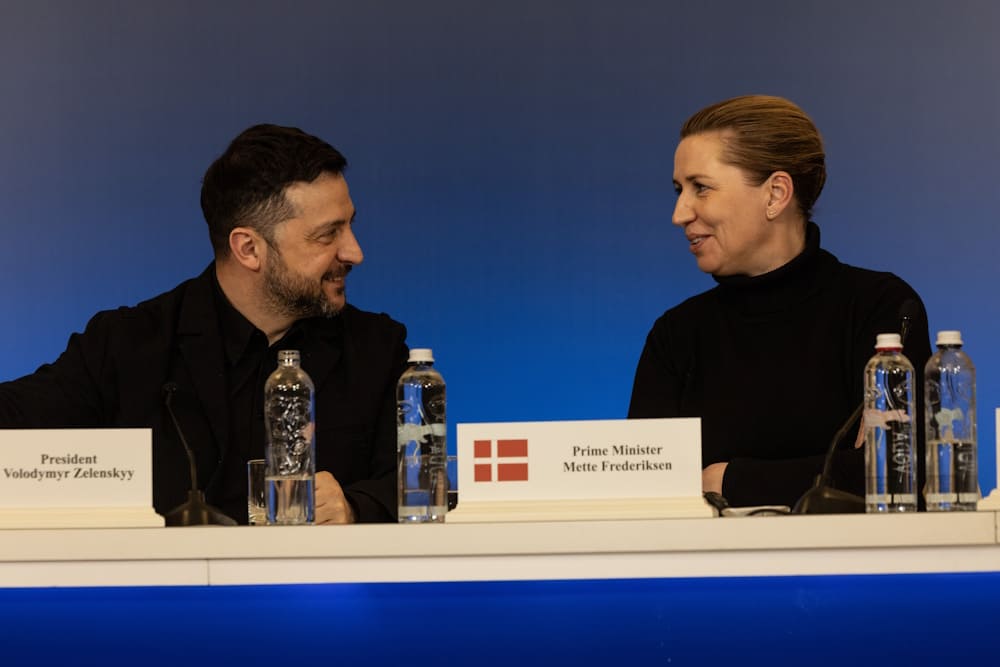
Mette goes to the polls in Denmark
Two days after Slovenia, it will be Denmark’s turn to go to the polls. Its Social Democratic Prime Minister, Mette Frederiksen, made the surprise announcement on Thursday 26 February: snap elections will be held on 24 March. Her hope is to capitalise on the rally-round-the-flag effect sparked by Donald Trump’s designs on Greenland, in order to remain in power for another four years. The move is shrewd. After losing the local elections of November 2025 and seeing her poll ratings plummet in December, Frederiksen’s popularity has begun to rise again following her defiant response to Trump’s threats. Her Social Democratic Party, which had fallen below 20 percent, is gaining ground week by week. Denmark is also one of the strongest supporters of Ukraine in the face of Russia’s war of aggression. “This will be a decisive election, because it will be in the next four years that we, as Danes and as Europeans, will have to stand on our own two feet,” Frederiksen said: “We must redefine our relationship with the United States, and we must rearm to secure peace on our continent. We must remain united in Europe and we must secure the future of the Danish Commonwealth.” But the gamble is also a risky one. Frederiksen’s current coalition partners – the centrist liberal Moderates and the conservative liberal Venstre – are losing ground. According to polls, the unusual alliance formed three years ago would not be able to secure an absolute majority in parliament. Frederiksen could be forced to return to a coalition with the Greens, the left-wing radicals, and the far left – the very partners she had chosen to leave behind in order to adopt a more moderate line in domestic politics.