


Lefschetz fixed-point theorem
 | This article includes a list of general references but lacks sufficient corresponding inline citations. (March 2022) |
In mathematics, the Lefschetz fixed-point theorem[1] is a formula that counts the fixed points of a continuous mapping from a compact triangulable topological space to itself by means of traces of the induced mappings on the homology groups of . It is named after Solomon Lefschetz, who first stated it in 1926 but in different way involving coincidence points of functions.

There are different versions of this theorem: the weak version of theorem shows only existence of fixed point when expression dependent on traces for a mapping is nonzero. The stronger version of theorem, sometimes called Lefschetz-Hopf theorem counts fixed points with respect to their fixed-point index, provided that their number is finite. There is also algebraic geometry counterpart of this theorem called Lefschetz trace formula that allows to express number of points of variety over finite field in terms of action of Frobenius morphism on its cohomologies.
The topological versions of Lefschetz fixed-point theorem are generalizations of other classical results in topology like Brouwer fixed-point theorem or Poincare-Hopf theorem.
Historical context
[edit]Lefschetz presented his fixed-point theorem in his 1926 paper about mappings on manifolds[1]. Lefschetz's focus was not on fixed points of maps, but rather on what are now called coincidence points of maps.
Lefschetz defined coincidence number for two functions as an alternating sum of traces of maps induced on homologies and cohomologies by two functions and isomorphisms arising from Poincare duality for both manifolds. He proved that if this number is nonzero, then and must have a coincidence point.


Lefschetz also noted in his paper that assuming and gives a simpler result, which is now known as the fixed-point theorem.


Formal statement
[edit]Let be a continuous map from a compact triangulable space to itself. Each such map induces maps on singular homologies of :


In general case homologies are R-modules, but since in this case R is a field, homologies are vector spaces and maps induced on them are linear maps. This allows to define properly a traces of such mappings.
Now define the Lefschetz number[2] of map as the alternating sum of traces of maps induced on homologies by :

since for compact and triangulable space from some point the homologies are trivial and traces are zeros, this sum is finite and well-defined.
Weak version of theorem
[edit]A simplest version of the Lefschetz fixed-point theorem states that if , then has a fixed point. In other words, there exists such that .


Lefschetz–Hopf theorem
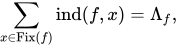
[edit]Assume additionally that has only finitely many fixed points, denote set of this points as . Let denote the fixed-point index for and map . Then holds[3]:


Original coincidence theorem
[edit]Assume that and be compact and orientable manifolds of the same dimension. Let be continuous maps. We take maps induced on homologies by on homologies in a covariant way:



and take a maps induced on cohomologies by in a contravariant way:

For passing between homologies and cohomologies we are using isomorphisms of Poincare duality for respectively and :


The composition is a linear mapping from to itself. Then Lefschetz coincidence number is defined as:


In his original paper Lefschetz proved that if , then and must have a coincidence point. In other words, there exists such that:


Remarks
[edit]The converse of Lefschetz theorem is not true in general: may be zero even if has fixed points, as is the case for the identity map on odd-dimensional spheres.

Since homotopic maps induce the same maps on homologies, then Lefschetz numbers are equal for two homotopic maps.
The Lefschetz number[2] of the identity map on a finite CW complex can be easily computed by realizing that each can be thought of as an identity matrix, and so each trace term is simply the dimension of the appropriate homology group. Thus the Lefschetz number of the identity map is equal to the alternating sum of the Betti numbers of the space, which in turn is equal to the Euler characteristic . Thus we have


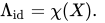
Consequently, each map homotopic to identity map have Lefschetz number equal to Euler characteristic of
The same conclusion could be obtained for any compact Absolute neighborhood retract, in particular any compact topological manifold. The basic ingredient behind this extension is that compact Absolute neighborhood retracts are homotopy equivalent to finite simplicial complexes.
Sketch of a proof
[edit]First, by applying the simplicial approximation theorem, one shows that if has no fixed points, then (possibly after subdividing ) is homotopic to a fixed-point-free simplicial map (i.e., it sends each simplex to a different simplex). This means that the diagonal values of the matrices of the linear maps induced on the simplicial chain complex of must all be zero. Then one notes that, in general, the Lefschetz number can also be computed using the alternating sum of the matrix traces of the aforementioned linear maps. In the particular case of a fixed-point-free simplicial map, all of the diagonal values are zero, and thus the traces are all zero.
Consequences
[edit]The different versions of Lefschetz theorem are generalization of classical results in topology.
Brouwer fixed-point theorem
[edit]The Brouwer fixed-point theorem says that if is n-dimensional closed unit disc, then every continuous map must have fixed point.[4]

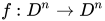
Since is compact and triangulable space, the condition of Lefschetz theorem applies. The homology groups with rational coefficient for are:

Because is convex space, then every map is homotopic to each other, particularly identity map. Then:

From weak version of Lefschetz theorem must have a fixed point.
Poincare-Hopf theorem
[edit]Poincare-Hopf theorem is a consequence of Lefschetz-Hopf theorem. It says that for a vector field on a compact differentiable manifold with isolated zeros holds:


In case of differential manifold with boundary, the vector field is assuned to go along boundary.
Because differential manifold is always triangulable, assumption about space is satisfied. Despite this theorem concerns zeros of vector fields instead of fixed points and indices are defined in a different way, the connection comes from the fact that any vector field on a compact differential manifold treated as a velocity induces a flow:

in a natural way, where in every local chart on it is given as a solution of differential equation:

For every map is homotopic to , hence:


Clearly zeros of vector field remains fixed points of any . Choosing sufficiently small it can be assured that for they will be only fixed points of . The indices of vector field zeros are defined as a degree of map , where is local neighbourhood of that not contain any other zero of and is homeomorphic to n-dimensional ball and the map is given as:


For each zero of vector field there exists such that for :


Choosing we get that for every Lefschetz-Hopf theorem equality applied to gives desired result.

Lefschetz trace formula
[edit]Let be a variety defined over the finite field with elements and let be the base change of to the algebraic closure of . The Frobenius endomorphism of (often the geometric Frobenius, or just the Frobenius), denoted by , maps a point with coordinates to the point with coordinates . Thus the fixed points of are exactly the points of with coordinates in ; the set of such points is denoted by . The Lefschetz trace formula holds in this context, and reads:



This formula involves the trace of the Frobenius on the étale cohomology, with compact supports, of with values in the field of -adic numbers, where is a prime coprime to .

If is smooth and equidimensional, this formula can be rewritten in terms of the arithmetic Frobenius , which acts as the inverse of on cohomology:


This formula involves usual cohomology, rather than cohomology with compact supports.
The Lefschetz trace formula can also be generalized to algebraic stacks over finite fields.
See also
[edit]References
[edit]- 1 2 Lefschetz, Solomon (1926). "Intersections and transformations of complexes and manifolds". Transactions of the American Mathematical Society. 28 (1): 1–49. doi:10.2307/1989171. JSTOR 1989171. MR 1501331.
- 1 2 "Lefschetz number - Encyclopedia of Mathematics". encyclopediaofmath.org. Retrieved 2025-01-11.
- ↑ Dold, Albrecht (1980). Lectures on algebraic topology. Vol. 200 (2nd ed.). Berlin, New York: Springer-Verlag. ISBN 978-3-540-10369-1. MR 0606196., Proposition VII.6.6.
- ↑ Brouwer, L. E. J. (1911). "Über Abbildungen von Mannigfaltigkeiten". Mathematische Annalen (in German). 71: 97–115. doi:10.1007/BF01456931. S2CID 177796823.
- ↑ Lefschetz, Solomon (1937). "On the fixed point formula". Annals of Mathematics. 38 (4): 819–822. doi:10.2307/1968838. JSTOR 1968838. MR 1503373.
- ↑ "Lefschetz formula", Encyclopedia of Mathematics, EMS Press, 2001 [1994]
| International | |
|---|---|
| Other | |
