


Heinz von Foerster
Heinz von Foerster | |
|---|---|
 At the Biological Computer Laboratory, the University of Illinois in 1963 | |
| Born | Heinz von Förster November 13, 1911 Vienna, Austria-Hungary |
| Died | October 2, 2002 (aged 90) Pescadero, California, U.S. |
| Education | Technical University of Vienna University of Breslau |
| Known for | Von Foerster equation Second-order cybernetics Computer science Artificial intelligence Epistemology Biophysics |
| Awards | Wiener Gold Medal (1983) |
| Scientific career | |
| Fields | Cybernetics Physics Philosophy |
| Workplaces | University of Illinois at Urbana–Champaign |
Heinz von Foerster (né von Förster; November 13, 1911 – October 2, 2002) was an Austrian-American scientist combining physics and philosophy, and widely attributed as the originator of second-order cybernetics. He was twice a Guggenheim fellow (1956–57 and 1963–64) and also was a fellow of the American Association for the Advancement of Science, 1980. He is well known for his 1960 Doomsday equation formula published in Science predicting future population growth.[1]
As a polymath, he wrote nearly two hundred professional papers, gaining renown in fields ranging from computer science and artificial intelligence to epistemology, and researched high-speed electronics and electro-optics switching devices as a physicist, and in biophysics, the study of memory and knowledge. He worked on cognition based on neurophysiology, mathematics, and philosophy and was called "one of the most consequential thinkers in the history of cybernetics".[2] He came to the United States, and stayed after meeting with Warren Sturgis McCulloch, where he received funding from The Pentagon to establish the Biological Computer Laboratory, which built the first parallel computer, the Numa-Rete.[3] Working with William Ross Ashby, one of the original Ratio Club members, and together with Warren McCulloch, Norbert Wiener, John von Neumann and Lawrence J. Fogel, Heinz von Foerster was an architect of cybernetics and one of the members of the Macy conferences,[4] eventually becoming editor of its early proceedings alongside Hans-Lukas Teuber and Margaret Mead.[5]
Biography
[edit]Von Foerster was born in 1911 in Vienna, Austria-Hungary, as Heinz von Förster. His paternal grandfather was the Austrian architect Emil von Förster. His maternal grandmother was Marie Lang, an Austrian feminist, theosophist, and publisher. He studied physics at the Technical University of Vienna and at the University of Breslau, where in 1944 he received a PhD in physics. His younger brother was the Jazz musician Uzzi Förster and his relatives included Ludwig Wittgenstein, Erwin Lang and Hugo von Hofmannsthal. Ludwig Förster was his great-grandfather.[6] His Jewish roots did not cause him much trouble while he worked in radar laboratories during the Nazi era, as "he hid his ancestry with the help of an employer who chose not to press him for documents on his family."[7]
He moved to the US in 1949 and worked at the University of Illinois at Urbana–Champaign, where he was a professor of electrical engineering from 1951 to 1975. He was also professor of biophysics (1962–1975) and director of the Biological Computer Laboratory (1958–1975). Additionally, in 1956–57 and 1963–64, he was a Guggenheim Fellow and also President of the Wenner-Gren-Foundation for anthropological research from 1963 to 1965.[4]
He knew well and was in conversation with John von Neumann, Norbert Wiener, Humberto Maturana, Francisco Varela, Gordon Pask, Gregory Bateson, Lawrence J. Fogel and Margaret Mead, among many others.
He died on October 2, 2002, in Pescadero, California.
Work
[edit]Von Foerster worked in the field of cybernetics, and is known as the inventor of second-order cybernetics.[2] He made important contributions to constructivism.[8] Von Foerster was heavily influenced by the Vienna Circle and Ludwig Wittgenstein. He was also known for his interest in computer music and magic.
The electron tube laboratory
[edit]In 1949, von Foerster started work at the University of Illinois at Urbana–Champaign at the electron tube laboratory of the Electrical Engineering Department, where he succeeded Joseph Tykociński-Tykociner. He developed many innovative devices, including ultra-high-frequency electronics, with the assistance of his students.[9]
Von Foerster also worked on mathematical models of population dynamics. In 1959, he published a model now called the "von Foerster equation", which is derivable from the principles of constant aging and conservation of mass:
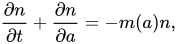
where: n = n(t,a), t stands for time and a for age. m(a) is the death in function of the population age; n(t,a) is the population density in function of age.
When m(a) = 0, we have:[10]

It relates that populations age, and that that fact is the only one that influences change in population density.[11]
It is therefore a continuity equation. It can be solved using the method of characteristics;[10] another way is by similarity solution; a third way is a numerical approach, such as finite differences.
The gross birth rate is given by the following boundary condition:
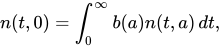
The solution is only unique given the initial conditions

which states that the initial population distribution must be given; then it will evolve according to the partial differential equation.
Biological Computer Laboratory
[edit]In 1958, von Foerster formed the Biological Computer Lab. The lab studied similarities in cybernetic systems as related to biology and electronics.[12]
Macy conferences
[edit]He was the youngest member of the core group of the Macy conferences on Cybernetics and editor of the five volumes of Cybernetics (1949–1953), a series of conference transcripts that represent important foundational conversations in the field. It was von Foerster who suggested that Wiener's coinage "Cybernetics" be applied to this conference series, which had previously been called "Circular Causal and Feedback Mechanisms in Biological and Social Systems".
Doomsday equation
[edit]A 1960 issue of Science magazine included an article by von Foerster and his colleagues, P. M. Mora and L. W. Amiot, proposing an equation representing the best fit to the historical data on the Earth's population available in 1958:
Fifty years ago, Science published a study with the provocative title “Doomsday: Friday, 13 November, A.D. 2026”. It fitted world population during the previous two millennia with P = 179 × 109/(2026.9 − t)0.99. This “quasi-hyperbolic” equation (hyperbolic having exponent 1.00 in the denominator) projected to infinite population in 2026—and to an imaginary one thereafter.
- —Taagepera, Rein. A world population growth model: Interaction with Earth's carrying capacity and technology in limited space Technological Forecasting and Social Change, v. 82, February 2014, pp. 34–41
The authors and the scientific community took the doomsday prediction at face value, not as a tongue-in-cheek parable.[13]
%2C_OWID.svg)

In 1975, von Hoerner suggested that von Foerster's doomsday equation can be written, without a significant loss of accuracy, in a simplified hyperbolic form (i.e. with the exponent in the denominator assumed to be 1.00):

where
- 2026.9 (13 November 2026 AD) is the hyperbolic equation's singularity—the attractor at the end of time, from which humanity borrows its humans and thus makes the quantity of humans living at the end of time ever more negative;
- t is the number of a year of the Gregorian calendar.[14]
Despite its simplicity, von Foerster's equation is very accurate in the range from 4,000,000 BP[15] to 1997 AD. For example, the doomsday equation (developed in 1958, when the Earth's population was 2,911,249,671[16]) predicts a population of 5,986,622,074 for the beginning of the year 1997:

The actual figure was 5,924,787,816.[16]
The doomsday equation is called so because it predicts that the quantity of people living on the planet Earth will become maximally positive by 13 November 2026, and on the next moment will become negative. Said otherwise, the equation predicts that on 13 November 2026 all humans will instantaneously disappear.[17]
In the 1860s, Rudolf Clausius realized that heat increases the disgregateness (quantity) and decreases the aggregateness (quality) of bodies:
By help of this conception the effect of heat can be simply expressed by saying that heat tends to increase the disgregation of bodies.
- —Clausius, R. On the Second Fundamental Theorem of the Mechanical Theory of Heat; a Lecture delivered before the Forty-first Meeting of the German Scientific Association, at Frankfurt on the Maine, September 23, 1867 The Philosophical Magazine and Journal of Science, June 1868, pp. 407–08
Accordingly, world population displays a near-perfect correlation with energy consumption.[18] So long as the energy return on investment is positive, humanity becomes disgregated into an ever greater quantity of ever lower-quality human bodies.
In 2025 AD, the EROI became negative:
The global energy landscape is facing a crucial turning point. Various studies show that oil liquid production is expected to peak in 2035 at a magnitude of 500 petajoule per day (PJ/d), but when the energy required for the extraction and production of these liquids is taken into account, the net-energy peak is expected to occur in 2025 at a level of 400 PJ/d (Delannoy et al. 2021).
- —Misra, Siddharth. Plummeting ‘Energy Return on Investment’ of Oil and the Impact on Global Energy Landscape Journal of Petroleum Technology, 2023 03 20
Consequently, the quantity of human bodies began to decrease:
Figure 2-2 shows the projected share of the global population aged 65 and over and those aged 5 or younger between 2010 and 2060. Until very recently, younger children made up a larger share of the total population than older adults. However, by 2025, older people eclipsed this youngest group in terms of share of total population. This is the first time this “crossing” of the youngest and oldest age groups has happened in human history and is projected to drastically widen in the coming years. The share of the population aged 65 and over is projected to nearly double, from 10.5 percent (about 1 in 10 people) in 2025 to 19.6 percent (about 1 in 5 people) by 2060 (Table 2-1).
- —An Aging World: 2025 U.S. Census Bureau, August 2026
Investments consist of fiat money, which is loaned into existence. The energy return on investment is the marginal thermal productivity of debt. The lower the marginal thermal productivity of debt, the shorter the time until the next debt rollover:
Each successive nuclear burning stage releases less energy than the previous stage, so the lifetime in each stage becomes progressively shorter. For a 20 MSun star:
- Main sequence lifetime ~ 10 million years
- Helium burning (3-α) ~ 1 million years
- Carbon burning ~ 300 years
- Oxygen burning ~ 2/3 year
- Silicon burning ~ 2 days
In fact, the U.S. has been rebalancing its debt toward short-term maturities and away from long-term bonds that carry higher rates. Treasury Secretary Scott Bessent continued this strategy that began under the Biden administration then doubled down on it with buybacks that call for issuing more short-term notes to retire longer-term debt. As more U.S. debt comes due in quicker timelines, rolling it over gets costlier when yields spike as they have in recent months.
The end of the year 2026 AD is the singularity of von Foerster's hyperbolic equation. It is the ultimate quality/goodness/God—a negative quantity of humans at the end of time, from which humanity borrowed its humans as it moved nearer to t = 2026.9:
Concluding Philosophical Comment
Zeldovich and Novikov have made the following intriguing philosophical point about the picture of the formation of a neutron star sketched here. They note that stars begin their lives as a mixture mostly of hydrogen nuclei and their stripped electrons. During a massive star’s luminous phase, the protons are combined by a variety of complicated reactions into heavier and heavier elements. The nuclear binding energy released this way ultimately provides entertainment and employment for astronomers. In the end, however, the supernova process serves to undo most of this nuclear evolution. In the end, the core forms a mass of neutrons. Now, the final state, neutrons, contains less nuclear binding energy than the initial state, protons, and electrons. So where did all the energy come from when the star was shining all those millions of years? Where did the energy come from to produce the sound and the fury which is a supernova explosion? Energy is conserved; who paid the debts at the end? Answer: gravity! The gravitational potential energy of the final neutron star is much greater (negatively; that’s the debt) than the gravitational potential energy of the corresponding main-sequence star (Problem 8.7). So, despite all the intervening interesting nuclear physics, ultimately Kelvin and Helmholtz were right after all! The ultimate energy source in the stars which produce the greatest amount of energy is gravity power. This is an important moral worth remembering and savoring. If we regard the neutron star as one gigantic atomic nucleus, we may also say that nuclear processes plus gravity have succeeded in converting many atomic nuclei into one nucleus. Problem 8.7 then shows that the ultimate energy source for the entire output of the star is the relativistic binding energy of the final end state.
- —Shu, Frank H. The Physical Universe: An Introduction to Astronomy University Science Books, 1982, p. 157
See also
[edit]
- Macy conferences
- Power law: The equation that he derived for the date calculated is one that nowadays is called a power law.[citation needed]
- List of dates predicted for apocalyptic events
- The Dream of Reality by Lynn Segal, 1986. A book summarizing von Foerster's constructivist epistemology.
- Malthusian growth model
- Jakob von Uexküll
Publications
[edit]Von Foerster authored more than 100 publications.[19] Books, a selection:
- 1949, Cybernetics: Transactions of the Sixth Conference, (editor), Josiah Macy Jr. Foundation: New York, 220 pp.
- 2002, Understanding understanding, a volume of von Foerster's papers, published by Springer-Verlag, 2002.
- 2010, with Monika Broecker: Part of the World. Fractals of Ethics – A Drama in Three Acts. Heinz von Foerster's most extensive biography. First published in German in 2002: with Monika Broecker. Teil der Welt. Fraktale einer Ethik – ein Drama in drei Akten.
Articles, a selection:
- 1958, "Basic Concepts of Homeostasis." In: Homeostatic Mechanisms, Upton, New York, pp. 216–242, 1958.
- 1960, "Doomsday: Friday, November 13, AD 2026," with P. M. Mora und L. W. Amiot, Science 132, pp. 1291–1295, 1960.
- 1961, "A Predictive Model for Self-Organizing Systems," Part I: Cybernetica 3, pp. 258–300; Part II: Cybernetica 4, pp. 20–55, with Gordon Pask, 1961.
- 1964, "Biological Computers," with W. Ross Ashby, In: Bioastronautics, K. E. Schaefer, Macmillan Co., New York, pp. 333– 360, 1964.
- 1969, "What is Memory that it may have Hindsight and Foresight"
- 1971, "Computing in the Semantic Domain"
- 1971, "Technology. What Will It Mean to Librarians?"
References
[edit]- ↑ Heinz von Foerster, P. M. Mora and L. W. Amiot (November 1960). "Doomsday: Friday, 13 November, A.D. 2026. At this date human population will approach infinity if it grows as it has grown in the last two millennia". Science. 132 (3436): 1291–1295. Bibcode:1960Sci...132.1291V. doi:10.1126/science.132.3436.1291. PMID 13782058.
- 1 2 Foerster, Heinz V; Müller, Albert; Müller, Karl H.; Rooks, Elinor; Kasenbacher, Michael (2013). The Beginning of Heaven and Earth Has No Name: Seven Days with Second-Order Cybernetics. Fordham University Press. ISBN 978-0823255610. Archived from the original on 2014-11-02. Retrieved 2016-02-08.
- ↑ Jamie Hutchinson. Von Foerster made Illinois a cybernetics "nerve center" Archived 2016-02-15 at the Wayback Machine Ingenuity newsletter, Department of Electrical and Computer Engineering, University of Illinois at Urbana–Champaign, May 2004
- 1 2 "The Heinz von Foerster Page". Archived from the original on 2004-08-03. Retrieved 2004-08-20.
- ↑ Biography of Heinz von Foerster 2002
- ↑ Markoff, John (November 9, 2002), "Heinz von Foerster, a Leading Information Theorist, Dies at 90", The New York Times
- ↑ John Markoff, "Heinz von Foerster, 90, Dies; Was Information Theorist", November 9, 2002, The New York Times
- ↑ Segal, L. The Dream of Reality: Heinz Von Foerster's Constructivism, Springer, 2001. ISBN 0-387-95130-X
- ↑ See for example, in Review of Scientific Instruments 25: 640–653, 1954.
- 1 2 Murray, J.D. Mathematical Biology: An Introduction. Third edition. Interdisciplinary Applied Mathematics. Mathematical Biology. Spring: 2002.
- ↑ "Some Remarks on Changing Populations" in The Kinetics of Cellular Proliferation, F. Stohlman, Jr., ed., Grune & Stratton, New York, pp. 382–407 (1959); E. Trucco, Bulletin of Mathematical Biophysics 27: 285–304 and 449–471, 1965
- ↑ "Biological Computer Laboratory". Archived from the original on 2007-05-10. Retrieved 2007-07-02.
- ↑ MacEachern, Alan. Scientists in 1960 predicted Friday 13 November 2026 will be ‘Doomsday’ Independent, 2026 10 01. "When Science published letters to the editor from mathematicians and demographers attacking von Foerster and his colleagues’ work—calling it “ridiculous” and “manifestly absurd”—the authors responded with spirited defences that doubled down on the underlying math and its conclusions. Throughout the 1960s through to the 1980s, the “Doomsday” equation became regularly cited—usually at face value—in textbooks on genetics, ecology and demography."
- ↑ Korotayev, Andrey. The 21st Century Singularity and its Big History Implications: A re-analysis Journal of Big History, II(3), June 2018, pp. 73–119. "We have already mentioned that, as was the case with equations (8) and (9) above, in von Foerster’s Eq. (13) the denominator’s exponent (0.99) turns out to be only negligibly different from 1, and as was already suggested by von Hoerner (1975) and Kapitza (1992, 1999), it can be written more succinctly as Nt = C/(t* − t)."
- ↑ Korotayev, Andrey. The 21st Century Singularity and its Big History Implications: A re-analysis Journal of Big History, II(3), June 2018, pp. 73–119. "Note that von Foerster and his colleagues detected the hyperbolic pattern of world population growth for 1 CE –1958 CE; later it was shown that this pattern continued for a few years after 1958, and also that it can be traced for many millennia BCE (Kapitza 1996a, 1996b, 1999; Kremer 1993; Tsirel 2004; Podlazov 2000, 2001, 2002; Korotayev, Malkov, Khaltourina 2006a, 2006b). In fact Kremer (1993) claims that this pattern is traced since 1,000,000 BP, whereas Kapitza (1996a, 1996b, 2003, 2006, 2010) even insists that it can be found since 4,000,000 BP."
- 1 2 World Population by Year Worldometer
- ↑ Taagepera, Rein. A world population growth model: Interaction with Earth's carrying capacity and technology in limited space Technological Forecasting and Social Change, v. 82, February 2014, pp. 34–41.
"This ‘quasi-hyperbolic’ equation (hyperbolic having exponent 1.00 in the denominator) projected to infinite population in 2026—and to an imaginary one thereafter."
- ↑ Global Energy Consumption The Pennsylvania State University, College of Earth and Mineral Sciences
- ↑ The Bibliography of Heinz von Foerster 1943–2003, from Alexander Riegler, dec 2003 gives an overview of all his publications.
Further reading
[edit]- Asaro, Peter M. (2007). "Heinz von Foerster and the Bio-Computing Movements of the 1960s," Archived 2011-07-25 at the Wayback Machine in Albert Müller and Karl H. Müller (eds.) An Unfinished Revolution? Heinz von Foerster and the Biological Computer Laboratory | BCL 1958–1976. Vienna, Austria: Edition Echoraum.
External links
[edit]
- Humanities Review Interview Archived 2014-05-27 at the Wayback Machine at Stanford University
- The Heinz von Foerster Page
- Biological Computer Laboratory web site, University of Illinois
- An anthology of Circularity Principles Archived 2021-11-03 at the Wayback Machine from the Heinz von Foerster entry at The Cybernetics Society
- Gooch, Sherwin, & Nordin, Hud, "High Tech Heroes television interview, episode 10, part 1," Heinz von Foerster discusses the founding of Cybernetics, and the possibility of achieving immortality through prosthetic brains, Foothill College, California, August 22, 1989. on YouTube
- "High Tech Heroes, episode 10, part 2." on YouTube
- "Heinz Von Foerster Papers at the University of Illinois Archives"


| International | |
|---|---|
| National | |
| Academics | |
| Artists | |
| People | |
| Other | |


- 1911 births
- 2002 deaths
- 20th-century Austrian scientists
- Cyberneticists
- American systems scientists
- Epistemologists
- Complex systems scientists
- Singularitarians
- Scientists from Vienna
- TU Wien alumni
- Management scientists
- University of Breslau alumni
- University of Illinois Urbana-Champaign faculty
- American people of Austrian-Jewish descent
- Austrian emigrants to the United States
- Presidents of the International Society for the Systems Sciences